education
970 TopicsFour opportunities for IT admins to get ready with Copilot Chat for education
Microsoft Education is offering four live webinar opportunities for IT administrators who want to confidently deploy and manage Microsoft 365 Copilot Chat. Each session covers the same practical guidance, so you can select the date that best fits your schedule. What you’ll learn We’ll walk through Copilot Chat configuration from the tenant level to the end-user experience, including options for students ages 13+, CSV, SDS, and PowerShell uploads, agents and extensibility, and current licensing and security controls. You’ll leave with actionable guidance to help deploy, manage, and optimize Copilot Chat safely across your organization. We’ll also share a brief look at some Microsoft Education experiences including Teach in Copilot, the Study and Learn agent, Copilot Notebooks, and Learning Activities. Choose a session and register September 16th, Wed @ 8am Pacific time - Register for the September 16 session September 30th, Wed @ 8am Pacific time - Register for the September 30 session October 14th, Wed @ 8am Pacific time - Register for the October 14 session October 28 th , Wed @ 8am Pacific time - Register for the October 28 session Reserve your spot today. Pick the session that works best for you and join us to build a secure, manageable path to Copilot Chat adoption in your education environment. Mike Tholfsen Group Product Manager Microsoft Education348Views1like0CommentsWhat's New in Microsoft EDU - Back to School August 2026
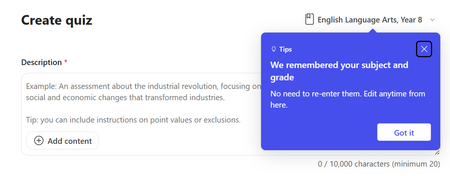
Welcome to our monthly update for Microsoft Education and thank you so much for being part of our growing community! Topics Teach in Microsoft Copilot updates Learning Zone updates Teams for Education updates Study and Learn agent updates Copilot Notebooks and OneNote updates Learning management system integration updates We’ve loved seeing the early impact at schools and institutions such as Brisbane Catholic Education and Miami Dade College and the exploration of new capabilities like agents. Get started with Copilot Chat, our no-cost AI-powered chat with data protection, and learn more about Microsoft 365 Copilot. 1. Teach in Microsoft Copilot updates Teach remembers your classes and settings Educators no longer need to re-enter their subject and grade level every time they use an AI creation tool. Remember Settings automatically saves previously-used Subjects and Grades and carries them across Teach, Teams, LTI, and OneNote Class Notebook. Set your course information once and reuse it, or switch between multiple courses in one click. This means a teacher with "Biology, Grade 9" and "Chemistry, Grade 11" can move between AI tools - lesson plans, quizzes, flashcards, rubrics - without ever filling in the same fields twice. Course details appear as a chip in the upper right of creation form, replacing blank fields with familiar context from day one. When: Available now Teach in your language and region AI creation tools across Teach, Teams, and Classwork now automatically detect language from the educator's content and browser settings - no manual language picker required. Whether you're working in Spanish, French, Japanese, or any supported language, generated content matches your actual teaching language without extra steps. When: Available now Unit Plans in Teach Unit Plans, the most requested tool in Teach, arrives soon! It brings standards, learning goals, pacing, lessons, and assessments together in one coherent plan for the entire unit. Set the unit length and weekly teaching schedule and ground it on your standards and materials. Teach builds a structured week-by-week sequence, maps standards to individual lessons, and places assessments at the right points across the unit. From there, you can refine the pacing, reorder lessons, and create connected lesson plans and assessments while keeping the whole unit in view. When: Coming September 2. Microsoft Learning Zone updates As AI becomes part of everyday learning, classroom experiences are becoming more active and interactive. Teachers are no longer limited to presenting content while students passively consume it. Instead, AI is helping teachers create engaging lessons faster, while giving students more opportunities to participate, practice, and receive feedback in real time. Learning Zone was built to support this shift, connecting AI-powered interactive lesson creation, classroom delivery, and learning insights in one experience. Create lessons on any Windows 11 device This school year, educators on any Windows 11 PC can create Learning Zone's interactive lessons through August 2027. Teachers can create lessons of up to 10 slides in minutes from an idea, standard, or trusted content source, making it easier to bring relevant and customized learning experiences into the classroom while saving valuable preparation time. When: Available Now Make classroom sessions more engaging and active Learning Zone is also expanding to support engaging live classroom experiences through educator-led interactive lessons. Students can join from their own devices and participate together in a live lesson experience, while teachers guide instruction, control pacing, and receive real-time insights into student understanding. When: Available Now Create lessons in more languages This September, Learning Zone is also expanding lesson creation support to French, Italian, Portuguese, and Japanese, alongside English and Spanish, helping more educators create lessons in their preferred language. When: September Interactive lessons in Copilot Teach and in Teams assignments To fit naturally into existing teaching workflows, Learning Zone integrates with Teach in the Microsoft 365 Copilot app, Teams Assignments, and LMS platforms through Microsoft LTI. Lessons can be created and assigned from the tools educators already use, while students complete work in familiar environments and grades sync automatically. When: Available Now And we're not stopping there. Based on ongoing feedback, Learning Zone continues to evolve with new capabilities that make lesson creation faster, teaching more effective, and learning more accessible and engaging. Recent additions include standards lookup, enhanced image support through Bing integration, new interactive activity types, Immersive Reader integration, and tablet support for students, with more improvements on the way. Together, these updates make it easier for educators to save time, create engaging learning experiences, and make purposeful use of the devices already in their classrooms. 3. Teams for Education updates Learning Activities in Assignments and Classwork Learning Activities - flashcards, fill in the blanks, matching, and quizzes - can now be added directly within Assignments and Classwork in Teams. Educators can attach an existing Learning Activity or create a new one without leaving the assignment workflow. Student progress is captured as part of the assignment experience, keeping interactive practice and review in one familiar place. Students can also create their own Learning Activities from educator-shared resources within an assignment. Share a document or PDF, and students can generate flashcards or study activities from it, supporting self-directed learning without extra setup from the teacher. When: Available Now Group assignments updates Creating differentiated groups for assignments just got easier. Educators can now reuse student groups from previous assignments - select a past assignment, pick the groups you want, and apply them to a new assignment in seconds. No more recreating the same reading groups, project teams, or skill-level clusters from scratch each time. After publishing an assignment, educators can move students between groups without recreating the assignment. Need to shift a student from one reading level to another mid-unit? A single "move member" action handles it cleanly while preserving existing student work. When: Available Now Control when students can undo turn-in Educators can now choose whether students can undo a submission after turning in an assignment. When creating or editing an assignment, set Students can undo turn-in to No to make each submission final until you return the work for revision. The setting can be changed for each assignment, and educators can choose their preferred default for new assignments in Assignments Settings. When: Available Now 4. Study and Learn agent updates Study and Learn Agent is available at aka.ms/studyandlearn in your Microsoft Education tenant. An AI coach based on learning science, it tutors learners by preserving productive struggles essential for learning instead of just giving answers or doing the work for them. Copilot chat needs to be enabled for K12 students 13-17 years to get access to the agent (see tutorial video for exact enablement steps). It is available and pinned for all adult learners by default. Copilot chat now opens with Study and Learn pre-selected For K-12 students who already have Copilot Chat enabled, Study and Learn Agent is now pre-selected when they start using Copilot Chat. Students can dismiss the agent. IT admins control this setting in the Education settings panel in the Microsoft 365 admin center. It is ON by default for K-12 and OFF by default for higher education, where admins can enable it. Study and Learn includes images to “show” instead of “tell” concepts Study and Learn conversations can now include a carousel of relevant, web-safe images sourced through search. Images support the next step in a student’s understanding, helping them work toward their own answer while preserving productive effort. Further improvements to images are planned. Available in 40 languages The agent is now available in 40 languages beyond English (US). Set your browser or operating system to a supported locale and visit https://aka.ms/studyandlearn. Learning activities will appear in your chosen app locale, and you can switch languages during a conversation for a multilingual learning experience. 5. Copilot Notebooks and OneNote updates We’re expanding what educators can create and do across OneNote, with new Copilot experiences coming along for the ride: Share links from Learning Activities now work across OneNote on the web, desktop, iPad, and iOS. When pasted into a OneNote page, these links automatically unfurl into interactive activities directly on the page. Coming soon to preview for Technology Adoption Program (TAP) customers: Copilot Teaching Tools directly in the OneNote Class Notebook toolbar. Want to try upcoming features early? Ask your IT admin to complete the form at aka.ms/joinEDUTAP to join TAP. Copilot Notebooks and Study guide are available to all educators and students Copilot Notebooks are available to all Microsoft 365 Education licenses (A1, A3, A5) without requiring an additional Copilot Premium license. Copilot Notebooks are AI-powered workspaces to gather all your materials on a single topic, chat with Copilot and create Study guide with interactive activities like flashcards, quizzes, matching and fill-in-the-blanks, Mind map, Word, Excel, and PowerPoint. 6. Learning management system integration updates Support for new learning management systems Welcome Skooler, Infinite Campus, and Blackbaud into our officially supported LMS platforms alongside Canvas, Blackboard, D2L/Brightspace and Moodle. The Microsoft 365 LTI app is LTI 1.3 Advantage Complete certified so able to support any platform that is conformant to the LTI 1.3 Advantage standard, but we partner closely with these LMS platforms to make sure our customers have a great experience. Copilot teaching tools are generally available Copilot teaching tools are a set of tools available in familiar LMS flows for creating and updating content. Educators can easily access AI-powered teaching tools to quickly make modifications to language, reading level, length, difficulty, alignment to relevant standards. They can also create Microsoft Learning Activities like flashcards, fill in the blanks, and matching games that can be shared with a class as study aids. Meetings keep in sync and recordings view Keeping your current roster in sync with meeting invites is easy – Enabling the keep in sync option in meetings ensures that your meeting invites to the are always in sync with the current LMS roster and students can co-teachers have invites and can join your meetings. We have also added a new (default) option for meeting recordings that allows teachers to explicitly publish recordings for the class, ensuring that all students and co-teachers have access to view or edit the recording and also giving a chance for educators to add captions or edit recordings before publishing for the class. Add co-teachers as meeting co-organizers The new setting to add co-teachers in a course as co-organizers to a meeting allows you to easily give your co-teachers in a course the ability to help you manage meetings and moderate online sessions. OneDrive 2tb file upload limit File upload limit for sharing files with a course is now 2tb, ensuring that large files like meeting recordings can be shared with a course without issues. ____________________________________ And finally, just to recap all the news we have for you this month, here’s a quick review of all the features that are generally available or are rolling out now: Teach module in Microsoft Copilot updates Settings to remember your classes Language and regional settings auto-detect and improvements Unit Plans Microsoft Learning Zone Available as a trial for Windows 11 Integration in to Teach, Teams and LMS Teach in Class mode Standards support New languages Improved images Teams for EDU updates Learning Activities in Assignments Reuse Groups Undo Turn-in Study and Learn agent updates IT Admin controls to enable "pre-selected" as the default 40+ languages supported Image improvements Copilot Notebooks available to all M365 education teachers and students LMS integration and Microsoft 365 LTI Support for new LMSes - Skooler, Infinite Campus and Blackbaud Copilot teaching tools generally available Meetings keep in sync and recording views Add co-teachers as meeting co-organizers OneDrive 2tb file upload limit Mike Tholfsen Group Product Manager Microsoft Education1.3KViews5likes0CommentsCalling all IT Admins - webinar on configuring Copilot Chat and updates for Students 13+
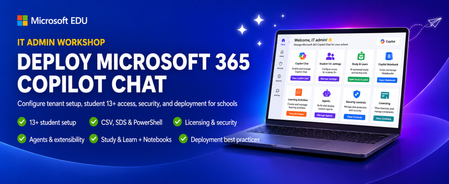
This IT Admin-focused workshop walks through how to configure Microsoft 365 Copilot Chat, from your tenant all the way to the end-user experience. When you enable Copilot Chat for students 13+, they will also get access to the new Study & Learn agent, Copilot Notebooks, Learning Activities and more. We cover the latest features that are available — including the new 13+ student configuration options, CSV, SDS and Powershell uploads, Copilot agents & extensibility, and updated licensing & security controls. By the end, you’ll be able to confidently deploy, manage, and optimize Copilot Chat in your environment so your users can safely harness AI productivity from day one. This 45-minute webinar will be led by Bill Sluss Principal Product Manager from the Microsoft Education team. When: Wednesday, August 19th @ 8am Pacific time Register: https://df.events.teams.microsoft.com/event/df.95feda23-419a-4d99-bfad-f7e4fd52a498@72f988bf-86f1-41af-91ab-2d7cd011db47?source=copyLinkOneEventsShareDialog Mike Tholfsen Group Product Manager Microsoft Education305Views0likes0Comments
Issues around our administratio email on school.onmiscrosoft.com
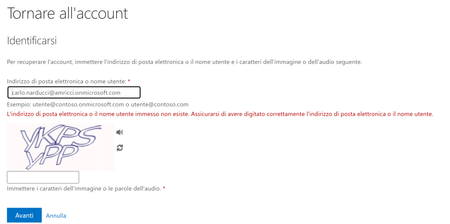
This page collects the issues (and related solutions/workarounds) linked to the administration account of the Microsoft 365 tenant http://school.onmicrosoft.com/. Context Tenant: my.name@myhttp://school.onmicrosoft.com/ Involved account: admin email address (specify which one, if needed) me and my administrator cannot access since jan 2026 Issues encountered Problem description Symptoms: my email amd my administrator email does not access the domani anymore Error message (if any): When it happens (frequency/time): no wayy to access other theachers have not this issue with the same domain Impact Who is blocked / which services are affected (Outlook, Teams, Entra ID, etc.) Urgency: Attempts already made [no way ] Password reset [ no way] Check MFA / sign-in methods [no way ] Try signing in from another browser / incognito [ ] Check Microsoft service status Next steps [ ] Collect screenshots and error codes see upper image [ ] Check sign-in logs (Entra ID) and any blocks (Conditional Access) [ ] Open a Microsoft support ticket (if needed) Notes / references Useful links: Last updated date:166Views0likes1CommentHands-on webinar: Set up your classroom in Teams for Education plus the new Study and Learn Agent
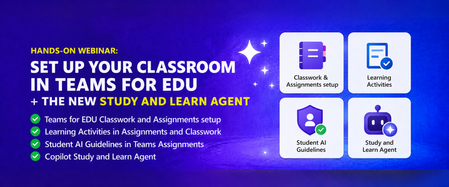
Join us on Wednesday, August 5th at 8:00 AM Pacific Time for a practical, 60-minute webinar to get your Microsoft Teams classroom ready for the new school year in the Northern hemisphere. Get your class set up in Assignments and Classwork, learn about new tools like Learning Activities, use Student AI Guidelines to set the right expectations for your students, and see how the Study and Learn Agent can be a study partner for your students. Follow along with your own Microsoft 365 Education account as we walk through each one. Register here: https://aka.ms/August5Training The session will be recorded and posted to the Microsoft Education YouTube channel so you can watch it later or share it with colleagues. Agenda - Get your Teams EDU classroom ready and learn about the Study and Learn Agent. ✅ Teams EDU Classwork / Assignments setup ✅ Learning Activities in Assignments and Classwork ✅ Student AI Guidelines in Teams Assignments ✅ Copilot Study and Learn Agent We look forward to seeing you on August 5th! Also, be sure to check out and sign up for our Microsoft Elevate Educator community. Mike Tholfsen Group Product Manager Microsoft Education211Views0likes0CommentsHands-on webinar: Teach Module in M365 Copilot and Copilot Notebooks (available for all educators)
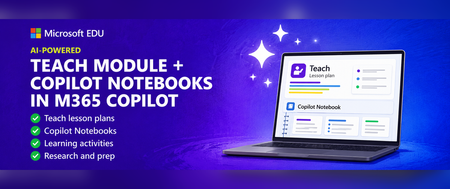
Join us on Wednesday, July 8th @ 8am Pacific Time for an in-depth professional development webinar on the new AI-powered "Teach" module in M365 Copilot that is fully rolled out and available to everyone. We will also be covering Copilot Notebooks and the Study Guide which is now also available to all M365 Educators and Students. This will be a 60-minute hands-on webinar where the Product Management team will walk through the new updates in detail and you can follow-along at home with your own M365 Education account. To reiterate, the Teach Module and Copilot Notebooks are available globally to all educators using Microsoft 365. And don’t worry – we’ll be recording these and posting on our Microsoft Education YouTube channel so you’ll always to able to watch later or share with others. Register here: https://msit.events.teams.microsoft.com/event/msit.ed7f065d-57a5-437c-ba23-12b0ef06a259@72f988bf-86f1-41af-91ab-2d7cd011db47 Agenda: How to use the new AI-powered "Teach" module in M365. ✅ Lesson plans and the new Keep Going feature ✅ Learning Zone integration ✅ Modifying Existing content ✅ Learning Activities ✅ Coplot Notebooks plus Study Guide We look forward to having you attend the event! Also, be sure to check out and sign up for our Microsoft Elevate Educator community. Mike Tholfsen Group Product Manager Microsoft Education team313Views1like0CommentsWhat’s New in Microsoft EDU - 23 new features for ISTE 2026
Welcome to our big ISTE 26 for Microsoft Education blog - we have 23 updates to announce! We’re thrilled to share new AI innovation and insights for education and show them in action next week at ISTELive 26 in Orlando, Florida, US. Join us at the show to learn more and hear about the latest from Microsoft Education at our booth and in dozens of sessions. Enjoy, and see you there! ISTE Topics Microsoft 365 – Learner updates Microsoft Learning Zone updates Microsoft 365 – Educator updates Teach and Learn apps for Windows Microsoft 365 Copilot Agents Learning Management System Integration updates 1. Microsoft 365 – Learner updates Copilot Notebooks and Study guide now available to all Microsoft 365 Students and Educators Copilot Notebooks are AI-powered workspaces for a subject or group project built on reference materials - bringing together all context behind a topic in one place for you or your group to collaborate on. They are now available to all Microsoft 365 Education licenses (A1, A3, A5) without requiring an additional Copilot Premium license. Also, the Study guide feature in Copilot Notebooks is now generally available. Copilot Notebooks are located in the Microsoft 365 Copilot app waffle. In Copilot Notebooks, users can add a variety of reference documents, summarize and analyze the content, create mind maps, Study guide, and soon also create Word, Excel, PowerPoint decks. Study Guide takes the materials learners already have and helps turn them into a collection of organized summary and deep dive topic pages as well as activities including flashcards, quizzes for self-quizzing, fill-in-the-blanks and matching. The important part: it is grounded in the sources you provide. Get started: Take the professional development course at aka.ms/notebooksandstudyguidemodule Learn more about Study guide Study and Learn Agent in additional languages The Study and Learn Agent is rolling out additional languages beyond English (US). Once the localized experience is fully rolled out, you can use it at https://aka.ms/studyandlearn after setting your browser or OS to the desired locale supported by the agent. The learning quality of the conversations will continue to get better over time. You can check out the Study & Learn agent launch blog here. We've also just launched a new white paper called: Learning by design: Learning science foundation of the Study and Learn AgentThis white paper from Microsoft Education shows how the Study and Learn Agent is designed to keep learning with students as they understand, practice, and build mastery through productive effort, while taking its place within the larger education ecosystem as a learner-centric complement to great teaching. Feel free to share feedback here. 2. Microsoft Learning Zone updates From generation to classroom instruction with Learning Zone Microsoft Learning Zone is a teaching and learning platform powered by hybrid AI, enabling educators to turn ideas, standards, or trusted content into structured, interactive lessons, deliver them as self-paced or educator-led experiences, and gain formative insights into student progress. By bringing creation, delivery, and feedback into one integrated experience, Learning Zone makes it safe and intuitive to adopt AI in everyday teaching. Since launching earlier this year, we’ve been listening closely to educators in real classrooms and are excited to introduce new updates that make Learning Zone even more powerful and practical in the classroom. Experience Learning Zone generation on any Windows 11 PC Starting at ISTE, educators on any Windows 11 PC can try Learning Zone’s lesson generation experience through August 2027. Educators can create up to 10-slide lessons and explore AI-powered interactive lesson creation - making it easy to experience the value and bring relevant and custom interactive lessons to their classrooms. Teach in class with educator-led interactive lessons Learning Zone is expanding beyond self-paced learning with a new live classroom experience. With educator-led interactive lessons, educators can guide the entire class in real time while enabling every student to actively participate. Students join a lesson lobby and follow along on their own devices, while educators control the pacing and flow of the lesson. When it’s time to practice, students can complete activities at their own pace, while educators receive real-time insights that help them adjust instruction on the spot. This creates a balanced classroom experience, combining structured teaching with flexible, student-centered engagement. Accessible where you teach Learning Zone integrates with the tools educators already use including Teach in the Microsoft 365 Copilot App, Teams Assignments, and leading LMS platforms. Educators can create interactive lessons directly from Teach in Copilot, as well as create new or assign existing lessons through Teams or via Microsoft LTI in their LMS. Students complete their work in their existing environment, with grades syncing automatically. These integrations are designed to reduce friction, streamline assignment workflows, and keep teaching and learning in one connected ecosystem. Expanded language support By Back-to-School 2026, Learning Zone will expand generation support to additional languages, including French, Italian, Portuguese, and Japanese, in addition to English and Spanish, supported today, helping more educators create lessons in their native language and support diverse classrooms worldwide. As a reminder, the Learning Zone experience and ready-to-learn gallery are already supported in 53 different languages. AI literacy ready-to-learn lessons powered by The Economist Learning Zone, in collaboration with The Economist Educational Foundation’s Topical Talk, introduces a free classroom-ready AI literacy collection. It combines Topical Talk’s teacher-led discussion on critical AI use with Learning Zone lessons that build the knowledge students need to contribute confidently and provide practical frameworks for assessing and verifying AI-generated information. In addition to the updates announced above, we’ve continued to expand Learning Zone based directly on educator feedback, introducing richer, more flexible lesson creation with new activity types such as Sort, Group, and Match, and enhanced visual support through Bing-sourced and uploaded images. These updates enable educators to create more versatile, engaging, and high-quality lessons with greater ease. 3. Microsoft 365 – Educator updates Teach in the Microsoft 365 Copilot App Teach brings AI-powered teaching tools together in one place in the Microsoft 365 Copilot App. You can plan curriculum grounded in your existing materials and standards, create resources, student-facing content, learning activities, and adapt that content to individual or class needs. Teach now includes 11 teaching tools, and here's what's new. Unit Plans Unit Plans is the most requested tool in Teach, and it's coming next quarter. It takes you past a single lesson to a full multi-lesson sequence, so you can plan a whole unit aligned to your standards and pacing. You set the unit length, how many lessons you teach each week, and the pieces you want included, and Teach generates a structured, week-by-week plan you can adjust and turn into individual lessons and assessments. When: Coming next quarter Teach remembers your classes and settings Educators no longer need to re-enter their subject and grade level every time they use an AI creation tool. Remember Settings automatically saves past-used Subjects and Grades and carries them across Teach, Teams, LTI, and OneNote. Set your course information once and reuse it, or switch between multiple courses in one click. This means a teacher with "Biology, Grade 9" and "Chemistry, Grade 11" can move between AI tools - lesson plans, quizzes, flashcards, rubrics - without ever filling in the same fields twice. Course details appear as a chip in the creation form, replacing blank fields with familiar context from day one. When: In Preview now, Available in August Teach in your language and region AI creation tools across Teach, Teams, and Classwork now automatically detect language from the educator's content and browser settings - no manual language picker required. Whether you're working in Spanish, French, Japanese, or any supported language, generated content matches your actual teaching language without extra steps. For English-speaking educators in the UK, Canada, and Australia, output quality has been improved to reflect regional spelling, date formats, and terminology. If the auto-detected language isn't what you need, a simple override on the result screen lets you change it after generation When: In Preview now, Available in August Standards updates We have been hard at work adding new standards to all our AI features with our partner EdGate, and are happy to share we now support 50+ countries, with more on the way! Standards can be added in Assignments, when creating rubrics, and in the Teach module when creating quizzes, lesson plans, or standards-aligned content. By ISTE, our educational standards coverage will span 54 countries and territories: Australia, Austria, Azerbaijan, Bahrain, Belgium, Bermuda, Brazil, Canada, Colombia, Costa Rica, Czech Republic, Denmark, Egypt, England, Estonia, Finland, France, Germany, Hong Kong, India, Indonesia, Ireland, Israel, Italy, Japan, Korea, Kuwait, Latvia, Lebanon, Lithuania, Malaysia, Mexico, Netherlands, New Zealand, Norway, Peru, Philippines, Poland, Portugal, Puerto Rico, Qatar, Romania, Saudi Arabia, Scotland, Singapore, Slovakia, South Africa, Spain, Sweden, Switzerland, Taiwan, Thailand, United Arab Emirates, and the United States. To request more standards, feel free to give us feedback at https://aka.ms/StandardsFeedback. Assignments in Teams and Microsoft 365 LTI Updates Learning Activities in Assignments and Classwork Learning Activities - flashcards, fill in the blanks, matching, and quizzes - can now be added directly within Assignments and Classwork in Teams. Educators can attach an existing Learning Activity or create a new one without leaving the assignment workflow. Student progress is captured as part of the assignment experience, keeping interactive practice and review in one familiar place. Students can also create their own Learning Activities from educator-shared resources within an assignment. Share a document or PDF, and students can generate flashcards or study activities from it, supporting self-directed learning without extra setup from the teacher. When: In Preview now, Available in July Student AI Guidelines Educators can now set clear expectations for how students should use AI on each assignment — directly within the assignment creation experience. Four guideline tiers (from "No AI use" to "Full AI use allowed") give teachers flexible, color-coded options they can customize to reflect their school or district policies. Guidelines are visible to students when they open an assignment, reducing confusion and supporting responsible AI use. When: Available Now Coming next in August: educators will be able to launch students directly into the Study and Learn Agent from within an assignment. Standards alignment in Teams Assignments - Instructions and Rubrics Educators can now add educational standards directly to their assignments in Teams. When you use AI to enhance your instructions, it takes those standards into account. And when you generate a Rubric for the same assignment, it pulls in those same standards as input - so your instructions and rubric stay aligned without extra work. When: Available Now Group Assignments Updates Creating differentiated groups for assignments just got easier. Educators can now reuse student groups from previous assignments - select a past assignment, pick the groups you want, and apply them to a new assignment in seconds. No more recreating the same reading groups, project teams, or skill-level clusters from scratch each time. After publishing an assignment, educators can move students between groups without recreating the assignment. Need to shift a student from one reading level to another mid-unit? A single "move member" action handles it cleanly while preserving existing student work. Coming next in August: Learning Groups let educators assign differentiated content (documents, URLs, resources) to each group within a single assignment — so every student gets materials matched to their level, all managed from one assignment view. When: In Preview now, Available in August 4. Teach and Learn apps on Windows We’re excited to introduce Teach and Learn on Windows, two new preview experiences designed to help educators and students get started faster with AI-powered teaching and learning. These lightweight experiences live right on the Windows taskbar, giving educators quick access to curriculum creation tools and giving students a simple launchpad into interactive study experiences. With Teach, educators can quickly access the same teaching tools they’ll find in the Microsoft 365 Copilot app to create lesson plans, interactive Learning Zone lessons, quizzes, rubrics, and other curriculum materials, all from the Windows taskbar. With Learn, students can join and practice learning activities like flashcards, fill-in-the-blanks, and matching. For eligible users, Learn will also provide a path to the Study and Learn agent, helping students get guided support as they practice, reflect, and build understanding at their own pace. Teach and Learn are available as new preview experiences for EDU Insiders today. We look forward to learning from educators and students as these companions evolve. 5. Microsoft 365 Copilot Agents and Grounding EDU Data Grounding delivers more relevant responses from Copilot, leveraging data generated by Classwork, Assignments, Grades, Insights, and more. Built directly into Copilot with targeted Educator content experience allows for quick and relevant content throughout Microsoft 365 Copilot Experience. 6. Learning Management System Integration updates Copilot Teaching tools in Microsoft 365 LTI are now available in public preview Copilot teaching tools are a set of tools available in familiar LMS flows for creating and updating content where educators can easily access AI-powered teaching tools to quickly make modifications to language, reading level, length, difficulty, alignment to relevant standards. They can also create Microsoft Learning Activities like flashcards, fill in the blanks, and matching games that can be shared with a class as study aids embedded directly into course content. LMS administrators who have deployed the Microsoft 365 LTI in their LMS can enable the Copilot Teaching Tools preview in Admin Settings: Instructors will see the new options in LMS course content menus where they can also link or embed Microsoft 365 files or create Microsoft Education Assignments where Learning Activities also can be used to engage students in practice. Follow the guide for your LMS to discover Copilot Teaching Tools today! Learning Zone interactive lessons and Learning Activities now in Microsoft Education Assignments Instructors can now assign a Learning Zone interactive lesson or add a Learning Activity to an assignment for practice. Microsoft Education assignments integrate seamlessly into your LMS as assigned content and send grades and feedback to the LMS gradebook automatically. With the Assignments app enabled by your LMS administrator in Microsoft 365 LTI, instructors will find Learning Activities and Interactive Lessons available in the Attach menu of Microsoft assignments. Make your next assignment interactive with Learning Zone lessons and Learning Activities. Supercharge your LMS with Microsoft 365 LTI and AI-powered experiences Microsoft 365 LTI, Copilot Teaching Tools, and Learning Zone interactive lessons for your LMS don’t require a Microsoft 365 Copilot license – any instructor or student with a Microsoft Academic license (ex: A1, A3, A5) will have access. Microsoft 365 LTI is LTI® 1.3 Advantage Certified, and works with Canvas, PowerSchool Schoology Learning, Blackboard, Brightspace by D2L, Moodle and other platforms that conform to the LTI Advantage standard. LMS administrators can Learn more about deploying Microsoft 365 LTI in your LMS. LTI® is a trademark of the 1EdTech® Consortium, Inc. (1edtech.org) ___________________________________________________________ And finally, just to recap all the news we have for you this month, here’s a quick review of all the features that are generally available or are rolling out now: Microsoft 365 Copilot – Learner updates Copilot Notebooks available to all Microsoft 365 Educators and Students Study Guide in Copilot Notebooks at general availability Study and Learn agent new languages and image support Microsoft Learning Zone updates Educator support for all Windows 11 devices (trial) Live Classroom teaching scenarios Integrated in Teams, LMSes and Teach Module Expanded language support New activities like matching, grouping and more New Economist lessons available Microsoft 365 Copilot – Educator updates Teach module – Unit Plans preview Remember Settings in Teach Module Set AI Guidelines for students in Teams Assignments Assign Study & Learn agent (later this year) Support for new countries for Standards and Curriculum (now over 50 countries) Standards integration into Teams Assignments Learning Activities integration in Teams Assignments and Classwork Collaboration Groups in Teams Assignments Resue existing groups in Assignments Learning Collaboration Groups in Teams Assignments (coming soon) Teach and Learn apps for Windows Teach app for Windows (preview this summer) Learn app for Windows (preview this summer) Microsoft 365 Agent updates EDU grounding available for Assignments, Grades and Classwork (now at general availability) Learning Management System Integration Copilot Teaching tools (preview) Have any feedback to share with us? As always, we'd love to hear it! Also, be sure to check out and sign up for our Microsoft Elevate Educator community. We are always looking to improve the education experience, and our favorite way to do that is with your support and awesome ideas!2.8KViews0likes5Comments
Deep-reasoning agents for academic research: The right tool for the task
Explore how deep‑reasoning agents can sharpen your research by helping you compare sources, test assumptions, and understand data in ways that align with academic standards and research workflows. General-purpose generative AI tools, such as Microsoft 365 Copilot Chat, are already helping academic researchers move faster—from brainstorming to literature discovery to early drafting. In our first post in this series, Strengthen your research workflow with generative AI, we show practical ways to put those capabilities to work. The next leap comes from specialized tools built for particular research tasks. In this second post, we focus on one especially promising category of generative AI: deep‑reasoning agents—specifically, Researcher and Analyst in Microsoft 365 Copilot. Our newest resource, The Academic Researcher’s Guide to Deep-Reasoning Agents, builds on the robust research methodology presented in our first guide, The Academic Researcher’s Guide to Generative AI. The second guide also adds instruction and foundational context for using deep‑reasoning agents in ways that align with academic research practices and norms. The latest guide begins by explaining the primary functions and utility of Researcher and Analyst, compared to each other and to Copilot Chat: Researcher is best for finding relevant sources and summarizing or organizing what’s already known. It pulls from documents, publications, and web sources to produce structured outputs with citations, which can help you frame questions and ground early-stage research. Analyst is best for working with structured data, such as datasets, spreadsheets, or other numerical records. It can reason through problems step by step, run Python, and show its work—useful for checking assumptions, exploring data, and creating visualizations without running Python locally. Copilot Chat is best for quick, flexible back-and-forth, especially when you want to brainstorm, iterate on wording, or explore ideas but don’t need a structured analysis. The Academic Researcher’s Guide to Deep-Reasoning Agents also offers practical help for choosing the right tool for the right task. It encourages readers to try different prompts and compare the kinds of results Copilot Chat, Researcher, and Analyst produce. Alongside example prompts and use cases, we share guidance for using Researcher and Analyst effectively and appropriately, including: How to use the deep-reasoning agents in the early unstructured exploratory phases of research and in the structured execution and reporting phase. How to consider and manage some of the limitations of deep-reasoning agents, including accuracy, source coverage, analytical validity, and reproducibility. Tips on effective prompting that are specific to these agents. Follow-up prompts to help improve and understand the outputs. As with any generative AI agents, Researcher and Analyst work best when you treat them as tools to support your thinking. They can surface options, test assumptions, and draft outputs for you to refine, but you’re still responsible for what you use and report. This guide shows how to use these tools in ways that fit academic research—supporting open exploration early on, while meeting the standards needed for analysis and reporting later. As in our first guide, we encourage you to approach deep‑reasoning agents as you would any research method: document what you do, test what you get, and plan around the tools’ limitations. To explore these approaches in depth, we invite you to download The Academic Researcher’s Guide to Deep-Reasoning Agents. Use it to compare tools, test prompts, and evaluate how these methods can support your own research questions and workflows.3.9KViews4likes1CommentAssignments in Microsoft Teams: Grading, feedback, and AI built into your flow
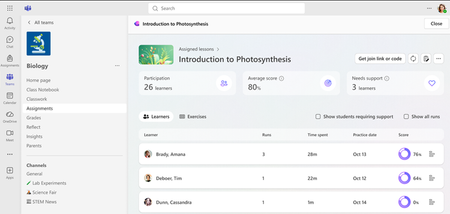
Assignments is where the daily work of teaching comes together — creating assignments, collecting student work, giving feedback, and tracking grades. Whether your school uses Microsoft Teams for Education or a learning management system like Canvas or Schoology, Assignments works where you already are. In Teams, it's built into every class team. In your LMS, it's available through the Microsoft 365 LTI® app. Over the past year, we've added AI tools directly into the assignment workflow. They show up while you're writing instructions, building a rubric, or grading student work. Every AI suggestion is editable, and you decide what stays. AI features in Assignments run within the Microsoft 365 education boundary — student data stays within your tenant and is not used to train AI models. If you're new to Assignments, this MS Learn module walks you through the basics. It covers the full feature set, including recent AI additions. Building an assignment You start with a title, instructions, and a due date. From there, you shape the assignment to fit what your students need: Attach resources — add Word, PowerPoint, PDF, or other files. You control whether students can edit them or just view them. Students can also snap photos of handwritten work and submit them as images. Add a quiz — attach a Forms quiz and scores sync back to your gradebook automatically. One of the most-used features in Assignments. Add apps — embed EDU apps like MakeCode, Nearpod, or Wakelet directly in the assignment. Choose your audience — assign to the full class, a group, or individual students. Group assignments support both group and individual grading. Include collaboration tools — add a Whiteboard for brainstorming, group work, or individual submissions. As you write your instructions, AI suggestions appear below the text box — you can add detail, add hints, add steps, add learning objectives, or align to academic standards (Common Core, NGSS, or your local curriculum framework), each with one click. The suggestions build on what you've already written, so they extend your instructions rather than replacing them. Use one, stack a few, or skip them. Setting expectations with rubrics and guidelines Rubrics are one of the most effective ways to show students what good work looks like. You can create a rubric from scratch or generate one from a description and a standard. Enter what the assignment is about, select a standard from the built-in library, and Assignments builds a multi-criteria rubric with proficiency levels. The result is fully editable — rename criteria, adjust descriptions, delete rows, or use the Enhance with AI panel to refine specific sections. For middle and high school classes where students may use AI tools for their work, you can set Student AI Guidelines directly on the assignment. Four levels — from full AI use to no AI — are visible to students before they start working. You can set a default level and copy your settings across classes with Import Settings. Practice, review, and check in Assignments integrates with tools that help students practice, build skills, and reflect — before, during, or after an assignment. Learning Activities Learning Activities let you create study materials directly from the documents you've already attached. Click the menu on an attached file and choose Flashcards, Fill in the Blanks, or Matching — the activity is generated from the document's content. Each activity is editable, so you can adjust cards, add hints, or remove items that don't fit. Learning Accelerators Learning Accelerators give students personalized practice with real-time feedback: Reading Progress — students read aloud, and AI detects fluency patterns like mispronunciations and omissions. You see individual and class-wide progress in Insights. Math Progress — AI-generated math problems with auto-grading and progress tracking. Search Progress — students practice search and information literacy skills within an assignment, with scaffolds and class-level comparison data. Speaker Progress — students practice presenting, and AI coaches them on pace, filler words, and delivery. You can assign a Reading Progress passage or a Search Progress activity the same way you assign an essay or a project. Reflect Reflect brings social-emotional check-ins into the classroom. Students respond to a prompt using emoji-based emotion selectors, and you see class wellbeing trends over time in Insights. You can schedule regular check-ins, run brain breaks, and use the data to spot students who might need extra support — all without leaving Teams. Grading and giving feedback When student work comes in, Assignments supports multiple ways to grade and respond: Rubric scoring — score each criterion, and students see exactly where they landed across proficiency levels. AI-drafted feedback — after you score a rubric, AI drafts a personalized summary in student-friendly language. It highlights what the student did well, where they can improve, and what to focus on next. You review it, edit anything that doesn't sound right, and return it. The draft is a starting point for your own voice. Inline markup — highlight, comment, track changes, and use digital ink directly in Word and PowerPoint submissions. PDF annotation — mark up PDF submissions. Video and audio feedback — record a short video or audio response for a more personal touch. These options give students feedback they can listen to, which is especially helpful for younger learners, students with reading difficulties, or anyone who benefits from hearing tone and emphasis. General comments — a text field for overall feedback. Students can revise and resubmit, and you can return work multiple times. The goal is a draft-feedback-revision loop — students improve their work based on your input, not just a final grade. You can also configure grading to match your school's policies — weighted categories, letter grades, complete/incomplete, or custom text instead of points. Built-in accessibility Immersive Reader is built into Assignments, so students can have any assignment text read aloud, adjust font size and spacing, highlight parts of speech, or translate content into their language — right where they're working. Combined with video and audio feedback, students who struggle with reading or written feedback still get the full experience. Keeping track across classes If you teach multiple sections, the cross-class view lets you see all assignments across every class from one place — Upcoming, Ready to grade, Past due, Returned, and Drafts — without switching between teams. You can also view assignments within a single class when you need to focus on one group. Works in your LMS If your school runs a learning management system, the Microsoft 365 LTI® app brings Assignments and other Microsoft 365 education tools directly into your LMS through the LTI 1.3 standard. You can create assignments with AI-generated rubrics, collect submissions, and give AI-drafted feedback — all without leaving your LMS. The Microsoft 365 LTI app works with: Canvas by Instructure PowerSchool Schoology Learning Blackboard by Anthology Brightspace by D2L Moodle™ Your IT admin handles the initial setup. Once installed, educators and students access Microsoft tools from within the LMS. For setup guidance, see the Microsoft 365 LTI deployment guide. Getting started If your school uses Microsoft Teams for Education, Assignments is built in — look for the Assignments tab in any class team. If your school runs an LMS, ask your IT admin about the Microsoft 365 LTI app. Assignments and its AI features are included with Microsoft 365 Education A1, A3, and A5 licenses at no additional cost. Helpful Links Assignments Create an assignment in Microsoft Teams Organize content, create assignments, and assess learners' understanding in Teams (MS Learn) Set Student AI Guidelines on an assignment Import Settings in Assignments and Grades Learning Activities and Learning Accelerators Learning Accelerators for Educators (MS Learn) — Reading Progress, Math Progress, Search Progress, Speaker Progress, Reflect, and Insights Build social and emotional skills with Reflect (MS Learn) Leverage data for action with Insights (MS Learn) LMS integration Microsoft 365 LTI deployment guide Community Join our EDU Insider Program: aka.ms/joinEIP Have questions or want to share how you're using Assignments in your classroom? Drop them in the comments below — I'd love to hear from you. Until next time, Leif Brenne906Views1like1CommentWhat's new in Assignments: interactive lessons, localized content, and smarter AI tools
Assignments in Microsoft Teams and through the Microsoft 365 LTI app has shipped a set of updates that connect interactive learning content directly into the assignment workflow, improve content quality across English-speaking regions, and give educators more control over AI-generated output. All of these features are available now for every Microsoft Education license (A1, A3, A5) at no extra cost. Watch a quick walkthrough of all the updates: What's new in Assignments Learning Zone interactive lessons in Assignments Educators using a Copilot+ PC can turn any teaching idea into an interactive lesson — with slides, quizzes, and activities — using the Learning Zone app. Those lessons now connect directly into the assignment workflow. When creating an assignment, educators see a new Learning Zone resource option. Pick a lesson, and it's attached to the assignment. Students complete the interactive lesson right inside their assignment in Teams or through the LMS, without leaving. When they finish, scores sync automatically — the student's completion percentage becomes their assignment grade. A few things to know: You need a Copilot+ PC to create lessons. Students can complete them on any device. If you don't have any lessons yet, the picker will link you to download the Learning Zone app. Students can also open the lesson in the Learning Zone app on Windows if they prefer. Learn more: Add a Learning Zone lesson to an assignment Student feedback view update We've updated how students see feedback on returned assignments. The view now reorganizes to put what matters most front and center: Feedback, feedback resources, rubric, and grades take the main space. Instructions and resources collapse into side sections — still accessible, just not competing for attention. Before this change, students saw everything at once — feedback mixed in with instructions, attachments, and rubrics. Many students struggled to find the feedback you spent time writing. Now it's the first thing they see when they open a returned assignment. This is already active for everyone. Nothing to turn on. Standards alignment across Instructions and Rubrics Educators can now add educational standards directly to their assignment. When you use AI to enhance your instructions, it takes those standards into account. And when you generate a Rubric for the same assignment, it pulls in those same standards as input — so your instructions and rubric stay aligned without extra work. We've also made a few other improvements to AI Instructions: Describe changes to tweak the output. After the AI generates a suggestion, you can describe what you want changed in a text field and re-generate. Want it shorter? More scaffolded? Focused on a specific concept? Type what you'd like changed and get an updated version — no need to start over. Shorter, more focused suggestions. When you use Add Detail, Add Sparkle, Add Hints, or other enhancements, the output stays closer to what you actually need rather than over-expanding your instructions. Learn more: Standards in Assignments and the Teach module English locale support across Assignments and the Teach module in Microsoft 365 Copilot AI features across both Assignments and the Teach module in Microsoft 365 Copilot now support English (UK), English (Canada), and English (Australia) in addition to English (US). Language is automatically selected based on your browser language settings. If your browser is set to en-GB, the AI generates content using British English. If you've used Teach before, it defaults to your previously used language. You can switch anytime from the Language dropdown when creating content. We've also updated the age/year selection to match what's appropriate for each locale — so you'll see "Year 9" instead of "Grade 9" when using English (UK), for example. Resources Video walkthrough: What's new in Assignments Getting started with Learning Zone Add a Learning Zone lesson to an assignment Standards in Assignments and Teach Set Student AI Guidelines on an assignment Create an assignment in Microsoft Teams688Views0likes2Comments