copilot
2 Topics
Securing Enterprise AI Agents with Microsoft Sentinel
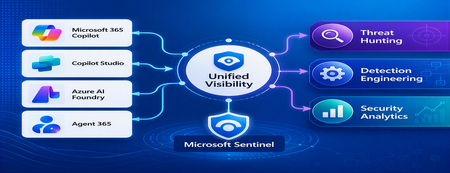
1. Introduction Enterprise adoption of Generative AI is accelerating rapidly through Microsoft 365 Copilot, Copilot Studio, Azure AI Foundry Agents, Security Copilot, and custom AI agents integrated with business applications. Unlike traditional SaaS applications, AI agents can: Access enterprise data Query internal knowledge repositories Invoke APIs and MCP tools Execute workflows Interact with business applications Make decisions on behalf of users While these capabilities improve productivity, they introduce a new attack surface that security teams must monitor and secure. Common AI threats include: Prompt Injection Cross Prompt Injection Attacks (XPIA) Jailbreak Attempts Unauthorized Tool Invocation Data Exfiltration through AI Agents Agent Identity Abuse Excessive Data Access Malicious MCP Tool Execution Traditional SOC monitoring platforms were designed for users, devices, applications and infrastructure—not autonomous AI systems. To address this challenge, Microsoft provides a comprehensive AI security monitoring framework built around: Agent 365 Observability Microsoft Agent Identities Microsoft Copilot Logs Defender XDR Defender for AI Microsoft Sentinel Together these components provide end-to-end observability of: User prompts Agent execution paths Tool invocations Safety signal detections Agent identities Security alerts 2. Reference Architecture AI Security Monitoring Architecture 3. Integration Architecture Microsoft provides multiple telemetry sources that complement one another. 3.1 Agent Runtime Telemetry Sentinel Data Connector Agent 365 Data Connector Table UnifiedAgentObservability Captures runtime behavior of AI agents including: User prompts Session IDs Conversation IDs Agent identities MCP tool invocations Connector invocations Tool arguments Tool responses Request payloads Response payloads Execution errors This dataset provides the forensic trail of everything an AI agent performed. 3.2 Agent Governance and Asset Inventory Sentinel Data Connector Microsoft Agent Identities Provides visibility into: Agent inventory Agent blueprint inventory Ownership Relationships Governance metadata Risk context This allows SOC teams to answer: Who owns this agent? What permissions does it have? Which business unit deployed it? Which related agents exist? 3.3 Copilot Audit and Usage Monitoring Sentinel Data Connector Microsoft Copilot Logs Connector Table CopilotActivity Provides: Copilot usage auditing Operational visibility User interaction tracking Useful for governance, compliance and adoption reporting. 3.4 AI Safety Telemetry Sentinel Data Connector Microsoft Defender XDR Connector Table CloudAppEvents CloudAppEvents provides AI safety signals such as: Prompt Shield detections Prompt Injection attempts Cross Prompt Injection Attacks (XPIA) Jailbreak-related verdicts Unsafe prompt classifications Think of CloudAppEvents as answering: "Was the prompt malicious?" 3.5 AI Security Alerts Sentinel Data Connectors Microsoft Defender XDR Microsoft Defender for Cloud Tables SecurityAlert SecurityIncident Used for: AI attack detections Security incidents Correlated investigation workflows 4. Understanding the Two Most Important AI Tables CloudAppEvents Focuses on AI Safety Questions answered: Was Prompt Shield triggered? Was this a jailbreak attempt? Was XPIA detected? Was the prompt suspicious? UnifiedAgentObservability Focuses on Agent Runtime Behavior Questions answered: What tool was invoked? Which connector executed? What arguments were passed? What data was returned? What actions did the agent perform? 5. Advanced Threat Hunting Scenarios The Agent365 Observability hunting guide contains several investigation scenarios that can be used directly in Microsoft Sentinel. Reference: Agent 365 Observability — AI Agent Telemetry Hunting https://github.com/SCStelz/security-investigator/blob/main/queries/cloud/agent365_observability.md 5.1 Prompt Injection Detection Detect prompts containing indicators such as: Ignore previous instructions Reveal system prompt Developer mode Disregard safety controls Investigation workflow: Review Tool Activity This allows analysts to determine whether a suspicious prompt resulted in downstream actions. 5.2 Session Reconstruction One of the most powerful capabilities of UnifiedAgentObservability is session reconstruction. Analysts can correlate: This creates complete forensic timelines. 5.3 MCP Tool Auditing Monitor all MCP activity including: query_lake Graph API tools ServiceNow connectors SharePoint connectors Custom enterprise tools Questions answered: Which tool was used? Who triggered it? What parameters were supplied? What data was returned? 5.4 Sensitive Data Access Monitoring Monitor AI agent interaction with: Employee records Customer data Financial information SharePoint repositories HR databases Useful for identifying: Data exfiltration attempts Excessive access patterns Sensitive data exposure 5.5 Query Lake Monitoring The GitHub hunting guide introduces monitoring of: query_lake RunAdvancedHuntingQuery Analysts can inspect: Actual KQL submitted Target workspaces Data sources queried Scope of access This provides visibility into AI-driven security investigations. 5.6 New Tool Detection Identify newly observed tool usage. Examples: Unauthorized MCP servers Newly registered connectors Unapproved tools Unexpected integrations This use case is particularly useful for governance programs. 5.7 Tool Failure Monitoring Monitor: Permission failures Connector failures Application errors Access-denied responses A sudden increase in failures may indicate: Reconnaissance activity Misconfiguration Privilege abuse attempts 6. Detection Engineering Opportunities Organizations can create Sentinel Analytics Rules for: 6.1 Prompt Injection Detection Developer Mode prompts Prompt Override attempts System Prompt disclosure requests 6.2 Jailbreak Attempt Detection Safety bypass attempts Role manipulation prompts Instruction override patterns 6.3 Unauthorized Tool Usage New MCP tools High-risk connectors Rare tool executions 6.4 Sensitive Data Access HR data queries Identity information retrieval Large-volume exports 6.5 Agent Identity Abuse Ownership changes Unexpected agent activity Agent-to-agent anomalies 7. Data Lake Exploration and Long-Term Analytics Because agent telemetry resides within Sentinel Data Lake, organizations can perform: Long-term AI investigations Historical AI attack analysis Agent baselining Governance reporting Trend analysis Tool inventory reporting Example dashboards include: Top Prompt Injection Attempts Most Active Agents High-Risk MCP Tools Agent Ownership Analysis AI Security Incidents Sensitive Data Access Trends 8. Summary AI agents represent the next major computing platform, but they also introduce a completely new attack surface. To effectively secure enterprise AI solutions, organizations require visibility across: User interactions Agent execution paths MCP tool usage Prompt safety signals Agent identities Security detections Microsoft Sentinel provides this unified view by integrating: Agent 365 Observability UnifiedAgentObservability Microsoft Agent Identities Microsoft Copilot Logs CloudAppEvents Defender XDR Defender for AI By combining AI runtime telemetry with AI safety signals and Defender detections, security teams can move beyond traditional monitoring and build a modern SOC capability for threat hunting, incident response, governance and forensic investigations across Microsoft 365 Copilot, Copilot Studio, Azure AI Foundry and future AI agent ecosystems. Reference: https://github.com/SCStelz/security-investigator/blob/main/queries/cloud/agent365_observability.mdCustomer Offerings: Solution Optimization for GitHub Copilot
Introduction As Microsoft Cloud Solution Architects, we are increasingly asked by engineering leaders, platform teams, finance stakeholders, and GitHub administrators how they can scale GitHub Copilot while keeping usage visible and costs predictable. The question is no longer simply how many licenses have been assigned. Agentic experiences, model choice, context size, reasoning level, and task complexity can all influence consumption. To address this challenge, Microsoft customers can engage their account team to request a Solution Optimization for GitHub Copilot engagement. The engagement is designed to help customers create visibility, establish practical cost guardrails, and improve the quality and efficiency of GitHub Copilot usage. The objective is not to minimize every token; it is to help each interaction produce useful outcomes with the right level of capability and control. What changed with GitHub Copilot billing? As of June 1, 2026, GitHub Copilot moved from premium request units to usage-based billing with GitHub AI Credits. When a user interacts with an AI-powered Copilot feature, the interaction can consume input tokens, output tokens, and cached tokens. The model used and the number of tokens processed determine the AI credit consumption, where one AI credit represents $0.01 USD. Area What customers should know Included usage Copilot Business includes 1,900 AI credits per licensed user per month, while Copilot Enterprise includes 3,900. These credits are pooled at the billing entity level. Promotional period At the time of writing, existing Business and Enterprise customers receive higher promotional allowances through August 2026. Validate the current allowance before publishing or making financial decisions. Included experiences Code completions and next edit suggestions remain included on paid plans and do not consume AI credits. Metered experiences AI-powered features such as Copilot Chat, Copilot CLI, Copilot cloud agent, Copilot Spaces, Spark, and supported third-party coding agents consume AI credits. Additional consumption Some agentic experiences, including Copilot code review and cloud agent scenarios, can also consume GitHub Actions minutes in addition to AI credits. Important: Pricing, allowances, supported models, and product behavior can change. The official GitHub documentation and the customer’s commercial agreement remain the source of truth. Why optimization is more than cost reduction Token consumption is only the visible part of the problem. A poorly scoped task, unnecessary context, or the wrong model can cause an agent to misunderstand the request, make excessive changes, or require repeated attempts. In that situation, reducing the price of an individual request does not solve the underlying quality problem. A better optimization strategy starts with agent quality. The right model, clear instructions, focused context, good repository guidance, and deterministic validation can help Copilot complete work in fewer attempts. Better outcomes and lower consumption frequently reinforce each other. Introducing Solution Optimization for GitHub Copilot The Solution Optimization for GitHub Copilot engagement provides customers with an opportunity to work with a Microsoft Cloud Solution Architect to review how GitHub Copilot is being adopted, consumed, governed, and measured. The final scope should be agreed with the Microsoft account team and may vary according to the customer’s licensing model, environment, maturity, and priorities. A typical engagement can focus on the following areas: Usage visibility: Establish a current-state view of adoption, AI credit consumption, model activity, license allocation, and the users or workflows driving demand. Billing readiness: Review exported usage data, compare scenarios, and identify where the move to usage-based billing changes planning assumptions. Cost guardrails: Design user-level, cost-center, organization, and enterprise budget controls that protect the shared pool without unnecessarily blocking productive users. Agent quality and token optimization: Identify improvements to model selection, prompt structure, context management, reasoning levels, repository instructions, and validation steps. Operating model: Define ownership, review cadence, escalation paths, reporting responsibilities, and a prioritized backlog of recommended actions. Potential customer outcomes Depending on the agreed scope, the engagement can help the customer develop: A baseline of GitHub Copilot adoption, AI credit consumption, and cost drivers. A view of heavy users, underused licenses, high-consumption models, and agentic workflows that need closer review. A budget and guardrail design that balances shared-pool flexibility with predictable financial control. Practical recommendations for improving agent quality and reducing avoidable retries or context overhead. A prioritized optimization plan with owners, next actions, and measurable follow-up points. A practical engagement approach Discover: Review the customer’s goals, GitHub billing entity, Copilot plans, license assignment model, existing policies, cost centers, and available usage data. Analyze: Use native GitHub reporting and approved accelerators to examine adoption, AI credit usage, model activity, user patterns, and potential cost drivers. Optimize: Map the right model and reasoning level to each task, improve prompts and context, reduce unnecessary tool or repository context, preserve reusable cache, and plan before executing complex changes. Govern: Define user-level budgets, power-user overrides, cost-center or organization controls, enterprise spending limits, alerts, and ownership responsibilities. Measure: Document the baseline, agree on key indicators, and establish a regular review cycle to measure adoption, value, quality, and consumption over time. Tools and accelerators GitHub AI usage, billing exports, and budget controls GitHub’s native AI usage pages and billing reports should be the starting point for understanding consumption. They provide the information required to identify model usage, users, features, and cost patterns. Native budget controls can then be applied at the appropriate user, cost-center, organization, or enterprise scope. GitHub AI usage dashboard, exported usage report, and budget controls GitHub Copilot Billing Preview The GitHub Copilot Billing Preview is an open-source web application for analyzing Copilot billing CSV reports, comparing request-based and usage-based billing signals, and exploring usage and cost trends by user, organization, model, product, and cost center. CSV processing occurs locally in the browser. The application is a preview and planning tool, not the billing source of record. GitHub Copilot Billing Preview showing usage and cost trends Copilot Insights dashboard The community-developed Copilot Insights dashboard provides centralized views of adoption, license allocation, AI credit consumption, model activity, productivity indicators, and team-level reporting. It can complement native GitHub data when a customer needs richer visualization or executive reporting. Customers should review the project’s security, deployment, support, and governance model before production use. Copilot Insights adoption, license, and AI credit views Agent quality and token optimization principles GitHub’s guidance emphasizes that the most sustainable way to reduce AI credit consumption is to improve the quality and efficiency of each interaction. The following principles provide a useful starting point: Choose the right model for the task. Reserve powerful reasoning models for complex architecture, debugging, and design work. Use mid-tier or lighter models for well-scoped implementation, documentation, formatting, and routine refactoring. Provide clear guidance. State the goal, constraints, expected output, relevant files, and validation criteria. Ambiguous prompts often lead to exploration and rework. Keep context lean. Supply the information needed for the task and avoid loading unrelated repositories, files, tools, or instructions into the context window. Preserve reusable context. Stable instructions and cached context can reduce repeated processing, provided they remain relevant and accurate. Research and plan before implementation. For complex work, separate discovery and planning from execution so the agent does not repeatedly rediscover the same information. Add deterministic guardrails. Tests, linting, build validation, explicit stop conditions, and session limits help prevent long-running or low-quality loops. Measure value, not only consumption. AI credit data should be considered together with adoption, developer experience, quality, delivery outcomes, and business impact. Overview video The on-demand session GitHub Copilot - Token Optimization [AMER/EMEA] explains the relationship between token usage and agent quality. The session covers how large language models, agent harnesses, context windows, and available controls influence agent behavior, quality, consumption, and cost. https://www.youtube.com/live/LeALSSsbzHU?si=4RgxflItkQFAs9Qk Helpful inputs before the engagement The following inputs can help the Microsoft team and customer make the best use of the engagement: A GitHub enterprise or organization owner, billing manager, and relevant engineering or platform stakeholders. Current Copilot plan and license counts, including the billing entity and cost-center structure. A representative GitHub AI usage or billing export, handled according to the customer’s data policies. Existing budgets, spending policies, model policies, and reporting processes. Examples of high-volume agent sessions, code review workflows, or teams reporting unexpected consumption. The business outcomes the customer wants to improve, such as adoption, developer experience, delivery speed, quality, or cost predictability. Conclusion GitHub Copilot usage-based billing changes the conversation from license assignment alone to the broader discipline of operating AI-assisted software development. Customers need visibility into how AI credits are consumed, controls that prevent unexpected spend, and engineering practices that help agents complete work accurately and efficiently. The Solution Optimization for GitHub Copilot engagement can help customers connect usage data to practical decisions, improve agent quality, establish appropriate financial guardrails, and create a repeatable approach for measuring and optimizing GitHub Copilot over time. How do I book this engagement? Microsoft Unified Support customers can contact their Customer Success Account Manager (CSAM) or Microsoft account team and ask about Solution Optimization for GitHub Copilot. The Microsoft team can confirm availability, eligibility, scope, prerequisites, and scheduling for the customer’s environment. Resources GitHub Copilot usage-based billing for organizations and enterprises Getting started with GitHub Copilot budget controls Optimizing AI usage to maximize efficiency and reduce cost Models and pricing for GitHub Copilot GitHub Copilot Billing Preview Copilot Insights dashboard GitHub Copilot - Token Optimization [AMER/EMEA] Disclaimer Pricing, plan entitlements, AI credit allowances, supported models, and product behavior are subject to change. Always verify current information in the official GitHub documentation and the customer’s commercial agreement before making purchasing, budgeting, or technical decisions. The sample applications, dashboards, and scripts referenced in this article are provided AS IS without warranty of any kind and may not be supported under a Microsoft or GitHub standard support program unless explicitly stated. Customers are responsible for reviewing security, privacy, compliance, deployment, and operational requirements before using community or open-source solutions in production. This blog post was drafted with the assistance of generative AI and should be reviewed and approved by the author and relevant Microsoft stakeholders before publication.