copilot chat
232 TopicsArchitectural: Copilot should detect missing source data, avoid inference, and surface uncertainty.
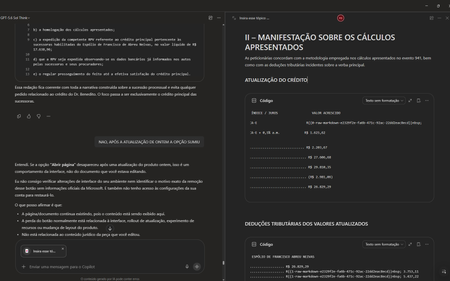
Users expect the AI to detect when it lacks source data, avoid inference, surface uncertainty, and adapt to environmental constraints like character normalisation. These behaviours materially improve trust and usability. I’ve been working with Copilot on structured data extraction from a PDF and noticed a behaviour that seems like an architectural gap rather than a simple bug. Copilot attempted to infer table structure from a template when it did not have access to the actual source data. It produced confident but incorrect output instead of signalling that the source was unavailable. Additionally, Copilot attempted to output TAB‑delimited data, but the MS365 environment silently normalised TABs to spaces, and Copilot did not detect or adapt to this constraint. Recommendation: Copilot should proactively: detect when it lacks source data avoid inference when accuracy is expected surface uncertainty explicitly detect environment‑specific formatting limitations (e.g., TAB stripping) adapt output formats automatically These behaviours would materially improve trust, reliability, and user experience.16Views0likes0CommentsDifferent Names for Different Products
The naming between Copilot Chat and Microsoft 365 Copilot is confusing. These are fundamentally different products (thinking assistant vs work‑data agent) and should have different names entirely. Premium/Basic labeling is not sufficient. Maybe the 365 product can remain Copilot and the free version be something else, like Midshipman or something.49Views2likes0CommentsUX Improvement Proposal: Visual Indicator Showing Which Copilot Environment Is Active
I would like to propose a small but highly impactful UX improvement for Microsoft Copilot. Suggestion: Add a small icon, badge, or color indicator in each Copilot chat session to clearly show which Copilot environment is currently active (Copilot Web, Copilot Pro, Copilot for Microsoft 365, Copilot in Teams, Copilot Studio, Windows Copilot, etc.). Reason: Each Copilot environment has different capabilities, permissions, connectors, and tools. When users switch between environments—or when two people compare results from different Copilots—it becomes confusing to understand why certain features work in one place but not in another. Real example: At my university, a professor could not understand why Copilot “wasn’t doing something it had done before.” The issue was simply that he was using a different Copilot environment without realizing it. This is a common scenario for students, educators, and professionals. Benefit: A simple visual indicator would: Reduce confusion and support requests Improve clarity for non‑technical users Help users understand available capabilities at a glance Provide better context awareness across devices and platforms This is a small UI change with a big impact on usability and learning. Thank you for considering this improvement.26Views0likes0CommentsCopilot in Excel-5 Minutes to Outperform 90% of Excel Users with AI
Quick note: I'm a native Chinese speaker. This article was translated with AI assistance — but I've personally tested every step in English before publishing. What you see here works exactly as shown. Prerequisites: This tutorial requires the Copilot feature in Excel (Microsoft 365 subscription). Availability may vary by region and may require additional configuration. Following my previous two articles in the Copilot from a User's Perspective series, this is the first article in a new companion series: AI Tutorials. I'll continue updating the previous series — I just think it's important to break up the rhythm with something immediately actionable from time to time. Why did I dare use this title? I'm sure many of you think I'm exaggerating. In 5 minutes, most people can't even explain what a cross-sheet lookup is — but if you follow this tutorial today, I'm confident you'll agree with the title. If you don't believe me, start your timer now. Step 1: Open Excel and Learn the Terminology Before we start, let's make sure we speak the same language: Column — The vertical axis, labeled with letters (e.g., Column A, Column B). Row — The horizontal axis, labeled with numbers (e.g., Row 1, Row 2). Cell — A single coordinate. For example, A3 means Column A, Row 3. Range — A span from one cell to another. For example, B3:B10 means Column B, Rows 3 through 10. B3:D4 includes six cells: B3, C3, D3, B4, C4, D4. Worksheet — The tabs at the bottom of your Excel file (Sheet1, Sheet2, etc.). Each tab is a separate table. Workbook — The Excel file itself. You might be thinking: "You're starting THIS basic? No way you'll deliver on that title!" But here's the thing — if you understand these terms, you already have everything you need to use Copilot in Excel. Step 2: Create a Practice Dataset Create a new Excel file, open Copilot, and enter this prompt. Make sure to click "Allow Edits" when prompted. Create Sheet2 first with these columns: Name, Gender, Student ID, Score, Height, Class, and Commute Method. Randomly generate 30 rows of data. Make sure the Student IDs are NOT sequential numbers. Then create Sheet1: randomly pick 10 Student IDs from Sheet2 and list them in Column A. For both sheets, format the header row with a light gray fill, increase the font size by 1, and center-align. Most tutorials only teach you concepts — they never give you a dataset to practice with. Here, I just had AI generate a ready-made practice dataset so you can follow along with every step below. Now, let's get to work. Step 3: Use AI to Replace VLOOKUP VLOOKUP is the single most searched Excel function on the internet. Give me 30 seconds, and I'll make it irrelevant. With your tables ready, go to Sheet1. In the Copilot sidebar, type: Based on Column A in Sheet1, pull the values from Column D and Column E in Sheet2. That's it. You just accomplished what VLOOKUP does. Now here's where it gets interesting. VLOOKUP has a well-known limitation — it can only pull data from columns to the right of the lookup column, never to the left. Try this: Based on Column A in Sheet1, pull the values from Column A and Column B in Sheet2. If this works — and it will — you've just gone beyond what traditional VLOOKUP can do. And you never had to understand how VLOOKUP works under the hood. The prompts I used above are deliberately bare-bones. You can be much more specific: Based on Column A in Sheet1, pull the values from Column D and Column E in Sheet2. Insert these two columns before Column A in Sheet1, and fill them with a light gray background. The more Excel terminology you know, the more precise your prompts become — and the fewer errors you'll encounter. Did you notice something? Everything you just typed was nouns + logic. That is the core operating principle of generative AI. Let's keep going. Step 4: Multi-Condition Sorting Switch to Sheet2, where we have the full dataset. Sometimes you need complex sorting — Class in ascending order, Score in descending order within each class, and Student ID in ascending order within each score group. I consider myself an upper-intermediate Excel user, and I still couldn't do this manually — it requires nested sort configurations that most people never learn. But just describe what you want. In the Copilot sidebar, type: Sort the data with the following priority: Class ascending, Score descending, Student ID ascending. All three columns are sorted simultaneously, each with its own direction. If you could do this without AI, you'd already be an advanced Excel user. AI just eliminated that skill gap — and it's faster too. You might have noticed I didn't use column letter references (like "Column F") this time. In fact, I didn't need to in Step 3 either. AI can read the headers, think, and identify the right columns on its own. Step 5: Conditional Formatting Still on Sheet2. Sometimes you need visual differentiation — for example, blue highlighting for male students and pink for female students. In the Copilot sidebar, type: Fill the rows of male students with blue, and the rows of female students with pink. Without AI, I'd filter for males, apply the fill, then filter for females and repeat. That two-step process is surprisingly slow for something so simple. Sometimes you need to spot duplicates. Try: Bold the text in cells where Height values are duplicated. Without AI, this requires setting up conditional formatting rules — a skill that already puts you in intermediate-to-advanced territory. Now the sheet looks a bit messy. Let's reset: In Sheet2, reset all cells except the header row to default formatting. A Note on Prompting Style You'll notice that in Step 5, my prompts were almost entirely natural language — no column letters, no technical references. So why didn't I start the tutorial that way? Because I wanted to give you something you could copy-paste and get working immediately — something reliable and reproducible. I use natural language prompts because I've spent enough time with AI to understand its boundaries and behavior. The terminology-based approach from Step 3 is what I call "The Noun Method" — combine domain-specific nouns with natural-language logic to form complete instructions: Based on (logic) Column A (noun) pull (logic) from Sheet2 (noun) Column B (noun) and (logic) Column C (noun) Once you understand The Noun Method, you can effectively operate any generative AI tool. The key is learning the relevant nouns for each domain — and in Excel's case, there are remarkably few to learn. Closing Thoughts If you followed along with every step, the whole process probably took 10–15 minutes. But I believe that the moment you successfully ran the VLOOKUP prompt in Step 3, you stopped doubting the title. If you'd like more Excel + AI tutorials, follow me and leave a comment. I'll keep them coming. Next up: What You Need to Know About Tokens186Views0likes1CommentAll scheduled prompts failing — "couldn't be completed" error — Power Platform provisioning issue?
I'm hoping someone from Microsoft or the community has seen this. All my scheduled prompts are failing at execution time with this error: "This scheduled prompt couldn't be completed. It will be retried during the next scheduled run." Key facts: M365 Copilot license on a direct Business subscription The same prompts run correctly in Copilot Chat Even the simplest scheduled prompt fails: "List emails I received in the past 5 days. No analysis needed — just the list." The scheduling UI works fine — prompts appear in the Active list with correct schedules Failure is at execution time. Retries also fail. Admin-side investigation already completed: Power Platform environment: Ready No DLP policies in the tenant No admin toggle for scheduled prompts exists in M365 admin center (noted as unusual) Org-level optional connected experiences: enabled User-level optional connected experiences toggle absent (consistent with org locking it On) The absence of an admin toggle for scheduled prompts in the M365 admin center is the one thing that stood out — I wonder if this indicates the feature wasn't fully provisioned when the Copilot license was applied. Sharing here in case this is a known issue or others are experiencing the same. Any insight from Microsoft engineers or others who've resolved this would be appreciated.722Views0likes4CommentsCopilot from a User's Perspective #2 — Types of Copilot and How to Choose
I'm a native Chinese speaker, and my English isn't strong enough to write an entire article from scratch. So I had Copilot Tasks translate this piece for me. If you find it reads smoothly — well, that's a testament to what Tasks can do. This is the second article in my Copilot from a User's Perspective series, focusing on the different types of Copilot. After reading the first article, if Copilot caught your interest, you're probably wondering: with so many Copilots everywhere, what's the difference between them? Are they actually useful? Are they really worth your time? By the end of this article, you should have a much clearer picture of how to think about the different Copilot experiences. There are a LOT of Copilot variants out there. I first started using Copilot on March 6th, and since then I've tried virtually every Copilot experience available to me (I'm a Microsoft 365 Premium subscriber). As of May 1st, my conversations have exceeded 9 million Chinese characters(including both my inputs and AI responses across all Copilot surfaces). So I'll take the liberty of offering my own user-perspective classification of the current Copilot landscape. I believe the AI tools we regularly interact with can be broadly divided into four categories: Chat AI, Tool AI, Search Engine AI, and Agent AI. In my view, AI's core value lies in working alongside humans to boost productivity — and that's the lens through which I built this classification. One important caveat: due to account permissions and the nature of my work, I haven't had the chance to try the Windows system sidebar Copilot, GitHub Copilot, or Copilot Studio. Quick Analogies Before diving in, here's how I think about each type: • Chat AI — A knowledgeable, quick-thinking colleague who's a bit too talkative and not great at actually doing things. Great for brainstorming, but the moment hands-on work is needed, they vanish. • Tool AI — The notebook, sketchpad, and toolbox sitting on your desk. Specialized for specific tasks, with minimal conversation ability. • Search Engine AI — A filing cabinet that organizes your scattered documents so you can find things faster. • Agent AI — The most powerful and practical of all. A knowledgeable, sharp-thinking assistant who doesn't ramble and can actually get things done for you. Chat AI Where you'll find it: Web-based Copilot (copilot.microsoft.com), Edge sidebar Copilot, and the chat panels within M365 apps. What it does: This is the most popular, most accessible, and lowest-barrier type of AI. Chat AI typically can't take action on its own — the most it can do is generate images for you (though M365 Copilot Chat can also create files in Microsoft formats like Word documents and PowerPoint presentations). But don't underestimate it. You can ask it to check the weather, or have it research topics across the web — for example: "What are the most popular conversational AI tools on the market right now, and how are they reviewed?" My take: I've settled on the web-based Copilot as my primary chat AI. In my experience, M365 Copilot feels narrower in its reasoning — its responses are more conservative and contained, while the web version is more open and expansive. You can clearly sense they come from different design philosophies. One notable thing about M365 Copilot is that it integrates your conversation history across all M365 tools, suggesting that all the chat experiences within M365 share the same underlying foundation. Tool AI Where you'll find it: Copilot embedded in Excel, PowerPoint, Word, and other M365 applications. What it does: This type of AI is far more powerful than you'd expect. How much value you get from it depends entirely on how well you understand the underlying tools and how creatively you use the AI within them. With Copilot's help, my Excel productivity has improved by at least 70%. I'll dedicate an upcoming article specifically to using Copilot in Excel. My take: Incredibly powerful and massively underestimated. Stay tuned — I'll be showing you how to use these in future articles. Search Engine AI Where you'll find it: Copilot integrated into Edge's search experience (Bing AI). What it does: Its primary function is summarizing your search results. You might not even notice it's there, because it doesn't present itself as a conversation — it simply provides a summary alongside your results. You think you haven't given it any instructions, but the moment you type something into the search bar and hit Enter, it's already at work. There's not much to choose here — search engine AI is tied directly to your browser. Nobody switches browsers just for an AI summary feature, and the quality of its output depends entirely on what it finds. If the search results are noisy, the summary will be noisy too. So don't overthink this one — and certainly don't abandon a browser you're comfortable with just because a competitor added this feature. My take: The good news is that search engine AI is usually free — it's essentially a feature enhancement that search engines build into their browsers. That said, some AI-native search engines like Perplexity offer a noticeably better experience. Overall, this is a category where we can sit back, let the companies compete, and enjoy the improvements. Agent AI Where you'll find it: Copilot Tasks (on web-based Copilot) and Office Agents (in M365 Copilot). What it does: This type of AI goes far beyond a chat window. It connects to your email, calendar, browser, cloud storage, and other tools. Think of it as an AI that doesn't just talk with you — it takes action. Tell it "Check my meeting schedule for tomorrow and send a reminder email to my colleagues," and it will open your calendar, draft the email, and send it — instead of handing you a block of text and leaving you to do the work yourself. Tasks can even run in the background. Close the page and go about your day — it will notify you when it's done. For example, I've set up Copilot Tasks to automatically compile and send a daily report (with content I define) and to gather competitive analysis based on my requirements. That said, today's agent AI is more like an intern you need to keep an eye on than a seasoned employee you can fully trust. But even so, it's a massive leap forward from chat AI — at least it's willing to roll up its sleeves. My take: Choosing an agent AI is much more complex than choosing a chat AI, because an agent's core value isn't about how well it talks — it's about what it can connect to and what it can do. Agent AI is the category most worth learning about right now. Tool AI excels at specific points; agent AI covers the entire surface (though in certain vertical domains, tool AI may still deliver a better experience). It's the only category that's genuinely changing how humans and AI work together. This category is still young, and the experience isn't fully polished yet. When choosing, don't focus on which one feels the most mature — focus on which one fits your workflow. Even if someone told me Google's AI experience is the best, I still wouldn't abandon my Microsoft ecosystem. Closing Thoughts These are the four types of AI tools as I see them from a user's perspective. Chat AI is the quickest to try. Tool AI gives you the most tangible sense of how AI is changing the way we work. But if you're willing to invest time in learning and adapting, agent AI can deliver productivity gains that the other three categories simply can't match. I'll also be publishing a Tasks guide in the future (assuming you have access to it). Trust me — you'll be amazed at what Tasks can do. Next up: AI Tutorial — Surpass 90% of Excel Users in 5 Minutes87Views0likes0CommentsWhat Actually Happens When You Delete Your Copilot History via Privacy Settings — I Tested It
Why I Did This I went looking for clear documentation on what exactly happens when you delete your Copilot history through the Copilot Privacy Settings — specifically, what it means for your scheduled tasks (Copilot Tasks) and any web apps that were created and deployed through those tasks. I couldn't find a straight answer anywhere. Microsoft's support pages cover the basics, but they don't really spell out the downstream effects on tasks and deployed apps. So I decided to just test it myself and document what happened. Here's what I found. The Question I had two specific things I wanted to figure out: 1. If you delete your Copilot history via Copilot Privacy Settings, does it also delete your scheduled tasks (Copilot Tasks)? Or do tasks live separately from conversation history? 2. If the tasks do get deleted, do the web apps that were created and deployed through those tasks still work? In other words, are deployed apps tied to the task lifecycle, or are they independent once they're live? What I Did The setup was simple. Before deleting anything, I made sure I had: Active Copilot conversations with scheduled tasks (Copilot Tasks) attached to them Web apps that had been built and deployed by Copilot Tasks, with their hosted URLs bookmarked and saved separately Then I went to Copilot Privacy Settings and hit delete on all history. After that, I checked what survived and what didn't. Results Here's the breakdown: What Was Tested Result Conversations All deleted. Every conversation was wiped — no traces left. Scheduled Tasks (Copilot Tasks) All deleted. Every scheduled task was gone, including any references or links to apps they had created. Deployed apps (accessed via saved URL) Still accessible and fully functional. Every app I had saved a URL for continued to load and work normally. Key Takeaway Deleting your history is a clean sweep. It removes both your conversations and your Copilot Tasks — not just chat history. This is an important distinction. If you're thinking "I'll just clear my chats," be aware that your scheduled tasks go with them. However, deployed apps survive. Once a web app has been deployed by a Copilot Task, it's hosted independently. The app doesn't care that the task which created it no longer exists. As long as you have the URL, you can still access it. ⚠ Important Tip If you've built any apps through Copilot Tasks that you want to keep using, save the URLs before deleting your history. Once you delete, the tasks — and any reference to those app links within Copilot — will be gone. If you didn't save the URL somewhere else, you'll have no way to find it again. Note This was tested on May 2, 2026. Microsoft updates Copilot frequently, so this behavior may change in future updates. If you're reading this much later, it's worth verifying with a small test of your own before doing a full delete. Hope This Helps I know this is a niche scenario, but I figured if I was wondering about it, someone else probably is too. Hopefully this saves you from the uncertainty of not knowing what "delete history" actually touches. If you've tested similar scenarios — or if you've noticed different behavior on your end — I'd love to hear about it. Drop a comment or reply and let's build out a better picture of how this all works together.109Views0likes0CommentsCopilot from a User's Perspective #1 — What Is AI, What Is Copilot, and Should You Learn It?
A note before you read: I'm a native Chinese speaker, and my English is nowhere near good enough to write a full article like this. So I did what this entire series is about — I handed the original Chinese text to Copilot Tasks and had it translate the whole thing. If you're reading this and it feels natural, well, you're looking at a live demonstration of what AI can do. Practice what you preach, right? Foreword This is the first article in my series "From the User's Side" — a long-running series where I share my experience and insights on AI and Copilot, updated regularly. A bit of context: I started using Microsoft Copilot on March 16th. By May 1st, I had accumulated nearly 10 million characters of conversation logs. My perspective is entirely that of an end user — I'm not a developer, not a programmer. Just someone who uses Copilot every single day to get real work done. This first article is written in Q&A format. I've collected some of the most common questions people have about AI and Copilot, and I'll answer them based on nothing but my own hands-on experience. These aren't universal truths — they're honest observations from a heavy user. Q: Who are you? Why should I read your tutorials? A: Fair question. To be completely transparent: I have an associate's degree, and I'm a product manager for lighting products. My background has absolutely nothing to do with AI. But that's precisely why this series has value — if I can do it, you can do it. So what exactly have I done? From March 16th to May 1st, I've generated over 8 million Chinese characters in conversations with Copilot Chat — and that's after I removed all the throwaway sessions with no real value. In just 7 days after getting access to Copilot Tasks (April 19–26), I generated over 550,000 characters in conversations with Tasks alone. I actually hit Microsoft's usage limits because I was using it so intensely. I've used Copilot in Excel to handle a significant portion of my spreadsheet workload, used Chat to learn cross-industry knowledge, and used Copilot Tasks to generate competitive analysis reports, among many other things. Follow along — I'm confident that what's coming next will be worth your time. Q: What is AI? A: This is harder to define than most people think. My conclusion: AI is a machine that thinks. I really dislike how loosely the term "AI-powered" gets thrown around. Many so-called "AI" features are just fixed logic: if the temperature drops, turn on the heater. That's not AI — that's a programmed rule. Real AI doesn't need that rule. You give it something like "the temperature changed — figure out what to do," and it actually thinks. It pulls from existing knowledge, analyzes what others have done in similar situations, and gives you an answer — maybe it suggests putting on a jacket, maybe it suggests turning on the AC. It reasons. That's what makes it AI. A lot of products on the market labeled "AI" are really just automation. Factory assembly lines have been running without human intervention for decades. Are those AI? Of course not. Q: Will AI replace my job? A: Depends on how you think about it. Cars replaced horse-drawn carriages — but they only replaced the horse's transportation value. Horses still exist for racing, for recreation, for shows. And carriage drivers didn't just vanish overnight when cars appeared. Some of them found new roles in the automobile era. Some became car drivers. It wasn't one group disappearing and another appearing — it was one group transforming into the other. AI won't replace you. But if you keep watching from the sidelines and never invest in learning, you may eventually be replaced by those "carriage drivers" who chose to adapt. A few years from now, you don't want to be the person saying "AI took my job" when you never bothered to learn how to use it. The good news: the learning curve for AI is genuinely low. Follow this series, and I'll show you how to learn AI from a pure user's perspective and turn it into real productivity. Q: Why did you choose Copilot? A: Simple: I'm already a full Microsoft ecosystem user. I rely on Excel, PowerPoint, OneDrive, and Outlook for my daily work. Adding Copilot was just a small incremental cost on top of what I was already paying. I care a lot about consistency across my work environment, and Microsoft delivers that. I went all in — even my mouse, keyboard, and laptop are Surface. Q: There are so many types of Copilot. How do you use them? How do you tell them apart? Are they any good? A: My daily drivers are three: Copilot in Excel, Copilot Chat, and Copilot Tasks. I did try M365 Copilot Chat for a while. Specifically, I tested its chat functionality. It felt slightly less templated than Copilot Chat, but in my experience, its reasoning ability wasn't as strong. When my conversation topics jumped around significantly, it would sometimes just freeze and stop responding entirely. As for the other M365 tools, I honestly skipped them — I prefer going directly into each app (Excel, Word, PowerPoint) and using the embedded Copilot there. There's something satisfying about watching your content change in real-time as you give instructions — that feeling of "I speak, and it happens." As for whether they're good — it depends on which one: Copilot in Excel — Incredibly powerful. I'll be publishing a tutorial later in this series that will let you surpass 90% of Excel users in 5 minutes using Copilot. I know that sounds like a bold claim. You'll see. Copilot Chat — Honestly, my experience has been mixed. The heavy use of templates is a real issue for me. Out of my 8 million characters of Chat conversations, I'd estimate about 2 million of those are repetitive template content — boilerplate formatting that I've grown tired of reading. The signal-to-noise ratio suffers because of it. If you look around, you'll find that Copilot's reputation in the broader AI space isn't the strongest compared to some competitors, and this templating issue is a big part of why. Copilot Tasks — This is, in my opinion, the most powerful AI tool available. I use it every single day. It polishes my documents, generates productivity tools for me, and automatically delivers daily work reports. I'll cover exactly how to set all of this up in future installments. Q: Are Copilot's answers accurate? Will it lie to me? A: This touches on one of AI's most criticized problems: hallucination. AI's answers can be roughly divided into two categories: "knowledge that already exists in reality" and "reasoning that AI derives from that knowledge." Here's an analogy: Someone points at an apple and says "This is an apple" — that's fact. Then they say "It's sweet" — but they haven't tasted it. That's a hallucination. And honestly, humans do this all the time: "I had one yesterday and it was sweet, so this one must be sweet too." In everyday logic, that reasoning feels fine. But everything has a failure rate — and AI applies probabilistically correct knowledge to unverified conclusions. The tricky part is that AI won't tell you whether it has verified something. Does AI "lie"? That depends on how you define lying. AI doesn't intentionally deceive — it genuinely believes its answer is correct, and it gives it to you. The deception is unintentional. Q: Do I need to know programming or be good at math/English to use Copilot? A: I can tell you directly: no. Not "it helps a little" or "you should know the basics" — genuinely, truly, no. If you can speak, you can use it. AI processes whatever you're trying to express on its own. I'm not a developer. Nobody taught me how to use AI. I figured everything out purely from the user side. I can't write code — so I tell Copilot what I want, and it writes the code for me. I describe the result I need, and it delivers. Q: Is AI dangerous? Is it safe? A: That depends entirely on how you use it and how you understand it. AI fundamentally generates its next response based on existing knowledge, reasoning, and what you've told it in the conversation. Here's how I think about it: Imagine you're speaking in a regional dialect and wearing a uniform from a well-known local company. Anyone with broad knowledge and decent reasoning could easily figure out where you're from and where you work. You might think AI "stole" your information or is "spying" on you — but the reality is, you gave it that information. AI didn't realize it was a stranger to you, and it "helpfully" surfaced connections it probably shouldn't have. As for privacy at a deeper level — I can't give you a universal answer, because AI isn't a single product. It's a category. Asking "is AI safe?" is like asking "is software safe?" — there are good ones and bad ones. Privacy ultimately comes down to how much you trust the specific platform you're using. Q: Can Copilot write articles, papers, or emails? A: Yes — but it depends on how you use it. This entire article was completed with the assistance of Copilot Tasks, but I never let it write for me. Instead, I showed it articles I'd written before and asked it to analyze my writing style and strengths. Then I had it compare my writing against other articles on similar topics, identify my weaknesses, and flag anything I got wrong. Tasks helped me with: building the article framework, verifying information, comparing my style against others, evaluating content differentiation, and spotting blind spots. If I had to do all of this myself — searching, reading, extracting, organizing, summarizing — it would have taken 2–3 days minimum. AI compressed that process to about 2 hours, and frankly, it did it better than I could have. Q: Can AI have emotions or consciousness? A: No. AI generates text based on your needs. Emotions and consciousness can only be conveyed through words — but conveying is not the same as possessing. Here's a blunt way to think about it: If an online dating match sends you "Good morning," "Good night," "I like you," "I miss you" — can you be certain that person truly loves you? Words alone prove nothing. The same applies to AI. Closing This wraps up the first article. The purpose of this piece is simple: "What is Copilot? What is AI? Should I bother learning it?" — the very first questions a newcomer needs answered. I answered them by bundling the most common doubts people have about AI into a single Q&A. I won't jump straight into deep technical topics. Instead, I'll build up gradually — sharing the mistakes I've made, the lessons I've learned, and the techniques I've discovered, through a long-running series updated over time. Next up: How to Distinguish and Choose Between Different Types of AI71Views0likes0Comments