battery life
6 Topics
A Dynamic Approach To Sleep
You close your laptop between meetings, then open it to pick up where you left off. When there’s plenty of battery, getting back to your task quickly matters most. When your charge is running low, making sure your PC still has power when you return matters more. Upcoming changes to adaptive hibernate in Windows are designed to balance those needs, adjusting how your PC rests based on its battery level. Modern Standby keeps your work in memory so your PC can wake up quickly, while still using some power. Hibernate saves your work to storage and uses almost no power, but resuming takes longer. Adaptive hibernate decides when to move your PC from sleep to hibernation, and that decision is always a tradeoff between a fast resume and preserving battery. What we learned from you When we looked at feedback from Windows Insiders and diagnostic data from devices in our experimentation population¹, two frustrations stood out: waiting through a slow resume when the battery was nearly full, and opening the lid to a PC that had run out of power. The data backed this up: when PCs went to sleep with more than 90% battery, nearly half (45.4%) of those sleep sessions still ended in hibernation, meaning a slower resume even though there was plenty of charge to spare². Both findings told us that a single, fixed rule for when to hibernate wasn’t serving people well. So we tuned adaptive hibernate around your battery level: favor fast resumes when there’s charge to spare, and protect the remaining charge when there isn’t. What's New? Get back to work quickly With a high charge, Windows now favors staying in Modern Standby rather than moving to hibernation. That means more fast resumes when you open your laptop again, whether you’re continuing a document or joining a Teams call. In our testing, the new policy resulted in up to 30% more instant-on resumes³. Protect your remaining battery As your battery level falls, Windows shifts its focus toward conserving the remaining charge. It limits activity during sleep at low battery levels and moves to hibernation sooner when the charge is very low. This is a deliberate tradeoff: at very low battery, resuming from hibernation can take a few seconds longer, but your PC is much less likely to be out of power when you come back. We’ve also added protections that limit how much charge is used while your PC is asleep. In our testing, standby battery drain was 6% or less 70% of the time⁴. Availability These improvements began rolling out with the October 2026 preview update and are expected to be fully rolled out to eligible PCs by the November 2026 security update. Rollout timing and availability may vary by device and region. There’s nothing you need to set up or manage. Adaptive hibernate is an automatic Windows policy: your PC adjusts how it rests based on its battery level, so you get the right balance without changing any settings. With this update, the Standby Budget and Standby Reserve power settings (StandbyBudgetPercent, StandbyBudgetRefreshInterval, StandbyBudgetRefreshCount and StandbyReserveTime), previously configurable through powercfg, are being retired on Windows 11, versions 24H2, 25H2, 26H1, 26H2 and later. Any custom values you previously set will be replaced by the adaptive policy. A hibernate timeout customized by you or your PC manufacturer is still honored. Together, these adaptive hibernate changes help you get back to work faster, conserve battery when it matters most, and continue to protect your PC from overheating or excessive battery drain while it’s asleep. Sources Data from the Windows Insider experimentation population on devices running Windows 11 OS build 26300.8479 or later from May 15th 2026 to June 19th 2026. Based on Windows diagnostic data from the Windows Insider experimentation population for sleep sessions that began with more than 90% battery, measured on devices running Windows 11 OS build 26300.8479 or later from May 15th 2026 to June 19th 2026 before the adaptive hibernate update. Based on the share of resumes from hibernation on PCs in a Windows Insider experimentation population, comparing devices running Windows 11 OS build 26300.8479 or later without the adaptive hibernate update to devices running build 26300.8479 or later with the update from May 15th 2026 to June 19th 2026; actual results vary by device, configuration, usage, and other factors. Based on battery drain per sleep session from May 15th 2026 to June 19th 2026 in a Windows Insider experimentation population, comparing Windows 11 OS build 26300.8479 or later without the adaptive hibernate update to devices running build 26300.8479 or later with the update; actual results vary by device, configuration, usage, and other factors.67Views0likes0Comments
Surface Pro 12 battery drains when shut down
I bought a Surface Pro 12 last December and it has 2 problems (possibly interlinked) since the start. The first is that when it is shut down, the battery drains. Within 48 hours, 20-25% has usually gone. To try and fix this I have: 1. Changed power settings to ensure that pressing buttons means shut down (closing keyboard/lid = sleep but I never close those til I've seen all the lights go out) 2. Performed a factory reset from cloud and run all updates. I did not reinstall all my apps, just my microsoft onedrive. 3. Performed a hard shut down holding the button down 4. Completed a commandline shutdown using /s/t 0 5. Generated a battery report which shows the battery is in good nick 6. fiddled around with the UEFI settings (toggling on, reboot then off again or vice versa) 7. Have disabled fast start up. Nothing works, the battery still drains. Does anyone know what this may be and how to prove it, more importantly how to fix it. My lovely 1st line support guy at Microsoft is ready to ship it to engineers to take a look at but before anyone else does anything, I want to see if we can fix it... especially since there's no indication of a hardware error (as far as the OS is concerned, I know I know...). that call is on Monday 31st so if anyone could answer before then. Now just to add the second issue (because I have a hunch it's related to the first). When I boot up, the surface pro doesn't connect by Wifi to anything. I have to do a start, reboot to get it to connect. It will mostly connect to my wifi (the first wifi it ever connected to) but for every other wifi, hell no. My instinct says something is preventing it from fully shutting down. Many thanks in advance633Views0likes3Comments
Surface Pro 11 Battery Issues?
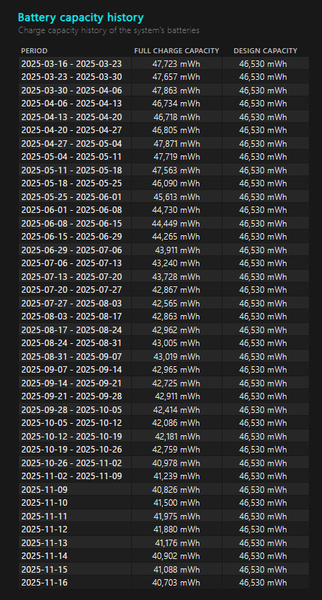
Its been less than one year on my surface pro 11 and i was feeling like the battery was not lasting as long as stated and also lagging at some points. When I did the battery health check it showed that it had dropped around 13% from design capacity. Is this normal and should I get it repaired/replaced under warranty? Its just bit of a hassle as I am outside of the US.... Microsoft surface pro users outside of the US doesnt seem to have the proper support also, no contact and no email response from raising tickets....625Views0likes1Comment
Surface Book Keyboard battery present BUT NOT ON USE
Hello, Recently I changed keyboard battery of my surface book with performance base model. After replacement the battery is present on screen and battery reports. But it shows all the time 93%. Also I realized the device only using tablet battery and after it finished it turn off. Guarentee already finished and I don`t have any microsoft store in my country. So I need to fix myself. How can I fix this issue ?2.2KViews0likes3CommentsMicrosoft Teams triggers GPU usage MacBook Pro 16
Hi there, I have isolated that Microsoft Teams is the only application that immediately triggers the GPU to switch to the high performance profile when it's running - for no reason to be honest, Microsoft Teams should not be doing this. It causes a significant loss in battery lifetime - no matter if idling in the back or not, because the GPU is constantly used according to activity monitor. I have the MacBook Pro 16 inch model and the profile is set to automatic graphics switching to make use of the integrated graphics as much as possible - Microsoft Teams immediately switches on the GPU on launch. Cheers, TakeoSolved11KViews0likes2Comments