azure networking
129 TopicsWired for Hybrid - What's New in Azure Networking - July 2023 Edition
Hello Folks, Azure Networking is the foundation of your infrastructure in Azure. Each month we bring you an update on What’s new in Azure Networking. In this blog post, we’ll cover what's new with Azure Networking in June 2023. In this blog post, we will cover the following announcements and how they can help you. Azure’s cross-region Load Balancer Updated default TLS policy for Azure Application Gateway Always Serve for Azure Traffic Manager Azure Virtual Network encryption Enjoy!38KViews1like0CommentsAzure Front Door: Implementing lessons learned following October outages
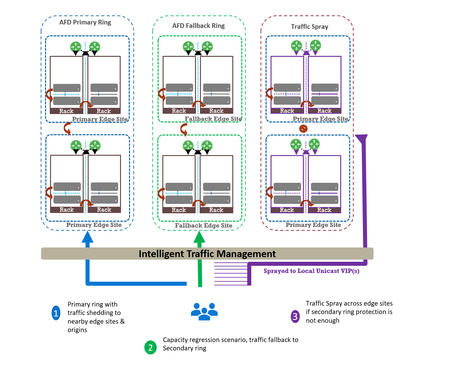
Abhishek Tiwari, Vice President of Engineering, Azure Networking Amit Srivastava, Principal PM Manager, Azure Networking Varun Chawla, Partner Director of Engineering Link to Part 2 - Azure Front Door Resiliency Series Link to Part 3 - Azure Front Door Resiliency Series Introduction Azure Front Door is Microsoft's advanced edge delivery platform encompassing Content Delivery Network (CDN), global security and traffic distribution into a single unified offering. By using Microsoft's extensive global edge network, Azure Front Door ensures efficient content delivery and advanced security through 210+ global and local points of presence (PoPs) strategically positioned closely to both end users and applications. As the central global entry point from the internet onto customer applications, we power mission critical customer applications as well as many of Microsoft’s internal services. We have a highly distributed resilient architecture, which protects against failures at the server, rack, site and even at the regional level. This resiliency is achieved by the use of our intelligent traffic management layer which monitors failures and load balances traffic at server, rack or edge sites level within the primary ring, supplemented by a secondary-fallback ring which accepts traffic in case of primary traffic overflow or broad regional failures. We also deploy a traffic shield as a terminal safety net to ensure that in the event of a managed or unmanaged edge site going offline, end user traffic continues to flow to the next available edge site. Like any large-scale CDN, we deploy each customer configuration across a globally distributed edge fleet, densely shared with thousands of other tenants. While this architecture enables global scale, it carries the risk that certain incompatible configurations, if not contained, can propagate broadly and quickly which can result in a large blast radius of impact. Here we describe how the two recent service incidents impacting Azure Front Door have reinforced the need to accelerate ongoing investments in hardening our resiliency, and tenant isolation strategy to mitigate likelihood and the scale of impact from this class of risk. October incidents: recap and key learnings Azure Front Door experienced two service incidents; on October 9 th and October 29 th , both with customer-impacting service degradation. On October 9 th : A manual cleanup of stuck tenant metadata bypassed our configuration protection layer, allowing incompatible metadata to propagate beyond our canary edge sites. This metadata was created on October 7 th , from a control-plane defect triggered by a customer configuration change. While the protection system initially blocked the propagation, the manual override operation bypassed our safeguards. This incompatible configuration reached the next stage and activated a latent data-plane defect in a subset of edge sites, causing availability impact primarily across Europe (~6%) and Africa (~16%). You can learn more about this issue in detail at https://aka.ms/AIR/QNBQ-5W8 On October 29 th : A different sequence of configuration changes across two control-plane versions produced incompatible metadata. Because the failure mode in the data-plane was asynchronous, the health checks validations embedded in our protection systems were all passed during the rollout. The incompatible customer configuration metadata successfully propagated globally through a staged rollout and also updated the “last known good” (LKG) snapshot. Following this global rollout, the asynchronous process in data-plane exposed another defect which caused crashes. This impacted connectivity and DNS resolutions for all applications onboarded to our platform. Extended recovery time amplified impact on customer applications and Microsoft services. You can learn more about this issue in detail at https://aka.ms/AIR/YKYN-BWZ We took away a number of clear and actionable lessons from these incidents, which are applicable not just to our service, but to any multi-tenant, high-density, globally distributed system. Configuration resiliency – Valid configuration updates should propagate safely, consistently, and predictably across our global edge, while ensuring that incompatible or erroneous configuration never propagate beyond canary environments. Data plane resiliency - Additionally, configuration processing in the data plane must not cause availability impact to any customer. Tenant isolation – Traditional isolation techniques such as hardware partitioning and virtualization are impractical at edge sites. This requires innovative sharding techniques to ensure single tenant-level isolation – a must-have to reduce potential blast radius. Accelerated and automated recovery time objective (RTO) – System should be able to automatically revert to last known good configuration in an acceptable RTO. In case of a service like Azure Front Door, we deem ~10 mins to be a practical RTO for our hundreds of thousands of customers at every edge site. Post outage, given the severity of impact which allowed an incompatible configuration to propagate globally, we made the difficult decision to temporarily block configuration changes in order to expedite rollout of additional safeguards. Between October 29 th to November 5 th , we prioritized and deployed immediate hardening steps before opening up the configuration change. We are confident that the system is stable, and we are continuing to invest in additional safeguards to further strengthen the platform's resiliency. Learning category Goal Repairs Status Safe customer configuration deployment Incompatible configuration never propagates beyond Canary · Control plane and data plane defect fixes · Forced synchronous configuration processing · Additional stages with extended bake time · Early detection of crash state Completed Data plane resiliency Configuration processing cannot impact data plane availability Manage data-plane lifecycle to prevent outages caused by configuration-processing defects. Completed Isolated work-process in every data plane server to process and load the configuration. January 2026 100% Azure Front Door resiliency posture for Microsoft internal services Microsoft operates an isolated, independent Active/Active fleet with automatic failover for critical Azure services Phase 1: Onboarded critical services batch impacted on Oct 29 th outage running on a day old configuration Completed Phase 2: Automation & hardening of operations, auto-failover and self-management of Azure Front Door onboarding for additional services March 2026 Recovery improvements Data plane crash recovery in under 10 minutes Data plane boot-up time optimized via local cache (~1 hour) Completed Accelerate recovery time < 10 minutes March 2026 Tenant isolation No configuration or traffic regression can impact other tenants Micro cellular Azure Front Door with ingress layered shards June 2026 This blog is the first in a multi-part series on Azure Front Door resiliency. In this blog, we will focus on configuration resiliency—how we are making the configuration pipeline safer and more robust. Subsequent blogs will cover tenant isolation and recovery improvements. How our configuration propagation works Azure Front Door configuration changes can be broadly classified into three distinct categories. Service code & data – these include all aspects of Azure Front Door service like management plane, control plane, data plane, configuration propagation system. Azure Front Door follows a safe deployment practice (SDP) process to roll out newer versions of management, control or data plane over a period of approximately 2-3 weeks. This ensures that any regression in software does not have a global impact. However, latent bugs that escape pre-validation and SDP rollout can remain undetected until a specific combination of customer traffic patterns or configuration changes trigger the issue. Web Application Firewall (WAF) & L7 DDoS platform data – These datasets are used by Azure Front Door to deliver security and load-balancing capabilities. Examples include GeoIP data, malicious attack signatures, and IP reputation signatures. Updates to these datasets occur daily through multiple SDP stages with an extended bake time of over 12 hours to minimize the risk of global impact during rollout. This dataset is shared across all customers and the platform, and it is validated immediately since it does not depend on variations in customer traffic or configuration steps. Customer configuration data – Examples of these are any customer configuration change—whether a routing rule update, backend pool modification, WAF rule change, or security policy change. Due to the nature of these changes, it is expected across the edge delivery / CDN industry to propagate these changes globally in 5-10 mins. Both outages stemmed from issues within this category. All configuration changes, including customer configuration data, are processed through a multi-stage pipeline designed to ensure correctness before global rollout across Azure Front Door’s 200+ edge locations. At a high level, Azure Front Door’s configuration propagation system has two distinct components - Control plane – Accepts customer API/portal changes (create/update/delete for profiles, routes, WAF policies, origins, etc.) and translates them into internal configuration metadata which the data plane can understand. Data plane – Globally distributed edge servers that terminate client traffic, apply routing/WAF logic, and proxy to origins using the configuration produced by the control plane. Between these two halves sits a multi-stage configuration rollout pipeline with a dedicated protection system (known as ConfigShield): Changes flow through multiple stages (pre-canary, canary, expanding waves to production) rather than going global at once. Each stage is health-gated: the data plane must remain within strict error and latency thresholds before proceeding. Each stage’s health check also rechecks previous stage’s health for any regressions. A successfully completed rollout updates a last known good (LKG) snapshot used for automated rollback. Historically, rollout targeted global completion in roughly 5–10 minutes, in line with industry standards. Customer configuration processing in Azure Front Door data plane stack Customer configuration changes in Azure Front Door traverse multiple layers—from the control plane through the deployment system—before being converted into FlatBuffers at each Azure Front Door node. These FlatBuffers are then loaded by the Azure Front Door data plane stack, which runs as Kubernetes pods on every node. FlatBuffer Composition: Each FlatBuffer references several sub-resources such as WAF and Rules Engine schematic files, SSL certificate objects, and URL signing secrets. Data plane architecture: o Master process: Accepts configuration changes (memory-mapped files with references) and manages the lifecycle of worker processes. o Workers: L7 proxy processes that serve customer traffic using the applied configuration. Processing flow for each configuration update: Load and apply in master: The transformed configuration is loaded and applied in the master process. Cleanup of unused references occurs synchronously except for certain categories à October 9 outage occurred during this step due to a crash triggered by incompatible metadata. Apply to workers: Configuration is applied to all worker processes without memory overhead (FlatBuffers are memory-mapped). Serve traffic: Workers start consuming new FlatBuffers for new requests; in-flight requests continue using old buffers. Old buffers are queued for cleanup post-completion. Feedback to deployment service: Positive feedback signals readiness for rollout.Cleanup: FlatBuffers are freed asynchronously by the master process after all workers load updates à October 29 outage occurred during this step due to a latent bug in reference counting logic. The October incidents showed we needed to strengthen key aspects of configuration validation, propagation safeguards, and runtime behavior. During the Azure Front Door incident on October 9 th , that protection system worked as intended but was later bypassed by our engineering team during a manual cleanup operation. During this Azure Front Door incident on October 29 th , the incompatible customer configuration metadata progressed through the protection system, before the delayed asynchronous processing task resulted in the crash. Configuration propagation safeguards Based on learnings from the incidents, we are implementing a comprehensive set of configuration resiliency improvements. These changes aim to guarantee that any sequence of configuration changes cannot trigger instability in the data plane, and to ensure quicker recovery in the event of anomalies. Strengthening configuration generation safety This improvement pivots on a ‘shift-left’ strategy where we want to ensure that we catch regression early before they propagate to production. It also includes fixing the latent defects which were the proximate cause of the outage. Fixing outage specific defects - We have fixed the control-plane defects that could generate incompatible tenant metadata under specific operation sequences. We have also remediated the associated data-plane defects. Stronger cross-version validation - We are expanding our test and validation suite to account for changes across multiple control plane build versions. This is expected to be fully completed by February 2026. Fuzz testing - Automated fuzzing and testing of metadata generation contract between the control plane and the data plane. This allows us to generate an expanded set of invalid/unexpected configuration combinations which might not be achievable by traditional test cases alone. This is expected to be fully completed by February 2026. Preventing incompatible configurations from being propagated This segment of the resiliency strategy strives to ensure that a potentially dangerous configuration change never propagates beyond canary stage. Protection system is “always-on” - Enhancements to operational procedures and tooling prevent bypass in all scenarios (including internal cleanup/maintenance), and any cleanup must flow through the same guarded stages and health checks as standard configuration changes. This is completed. Making rollout behavior more predictable and conservative - Configuration processing in the data plane is now fully synchronous. Every data plane issue due to incompatible meta data can be detected withing 10 seconds at every stage. This is completed. Enhancement to deployment pipeline - Additional stages during roll-out and extended bake time between stages serve as an additional safeguard during configuration propagation. This is completed. Recovery tool improvements now make it easier to revert to any previous version of LKG with a single click. This is completed. These changes significantly improve system safety. Post-outage we have increased the configuration propagation time to approximately 45 minutes. We are working towards reducing configuration propagation time closer to pre-incident levels once additional safeguards covered in the Data plane resiliency section below are completed by mid-January, 2026. Data plane resiliency The data plane recovery was the toughest part of recovery efforts during the October incidents. We must ensure fast recovery as well as resilience to configuration processing related issues for the data plane. To address this, we implemented changes that decouple the data plane from incompatible configuration changes. With these enhancements, the data plane continues operating on the last known good configuration—even if the configuration pipeline safeguards fail to protect as intended. Decoupling data plane from configuration changes Each server’s data plane consists of a master process which accepts configuration changes and manages lifecycle of multiple worker processes which serve customer traffic. One of the critical reasons for the prolonged outage in October was that due to latent defects in the data plane, when presented with a bad configuration the master process crashed. The master is a critical command-and-control process and when it crashes it takes down the entire data plane, in that node. Recovery of the master process involves reloading hundreds of thousands of configurations from scratch and took approximately 4.5 hours. We have since made changes to the system to ensure that even in the event of the master process crash due to any reason - including incompatible configuration data being presented - the workers remain healthy and able to serve traffic. During such an event, the workers would not be able to accept new configuration changes but will continue to serve customer traffic using the last known good configuration. This work is completed. Introducing Food Taster: strengthening config propagation resiliency In our efforts to further strengthen Azure Front Door’s configuration propagation system, we are introducing an additional configuration safeguard known internally as Food Taster which protects the master and worker processes from any configuration change related incidents, thereby ensuring data plane resiliency. The principle is simple: every data-plane server will have a redundant and isolated process – the Food Taster – whose only job is to ingest and process new configuration metadata first and then pass validated configuration changes to active data plane. This redundant worker does not accept any customer traffic. All configuration processing in this Food Taster is fully synchronous. That means we do all parsing, validation, and any expensive or risky work up front, and we do not move on until the Food Taster has either proven the configuration is safe or rejected it. Only when the Food Taster successfully loads the configuration and returns “Config OK” does the master process proceed to load the same config and then instruct the worker processes to do the same. If anything goes wrong in the Food Taster, the failure is contained to that isolated worker; the master and traffic-serving workers never see that invalid configuration. We expect this safeguard to reach production globally in January 2026 timeframe. Introduction of this component will also allow us to return closer to pre-incident level of configuration propagation while ensuring data plane safety. Closing This is the first in a series of planned blogs on Azure Front Door resiliency enhancements. We are continuously improving platform safety and reliability and will transparently share updates through this series. Upcoming posts will cover advancements in tenant isolation and improvements to recovery time objectives (RTO). We deeply value our customers’ trust in Azure Front Door. The October incidents reinforced how critical configuration resiliency is, and we are committed to exceeding industry expectations for safety, reliability, and transparency. By hardening our configuration pipeline, strengthening safety gates, and reinforcing isolation boundaries, we’re making Azure Front Door even more resilient so your applications can be too.19KViews25likes15Comments
Consistent DNS resolution in a hybrid hub spoke network topology
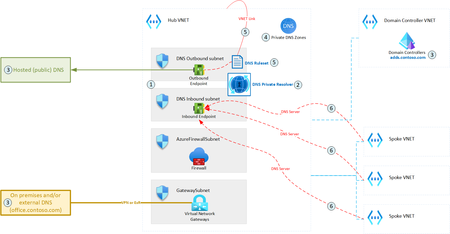
DNS is one of the most essential networking services, next to IP routing. A modern hybrid cloud network may have various sources of DNS: Azure Private DNS Zones, public DNS, domain controllers, etc. Some organizations may also prefer to route their public Internet DNS queries through a specific DNS provider. Therefore, it is crucial to ensure consistent DNS resolution across the whole (hybrid) network. This article describes how DNS Private Resolver can be leveraged to build such architecture.19KViews6likes5CommentsThe Deployment of Hollow Core Fiber (HCF) in Azure’s Network
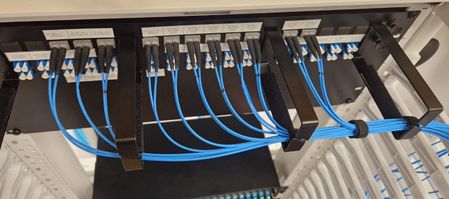
Co-authors: Jamie Gaudette, Frank Rey, Tony Pearson, Russell Ellis, Chris Badgley and Arsalan Saljoghei In the evolving Cloud and AI landscape, Microsoft is deploying state-of-the-art Hollow Core Fiber (HCF) technology in Azure’s network to optimize infrastructure and enhance performance for customers. By deploying cabled HCF technology together with HCF-supportable datacenter (DC) equipment, this solution creates ultra-low latency traffic routes with faster data transmission to meet the demands of Cloud & AI workloads. The successful adoption of HCF technology in Azure’s network relies on developing a new ecosystem to take full advantage of the solution, including new cables, field splicing, installation and testing… and Microsoft has done exactly that. Azure has collaborated with industry leaders to deliver components and equipment, cable manufacturing and installation. These efforts, along with advancements in HCF technology, have paved the way for its deployment in-field. HCF is now operational and carrying live customer traffic in multiple Microsoft Azure regions, proving it is as reliable as conventional fiber with no field failures or outages. This article will explore the installation activities, testing, and link performance of a recent HCF deployment, showcasing the benefits that Azure customers can leverage from HCF technology. HCF connected Azure DCs are ready for service The latest HCF cable deployment connects two Azure DCs in a major city, with two metro routes each over 20km long. The hybrid cables both include 32 HCF and 48 single mode fiber (SMF) strands, with HCFs delivering high-capacity Dense Wavelength Division Multiplexing (DWDM) transmission comparable to SMF. The cables are installed over two diverse paths (the red and blue lines shown in image 1), each with different entry points into the DC. Route diversity at the physical layer enhances network resilience and reliability by allowing traffic to be rerouted through alternate paths, minimizing the risk of network outage should there be a disruption. It also allows for increased capacity by distributing network traffic more evenly, improving overall network performance and operational efficiency. Image 1: Satellite image of two Azure DC sites (A & Z) within a metro region interconnected with new ultra-low latency HCF technology, using two diverse paths (blue & red) Image 2 shows the optical routing that the deployed HCF cables take through both Inside Plant (ISP) and Outside Plant (OSP), for interconnecting terminal equipment within key sites in the region (comprised of DCs, Network Gateways and PoPs). Image 2: Optical connectivity at the physical layer between DCA and DCZ The HCF OSP cables have been developed for outdoor use in harsh environments without degrading the propagation properties of the fiber. The cable technology is smaller, faster, and easier to install (using a blown installation method). Alongside cables, various other technologies have been developed and integrated to provide a reliable end-to-end HCF network solution. This includes dedicated HCF-compatible equipment (shown in image 3), such as custom cable joint enclosures, fusion splicing technology, HCF patch tails for cable termination in the DC, and a HCF custom-designed Optical Time Domain Reflectometer (OTDR) to locate faults in the link. These solutions work with commercially available transponders and DWDM technologies to deliver multi-Tb/s capacities for Azure customers. Looking more closely at a HCF cable installation, in image 4 the cable is installed by passing it through a blowing-head (1) and inserting it into pre-installed conduit in segments underground along the route. As with traditional installations with conventional cable, the conduit, cable entry/exit, and cable joints are accessible through pre-installed access chambers, typically a few hundred meters apart. The blowing head uses high-pressure air from a compressor to push the cable into the conduit. A single drum-length of cable can be re-fleeted above ground (2) at multiple access points and re-jetted (3) over several kilometers. After the cables are installed inside the conduit, they are jointed at pre-designated access chamber locations. These house the purpose designed cable joint enclosures. Image 4: Cable preparation and installation during in-field deployment Image 5 shows a custom HCF cable joint enclosure in the field, tailored to protect HCFs for reliable data transmission. These enclosures organize the many HCF splices inside and are placed in underground chambers across the link. Image 5: 1) HCF joint enclosure in a chamber in-field 2) Open enclosure showing fiber loop storage protected by colored tubes at the rear-side of the joint 3) Open enclosure showing HCF spliced on multiple splice tray layers Inside the DC, connectorized ‘plug-and-play’ HCF-specific patch tails have been developed and installed for use with existing DWDM solutions. The patch tails interface between the HCF transmission and SMF active and passive equipment, each containing two SMF compatible connectors, coupled to the ISP HCF cable. In image 6, this has been terminated to a patch panel and mated with existing DWDM equipment inside the DC. Image 6: HCF patch tail solution connected to DWDM equipment Testing To validate the end-to-end quality of the installed HCF links (post deployment and during its operation), field deployable solutions have been developed and integrated to ensure all required transmission metrics are met and to identify and restore any faults before the link is ready for customer traffic. One such solution is Microsoft’s custom-designed HCF-specific OTDR, which helps measure individual splice losses and verify attenuation in all cable sections. This is checked against rigorous Azure HCF specification requirements. The OTDR tool is invaluable for locating high splice losses or faults that need to be reworked before the link can be brought into service. The diagram below shows an OTDR trace detecting splice locations and splice loss levels (dB) across a single strand of installed HCF. The OTDR can also continuously monitor HCF links and quickly locate faults, such as cable cuts, for quick recovery and remediation. For this deployment, a mean splice loss of 0.16dB was achieved, with some splices as low as 0.04dB, comparable to conventional fiber. Low attenuation and splice loss helps to maintain higher signal integrity, supporting longer transmission reach and higher traffic capacity. There are ongoing Azure HCF roadmap programs to continually improve this. Performance Before running customer traffic on the link, the fiber is tested to ensure reliable, error-free data transmission across the operating spectrum by counting lost or error bits. Once confirmed, the link is moved into production, allowing customer traffic to flow on the route. These optical tests, tailored to HCF, are carried out by the installer to meet Azure’s acceptance requirements. Image 8 illustrates the flow of traffic across a HCF link, dictated by changing demand on capacity and routing protocols in the region, which fluctuate throughout the day. The HCF span supports varying levels of customer traffic from the point the link was made live, without incurring any outages or link flaps. A critical metric for measuring transmission performance over each HCF path is the instantaneous Pre-Forward Error Correction (FEC) Bit Error Rate (BER) level. Pre-FEC BERs measure errors in a digital data stream at the receiver before any error correction is applied. This is crucial for transmission quality when the link carries data traffic; lower levels mean fewer errors and higher signal quality, essential for reliable data transmission. The following graph (image 9) shows the evolution of the Pre-FEC BER level on a HCF span once the link is live. A single strand of HCF is represented by a color, with all showing minimal fluctuation. This demonstrates very stable Pre-FEC BER levels, well below < -3.4 (log 10 ), across all 400G optical transponders, operating over all channels during a 24-day period. This indicates the network can handle high-data transmission efficiently with no Post-FEC errors, leading to high customer traffic performance and reliability. Image 9: Very stable Pre-FEC BER levels across the HCF span over 20 days The graph below demonstrates the optical loss stability over one entire span which is comprised of two HCF strands. It was monitored continuously over 20 days using the inbuilt line system and measured in both directions to assess the optical health of the HCF link. The new HCF cable paths are live and carrying customer traffic across multiple Azure regions. Having demonstrated the end-to-end deployment capabilities and network compatibility of the HCF solution, it is possible to take full advantage of the ultra-stable, high performance and reliable connectivity HCF delivers to Azure customers. What’s next? Unlocking the full potential of HCF requires compatible, end-to-end solutions. This blog outlines the holistic and deployable HCF systems we have developed to better serve our customers. While we further integrate HCF into more Azure Regions, our development roadmap continues. Smaller cables with more fibers and enhanced systems components to further increase the capacity of our solutions, standardized and simplified deployment and operations, as well as extending the deployable distance of HCF long haul transmission solutions. Creating a more stable, higher capacity, faster network will allow Azure to better serve all its customers. Learn more about how hollow core fiber is accelerating AI. Recently published HCF research papers: Ultra high resolution and long range OFDRs for characterizing and monitoring HCF DNANFs Unrepeated HCF transmission over spans up to 301.7km14KViews10likes1CommentMicrosoft Azure scales Hollow Core Fiber (HCF) production through outsourced manufacturing
Introduction As cloud and AI workloads surge, the pressure on datacenter (DC), Metro and Wide Area Network (WAN) networks has never been greater. Microsoft is tackling the physical limits of traditional networking head-on. From pioneering research in microLED technologies to deploying Hollow Core Fiber (HCF) at global scale, Microsoft is reimagining connectivity to power the next era of cloud networking. Azure’s HCF journey has been one of relentless innovation, collaboration, and a vision to redefine the physical layer of the cloud. Microsoft’s HCF, based on the proprietary Double Nested Antiresonant Nodeless Fiber (DNANF) design, delivers up to 47% faster data transmission and approximately 33% lower latency compared to conventional Single Mode Fiber (SMF), bringing significant advantages to the network that powers Azure. Today, Microsoft is announcing a major milestone: the industrial scale-up of HCF production, powered by new strategic manufacturing collaborations with Corning Incorporated (Corning) and Heraeus Covantics (Heraeus). These collaborations will enable Azure to increase the global fiber production of HCF to meet the demands of the growing network infrastructure, advancing the performance and reliability customers expect for cloud and AI workloads. Real-world benefits for Azure customers Since 2023, Microsoft has deployed HCF across multiple Azure regions, with production links meeting performance and reliability targets. As manufacturing scales, Azure plans to expand deployment of the full end-to-end HCF network solution to help increase capacity, resiliency, and speed for customers, with the potential to set new benchmarks for latency and efficiency in fiber infrastructure. Why it matters Microsoft’s proprietary HCF design brings the following improvements for Azure customers: Increased data transmission speeds with up to 33% lower latency. Enhanced signal performance that improves data transmission quality for customers. Improved optical efficiency resulting in higher bandwidth rates compared to conventional fiber. How Microsoft is making it possible To operationalize HCF across Azure with production grade performance, Microsoft is: Deploying a standardized HCF solution with end-to-end systems and components for operational efficiency, streamlined network management, and reliable connectivity across Azure’s infrastructure. Ensuring interoperability with standard SMF environments, enabling seamless integration with existing optical infrastructure in the network for faster deployment and scalable growth. Creating a multinational production supply chain to scale next generation fiber production, ensuring the volumes and speed to market needed for widespread HCF deployment across the Azure network. Scaling up and out With Corning and Heraeus as Microsoft’s first HCF manufacturing collaborators, Azure plans to accelerate deployment to meet surging demand for high-performance connectivity. These collaborations underscore Microsoft’s commitment to enhancing its global infrastructure and delivering a reliable customer experience. They also reinforce Azure’s continued investment in deploying HCF, with a vision for this technology to potentially set the global benchmark for high-capacity fiber innovation. “This milestone marks a new chapter in reimagining the cloud’s physical layer. Our collaborations with Corning and Heraeus establish a resilient, global HCF supply chain so Azure can deliver a standardized, world-class customer experience with ultra-low latency and high reliability for modern AI and cloud workloads.” - Jamie Gaudette, Partner Cloud Network Engineering Manager at Microsoft To scale HCF production, Microsoft will utilize Corning’s established U.S. facilities, while Heraeus will produce out of its sites in both Europe and the U.S. "Corning is excited to expand our longtime collaboration with Microsoft, leveraging Corning’s fiber and cable manufacturing facilities in North Carolina to accelerate the production of Microsoft's Hollow Core Fiber. This collaboration not only strengthens our existing relationship but also underscores our commitment to advancing U.S. leadership in AI innovation and infrastructure. By working closely with Microsoft, we are poised to deliver solutions that meet the demands of AI workloads, setting new benchmarks for speed and efficiency in fiber infrastructure." - Mike O'Day, Senior Vice President and General Manager, Corning Optical Communications “We started our work on HCF a decade ago, teamed up with the Optoelectronics Research Centre (ORC) at the University of Southampton and then with Lumenisity prior to its acquisition. Now, we are excited to continue working with Microsoft on shaping the datacom industry. With leading solutions in glass, tube, preform, and fiber manufacturing, we are ready to scale this disruptive HCF technology to significant volumes. We’ll leverage our proven track record of taking glass and fiber innovations from the lab to widespread adoption, just as we did in the telecom industry, where approximately 2 billion kilometers of fiber are made using Heraeus products.” - Dr. Jan Vydra, Executive Vice President Fiber Optics, Heraeus Covantics Azure engineers are working alongside Corning and Heraeus to operationalize Microsoft manufacturing process intellectual property (IP), deliver targeted training programs, and drive the yield, metrology, and reliability improvements required for scaled production. The collaborations are foundational to a growing standardized, global ecosystem that supports: Glass preform/tubing supply Fiber production at scale Cable and connectivity for deployment into carrier‑grade environments Building on a foundation of innovation: Microsoft’s HCF program In 2022, Microsoft acquired Lumenisity, a spin‑out from the Optoelectronics Research Centre (ORC) at the University of Southampton, UK. That same year, Microsoft launched the world’s first state‑of‑the‑art HCF fabrication facility in the UK to expand production and drive innovation. This purpose-built site continues to support long‑term HCF research, prototyping, and testing, ensuring that Azure remains at the forefront of HCF technology. Working with industry leaders, Microsoft has developed a proven end‑to‑end ecosystem of components, equipment, and HCF‑specific hardware necessary and successfully proven in production deployments and operations. Pushing the boundaries: recent breakthrough research Today, the University of Southampton announced a landmark achievement in optical communications: in collaboration with Azure Fiber researchers, they have demonstrated the lowest signal loss ever recorded for optical fibers (<0.1 dB/km) using research-grade DNANF HCF technology (see figure 4). This breakthrough, detailed in a research paper published in Nature Photonics earlier this month, paves the way for a potential revolution in the field, enabling unprecedented data transmission capacities and longer unamplified spans. ecords at around 1550nm [1] 2002 Nagayama et al. 1 [2] 2025 Sato et al. 2 [3] 2025 research-grade DNANF HCF Petrovich et al. 3 This breakthrough highlights the potential for this technology to transform global internet infrastructure and DC connectivity. Expected benefits include: Faster: Approximately 47% faster, reducing latency, powering real-time AI inference, cloud gaming and other interactive workloads. More capacity: A wider optical spectrum window enabling exponentially greater bandwidth. Future-ready: Lays the groundwork for quantum-safe links, quantum computing infrastructure, advanced sensing, and remote laser delivery. Looking ahead: Unlocking the future of cloud networking The future of cloud networking is being built today! With record-breaking [3] fiber innovations, a rapidly expanding collaborative ecosystem, and the industrialized scale to deliver next-generation performance, Azure continues to evolve to meet the demands for speed, reliability, and connectivity. As we accelerate the deployment of HCF across our global network, we’re not just keeping pace with the demands of AI and cloud, we’re redefining what’s possible. References: [1] Nagayama, K., Kakui, M., Matsui, M., Saitoh, T. & Chigusa, Y. Ultra-low-loss (0.1484 dB/km) pure silica core fibre and extension of transmission distance. Electron. Lett. 38, 1168–1169 (2002). [2] Sato, S., Kawaguchi, Y., Sakuma, H., Haruna, T. & Hasegawa, T. Record low loss optical fiber with 0.1397 dB/km. In Proc. Optical Fiber Communication Conference (OFC) 2024 Tu2E.1 (Optica Publishing Group, 2024). [3] Petrovich, M., Numkam Fokoua, E., Chen, Y., Sakr, H., Isa Adamu, A., Hassan, R., Wu, D., Fatobene Ando, R., Papadimopoulos, A., Sandoghchi, S., Jasion, G., & Poletti, F. Broadband optical fibre with an attenuation lower than 0.1 decibel per kilometre. Nat. Photon. (2025). https://doi.org/10.1038/s41566-025-01747-5 Useful Links: The Deployment of Hollow Core Fiber (HCF) in Azure’s Network How hollow core fiber is accelerating AI | Microsoft Azure Blog Learn more about Microsoft global infrastructure14KViews6likes0Comments
Hosting a Windows or Linux DHCP server in Azure for servicing remote sites or DHCP as a Service
I believe currently it is not possible to host a Windows or Linux DHCP server in Azure for servicing/managing IP address allocation to remote sites on a WAN. Does anyone know of a work around or 'DHCP as a Service' offering that is cloud based?12KViews0likes1CommentDNS best practices for implementation in Azure Landing Zones
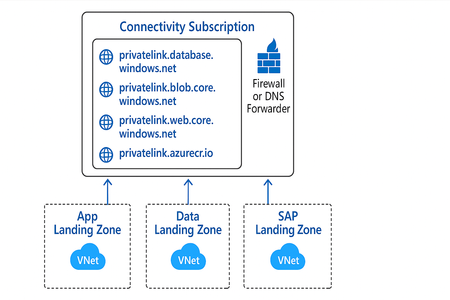
Why DNS architecture matters in Landing Zone A well-designed DNS layer is the glue that lets workloads in disparate subscriptions discover one another quickly and securely. Getting it right during your Azure Landing Zone rollout avoids painful refactoring later, especially once you start enforcing Zero-Trust and hub-and-spoke network patterns. Typical Landing-Zone topology Subscription Typical Role Key Resources Connectivity (Hub) Transit, routing, shared security Hub VNet, Azure Firewall / NVA, VPN/ER gateways, Private DNS Resolver Security Security tooling & SOC Sentinel, Defender, Key Vault (HSM) Shared Services Org-wide shared apps ADO and Agents, Automation Management Ops & governance Log Analytics, backup etc Identity Directory and auth services Extended domain controllers, Azure AD DS All five subscriptions contain a single VNet. Spokes (Security, Shared, Management, Identity) are peered to the Connectivity VNet, forming the classic hub-and-spoke. Centralized DNS with mandatory firewall inspection Objective: All network communication from a spoke must cross the firewall in the hub including DNS communication. Design Element Best-Practice Configuration Private DNS Zones Link only to the Connectivity VNet. Spokes have no direct zone links. Private DNS Resolver Deploy inbound + outbound endpoints in the Connectivity VNet. Link connectivity virtual network to outbound resolver endpoint. Spoke DNS Settings Set custom DNS servers on each spoke VNet equal to the inbound endpoint’s IPs. Forwarding Ruleset Create a ruleset, associate it with the outbound endpoint, and add forwarders: • Specific domains → on-prem / external servers • Wildcard “.” → on-prem DNS (for compliance scenarios) Firewall Rules Allow UDP/TCP 53 from spokes to Resolver-inbound, and from Resolver-outbound to target DNS servers Note: Azure private DNS zone is a global resource. Meaning single private DNS zone can be utilized to resolve DNS query for resources deployed in multiple regions. DNS private resolver is a regional resource. Meaning it can only link to virtual network within the same region. Traffic flow Spoke VM → Inbound endpoint (hub) Firewall receives the packet based on spoke UDR configuration and processes the packet before it sent to inbound endpoint IP. Resolver applies forwarding rules on unresolved DNS queries; unresolved queries leave via Outbound endpoint. DNS forwarding rulesets provide a way to route queries for specific DNS namespaces to designated custom DNS servers. Fallback to internet and NXDOMAIN redirect Azure Private DNS now supports two powerful features to enhance name resolution flexibility in hybrid and multi-tenant environments: Fallback to internet Purpose: Allows Azure to resolve DNS queries using public DNS if no matching record is found in the private DNS zone. Use case: Ideal when your private DNS zone doesn't contain all possible hostnames (e.g., partial zone coverage or phased migrations). How to enable: Go to Azure private DNS zones -> Select zone -> Virtual network link -> Edit option Ref article: https://learn.microsoft.com/en-us/azure/dns/private-dns-fallback Centralized DNS - when firewall inspection isn’t required Objective: DNS query is not monitored via firewall and DNS query can be bypassed from firewall. Link every spoke virtual directly to the required Private DNS Zones so that spoken can resolve PaaS resources directly. Keep a single Private DNS Resolver (optional) for on-prem name resolution; spokes can reach its inbound endpoint privately or via VNet peering. Spoke-level custom DNS This can point to extended domain controllers placed within identity virtual. This pattern reduces latency and cost but still centralizes zone management. Integrating on-premises active directory DNS Create conditional forwarders on each Domain Controller for every Private DNS Zone pointing it to DNS private resolver inbound endpoint IP Address. (e.g.,blob.core.windows.net database.windows.net). Do not include the literal privatelink label. Ref article: https://github.com/dmauser/PrivateLink/tree/master/DNS-Integration-Scenarios#43-on-premises-dns-server-conditional-forwarder-considerations Note: Avoid selecting the option “Store this conditional forwarder in Active Directory and replicate as follows” in environments with multiple Azure subscriptions and domain controllers deployed across different Azure environments. Key takeaways Linking zones exclusively to the connectivity subscription's virtual network keeps firewall inspection and egress control simple. Private DNS Resolver plus forwarding rulesets let you shape hybrid name resolution without custom appliances. When no inspection is needed, direct zone links to spokes cut hops and complexity. For on-prem AD DNS, the conditional forwarder is required pointing it to inbound endpoint IP, exclude privatelink name when creating conditional forwarder, and do not replicate conditional forwarder Zone with AD replication if customer has footprint in multiple Azure tenants. Plan your DNS early, bake it into your infrastructure-as-code, and your landing zone will scale cleanly no matter how many spokes join the hub tomorrow.10KViews6likes5CommentsWhat's New in Azure Networking - December Edition
Looking for the latest and greatest in Azure Networking? Not sure how new features can benefit you? Well, you've come to the right place. Pierre and I cover new Azure Networking features for you in this new blog to accompany our new series, Wired for Hybrid, on YouTube.9.6KViews3likes3Comments