accessibility
135 Topics
Help Desk Sent Me Here...Help!
I'm getting the msg in a ribbon at the top of my excel files as follows: COULDN'T VERIFY SUBSCRIPTION Excel couldn't verify your Microsoft 365 subscription. Please make sure that you're connected to the Internet. ( I am ). we've rebooted several times, uninstalled, reinstalled etc. I can open all my excel files, but can't edit or save them. All dropdowns are "grayed" out. Microsoft Help Desk sent me here.265Views0likes3Comments
Personalize PowerPoint Live with Theme, Navigation, and Notes pane controls
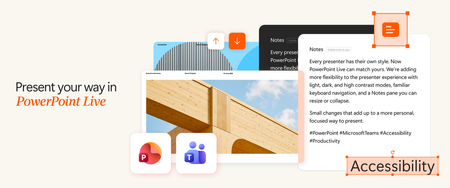
PowerPoint Live now gives presenters more ways to personalize and control their presentation experience with: light, dark, and high contrast modes up and down arrow key slide navigation a resizable Notes pane What’s new Previously, PowerPoint Live offered fewer options for customizing your presentation experience. Navigation controls were more limited, and the Notes pane always occupied valuable screen space even when you didn't need it. These updates make the PowerPoint Live experience more flexible and personalized. PowerPoint Live now supports light, dark, and high contrast modes, so you can choose the viewing experience that works best for your preferences, environment, and accessibility needs. Up and down arrow keys and Page Up and Page Down keys let you navigate slides using familiar keyboard commands and compatible presentation devices anywhere in the experience. Lastly, the resizable Notes pane lets you expand it when you need more room to read, make it smaller when you need more space for your slides, or collapse it completely when you don’t have notes to reference. Together, these improvements help PowerPoint Live adapt to your workflow, make for fewer distractions, and create a more personalized way to present. How it works How to select a theme Select the three dots (...) next to your profile picture in Teams. Settings > Appearance. Then, choose Light, Dark, Classic, or High contrast. When you begin presenting with PowerPoint Live, your theme will appear as selected. How to navigate with up and down arrow keys or Page Up / Page Down keys Start presenting your slides with PowerPoint Live. Press the down arrow key or Page Down key on your keyboard to advance through the presentation, and the up arrow key or the Page Up key to return to the previous slide. NOTE: You can also use a compatible presentation clicker that sends up and down arrow key or page up/Down commands to navigate without changing your existing presentation workflow. How to resize or collapse the Notes pane Start presenting with PowerPoint Live, and hover over the divider between the slide and the Notes pane to reveal the resize cursor. Drag the divider to make the Notes pane larger or smaller, or drag it toward the right edge of the screen to collapse it. When the Notes pane is collapsed, click the arrow or drag the resize handle to reopen it. Availability Features covered in this blog roll out over time to enable us to monitor quality and performance, so some features may not be available to you right away. Feedback We’d love to hear from you! To provide feedback on these changes, select … in the top-right corner of Teams while in a Teams meeting, then select Report a problem. For category, select Meetings - PowerPoint Live, then describe your feedback or issue and hit submit.1.1KViews3likes0CommentsUnlocking Microsoft 365 Adoption in Engineering, Manufacturing, and Regulated Industries
Executive Feedback to Microsoft Leadership: Expanding the Value of Microsoft 365 Beyond Cloud-First Workflows Executive Summary Microsoft has successfully built the industry's leading cloud collaboration ecosystem around Microsoft 365, OneDrive, and SharePoint. The strategy has delivered substantial value for information workers, distributed teams, and organizations pursuing cloud-first operating models. However, there is a significant and often overlooked customer segment that remains underserved: engineering, manufacturing, healthcare, medical device, industrial, laboratory, defense, and other regulated organizations whose primary workflows are intentionally built around file-based repositories, network shares, PDM/PLM systems, and controlled document environments. The challenge is not opposition to cloud technology. The challenge is that many of these organizations prioritize data integrity, traceability, predictability, and workflow continuity above all else. As a result, they often perceive modern Microsoft productivity capabilities such as AutoSave, coauthoring, and version history as being unnecessarily coupled to OneDrive and SharePoint. This creates an important business opportunity. Microsoft could unlock substantial additional Microsoft 365 adoption and customer goodwill by extending modern document protection and collaboration capabilities to local, network-hosted, and hybrid file environments without requiring a complete migration to OneDrive or SharePoint. This is not a request to replace cloud services. It is a request to recognize that cloud-first and file-based workflows can coexist. The Opportunity Is Larger Than It Appears Many of Microsoft's largest enterprise customers operate in environments where files are not simply documents. They are: Design history files Manufacturing records Engineering drawings Validation reports Device master records Controlled procedures Laboratory data Regulatory submissions Quality records For these organizations, file location, revision control, ownership, auditability, and retention are operational requirements rather than convenience features. Microsoft itself acknowledges that Office AutoSave currently requires files to be stored in OneDrive or SharePoint. Files opened from traditional file-system locations do not receive the same experience. As a result, many organizations feel they must choose between: Maintaining proven operational workflows. Accessing Microsoft's most advanced productivity features. That is a business decision many organizations simply refuse to make. The Real Barrier Is Not Technology. It Is Trust. Discussions around cloud adoption are often framed as a resistance-to-change problem. Research consistently suggests otherwise. Studies examining enterprise cloud adoption repeatedly identify security concerns, data privacy concerns, and control over organizational information as major barriers to adoption. One study found security concerns dramatically increased the likelihood that organizations would reject cloud adoption. Similarly, KPMG's cloud transformation research notes that concerns about data loss, audit findings, compliance issues, and operational risk can slow or limit cloud initiatives. The lesson is important: Organizations rarely reject technology because it is new. They reject technology because they do not trust it with critical business information. Once users experience: unexpected file overwrites, synchronization ambiguity, permission confusion, data residency uncertainty, conflicting document versions, trust declines rapidly. Trust, not functionality, is often the limiting factor. Engineering Users Experience the World Differently Microsoft's cloud ecosystem was largely designed around information-worker collaboration. Engineering organizations frequently operate under different assumptions: Information Worker Priority Engineering Priority Seamless sharing Data integrity Anywhere access Traceability Real-time collaboration Configuration control Ease of use Auditability Cloud accessibility Revision certainty Neither approach is wrong. The challenge is that Microsoft increasingly optimizes for one while under-serving the other. An Example: AutoSave AutoSave is one of the most valuable additions Microsoft has made to Office. The value proposition is obvious: Reduced data loss Improved productivity Lower cognitive burden Better user confidence Microsoft's own documentation describes AutoSave as continuously saving changes while users work, but only when documents reside in OneDrive or SharePoint. From Microsoft's perspective, this design is understandable. From the customer perspective, the message often becomes: "Modern document protection is available, but only if you adopt Microsoft's preferred storage architecture." Many customers view this not as a technical limitation, but as product segmentation. Microsoft Could Learn from Version Control Systems Modern software development solved multi-user document conflicts decades ago. Git was specifically designed around realities such as: multiple devices, multiple contributors, offline work, concurrent editing, conflicting changes. Critically, Git assumes conflicts are inevitable. Rather than hiding them, Git exposes conflicts and provides mechanisms to resolve them. Many engineers trust Git precisely because its behavior is transparent. By comparison, file synchronization systems often attempt to abstract away complexity. When synchronization fails, users can no longer determine: which version is authoritative, which edits are newer, what happened, who changed what. The engineering mindset is frequently: Show me the conflict. rather than Hide the conflict and make a decision on my behalf. The Untapped Hybrid Customer Much discussion around Microsoft 365 assumes organizations are either: Cloud-first, or Legacy. In reality, many enterprises are neither. Many operate as hybrid organizations and intentionally will continue to do so. Research from industry and security organizations continues to show persistent adoption of hybrid and multi-cloud architectures driven by governance, security, compliance, and operational requirements. These customers are not rejecting Microsoft. They are already paying customers. They often purchase: Microsoft 365 Windows Azure Teams Active Directory SQL Server Yet many would immediately purchase additional capabilities if Microsoft offered: Local AutoSave Office AutoSave functionality for: NTFS local storage SMB file shares NAS systems PDM-managed documents Local Version History Built-in document time travel without cloud dependence. Hybrid Collaboration Coauthoring capabilities that operate through enterprise file infrastructure. Enterprise Conflict Resolution Visualization and reconciliation of competing document changes. Network-Aware Document Protection The same confidence users experience in OneDrive without requiring migration to OneDrive. The Revenue Opportunity This is not merely a product-improvement request. It is a business opportunity. A significant portion of engineering and regulated industries remain hesitant to migrate entirely into cloud-centric document ecosystems because the perceived operational risks exceed the perceived benefits. Rather than forcing an all-or-nothing decision, Microsoft could monetize a middle path: Microsoft 365 Hybrid Collaboration A premium offering delivering: AutoSave Version History Recovery Conflict Resolution Audit Visibility for enterprise-controlled file infrastructure. Organizations that decline OneDrive adoption today may still eagerly purchase these capabilities. In effect, Microsoft could create incremental revenue from customers who are already committed to the Microsoft ecosystem but currently feel underserved by a cloud-only feature strategy. Recommendation Microsoft should stop treating file-server and network-share users as transitional users waiting to migrate. Many are not transitioning. Many have intentionally chosen architectures optimized for regulatory compliance, engineering rigor, operational control, and data governance. The future should not require choosing between: modern productivity features, and trusted enterprise workflows. The organizations building medical devices, industrial equipment, aerospace systems, manufacturing infrastructure, energy systems, and critical technologies represent some of Microsoft's most technically sophisticated and commercially valuable customers. They deserve first-class support for the workflows they intentionally operate. The opportunity is not to move every customer to the cloud. The opportunity is to bring Microsoft's best innovations to every customer, regardless of where their files live.101Views0likes0Comments
Microsoft Sign In Loop
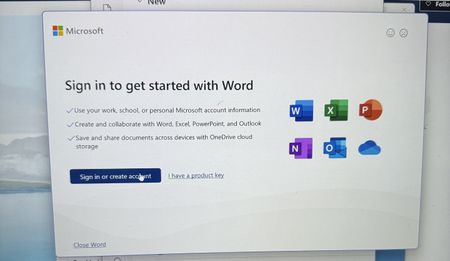
I am trying to sing into Microsoft 365, but every time I do, it takes me back to the login screen. I sing in with my outlook account, but I can't reach the applications. I can sign in on the browser, but not the applications on my computer. I have tried uninstalling and reinstalling M365, but the issue still persists389Views0likes1Comment
Word styles + semantics for accessibility
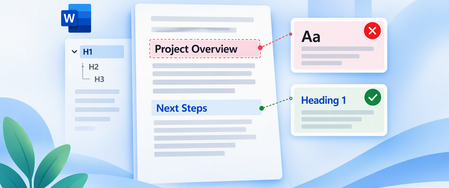
Word is the most widely used authoring tool, which makes it the best place to build accessibility in from the start. Three requests, in priority order: Show the Navigation Pane (Headings view) by default. Displaying the document's heading structure while users write makes hierarchy visible and errors easy to spot. At minimum, show Headings. Match default visual styles to semantic hierarchy. Make H1 the most prominent style, with H2, H3, and H4 each visibly a step lower. Today, Styles read as purely visual choices, so users often skip levels or fake headings for looks, producing inaccessible documents. Aligning appearance with structure would make accessible output the default. Add heading-hierarchy checks to Check Accessibility (or as a proofing-style alert). Flag more than one H1 or skipped levels (e.g., H3 not under H2), and let users fix them in one step using the styles in request #2. Also flag any fonts less than 12 points for possibly being inaccessible. Make this optional, with an IT policy toggle for organizations. Why it matters: Our organization must meet U.S. Federal Title II accessibility requirements for all web PDFs by April 26, 2027. Without an easy path, our simplest option is to remove them. If users could create properly structured Word documents and export accessible PDFs, we'd have a practical solution to share with staff and the public we serve.90Views0likes0Comments