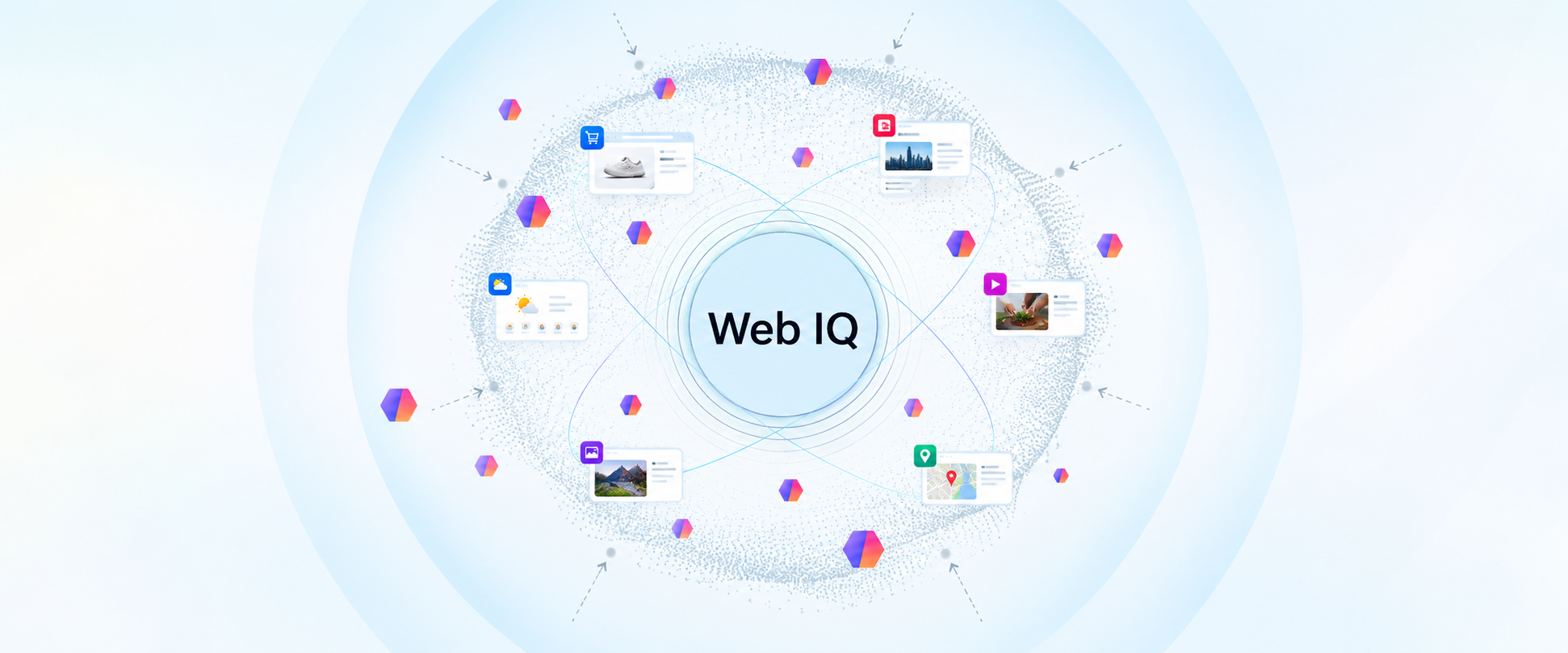
Our previous blog post covers how Web IQ retrieves web content. This post covers where to use it: five workflows where web evidence makes an AI agent’s answers more useful.
Better AI decisions start with the full picture
AI agents and applications are only as useful as the information they can access. While enterprise data provides valuable context about what's happening inside an organization, many business-critical questions also depend on what's happening outside it. From changing regulations and emerging market trends to supplier disruptions and competitive developments, agents need fresh information from the web to deliver more complete answers, make informed decisions, and take meaningful action.
Web IQ brings that external intelligence into AI agents and applications through powerful web search and grounding APIs. As the web intelligence layer of Microsoft IQ, Web IQ complements Work IQ, Fabric IQ, and Foundry IQ by connecting agents to relevant, up-to-date information from across the web. Developers can combine this external context with authorized enterprise data to build agents that understand both their organization's business and the world around it.
So what does this look like in practice? In this post, we'll explore five real-world use cases where external web intelligence helps AI agents solve business challenges, from employee-facing workflows to customer-facing experiences. Each example illustrates how Web IQ adds value and how developers can bring external grounding into their applications.
Note: The five scenarios below are hypothetical illustrations, not customer deployments or measured results.
Use case 1: Research and competitive intelligence
It’s the week before quarterly planning, and a product team wants to know what has changed in its market since the last review. Which competitors have launched something new, which have repriced, and where does any of it challenge the team’s positioning? The internal briefing deck can’t help much here. It only knows what the team already knew.
With Web IQ, the team’s research agent can pull in recent product announcements, vendor documentation and industry coverage, then compare what it finds against the last briefing and the team’s own positioning. Every change links back to its source, so the team can quickly tell a genuine new capability from a renamed bundle or an unverified claim. Analysts doing any kind of research get the same benefit: their work starts from current, sourced evidence, and they spend less time checking it.
Use case 2: Customer service for delivery questions
A customer opens a retailer’s support chat with a simple question: why hasn’t my order shipped? The order system knows there’s a delay, but not why. The reason is a port closure that has been in the news all morning, and the chatbot has no way of knowing about it on its own.
With Web IQ, the chatbot can check carrier advisories, port notices and news coverage when the customer asks, and combine what it finds with the customer’s order status. Instead of a vague “your order is delayed,” the customer gets a clear, sourced explanation and a sense of what to expect. When the evidence doesn’t support a firm answer, the chatbot says so and hands off to a person. The application can also run the same check on a schedule to catch changes, like an updated carrier advisory, and let affected customers know before they have to ask.
Use case 3: Shopping assistance for product questions
A shopper on an electronics retailer’s site is about to buy a dock and asks the store’s assistant two questions: will it work with my laptop and two monitors, and is it worth it over the older model? The catalog describes the dock well enough, but it doesn’t list every laptop the dock supports, and it doesn’t know what launched last month.
With Web IQ, the assistant can retrieve the laptop maker’s specifications, compatibility notices and recent product coverage, and pair them with the retailer’s own catalog, pricing and inventory. The shopper gets a sourced answer about what will work and what’s new, rather than a confident but wrong “yes” that turns into a return. Marketing teams can draw on the same signals to keep product pages and campaigns in step with the market.
Use case 4: Regulatory, compliance and public-sector services
A company is getting ready to launch a product in a new market, and its compliance team needs to know what has changed. New guidance, updated rules and permitting requirements are scattered across regulator and agency websites, and the team’s launch checklist was written before most of them were published.
With Web IQ, a compliance agent can find recent regulator publications, official guidance and public notices, and line them up against the company’s product plans and policies. The team gets a review packet with sources and stated effective dates, with official text kept separate from third-party commentary, so a qualified reviewer can act on changes before outdated rules become a risk. The same pattern works on the public side, too. A city could offer residents and small businesses a permitting assistant that walks a café owner through the city, county and state rules for adding outdoor seating, with a route to city staff when a case needs judgment.
Use case 5: Sales preparation and data enrichment
An account manager has a renewal meeting on Thursday. Since their last conversation, the customer has announced an acquisition and launched a new service, and none of it shows up in the account record. Walking in without that context means asking the wrong questions, or missing the right ones.
With Web IQ, a sales agent can pull in the customer’s recent announcements, market developments and relevant third-party reporting, and connect them to the account history the team already has. The account manager gets a short meeting brief with sourced discovery questions, without the agent guessing at what the customer intends. The same approach can enrich other workflows, adding published research or market context to account, product and vendor records.
Bringing the outside world in
Each of these examples comes down to the same idea: the best answer often depends on something happening outside your organization, whether that’s a competitor’s launch, a port closure, a new product or a regulatory update. Web IQ brings that outside context into the conversation and pairs it with what your business already knows, so employees and customers get answers that are current, sourced and relevant to their situation.
A good place to start is a single question your users ask today that your internal data can’t fully answer. That’s usually where Web IQ makes the biggest difference.
Resources
Resources
Additional reading:

 Microsoft