Forum Discussion

Formula Challenge: The most efficient way to generate a Number Spiral (Ulam spiral) ?
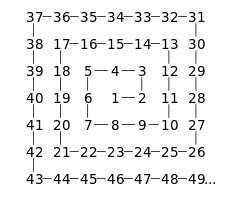

I don't know if thunks could make this better but please give this a time trial:
=LET(halfside,C2,whole,2*halfside,
x,SEQUENCE(1,whole,0),y,TRANSPOSE(x),s,SEQUENCE(1,whole,whole-2,-2),sq,s^2,s_r,SEQUENCE(1,whole,-whole+1,2),sq_r,s_r^2,
west,(sq-x+y)*(x<y)*(x<whole-y),
north,(TRANSPOSE(sq)+4*(whole-2*y-1)+y-x)*(x>=y)*(y+1<whole-x),
east,(sq_r+x-y+1)*(x>y)*(x>=whole-y-1),
south, (TRANSPOSE(sq_r-s_r)+y-whole +x+2)*(x>=whole-y)*(x<=y),
west+north+east+south)
basically I looked at the spiral as 4 quadrants (north, south, east, west) (basically the colored square by ShayCapehart but with the red including the 1 and diagnol and the yellow including the 3 and that diagnol) and each line in those quadants is a simple series with an offset from a perfect square (odd or even). I then 'mask' each quadrant and then add the 4 quadrants together. I think I could further improve the logic and math a little. maybe only calculate the relevant 1/2 of the matrix and then pad it. But even in this 'crude' form it seems to perform pretty well.

The timings show some good savings with using thunks:
Your function with thunks:
//Thunked variant

SpiralMTVariantλ=
LAMBDA(
    halfside,

LET(
    whole, 2 * halfside,
    x,     LAMBDA(SEQUENCE(1, whole, 0)),
    y,     LAMBDA(TRANSPOSE(x())),
    s,     LAMBDA(SEQUENCE(1, whole, whole - 2, -2)),

    sq,    LAMBDA(s() ^ 2),

    s_r,   LAMBDA(SEQUENCE(1, whole, -whole + 1, 2)),

    sq_r,  LAMBDA(s_r() ^ 2),

    west,  LAMBDA((sq() - x() + y()) * (x() < y()) * (x() < whole - y())),

    north, LAMBDA((TRANSPOSE(sq()) + 4 * (whole - 2 * y() - 1) +
           y() - x()) * (x() >= y()) * (y() + 1 < whole - x())),

    east,  LAMBDA((sq_r() + x() - y() + 1) * (x() > y()) * (x() >= whole - y() - 1)),
    south, LAMBDA((TRANSPOSE(sq_r() - s_r()) + y() - whole + x() + 2) *
           (x() >= whole - y()) * (x() <= y())),

    west() + north() + east() + south()
));
- m_tarlerMar 10, 2026Silver Contributor
very nice. you didn't push it to the 51,854,401 elements you tested below but my testing seemed to perform very well but different machines and all, so wasn't sure. As for the Thunks, it seems to be like a 15% savings. I would be curious to see how much savings I could get from removing the 1/2 matrix on each quadrant that I mask out anyhow.