Forum Discussion

Patrick2788
Jul 18, 2023Silver Contributor
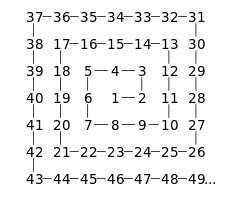
Formula Challenge: The most efficient way to generate a Number Spiral (Ulam spiral) ?
The goal: Ulam spiral - Wikipedia The trick is creating a function capable of producing the largest matrix of numbers possible (this may rule out the recursive approach). The approach ...

Patrick2788
Mar 09, 2026Silver Contributor
I thought it would be interesting to use the Ulam Spiral to demonstrate 2D element-wise rotation within rings.
I was curious what this solution would look like in Excel. The most practical function used within is simple ring extraction from a 2D array. I can't think of any other use cases for the rotational parts. It was something I had visualized and had to complete it regardless of practicality.
//  Author:     Patrick H.
//  Date:       2/26/2026

//  Title:      Rotate2Dλ Demonstration

/*
    This demonstration illustrates how Excel’s formula language is expressive
    enough to implement a full 2D rotational engine - a small example of
    Excel’s computational completeness.


    The larger task can be broken into smaller, solvable tasks:

    Extract ring by layer from a 2D grid - Ringλ
                        |
                        |
    Rotate each ring with recursion (Clockwise or Reverse) RingRotateλ, RingRotateRevλ
                        |
                        |
    Iterate through all rings in a 2D array and rotate - Rotate2Dλ

    ** Rotate2Dλ calls RingRotateλ or RingRotateRevλ, which call Ringλ **


Examples:

A ring is a perimeter layer of the grid: the outermost cells form ring 1,
the next layer inward is ring 2, and so on.


Letters is comprised of 3 rings
	A	B	C	D	E
	F	G	H	I	J
	K	L	M	N	O
	P	Q	R	S	T
	U	V	W	X	Y

	Clockwise rotation by ring
	=Rotate2Dλ(Letters,1)
	F	A	B	C	D
	K	L	G	H	E
	P	Q	M	I	J
	U	R	S	N	O
	V	W	X	Y	T

	Reverse rotation by ring
	=Rotate2Dλ(Letters,1,1)
	B	C	D	E	J
	A	H	I	N	O
	F	G	M	S	T
	K	L	Q	R	Y
	P	U	V	W	X

*/
//-----------------------------------------------------------------------------------
//  Rotate2Dλ
//-----------------------------------------------------------------------------------
//  Author:      Patrick H.
//  Date:        2/18/2026
//  Version:     1.0
//
//  Description:
//      Rotates all layers (rings) of a 2D grid by a specified number of rotations,
//      either clockwise or counterclockwise. Rotation counts are optimized based on
//      the perimeter of the outer ring so that no more rotation steps are performed
//      than mathematically necessary.
//
//      Example:
//          For a 10×10 grid with 500 requested rotations:
//
//              MOD(500, (10*2 + 10*2) - 4) = 32
//
//          Only 32 effective rotations are required to produce the final state.
//
//  Parameters:
//      grid        – Required 2D array representing the full grid.
//      [rotations] – Optional number of rotations. Defaults to 1 if omitted.
//                    Negative or non-numeric values are treated as invalid.
//      [reverse]   – Optional Boolean. If TRUE, rotates each ring in the reverse
//                    (counterclockwise) direction. If omitted, rotation is clockwise.
//
//  Notes:
//      • This wrapper applies rotation optimization globally. Each ring receives the
//        same effective rotation count.
//      • Literal rotation behavior is handled by RingRotateλ and RingRotateRevλ.
//      • Degenerate rings (1×N, N×1, 2×N, etc.) are safely handled within the ring
//        rotation functions via Ringλ and Squeezeλ.
//
//  Lambdas called:
//      RingRotateλ, RingRotateRevλ
//      (Ringλ and Squeezeλ are called internally by those functions.)


Rotate2Dλ=
LAMBDA(
    grid,
    [rotations],
    [reverse],
LET(
    //Dimensions
    h,             ROWS(grid),     w,  COLUMNS(grid),

    //Set rotation count
    rotations,     IF(ISOMITTED(rotations),1,rotations),

    //No-rotation scenarios
    IsScalar?,     AND(h = 1,w = 1),
    IsID?,         XOR(h = 1, w = 1),

    //Halting scenario
    InvalidRot?,   OR(ISTEXT(rotations),rotations <= 0),

    //Logic gate
    IF(IsScalar?,grid,
        IF(IsID?,grid,
            IF(InvalidRot?,"#ROTATION!",
LET(
    //How many rotations are needed?
    passes,        MOD(rotations,(h*2 + w*2) - 4),

    //Set rotation function
    IsClockwise?,  OR(ISOMITTED(reverse),reverse = FALSE),
    Rotateλ,       IF(IsClockwise?,RingRotateλ,RingRotateRevλ),

    //Ring count layers
    layers,        (MIN(h,w) + 1) / 2,
    k,             SEQUENCE(layers),

    //Rotate each layer of 2D array
    Iterateλ,      LAMBDA(acc,each_layer,Rotateλ(acc,each_layer,passes)),
    rotated,       REDUCE(grid,k,Iterateλ),
    rotated
))))));


//-----------------------------------------------------------------------------------
//  RingRotateRevλ
//-----------------------------------------------------------------------------------
//  Author:      Patrick H.
//  Date:        2/18/2026
//  Version:     1.0
//
//  Description:
//      Rotates a single ring (layer) of a 2D grid in the reverse (counterclockwise)
//      direction while preserving the grid’s shape. The function accepts a source
//      grid, a target layer index, and an optional rotation count. The returned grid
//      matches the dimensions of the input grid.
//
//  Parameters:
//      grid        – Required 2D array representing the full grid.
//      layer       – Integer ≥ 1 indicating which ring to rotate.
//                    For an N×M grid, layer 1 is the outermost ring.
//                    Layers exceeding the innermost ring return the grid unchanged.
//      [rotations] – Optional number of counterclockwise rotations.
//                    Defaults to 1 if omitted. Negative or non-numeric values
//                    are treated as invalid.
//
//  Notes:
//      • This function performs literal rotation steps; it does not optimize rotation
//        counts. Optimization is handled by the Rotate2Dλ wrapper.
//      • Ring extraction is performed via Ringλ, which ensures correct handling of
//        degenerate rings (1×N, N×1, 2×N, etc.).
//      • Clockwise rotation is implemented in the companion function RingRotateλ.
//
//  Lambdas called:
//      Ringλ, Squeezeλ

RingRotateRevλ=
LAMBDA(
    grid,
    layer,
    [rotations],
LET(
    //Set rotations and validate
    rotations,   IF(ISOMITTED(rotations),1,rotations),
    InvalidRot?, OR(ISTEXT(rotations),rotations < 0),

    //Mesh grid
    i,           MGridλ(grid),     j,  MGridλ(grid,1),

    //Max dimensions
    h,           ROWS(grid),       w,  COLUMNS(grid),

    //Ring extracted
    ring,        Ringλ(grid,layer,""),

    //Ring without padding to detect 1D layers
    squeezed,    Squeezeλ(ring,""),

    //No rotation scenarios
    Is1D?,       OR(ROWS(squeezed) = 1,COLUMNS(squeezed) = 1),
    Two_x_Two,   AND(ROWS(ring) = 2, COLUMNS(ring) = 2),
    traversed,   IF(Two_x_Two,Traverseλ(ring,3),FALSE),

    IF(InvalidRot?,"#ROTATIONS!",
        IF(Is1D?,grid,
            IF(Two_x_Two,traversed,

LET(
    //Identify ring parts for i/j offsets
    occupied?, LEN(ring) <> 0,

    //Clockwise masks
    top,       occupied? * (i = layer) * (j <= w - layer),
    left,      occupied? * (j = layer) *  (i > layer) * (i <= h - layer + 1),
    right,     occupied? * (j = w - layer + 1) * (i >= layer) * (i < h - layer + 1),
    bottom,    occupied? * (i = h - layer + 1) * (j > layer) * (j <= w - layer + 1),

    //Local navigation function ↑↓←

    Decideλ,   LAMBDA(
                    logic1,true1,
                    logic2,true2,
                    logic3,true3,
                    logic4,true4,
                    fallback,       // 0 for non-ring elements
                    IF(logic1,true1,IF(logic2,true2,IF(logic3,true3,IF(logic4,true4,fallback))))),

    //Indices
    r,         i + Decideλ(top,0,
                           bottom,0,
                           left,-1,
                           right,1,0),

    c,         j + Decideλ(top,1,
                           bottom,-1,
                           left,0,
                           right,0,0),

    rotated,   INDEX(grid,r,c),
    IF(rotations = 0,grid, RingRotateRevλ(rotated,layer,rotations - 1)
)))))));


//-----------------------------------------------------------------------------------
//  RingRotateλ
//-----------------------------------------------------------------------------------
//  Author:      Patrick H.
//  Date:        2/18/2026
//  Version:     1.0
//
//  Description:
//      Rotates a single ring (layer) of a 2D grid while preserving the grid’s shape.
//      The function accepts a source grid, a target layer index, and an optional
//      rotation count.
//
//  Parameters:
//      grid        – Required 2D array
//      layer       – Integer ≥ 1 indicating which ring to rotate.
//                    For an N×M grid, layer 1 is the outermost ring.
//                    Layers exceeding the innermost ring return the grid unchanged.
//      [rotations] – Optional number of clockwise rotations. Defaults to 1 if omitted.
//                    Negative or non-numeric values are treated as invalid.
//
//  Notes:
//      • This function performs literal rotation steps; it does not optimize rotation
//        counts. Optimization is handled by the Rotate2Dλ wrapper.
//      • Ring extraction is performed via Ringλ, which ensures correct handling of
//        degenerate rings (1×N, N×1, 2×N, etc.).
//      • Reverse rotation is implemented in the companion function RingRotateRevλ.
//
//  Lambdas called:
//      Ringλ, Squeezeλ


RingRotateλ=
LAMBDA(
    grid,
    layer,
    [rotations],
LET(
    //Set rotations and validate
    rotations,   IF(ISOMITTED(rotations),1,rotations),
    InvalidRot?, OR(ISTEXT(rotations),rotations < 0),

    //Mesh grid
    i,           MGridλ(grid),     j,  MGridλ(grid,1),

    //Max dimensions
    h,           ROWS(grid),       w,  COLUMNS(grid),

    //Ring extracted
    ring,        Ringλ(grid,layer,""),

    //Ring without padding to detect 1D layers
    squeezed,    Squeezeλ(ring,""),

    //No rotation scenarios
    Is1D?,       OR(ROWS(squeezed) = 1,COLUMNS(squeezed) = 1),
    Two_x_Two,   AND(ROWS(ring) = 2, COLUMNS(ring) = 2),
    traversed,   IF(Two_x_Two,Traverseλ(ring,3),FALSE),

    IF(InvalidRot?,"#ROTATIONS!",
        IF(Is1D?,grid,
            IF(Two_x_Two,traversed,

LET(
    //Identify ring parts for i/j offsets
    occupied?, LEN(ring) <> 0,

    //Clockwise masks
    top,       occupied? * (i = layer) * (j > layer) * (j <= w - layer + 1),
    left,      occupied? * (j = layer) * (i >= layer) * (i < h - layer + 1),
    right,     occupied? * (j = w - layer + 1) * (i >= layer + 1) * (i <= h - layer + 1),
    bottom,    occupied? * (i = h - layer + 1) * (j >= layer) * (j < w - layer + 1),

    //Local navigation function ↑↓←

    Decideλ,   LAMBDA(
                    logic1,true1,
                    logic2,true2,
                    logic3,true3,
                    logic4,true4,
                    fallback,       // 0 for non-ring elements
                    IF(logic1,true1,IF(logic2,true2,IF(logic3,true3,IF(logic4,true4,fallback))))),

    //Indices
    r,         i + Decideλ(top,0,
                           bottom,0,
                           left,1,
                           right,-1,0),

    c,         j + Decideλ(top,-1,
                           bottom,1,
                           left,0,
                           right,0,0),

    rotated,   INDEX(grid,r,c),
    IF(rotations = 0,grid,RingRotateλ(rotated,layer,rotations - 1))
))))));


//-----------------------------------------------------------------------------------
//  Ringλ
//-----------------------------------------------------------------------------------
//  Author:      Patrick H.
//  Date:        2/17/2026
//  Version:     1.0
//
//  Description:
//      Extracts a single ring (layer) from a 2D grid while preserving the overall
//      shape of the grid. The ring is identified by its layer index, where layer 1
//      corresponds to the outermost perimeter and higher layers move inward. The
//      returned array matches the dimensions of the input grid, with all non-ring
//      cells filled using the specified fill value.
//
//  Parameters:
//      grid         – Required 2D array representing the full grid.
//      layer        – Integer ≥ 1 specifying which ring to extract.
//                     For an N×M grid, layer 1 is the outermost ring.
//                     Layers exceeding the innermost ring return an empty array.
//      [fill_value] – Optional scalar used to fill all non-ring cells in the output.
//                     Defaults to 0 if omitted.
//
//  Notes:
//      • This function performs no rotation; it only extracts the ring mask.
//      • Degenerate rings (1×N, N×1, 2×N, etc.) are preserved exactly as extracted.
//      • RingRotateλ and RingRotateRevλ rely on Ringλ to correctly identify ring
//        boundaries before performing rotation.
//      • The output always matches the dimensions of the input grid.
//
//  Used by:
//      RingRotateλ, RingRotateRevλ


Ringλ=
LAMBDA(
    grid,
    layer,
    [fill_value],

LET(
    //Dimensions
    h,  ROWS(grid),         w,  COLUMNS(grid),

    //Validation check
    IsScalar?,     AND(h = 1, w = 1),
    Is1D?,         OR(h = 1, w = 1),
    InvalidLayer?, OR(ISTEXT(layer),layer <= 0),
    MaxLayer,      INT((MIN(h,w) + 1) / 2),

    //Logic gate
    IF(IsScalar?,grid,
        IF(Is1D?,"#1D-ARRAY!",
            IF(InvalidLayer?,"#LAYER!",
                IF(Layer > MaxLayer,"#MAX-LAYER: "&MaxLayer,

LET(
    //Optional fill value
    fill_value, IF(ISOMITTED(fill_value),0,fill_value),

    //Mesh grid
    i,  MGridλ(grid),   j,  MGridλ(grid,1),

    //Edges of ring
    top,    ((i = layer) + (i = 1 + h - layer)) *
            ((j > layer - 1) * (j <= 1 + w - layer)) ,

    side,   ((j = layer) + (j = 1 + w - layer)) *
            ((i > layer - 1) * (i <= 1 + h - layer)),

    // 1/0 ring mask
    mask,   SIGN(top + side),
    final,  IF(mask,grid,fill_value),
    final

)))))));


//---Utilities---


//-----------------------------------------------------------------------------------
//  MGridλ
//-----------------------------------------------------------------------------------
//  Author:     Patrick H.
//  Date:       2026‑02‑09
//  Version:    1.0
//
//  Description:
//      Generates row‑index or column‑index grids matching the shape of a supplied
//      array. This is the Excel equivalent of MATLAB’s meshgrid or NumPy’s indices.
//      By default, MGridλ returns row indices. When the optional parameter is TRUE,
//      it returns column indices instead.
//
//  Parameters:
//      grid        – A 1D or 2D array whose dimensions determine the output size.
//      [col_index] – If TRUE, return column indices. If omitted, return row indices.
//
//  Example:
//      Input grid:
//          {1,2,3;
//           4,5,6;
//           7,8,9}
//
//      =MGridλ(grid)
//          {1,1,1;
//           2,2,2;
//           3,3,3}
//
//      =MGridλ(grid, TRUE)
//          {1,2,3;
//           1,2,3;
//           1,2,3}
//
//  Notes:
//      • Uses Resizeλ to broadcast SEQUENCE vectors across the grid dimensions.
//      • Works for both 1D and 2D arrays.
//      • Output always matches the geometry of the input grid.
//-----------------------------------------------------------------------------------


MGridλ=
LAMBDA(
    grid,[col_index],

LET(
    //Return mode
    RowIdx?,    ISOMITTED(col_index),

    //Grid dimensions
    h,          ROWS(grid), w,  COLUMNS(grid),

    //Deferred index grids
    i,          LAMBDA(Resizeλ(SEQUENCE(h),,w)),
    j,          LAMBDA(Resizeλ(SEQUENCE(,w),h)),

    //Select row or column index grid
    idx,        IF(RowIdx?,i(),j()),
    idx

));

//-----------------------------------------------------------------------------------
//  Resizeλ
//-----------------------------------------------------------------------------------
//  Author:      Patrick H.
//  Date:        2/18/2026
//  Version:     1.0
//
//  Description:
//      Repeats a 2D array vertically and/or horizontally by integer repeat counts.
//      Users may specify height, width, or both. If either parameter is omitted,
//      the omitted dimension defaults to 1. Geometry is preserved; no flattening
//      occurs.
//
//  Example:
//      Input:
//          {1,2;
//           3,4}
//
//      =Resizeλ(array, 2, 3)
//
//      Output:
//          {1,2,1,2,1,2;
//           3,4,3,4,3,4;
//           1,2,1,2,1,2;
//           3,4,3,4,3,4}
//
//  Parameters:
//      array        – Required 2D array to be repeated.
//      [height]     – Optional vertical repeat count. Defaults to 1.
//      [width]      – Optional horizontal repeat count. Defaults to 1.
//
//  Notes:
//      • Repetition is performed via index remapping, not concatenation.
//      • Output geometry is (h × height) by (w × width).
//-----------------------------------------------------------------------------------


Resizeλ=
LAMBDA(
    array,[height],[width],

LET(
    //Dimensions
    h,  ROWS(array),   w,  COLUMNS(array),

    //Omission checks
    HeightOmitted?,        ISOMITTED(height),
    WidthOmitted?,         ISOMITTED(width),
    NoHWInput?,            HeightOmitted? + WidthOmitted? = 2,

    //Default repeat counts
    height,                IF(OR(NoHWInput?,HeightOmitted?),1,height),
    width,                 IF(OR(NoHWInput?,WidthOmitted?),1,width),

    //Scenarios
    NoRepeat?,             AND(height= 1,width = 1),
    IsScalar?,             AND(h = 1, w = 1),
    ExpandScalar,          EXPAND(array,height,width,array),
    InvalidRepeat?,        OR(ISTEXT(height),ISTEXT(width),
                                OR(AND(ISNUMBER(height),height <= 0),
                                AND(ISNUMBER(width),width <= 0))),

    //Logic gate
    IF(NoRepeat?,array,

        IF(IsScalar?,ExpandScalar,

                IF(InvalidRepeat?,array,

//Proceed
LET(
    //Expanded dimensions
    k,       h * height,
    k₂,      w * width,

    //Indices - deferred
    i,       LAMBDA(1 + MOD(SEQUENCE(k,,0,),h) * SEQUENCE(,k₂,1,0)),
    j,       LAMBDA(1 + MOD(SEQUENCE(,k₂,0),w) * SEQUENCE(k,,1,0)),

    //Construct repeated array
    new_arr, INDEX(array,i(),j()),
    new_arr
))))));

//Author:   Patrick H.
//Date:     10/27/2025
//Version:  1.0
//Repo:     Please see The Diagonal Suite for a full suite of functions.

//-------------------------------------------------------------------------------------------
//Traverseλ -   counter_clockwise Axis Remapper
//-------------------------------------------------------------------------------------------

//The selected axis is remapped to the top-left traversal order.

//Accepted counter_clockwises:
//  "NE" or 1 → Northeast (↗)
//  "SE" or 2 → Southeast (↘)
//  "SW" or 3 → Southwest (↙)

//Parameters:
//array     →   2D input array (scalars not accepted)
//new_axis  →   Axis counter_clockwise ("NE", "SE", "SW" or 1–3)

Traverseλ =
LAMBDA(
    array,
    new_axis,

//Input validation
IF(OR(ROWS(array)=1,COLUMNS(array)=1),                "#2D-ARRAY!",
IF(AND(ISNUMBER(new_axis),OR(new_axis<=0,new_axis>3)),"#AXIS!",

LET(
    //Dimensions
    i,      ROWS(array),
    j,      COLUMNS(array),

    //Axis traversal indices (deferred)

    x_NE,   LAMBDA(SEQUENCE(j,,1,0)*SEQUENCE(,i)),
    y_NE,   LAMBDA(SEQUENCE(j,,j,-1)*SEQUENCE(,i,1,0)),

    x_SE,   LAMBDA(SEQUENCE(i,,i,-1)*SEQUENCE(,j,1,0)),
    y_SE,   LAMBDA(SEQUENCE(i,,j,0)+SEQUENCE(,j,0,-1)),


    x_SW,   LAMBDA(SEQUENCE(j,,i,0)+SEQUENCE(,i,0,-1)),
    y_SW,   LAMBDA(SEQUENCE(j,,1)*SEQUENCE(,i,1,0)),

    //Axis mode selection
    mode,   IF(ISNUMBER(new_axis),new_axis,
                              SWITCH(new_axis,"NE",1,"SE",2,"SW",3,1)),
    //Index selection
    x,      CHOOSE(mode,x_NE,x_SE,x_SW),
    y,      CHOOSE(mode,y_NE,y_SE,y_SW),

    //Unwrap indices and get results
    result, INDEX(array,x(),y()),
    result
))));


//-----------------------------------------------------------------------------------
// Squeezeλ
//-----------------------------------------------------------------------------------

// Description:
// Removes null and straight zero vertical or horizontal vectors from a 2D array.
// Supports optional custom criteria for removal.
//-----------------------------------------------------------------------------------
// Parameters:
// array           - array (1D or 2D) where rows or columns are removed.
// Optional parameters:
// custom_criteria - scalar criteria for removal of rows or columns.
// suppress_zeros  - Set to TRUE will replace 0s with empty "" in final result.
//-----------------------------------------------------------------------------------


Squeezeλ=
LAMBDA(
    array,
    [custom_criteria],
    [suppress_zeros],
LET(

    HideZero?,  NOT(ISOMITTED(suppress_zeros)),

    //Shape
    i,          SEQUENCE(ROWS(array)),  j,    SEQUENCE(,COLUMNS(array)),

    //Retain non-blank rows, columns. Straight zero vectors are purged.
    Keepλ,      LAMBDA(v,NOT(AND(TOCOL(v,2)=0))),

    //Custom criteria
    Customλ,    LAMBDA(v,NOT(AND(TOCOL(v,2)=custom_criteria))),

    //Function selectino
    fn,         IF(ISOMITTED(custom_criteria),Keepλ,Customλ),

    a,          TOCOL(IF(BYROW(array,fn),i,NA()),2),
    b,          TOROW(IF(BYCOL(array,fn),j,NA()),2),
    IsEmpty?,   AND(ISERROR(a),ISERROR(b)),

    //Reset shape
    x,          ROWS(a),
    y,          COLUMNS(b),

    //Mesh grid
    r,          a * SEQUENCE(,y,1,0),
    c,          b * SEQUENCE(x,,1,0),

    //Get results, suppress 0s
    result,     INDEX(array,r,c),
    result_b,   IF(result=0,"",result),

    deliver,    IF(IsEmpty?,"#EMPTY-ARRAY!",IF(HideZero?,result_b,result)),
    deliver
));
Attaching a link in case the attachment is zapped: Excel-Lambda-Playground/Rotate2Dλ Demo.xlsx at main · Patrick2788/Excel-Lambda-Playground