Forum Discussion

PeterBartholomew1
Jan 17, 2026Silver Contributor
Excel Challenge - Pivoting poorly structured data
This is from an ExcelBI challenge. I thought it may be worth while posting my solution here as a demonstration of modern Excel methods. Challenge Like many of such challenges, the natural solu...
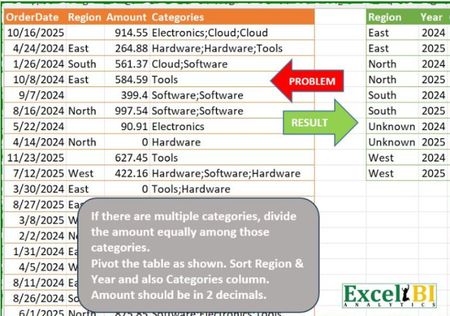
- Jan 18, 2026
This won't win the award for shortest function. I didn't set out to make a generalized function, but a modular approach using existing functions in my library allowed me to pull this together quickly.
//-----------------------------------------------------------------------------------
//PivotbyCatλ
//-----------------------------------------------------------------------------------
// Author:  Patrick H
// Date:    1/18/2026
// Description:
//   Pivot by row fields (one of which is a date), categories, and values.
//   It's presumed the categories array must be split prior to aggregation so a
//   delimiter must be specified. With optional parameters for aggregation type (function)
//   and date display (date_format).
// Parameters:
//   row_detail        - 1D Array of non-dates.
//   row_dates         - 1D Array of dates.
//   categories        - 1D Array containing category information strung together with a delimiter.
//   values            - 1D Array of numbers.
//   delimiter         - Delimiter used in the categories array.
//
// Optional Parameters:
//   [date_format]     - Format code for dates array. If omitted, defaults to "yyy".
//   [function]        - ETA or Lambda function for aggregation. If omitted, defaults to SUM.
//
// Lambdas called:      Streakλ, RepeatRowsλ


PivotbyCatλ=
LAMBDA(
    row_detail,row_dates,categories,values,delimiter,[date_format],[function],

//Validate inputs
LET(
    //Dimensions
    r₁,            ROWS(row_detail),  r₂,     ROWS(row_dates),
    r₃,            ROWS(categories),  r₄,     ROWS(values),

    //Halting scenarios
    ShapeMismatch, OR(r₁ <> r₂,r₁ <> r₃,r₁ <> r₄),

    InvalidDates,  OR(AND(ISERROR(DATEVALUE(TEXT(row_dates,date_format))),
                          ISERROR(VALUE(TEXT(row_dates,date_format)))),
                      NOT(AND(ISNUMBER(row_dates)))),

    InvalidFn,     AND(NOT(ISOMITTED(function)),
                       ISERROR(BYROW({1,1;2,2},function))),

    scenarios,     VSTACK(ShapeMismatch,InvalidDates,InvalidFn),

    errors,        {"#DIMENSIONS!";"#DATES!";"#INVALID-FUNCTION!"},

    //Logic gate
    FILTER(errors,scenarios,

//Proceed
LET(
    //Optional parameters
    fnλ,        IF(ISOMITTED(function),SUM,function),
    date_format,IF(ISOMITTED(date_format),"yyy",date_format),

    //Local functions
    CountCatλ,  LAMBDA(row,COUNTA(TEXTSPLIT(row,delimiter))),
    Parseλ,     LAMBDA(array,instance,
                       TEXTBEFORE(TEXTAFTER(delimiter&array&delimiter,
                       delimiter,instance,,,array),delimiter,,,,categories)),

    //Categories in each row
    k,          BYROW(categories,CountCatλ),

    //Indices
    i,          RepeatRowsλ(SEQUENCE(r₁),k),
    j,          Streakλ(i),

    //Row fields
    a,          RepeatRowsλ(row_detail,k),
    detail,     IF(a= 0, "Unknown",a),
    dates,      RepeatRowsλ(TEXT(row_dates,date_format),k),
    sort_key,   IFERROR(DATEVALUE(dates),VALUE(dates)),
    row_fields, HSTACK(sort_key,detail,dates),

    //Column fields
    unpack,     RepeatRowsλ(categories,k),
    categories, Parseλ(unpack,j),

    //Value field
    values,     RepeatRowsλ(values / k,k),

    //Aggregation
    agg,        DROP(PIVOTBY(row_fields,categories,values,fnλ,,0,,0),,1),
    agg
    ))));


//-----------------------------------------------------------------------------------
//Streakλ
//-----------------------------------------------------------------------------------
// Author:  Patrick H
// Date:    12/22/25
// Description:
//   Calculate streaks of consecutive values within 1D or 2D arrays.
//
// Parameters:
//   array             - Array (1D or 2D).
//
// Optional Parameters:
//   [Horizontal?]     - For 1D arrays, calculate streaks column‑wise instead of row‑wise.
//   [Include_Symbol?] - TRUE to include the symbol with streak counts (e.g., W·1, W·2, L·1).

Streakλ=
LAMBDA(
    array,[Horizontal?],[Include_Symbol?],

// Handle scalar input
IF(AND(ROWS(array)=1,COLUMNS(array)=1),array,
LET(
    //Dimensions
    i,      ROWS(array),     j,COLUMNS(array),
    Is2D?,  AND(i>1,j>1),

    //Flatten if 2D array
    array,  IF(Is2D?,TOCOL(array),array),

    //Direction for stacking
    NoDir?, ISOMITTED(Horizontal?),
    fn,     IF(NoDir?,VSTACK,HSTACK),

    //Build true/false array for streak detection
    kept,   IF(NoDir?,DROP(array,-1),DROP(array,,-1)),
    bool,   array=fn("omit",kept),

    //Accumulate streak counts
    acc,    SCAN(0,bool,LAMBDA(a,v,IF(a=0,1,IF(v,a+1,1)))),

    //Optionally include symbol with streak counts
    result, IF(ISOMITTED(Include_Symbol?),acc,
                                          array&UNICHAR(183)&acc),

    //Wrap result back to 2D if original array was 2D
    deliver,IF(Is2D?,WRAPROWS(result,j),result),

    deliver
)));

//-----------------------------------------------------------------------------------
//RepeatRowsλ
//-----------------------------------------------------------------------------------
//Author:   Patrick H.
//Date:   	11/7/2025
//Version:	1.0

//Description:
//Repeat each row in the supplied array by a corresponding repeat count.
//Arrays and scalars are supported.
//-----------------------------------------------------------------------------------
//Parameters:
//array    -    array to be repeated
//repeat   -    1D array of repeat integers

RepeatRowsλ =
LAMBDA(
    array,
    repeat,

//Check inputs
IF(OR(ISTEXT(repeat),repeat<=0),#VALUE!,

LET(
    //Flatten input
    repeat,  TOCOL(repeat),

    //Dimensions and row indexing
    A↕,      ROWS(array),  R↕,ROWS(repeat),

    r,       IF(A↕<>R↕,EXPAND(repeat,A↕,,@TAKE(repeat,-1)),
                 repeat),

    i,       SEQUENCE(ROWS(r)),

    m,       MAX(r),

    idx,     LAMBDA(TOCOL(IF(SIGN(r-SEQUENCE(,m,0))=1,i,NA()),2)),

    //Unwrap idx but defer delivery until function invocation
    deliver, LAMBDA(CHOOSEROWS(array,idx())),

    deliver
))());
Pivot by row fields (one of which is a date), categories, and values.


NikolinoDE
Jan 17, 2026Platinum Contributor
This is a very solid—and very modern—Excel solution. You’ve essentially built a small, well-thought-out transformation pipeline using LAMBDA functions.
The way you normalize the data first and only then pivot is especially elegant, and your custom BYROW approach neatly sidesteps one of Excel’s more frustrating limitations.
A great example of how far “formula-only” Excel has come, and a very instructive solution to the challenge.
Thank you for sharing it with us.