Forum Discussion

Cumulative Sum of Each Column or Row
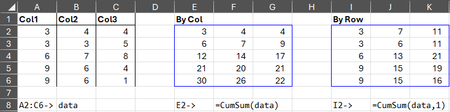
- Jan 20, 2026
While I can't speak on the technical aspects of the concept of lazy evaluation, I do feel there is a time and place for it (and this doesn't appear to be one of those times). In a recent discussion, The Diagonal Suite: Gentle thunking goes a long way!, it was suggested that using thunks to delay eager evaluation whenever possible in generalized Lambda development will always result in quicker calculation times. However, a simple Timer test shows this to not always be the case.
When testing your function as written with a large array, SEQUENCE(1000000,10), the results on my system were 3,500ms by_col and 3,000ms by_row on average (tested multiple times). I then modified the function definition by removing all 4 instances of LAMBDA(...)() and the average calculation times dropped to 2,500ms by_col and 2,000ms by_row. The formula I used to conduct the test was:
=Timer(A1,LAMBDA(x,CumSum(SEQUENCE(1000000,10),x)))...where A1 was a checkbox to toggle the by_row argument on and off.
Aside from that, it's also possible to simplify the function definition by modifying the sub-function with additional parameters to swap ROWS with COLUMNS and VSTACK with HSTACK (as well as the rows and [columns] arguments of TAKE and DROP), which will eliminate having to check IF(by_row,...) twice:
= LAMBDA(array,[by_row],
    LET(
        fn, LAMBDA(a,f₁,f₂,i,[j],IF(f₁(a)=1,a,a-f₂(0,DROP(TAKE(a,i,j),j,i)))),
        IF(
            by_row,
            fn(SCAN(0,array,SUM),ROWS,VSTACK,,-1),
            fn(TRANSPOSE(SCAN(0,TRANSPOSE(array),SUM)),COLUMNS,HSTACK,-1)
        )
    )
)
Furthermore, the check for a single row or column can also be eliminated by rearranging the order of VSTACK/HSTACK and DROP (stack first to prevent DROP from erroring):
=LAMBDA(array,[by_row],
    LET(
        fn, LAMBDA(a,fx,i,[j],a-DROP(fx(0,TAKE(a,i,j)),j,i)),
        IF(
            by_row,
            fn(SCAN(0,array,SUM),VSTACK,,-1),
            fn(TRANSPOSE(SCAN(0,TRANSPOSE(array),SUM)),HSTACK,-1)
        )
    )
)
This also shaved an additional 200ms off the average calculation times in my tests.
These are just my humble observations/suggestions. Your function is already very efficient as is. ;)
Kind regards.

While I can't speak on the technical aspects of the concept of lazy evaluation, I do feel there is a time and place for it (and this doesn't appear to be one of those times). In a recent discussion, The Diagonal Suite: Gentle thunking goes a long way!, it was suggested that using thunks to delay eager evaluation whenever possible in generalized Lambda development will always result in quicker calculation times. However, a simple Timer test shows this to not always be the case.
When testing your function as written with a large array, SEQUENCE(1000000,10), the results on my system were 3,500ms by_col and 3,000ms by_row on average (tested multiple times). I then modified the function definition by removing all 4 instances of LAMBDA(...)() and the average calculation times dropped to 2,500ms by_col and 2,000ms by_row. The formula I used to conduct the test was:
=Timer(A1,LAMBDA(x,CumSum(SEQUENCE(1000000,10),x)))...where A1 was a checkbox to toggle the by_row argument on and off.
Aside from that, it's also possible to simplify the function definition by modifying the sub-function with additional parameters to swap ROWS with COLUMNS and VSTACK with HSTACK (as well as the rows and [columns] arguments of TAKE and DROP), which will eliminate having to check IF(by_row,...) twice:
= LAMBDA(array,[by_row],
    LET(
        fn, LAMBDA(a,f₁,f₂,i,[j],IF(f₁(a)=1,a,a-f₂(0,DROP(TAKE(a,i,j),j,i)))),
        IF(
            by_row,
            fn(SCAN(0,array,SUM),ROWS,VSTACK,,-1),
            fn(TRANSPOSE(SCAN(0,TRANSPOSE(array),SUM)),COLUMNS,HSTACK,-1)
        )
    )
)
Furthermore, the check for a single row or column can also be eliminated by rearranging the order of VSTACK/HSTACK and DROP (stack first to prevent DROP from erroring):
=LAMBDA(array,[by_row],
    LET(
        fn, LAMBDA(a,fx,i,[j],a-DROP(fx(0,TAKE(a,i,j)),j,i)),
        IF(
            by_row,
            fn(SCAN(0,array,SUM),VSTACK,,-1),
            fn(TRANSPOSE(SCAN(0,TRANSPOSE(array),SUM)),HSTACK,-1)
        )
    )
)
This also shaved an additional 200ms off the average calculation times in my tests.
These are just my humble observations/suggestions. Your function is already very efficient as is. ;)
Kind regards.

It appears you made the function roughly 30% faster (it was 45% slower). Thanks a lot, and thanks for the link that provided me the means (formula) to confirm your findings.
For the fun of it, here's a naughty version of your last formula:
=LAMBDA(a,[by_row],LET(
    f,LAMBDA(a,f,i,[j],a-DROP(f(0,TAKE(a,i,j)),j,i)),
    IF(by_row,f(SCAN(0,a,SUM),VSTACK,,-1),
        f(TRANSPOSE(SCAN(0,TRANSPOSE(a),SUM)),HSTACK,-1))))
I only recently discovered that one could get away with that.
- djclementsJan 21, 2026Silver Contributor
LOL, naughty, as in recycling the same variable names, a and f, in 2 locations (especially f, which defines the sub-function name, as well as one of its arguments)? Yes, this can be done, although I typically avoid it for clarity and debugging purposes. Even recursive functions defined within LET can use the same variable for the function name, as well as its combinator, e.g. =LET(fn,LAMBDA(fn,arg,... vs =LET(fn,LAMBDA(me,arg,... but I find the latter easier to read.
Glad to have helped. Cheers!