word
737 Topics
Word - Insert Key
Why doesn't the Insert key on the keyboard do anything? It's a key on the keyboard, make use of it! Most obviously, why doesn't pressing it make it change to overtype text. Why when in tables doesn't the insert key allow you to add rows to a table where you currently are? Today I found it very painful to add more than one row to a table. Even after an internet search I didn't find an easy way quickly. Surly making use of the insert key and pressing it once per new row would be the most easy? It works like this in MS Project.41Views0likes2CommentsFinding the recycling bin on Microsoft word
I have had to go on a wild goose chase, to be quite frank with you, for the recycling bin on word. I was about to lock in and have my “academic comeback”, as the bairns say on social media platforms such as TikTok and Instagram, and I was taken off my track to find this stupid recycling bin. I am still yet to find and it and I am very unhappy, not only was google no help but so was Microsoft. 1/ Micro out of 10. Very upset need I remind you. Those special documents are now swimming in the land of the meta, in the river of the Zuckerberg and I can’t do anything about it. Get with the programme Microsoft. sincerely, disappointed.57Views0likes2Comments
Word corruption
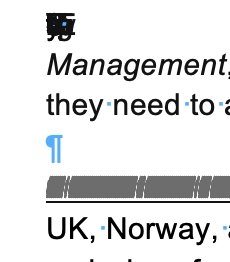
I am using Microsoft 365 on Mac running Tahoe 26.3.1. I downloaded a Google document from a client as a .docx Word document. This is something I do often. My client is also using a Mac. The Word document has corruptions in it, full lines of text are appearing as lines (like a barcode) and there seem to be letters and symbols stacked up on top of each other. Screenshots attached. I have tried saving as a .doc Word document but the corruptions are still there. If I select all of the text and change the font, the corruptions are still there. I copied the text into Text Edit and converted to plain text. The corruptions disappear in Text Edit but so does any text that was there, sentences are incomplete. If I copy and paste this plain text into a new Word document, the corruptions reappear. If I import the Plain Text into InDesign, the corruptions reappear. If I copy and paste the plain text into InDesign, the corruptions reappear. This strikes me as very odd because as far as I know Plain Text should remove any corruptions. My client says that they see no corruptions in the Word doc or in the Plain Text doc that they created. But when they send these docs in email, the corruptions are still there. I spent 4 hours with Microsoft Support yesterday trying to figure out the problem and when they couldn't figure it out, they just closed and left the chat.... I would love to let my client know what they can do to fix this on their end so that we can move forward with the project. Any suggestions are appreciated!20Views0likes0Comments
Word styles + semantics for accessibility
Word is the most widely used authoring tool, which makes it the best place to build accessibility in from the start. Three requests, in priority order: Show the Navigation Pane (Headings view) by default. Displaying the document's heading structure while users write makes hierarchy visible and errors easy to spot. At minimum, show Headings. Match default visual styles to semantic hierarchy. Make H1 the most prominent style, with H2, H3, and H4 each visibly a step lower. Today, Styles read as purely visual choices, so users often skip levels or fake headings for looks, producing inaccessible documents. Aligning appearance with structure would make accessible output the default. Add heading-hierarchy checks to Check Accessibility (or as a proofing-style alert). Flag more than one H1 or skipped levels (e.g., H3 not under H2), and let users fix them in one step using the styles in request #2. Also flag any fonts less than 12 points for possibly being inaccessible. Make this optional, with an IT policy toggle for organizations. Why it matters: Our organization must meet U.S. Federal Title II accessibility requirements for all web PDFs by April 26, 2027. Without an easy path, our simplest option is to remove them. If users could create properly structured Word documents and export accessible PDFs, we'd have a practical solution to share with staff and the public we serve.18Views0likes0Comments
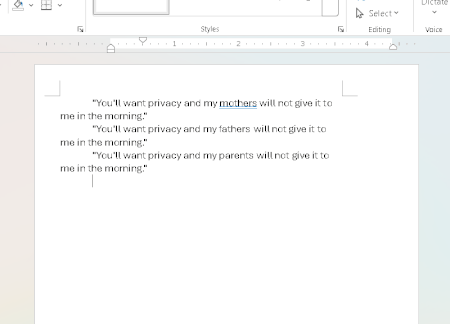
Just fix plural mothers in word, goodness this is offensive.
Apparently just asking this question required two hours of unpaid labor on my part, as well as running a fricking experiment for your guys. I just wanted to turn the rule off for this, but apparently you won't let me do this so please fix Word so it stops asking me for worse grammar. Because tech support sent me here, I already ran the experiments for you. Apparently you can have plural fathers, and parents, but not mothers, which is fricking great. Value judgements from word. The solutions make the grammar WORSE, and some people have more than one mother. It's not even cultural. Some people have a stepmother and a birth mother Persists in android as well: It's just fricking lame, and all I wanted was to be able to turn the rule causing this off as it was annoying for the project I was working on. Techsupport told me to come here, and if I am now your QA person I would like to be paid, thanks.31Views0likes1Comment
Word Mail Merge->PDF->Auto Name
I am trying to think of a way to automate a process. Part of this is in word and part with Adobe. Basically, here is the scenario. Every year all the staff in the company (about 350-400 employees) get evaluated and then their compensation is recalculated and an employment contract sent to them for the next year. The contract is in PDF form which they digitally sign and return to the company. Right now the process is like this: A spreadsheet is created with all the employee specific information. The spreadsheet data is merged with the standard employment agreement based on their title. The merge creates a different document for each employee which must then be saved (named with the employee name), converted to a PDF, and then a digital signature is requested via Adobe. I would like to automate this whole procedure. I would like to mail merge, save each document as a Word Doc and then a PDF under the employee's name. Once I have all of that, I would like to get PDF to send out all the documents via email (which will be in the spreadsheet too). I am a programmer so code does not scare me in the least. I am just not sure of the approach to take. Any thoughts? Thanks in advance.4.6KViews0likes3Comments
OneDrive files opened from Finder not recognized as cloud files on Mac
Office for Mac: OneDrive files opened from Finder no longer recognized as cloud files – AutoSave disabled Hi everyone, I am experiencing a persistent issue with Microsoft 365 for Mac and OneDrive that started suddenly around August 10, 2026. The same setup and workflow had worked without problems for more than two years before that. Problem My Office files are stored in OneDrive and synchronized to my Mac via the standard macOS File Provider. When I open an Excel or Word file by double-clicking it in Finder, the Office application opens the file, but it apparently does not recognize it correctly as a OneDrive/cloud file. For example: AutoSave is disabled real-time co-authoring does not work as expected when I try to enable AutoSave manually, Office behaves as if the file were local and asks me to upload/save it to OneDrive – even though the file is already stored and synchronized in OneDrive However, if I open the exact same file from within Excel or Word via the OneDrive/Online Locations option, everything works correctly: AutoSave is enabled immediately co-authoring works changes made by another user appear in real time This behavior is reproducible with multiple files and affects both Excel and Word, so it does not appear to be an issue with one particular workbook or application. Environment MacBook Air M2 current macOS version current Microsoft 365 version current OneDrive version OneDrive Personal files synchronized through the standard macOS File Provider I have also tested opening files directly from: ~/Library/CloudStorage/OneDrive/... The result is the same: when opened from Finder, Office does not appear to recognize the file correctly as a cloud file and AutoSave remains disabled. Troubleshooting already performed I have already: completely reset and reconfigured OneDrive allowed OneDrive to fully resynchronize verified the files and folders in OneDrive on the web confirmed that OneDrive reports everything as synchronized restarted Finder and macOS removed and recreated Finder shortcuts/favorites tested without Finder favorites or aliases tested directly from ~/Library/CloudStorage/OneDrive updated macOS updated all Microsoft 365 applications updated OneDrive None of these steps changed the behavior. Key diagnostic result The following comparison is consistently reproducible: Finder → OneDrive file → double-click → Excel/Word → AutoSave OFF → file appears not to be recognized as an active OneDrive cloud document → co-authoring does not work correctly Excel/Word → Open → OneDrive/Online Locations → same file → AutoSave ON immediately → cloud functionality works → co-authoring works correctly This suggests that OneDrive synchronization itself is functioning correctly. The issue seems specifically related to the handoff between macOS Finder / Apple File Provider / OneDrive and Microsoft 365 for Mac when a OneDrive file is opened from Finder. Important detail This is not a workflow that has never worked on macOS. For more than two years, we routinely opened our synchronized OneDrive Word and Excel files directly from Finder. Office recognized them as cloud files, AutoSave was available, and collaborative editing worked normally. The behavior changed suddenly around August 10, 2026, without us intentionally changing the OneDrive folder structure or our workflow. Question Has anyone else encountered this recently? In particular: Is this a known regression in Microsoft 365 for Mac, OneDrive for Mac, or their integration with Apple's File Provider? Why would Office recognize a file as a OneDrive cloud document when opened through the application's Online Locations, but not when the exact same synchronized file is opened from Finder? Is there a way to reset or repair the Microsoft 365/OneDrive cloud-file recognition or File Provider integration without resetting the entire OneDrive again? Are there any relevant logs, caches or diagnostics that could show why Office considers a Finder-opened OneDrive file to be local? Opening every document through the Office application's Online Locations is a possible workaround, but it is not a practical long-term solution when working with a larger shared folder structure in Finder. I have already contacted both Apple Support and Microsoft Support. Apple referred me to Microsoft, and Microsoft Support subsequently recommended that I raise the issue here in the Tech Community. Any insight from Microsoft staff, MVPs or others familiar with Microsoft 365 for Mac, OneDrive and the macOS File Provider would be greatly appreciated.1.2KViews7likes8Comments