transactable apps
222 TopicsSolving cloud challenges with Canonical and Microsoft Azure through Linux and open-source solutions
In this guest blog post, Jehudi Castro-Sierra, Public Cloud Alliances Director at Canonical, examines the technical and strategic benefits of deploying Ubuntu Pro 24.04 LTS and explains how Canonical and Microsoft Azure are working together to provide scalable and flexible infrastructure for enterprises and developers and drive increased automation and security, cost optimization, and sustainable IT practices.1.2KViews9likes0CommentsMonetize your AI apps and agents on Marketplace to realize growth
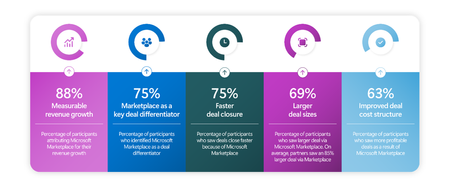
Ready to stop guessing how to monetize your offer? Skip right to App Advisor Software development companies are building faster than ever. But when it comes to sales, the key to monetization happens early. Monetization, packaging, and operational execution helps determine whether your AI solution becomes a growth engine on Microsoft Marketplace. New data reinforces the opportunity. According to Omdia research highlighted in Microsoft’s blog on the partner revenue opportunity: 88% of partners selling through Marketplace report revenue growth, 75% close deals faster, 69% secure larger deals, 60% agree Marketplace improved their deal structure. The Omdia study found that among partners that sell through Marketplace (compared to direct go-to-market and sales motions), they saw incredible gains with Marketplace. The opportunity is clear. The question is how to capture it consistently. How the AI app and agent monetization checklist helps The time to think about sales is when you’re building, not just when you hit “publish” on an offer. That’s why the Microsoft Marketplace Monetization Checklist for SaaS and Container Offers was created as part of the AI envisioning sessions. It gives your team a structured, practical framework to move from idea to revenue with confidence. A solution can offer immense value, but because monetization decisions are made too late, it can perform worse than expected. Pricing models, packaging tiers, metering accuracy, and subscription flows are often bolted on after architecture is finalized. The checklist changes that. It organizes monetization strategy around the five pillars of the Well-Architected Framework so that revenue design and technical design stay aligned. This checklist is also featured in App Advisor Build and Publish stage, so that you don’t miss a single step along the way. This ensures your offer is: Secure and enterprise-ready, Reliable across subscription lifecycle events, Cost-optimized for margin protection, Performance-aligned to your pricing model, Operationally structured for scale. Instead of guessing, you follow a clear path. Monetizing your offer the right way While designed for Saas and Azure Container offers, this checklist can be helpful for any offer. It guides you through key decisions that directly impact growth: Define your revenue model early during design, not after deployment, Model cost of goods sold against pricing tiers to protect margin, Package plans intentionally (Starter, Pro, Enterprise) to drive upsell, Implement secure licensing and Marketplace API validation to prevent revenue leakage, Optimize trial-to-paid conversion with structured upgrade paths. The checklist also reinforces operational execution with best practices for both SaaS and Azure Container offers. The result: an offer built for revenue, not just deployment. From build to publish to monetization on Microsoft Marketplace Building a great app or agent for your customers is the goal, but scaling your sales helps you grow. You’re not just publishing an offer, you’re building: A pricing strategy aligned to architecture, A subscription model aligned to customer value, An operational model aligned to Marketplace growth. This is how your company can turn Marketplace from a just listing platform into a revenue multiplier. Ready to monetize apps and agents on Microsoft Marketplace? You don’t have to guess how to grow. Use these resources to monetize your app or agent and get world-class Microsoft best practices, curated for you: Download the Marketplace Monetization Checklist, See the opportunity for your revenue growth in App Advisor, Watch sessions with experts by signing up for the AI Envisioning sessions.707Views8likes0CommentsSecure Active Directory service accounts with Silverfort's solution in Azure Marketplace
In this guest blog post from Azure Marketplace partner Silverfort, its Chief Strategy Officer, Ron Rasin, explains how his company helps enterprises prevent cyberattacks by finding, securing, and monitoring service accounts.888Views8likes0CommentsCustomer review: Compliance Process Automation for Teams ensures conformity to financial regulations
Compliance Automation for Teams is a solution from Open Lake Technology published to Microsoft AppSource. It automatically ensures compliance with financial regulations, providing companies of all sizes alerts and reporting regarding the financial rules about communication services. Microsoft interviewed G.F., head of infrastructure at a European asset manager, to learn what they had to say about the solution.486Views8likes0CommentsProduction ready architectures for AI apps and agents on Marketplace
Why “production‑ready” architecture matters for Marketplace AI apps and agents A working AI prototype is not the same as a production‑ready AI app in Microsoft Marketplace. Marketplace solutions are expected to operate reliably in real customer environments, alongside mission‑critical workloads and under enterprise constraints. As a result, AI apps published through Marketplace must meet a higher bar than “it works in a demo.” You can always get a curated step-by-step guidance through building, publishing and selling apps for Marketplace through App Advisor. Production‑ready Marketplace AI apps must assume: Alignment with enterprise expectations and Azure well‑architected AI principles, including cost optimization, security, reliability, operational excellence, and performance efficiency Architectural decisions made early are difficult to reverse, especially once customers, tenants, and billing relationships are in place A higher trust bar from customers, who expect Marketplace solutions to be Microsoft‑vetted, certified, and safe to run in production Customers come to Marketplace expecting solutions that are ready to run, ready to scale, and ready to be supported—not experiments. This post focuses on the architectural principles and patterns required to meet those expectations. Specific services and implementation details are covered later in the series. This post is part of a series on building and publishing well-architected AI apps and agents in Microsoft Marketplace. The series focuses on AI apps and agents that are architected, hosted, and operated on Azure, with guidance aligned to building and selling solutions through Microsoft Marketplace. Aligning offer type and architecture early sets you up for success A strong indicator of a smooth Marketplace journey is early alignment between offer type and solution architecture. Offer type defines more than how an AI app is listed—it establishes clear roles and responsibilities between publishers and customers, which in turn shape architectural boundaries. Across all other offer types, architecture must clearly answer three questions: Who owns the runtime? Where does the AI execute? Who controls updates and ongoing operations? These decisions will vary depending on whether the solution resides in the customer’s or publisher’s tenant based on the attributes associated with the following transactable marketplace offer types: SaaS offers, where the AI runtime lives in the publisher’s environment and architecture must support multitenant AI app design, strong isolation, and centralized operations Container offers, where workloads run in the customer’s Kubernetes environment and architecture emphasizes portability and clear operational assumptions Virtual Machine offers, where preconfigured environments run in the customer’s subscription and architecture is more tightly coupled to the OS and infrastructure footprint Azure Managed Applications, where the solution is deployed into the customer's subscription and architecture must balance customer control with defined lifecycle boundaries. What makes this model distinctive is its flexibility: an Azure Managed Application can package containers, virtual machines, or a combination of both — making it a natural fit for solutions that require customer-controlled infrastructure without sacrificing publisher-managed operations. The packaging choice shapes the underlying architecture, but the managed application wrapper is what defines how the solution is deployed, updated, and governed within the customer's environment. Architecture decisions naturally reinforce Marketplace requirements and reduce certification and operational friction later. Key factors that benefit from early alignment include: Roles and responsibilities, such as who operates the AI runtime and who is responsible for uptime, patching, scaling, and ongoing operations Proximity to data, particularly for AI solutions that rely on customer‑specific or proprietary data, where placement affects performance, data movement, and compliance Core architectural building blocks of AI apps Designing a production‑ready AI app starts with treating the solution as a system, not a single service. AI apps—especially agent‑based solutions—are composed of multiple cooperating layers that together enable reasoning, action, and safe operation at scale. At a high level, most production‑ready AI apps include the following building blocks: Interaction layer, which serves as the entry point for users or systems and is responsible for authentication, request shaping, and consistent responses Orchestration layer, which coordinates reasoning, tool selection, workflow execution, and retrieval‑augmented generation (RAG) flows across multi‑step interactions Model endpoints, which provide inference and generation capabilities and introduce distinct latency, cost, and dependency characteristics Data sources, including vector stores, operational data, documents, and logs that the AI system reasons over Control planes, such as identity, configuration, policy enforcement, feature flags, and secrets management, which govern behavior without redeploying core logic Observability, which enables tracing, monitoring, and diagnosis of agent decisions, actions, and outcomes Networking, which connects components using a zero‑trust posture where every call is authenticated and outbound access is explicitly controlled Together, these components form the foundation of most Marketplace‑ready AI architectures. How they are composed—and where boundaries are drawn—varies by offer type, tenancy model, and customer requirements. Specific services, patterns, and implementation guidance for each layer are explored later in the series. Tenancy design choices as an early architectural decision One of the earliest and most consequential architectural decisions is where the AI solution is hosted. Does it run in the publisher’s tenant, or is it deployed into the customer’s tenant? This choice establishes foundational boundaries and is difficult to change later without significant redesign. If the solution runs in the publisher’s tenant, it is inherently multi‑tenant and must be designed with strong logical isolation across customers. If it runs in the customer’s tenant, deployments are typically single‑tenant by default, with isolation provided through infrastructure boundaries. Many Marketplace AI apps fall between these extremes, making it essential to define the AI tenancy model early. Common tenancy approaches include: Publisher‑hosted, multi‑tenant solutions, where a shared AI runtime serves multiple customers and requires strict isolation of customer data, inference requests, identity, and cost attribution Customer‑hosted, single‑tenant deployments, where each customer operates an isolated instance within their own Azure subscription, often preferred for regulated or tightly controlled environments Hybrid models, which combine centralized AI services with customer‑hosted data or execution layers and require carefully defined trust and access boundaries Tenancy decisions influence several core architectural dimensions, including: Identity and access boundaries, which define how users and agents authenticate and act across tenants Data isolation, including how customer data is stored, processed, and protected Model usage patterns, such as shared models versus tenant‑specific models Cost allocation and scale, including how usage is tracked and attributed per customer These considerations are not implementation details—they shape how the AI system behaves, scales, and is governed in production. Reference architecture guidance for multi‑tenant AI and machine learning solutions in the Azure Architecture Center explores these tradeoffs in more detail. Understanding your customer’s needs Designing a production‑ready AI architecture starts with understanding the environment your customers expect your solution to operate in. Marketplace customers vary widely in their security posture, compliance obligations, operational practices, and tolerance for change. Architectures that reflect those realities reduce friction during onboarding, certification, and long‑term operation. Key customer considerations that shape architecture include: Security and compliance expectations, such as industry regulations, internal governance policies, or regional data requirements Target environments, including whether customers expect solutions to run in their own Azure subscription or are comfortable consuming centrally hosted services Change and outage windows, where operational constraints or seasonal restrictions require predictable and controlled updates Architectural alignment with customer needs is not about designing for every edge case. It is about making intentional tradeoffs that reflect how customers will deploy, operate, and depend on your AI solution in production. Specific security controls, compliance enforcement mechanisms, and operational policies are explored later in the series. This section establishes the architectural mindset required to support them. Separating environments for safe iteration Production AI systems must evolve continuously while remaining stable for customers. Separating environments is how publishers enable safe iteration without destabilizing live usage—and how customers maintain confidence when adopting and operating AI solutions in their own environments. From the publisher’s perspective, environment separation enables: Iteration on prompts, models, and orchestration logic without impacting production customers Validation of behavior changes before rollout, especially for AI‑driven systems where small changes can produce materially different outcomes Controlled release strategies that reduce operational risk From the customer’s perspective, environment separation shapes how the solution fits into their own development and operational practices: Where the solution is deployed across development, staging, and production environments How deployments are repeated or promoted, particularly when the solution runs in the customer’s tenant Whether environments can be recreated predictably, or whether customers are forced to manually reconfigure deployments with each iteration When AI solutions are deployed into the customer’s tenant, environment design becomes especially important. Customers should not be required to reverse‑engineer deployment logic, recreate environments from scratch, or re‑establish trust boundaries every time the solution evolves. These concerns should be addressed architecturally, not deferred to operational workarounds. Environment separation is therefore not just a DevOps choice—it is an architectural decision. It influences identity boundaries, deployment topology, validation strategies, and the shared operational contract between publisher and customer. Designing for AI‑specific scalability patterns AI workloads do not scale like traditional web or CRUD‑based applications. While front‑end and API layers may follow familiar scaling patterns, AI systems introduce behaviors that require different architectural assumptions. Production‑ready AI architectures must account for: Bursty inference demand, where usage can spike unpredictably based on user behavior or downstream automation Long‑running or multi‑step agent workflows, which may span tools, data sources, and time Model‑driven latency and cost characteristics, which influence throughput and responsiveness independently of application logic As a result, scalability decisions often vary by layer. Horizontal scaling is typically most effective in interaction, orchestration, and retrieval components, while model endpoints may require separate capacity planning, isolation, or throttling strategies. Treating identity as an architectural boundary Identity is foundational to Marketplace AI apps, but architecture must plan for it explicitly. Identity decisions define trust boundaries across users, agents, and services, and shape how the solution scales, secures access, and meets compliance requirements. Key architectural considerations include: Microsoft Entra ID as a foundation, where identity is treated as a core control plane rather than a late‑stage integration How users sign in, including: Their own corporate Microsoft Entra ID tenant B2B scenarios where one Entra ID tenant trusts another B2C identity providers for customer‑facing experiences How tenants authenticate, particularly in multi‑tenant or cross‑organization scenarios How AI agents act on behalf of users, including delegated access, authorization scope, and auditability How services communicate securely, using a zero‑trust posture where every call is authenticated and authorized Treating identity as an architectural boundary helps ensure that trust relationships remain explicit, enforceable, and consistent across tenants and environments. This foundation is critical for supporting secure operation, compliance enforcement, and future tenant‑linking scenarios. Designing for observability and auditability Production‑ready AI apps must be observable and auditable by design. Marketplace customers expect visibility into how systems behave in production, and publishers need clear insight to diagnose issues, operate reliably, and meet enterprise trust and compliance expectations. Key architectural considerations include: End‑to‑end observability, covering user interactions, agent reasoning steps, tool invocations, and downstream service calls Clear audit trails, capturing who initiated an action, what the AI system did, and how decisions were executed—especially when agents act on behalf of users Tenant‑aware visibility, ensuring logs, metrics, and traces are correctly attributed without exposing data across tenants Operational transparency, enabling effective troubleshooting, incident response, and continuous improvement without ad‑hoc instrumentation AI app observability design goes beyond infrastructure health. It must also account for AI‑specific behavior, such as prompt execution, model selection, retrieval outcomes, and tool usage. Without this visibility, diagnosing failures, validating changes, or explaining outcomes becomes difficult in real customer environments. Auditability is equally critical. Identity, access, and action histories must be traceable to support security reviews, regulatory obligations, and customer trust—particularly in regulated or enterprise settings. Common architectural pitfalls in Marketplace AI apps Even experienced teams run into similar challenges when moving from an AI prototype to a production‑ready Marketplace solution. The following pitfalls often surface when architectural decisions are deferred or made implicitly. Common pitfalls include: Treating AI as a single service instead of a system, where model inference is implemented without considering orchestration, data access, identity, observability, and operational boundaries Hard‑coding tenant assumptions, such as assuming a single tenant, identity model, or deployment topology, which becomes difficult to unwind as customer requirements diversify Not planning for a resilient model strategy, leaving the architecture fragile when model versions change, capabilities evolve, or providers introduce breaking behavior Assuming data lives within the same boundary as the solution, when in practice it may reside in a different tenant, subscription, or control plane Tightly coupling prompt logic to application code, making it harder to iterate on AI behavior, validate changes, or manage risk without full redeployments Assuming issues can be fixed after go‑live, which underestimates the cost and complexity of changing architecture once customers, subscriptions, and trust relationships are in place While these pitfalls may be caused by a lack of technical skill on the customer’s side, they could typically emerge when architectural decisions are postponed in favor of speed, or when AI behavior is treated as an isolated concern rather than part of a production system. What’s next in the journey The architectural decisions made early—around offer type, tenancy, identity, environments, and observability—establish the foundation on which everything else is built. When these choices are intentional, they reduce friction as the solution evolves, scales, and adapts to real customer needs. The next set of posts builds on this foundation, exploring different dimensions of operating, securing, and evolving Marketplace AI apps in production. See the next post in the series: Securing AI apps and agents on Microsoft Marketplace | Microsoft Community Hub. Key resources See curated, step-by-step guidance to help you build, publish, or sell your app or agent (no matter where you start) in App Advisor Quick-Start Development Toolkit can connect you with code templates for AI solution patterns Microsoft AI Envisioning Day Events How to build and publish AI apps and agents for Microsoft Marketplace Get over $126K USD in benefits and technical consultations to help you replicate and publish your app with ISV Success809Views7likes1CommentBuild smarter, publish faster: Here’s what’s new in App Advisor
App Advisor just got a major upgrade - and it’s changing the game for software development companies building apps and agents for the Microsoft Marketplace. Since its MVP launch in January 2024, App Advisor has helped thousands of partners like you streamline their journey. 💬 What partners are saying App Advisor isn’t just a tool - it’s a game-changer. Here’s what partners have shared about their experience: “I appreciate that App Advisor curates the content for the partner since the amount of data available is just so vast. It does a great job of curating for them based on their goals.” Frank Valdivieso, President & CEO, Gryphon Consulting ⚡What’s new? Smarter focus, faster execution, and scalable growth Now, with six new features launched in the US (and global availability coming soon), App Advisor is making it easier than ever to stay focused, move faster, and scale smarter with apps and agents. Here’s what’s new: 🛠️ In-app marketplace offer creation Start your marketplace journey directly within App Advisor - no context switching required. You can now initiate offer creation for popular offer types without leaving the platform. Not signed up to publish - no problem! App Advisor can get you signed up and on your way to creating your offer. 🚀 Tailored recommendations by marketplace offer type Confidently align your app with the right marketplace offer and pricing model using our interactive wizard. Get personalized recommendations based on your app profile and program membership - and fast-track publishing to launch sooner. 📁 Multi-project save with Partner Center linking Advance multiple apps and agents from a single, centralized experience. Save guidance across projects and link each to its Partner Center offer for seamless continuity. 🎯 Membership-based guidance Receive personalized guidance based on your ISV Success or Marketplace Rewards membership. App Advisor adapts its recommendations to help you make faster, smarter decisions. ✅ ISV Success sign-up integration Sign up for ISV Success and resume your workflow without disruption. Unlock benefits like cloud credits, technical consults, and go-to-market resources - all without breaking your build flow. 🎥 Embedded video playback Explore how to build, publish, and grow your apps and agents with step-by-step video guidance. Watch demos and guidance videos directly within App Advisor. Stay in flow with seamless, distraction-free learning, all while keeping the AI-powered assistant visible and ready to help. Ready to accelerate your marketplace success? Dive into App Advisor today to build, publish, and sell transactable offers with clarity, speed, and confidence. Make sure you check out the new Microsoft Marketplace - the single destination to find, try, and buy AI apps, tools, and agents. Read the blog to learn more. Ready to level up with App Advisor? Watch this quick video and unlock what’s next!276Views7likes0Comments