training
34 TopicsJoin us at Microsoft 365 Copilot Discovery event in Huntsville, AL! - UPDATED LOCATION AND DATES!
The Microsoft 365 Copilot Discovery event in Huntsville, AL features hands-on demos, expert sessions, and real-world use cases showcasing AI-driven productivity, Microsoft Copilot capabilities, and modern workplace innovation. The event takes place on May 19th 2026 in Huntsville, AL.406Views0likes0CommentsFrom AI pilots to public decisions: what it really takes to close the intelligence gap
Across the public sector, the conversation about AI has shifted. The question is no longer whether AI can generate insight—most leaders have already seen impressive pilots. The harder question is whether those insights survive the realities of government: public scrutiny, auditability, cross‑department delivery, and the need to explain decisions in plain language. That challenge was recently articulated by Sadaf Mozaffarian, writing in Smart Cities World, in the context of city‑scale AI deployments. Governments don’t need more experiments. They need decision‑ready intelligence—intelligence that can be acted on safely, governed consistently, and defended when outcomes are questioned. What’s emerging now is a more operational lens on AI adoption, one that exposes two issues many pilots quietly avoid. Decision latency is the real enemy In government, decision latency is not about slow analytics, it’s the time lost between having a signal and being able to act on it with confidence. Much of the focus in AI discussions is on accuracy, bias, or model performance. But in cities, the more damaging problem is often this latency. When data is fragmented across departments, policies live in PDFs, and institutional knowledge walks out the door at 5pm, leaders may have insight but still can’t decide fast enough. AI pilots often demonstrate answers in isolation, but they don’t reduce the friction between insight, approval, and execution. Decision‑ready intelligence directly attacks this problem. It brings together: Operational data already trusted by the organization Policy and regulatory context that constrains decisions Human checkpoints that reflect how accountability actually works The result isn’t faster answers—it’s faster decisions that stick, because they align with how governments are structured to operate. Institutional memory is infrastructure Cities invest heavily in physical infrastructure—roads, pipes, facilities—but far less deliberately in institutional memory. Yet planning rationales, inspection notes, precedent cases, and prior decisions are often what make or break today’s choices. Consider a routine enforcement or permitting decision that looks reasonable on current data, but quietly contradicts a prior settlement, a regulator’s interpretation, or a lesson learned during a past inquiry. AI systems that don’t account for this history don’t just miss context, they create risk. Decision‑ready intelligence treats institutional memory as a first‑class asset. It ensures that when AI supports a decision, it does so with: Access to relevant historical records and prior outcomes Clear lineage back to source documents and policies Logging that preserves not just what was decided, but why This is what allows governments to move faster without relearning the same lessons under audit pressure. Why this matters now Public sector AI initiatives rarely fail because of a lack of ambition. They stall because trust questions—governance, records, explainability—arrive too late. By the time leaders ask, “Can we stand behind this decision?” the system was never designed to answer. Decision‑ready intelligence flips that sequence. Governance is not bolted on after the pilot; it’s built into the operating model from the start. That’s what allows agencies to scale from a single use case to repeatable patterns across departments. A practical starting point The cities making progress aren’t trying to transform everything at once. They start small but visible: Identify one cross‑department “moment of truth” Define what must be logged, retained, and explainable Connect just enough data, policy, and work context to support that decision From there, they reuse the same patterns—governed data products, policy knowledge bases, and human‑in‑the‑loop workflows—to scale responsibly. AI in government will ultimately be judged the same way every public investment is judged: by outcomes, fairness, and public confidence. Closing the intelligence gap isn’t about smarter models. It’s about designing decision systems that reflect how governments actually work—and are held accountable. Learn more by reading Sadaf's full article: Closing the intelligence gap: how cities turn AI experiments into operational impact294Views0likes0CommentsThe City Leader's Dilemma: How AI Is turning urban strain into strategic advantage
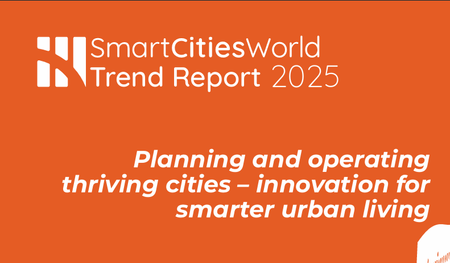
Ready to transform how your city plans and operates? Download the Trend Report 2025: Planning and operating thriving cities – innovation for smarter urban living to access the complete playbook on AI-powered urban innovation, complete with case studies from Bangkok, Singapore, Barcelona, and Manchester. Urban challenges aren’t slowing down. Populations are growing, climate pressures are intensifying, and residents expect seamless services, while budgets remain flat and workforces stretch thin. Traditional approaches can’t keep pace. The good news? Cities worldwide are showing that AI and digital innovation can drive meaningful improvements. Recent studies indicate that more than half of surveyed cities are already using AI to upgrade operations, and most plan to expand adoption in the next three years. For many leaders, the question is less about whether to act and more about how to act responsibly and effectively. After studying the latest research and real-world deployments, three strategic shifts stand out, each offering a different lens on how forward-thinking city leaders are turning pressure into progress. Shift One: From Fragmented services to unified citizen experiences Residents expect seamless problem-solving, not organizational complexity. Yet many cities operate in silos, transit systems, permitting offices, 311 reporting, and community engagement often run on separate platforms. The result? Multiple apps for residents, duplicated effort for staff, and missed insights locked in departmental databases. Leading cities are breaking this pattern through unified digital platforms powered by AI. Bangkok’s Traffy Fondue: Citizens report issues like broken streetlights or flooding via a mobile interface. AI categorizes each report and routes it to the right department. By mid-2025, the platform handled nearly one million citizen reports, improving engagement and reducing administrative overhead. The outcome? Reduced administrative overhead, and something harder to measure but equally important: residents who believe their government actually listens. Buenos Aires took a similar path with "Boti," a WhatsApp chatbot that evolved from a COVID-era tool into a citywide digital assistant. Citizens report issues, ask questions, and access services through the messaging app they already use daily. Technology that meets residents where they are improves efficiency and strengthens trust, when guided by principles of transparency and fairness. Shift Two: From reactive planning to predictive foresight Traditional urban planning relies on static models: masterplans, zoning maps, historical growth trends. These tools served their purpose. But they cannot capture the complexity of future risks, extreme weather, evolving mobility patterns, or the cascading effects of a single development decision. Digital twins complement human expertise by integrating geospatial data, climate models, and policy scenarios, helping cities make smarter decisions with limited budgets. Singapore's Digital Urban Climate Twin integrates geospatial data with climate models to simulate how different policies would affect temperature and thermal comfort across neighborhoods. These tools support informed decision-making while maintaining human oversight and accountability. The result? Strategic adaptation rather than reactive firefighting. Sydney built an urban digital twin that correlates environmental conditions with traffic accidents, using machine learning to predict crash risk on specific road segments. City planners can now test interventions virtually, what happens if we lower speed limits here? Add a bike lane there? Before committing resources. Even smaller cities are finding value. Imola, Italy uses a microclimate digital twin to model heat distribution street by street, guiding decisions about where to plant trees or specify cool pavement materials. The paradigm shift is profound: instead of planning based on what happened, cities can now plan based on what's likely to happen. This is how you make smart bets with limited budgets. Shift Three: From tech adoption to governance architecture Here's where many cities stumble. They invest in flashy pilots without building the institutional structures to sustain them. The cities getting this right treat governance as a strategic asset, not a compliance burden. Singapore's Model AI Governance Framework provides practical guidelines for transparency, fairness, and human-centric design. Its AI Verify toolkit lets organizations test their systems for resilience, accountability, and bias before deployment. Barcelona takes a different but equally rigorous approach, treating municipal data as a public asset under its Data Commons program. The city's procurement strategy favors open-source solutions, preventing vendor lock-in while supporting local innovation ecosystems. Both models share a common insight: rapid innovation doesn't automatically produce equitable outcomes. Governance creates the guardrails that allow experimentation without derailment. For city leaders, this means building cross-sector governance councils, adopting clear data strategies, creating ethical AI frameworks, and investing in workforce capability. These aren't obstacles to innovation; they're the foundation that makes sustained innovation possible. The Path Forward Cities that thrive in combine strategic vision with disciplined, responsible technology use. They embed digital capabilities into decision-making, supported by robust policies and cross-department collaboration. Learn how Microsoft helps governments build tech-empowered cities and resilient infrastructure at Microsoft for government. The Smart Cities World 2025 Trend Report provides the detailed case studies, governance frameworks, and implementation roadmaps to make this real. Download your copy now and start building the city your residents deserve.288Views0likes0CommentsJoin Microsoft at IACP 2025: Empower public safety operations with trusted AI
The International Association of Chiefs of Police (IACP) Annual Conference and Exposition is the premier global event for law enforcement leaders, bringing together more than 16,000 public safety professionals. This year, IACP 2025 takes place October 18–22 at the Colorado Convention Center in Denver, and Microsoft is proud to be part of the conversation. As your trusted partner in public safety innovation, we invite you to connect with us at booth #362 to discover how Microsoft and our ecosystem of partners are helping agencies modernize operations, improve decision-making, and build safer communities through trusted AI. Microsoft’s presence at IACP 2025 centers around three key pillars that reflect the evolving needs of law enforcement and public safety agencies: Empower the government workforce Streamline workflows with secure AI copilots, enhance collaboration across departments, and boost efficiency with intuitive digital tools. Enable AI-driven decision making Accelerate officer workflows with real-time insights and unify data to support faster, more informed decisions. Transform emergency response Modernize communications, integrate systems for real-time situational awareness, and automate operations to improve coordination and outcomes. Experience Innovation Firsthand At booth #362, attendees can explore hands-on demos of Microsoft solutions including Microsoft 365 Copilot, Researcher and Analyst agents, and Copilot Studio agents tailored for first responders. These tools are designed to help agencies work smarter, respond faster, and serve communities more effectively. You’ll also have the opportunity to connect with our partners, Altia, DisasterTech, Insight, Pimloc, Remark, Revelen.AI, Triangula, and Zencos who are showcasing their solutions that support officer workflows, evidence management, reporting, and analytics. Don’t miss the Emergency Response Platform vehicle demo, supported by Darley, Dejero, and 3AM which highlights how AI and real-time data can transform field operations and emergency response at the tactical edge. Attend Our Thought Leadership Session Join us for a featured education session in the Leadership Track: Is "Technology Sharing" the Key to Law Enforcement Innovation? 📅 Saturday, October 18 🕤 9:30 – 10:30 AM MT 📍 Room 505/506 This session explores how collaborative platforms and shared technology models can reduce costs, accelerate deployment, and improve outcomes across jurisdictions, offering a blueprint for scalable innovation. Let’s Connect We’d love to meet with you one-on-one to discuss your agency’s goals and challenges. Request a meeting with a Microsoft expert to explore how AI and cloud technologies can support your mission. Visit Microsoft at booth #362 to explore AI-powered public safety solutions and skilling opportunities. Together, we can build safer, more resilient communities through innovation.262Views0likes0CommentsM365 Copilot Prompt-a-thon: A Hands-On Event for Government Innovators
Ready to supercharge your workflow with AI? Join us for Power Your AI Transformation with Microsoft Cloud — a dynamic, hands-on workshop designed exclusively for government professionals! Discover how to harness the power of Copilot in Microsoft 365 GCC to tackle real-world mission scenarios, boost productivity, and collaborate with experts and peers.963Views0likes0CommentsBreaking the Search Habit
In today's fast-paced digital world, digital workers of all kinds are constantly seeking ways to streamline their workflows and enhance productivity. One of the most exciting new tools available is Copilot, an "answer engine" that goes beyond the capabilities of traditional search engines. To help illustrate the unique benefits of Copilot, I recently hosted a game show-style event showcasing its ability to synthesize information from multiple sources and provide comprehensive answers, saving time and energy. The best part? I used Copilot itself to help me create the framework for this gameshow in just a few minutes. I'll include the prompts and responses I used at the end of this article so you can see just how easy it was. A special thanks to all those who attended our recent Tribal Nations conference and learning event where leaders from some of America's most tech-forward tribes come to explore what Copilot could do to bring greater productivity and equity to its members and business interests. So, why a game show format? I believe that engagement == better learning so the game show format was designed to be interactive and quasi-competitive, making it easy and fun for participants to grasp the differences between Copilot and standard search engine experiences in a memorable way. The event featured a series of fun activities and challenges that highlighted Copilot's conversational ease and ability to provide composite answers. For example, participants were asked to solve complex queries using both Copilot and traditional search engines, demonstrating how Copilot's approach simplifies the process. For extra fun, Copilot also provided me with taglines, slogans, and even a fun graphic, all in literally just a few minutes. I went from idea to implementation, all in under 20 minutes. Copilot is an Answer Engine Unlike traditional search engines that require multiple queries and manual collation of information, Copilot acts as an answer engine, synthesizing data from various sources to provide a single, comprehensive response. The game show showcased activities where participants experienced firsthand how Copilot can save valuable time and effort. By leveraging Copilot, information professionals can focus on more strategic tasks rather than getting bogged down in repetitive search queries. I find this an incredibly important distinction for a couple reasons... First, we've all adopted search syntax as a second language. When we sit down at that search prompt we choose the right key words, in the right order, and heck… we've gotten pretty good at it. But the same string of keywords sent to Copilot frequently disappoint in results. It can be a challenge to trust the natural language capabilities of Copilot to hear and understand (and communicate back!) without using stilted search syntax tricks. Second, part of how Copilot differentiates itself from standard search queries is that it can actually retrieve information from disparate sources to compare and collate its response. The more specific and natural-language your question the better it seems to response. An example that seemed to resonate with folks during the gameplay: "I am a 49 year old cloud solution architect with 27 years of experience in the IT field, living in the Seattle area and I'm considering moving to Tampa Bay Florida. What can I expect in terms of changes to my cost of living and compensation?" What's important to note is that both contestants are likely to generate an answer, but Copilot excelled by doing it faster and more comprehensively. Collating and presenting data from several different searches as a complete answer, and it self-cites so you can quickly vet your information sources! Most importantly, it invites follow-up questions in a conversational manner that lets you dig further into details or compare more broadly in the abstract. Here's a quick screenshot of the reply generated in just seconds: Breaking the Search Habit The tagline "breaking the search habit" captures the key takeaway from the event. Copilot offers a different experience, emphasizing conversational ease over specific search syntax. Participants learned that talking to Copilot is more intuitive and efficient, allowing them to obtain the information they need without the hassle of crafting precise search queries, and then stitching together data from across a dozen different web results. This shift in approach can significantly enhance productivity and streamline workflows. Conclusion The game show event was a resounding success, providing participants with a fun and informative way to understand the benefits of Copilot. By breaking the search habit and embracing Copilot's answer engine capabilities, they unlocked new levels of efficiency and productivity. I encourage everyone to explore Copilot and experience the difference for themselves and hope that this approach can be a fun and engaging way to help folks in your organization add a powerful new capability to their toolkits. As promised, here are the handful of interactions with Copilot that produced everything I needed to make this fun game show in just minutes...591Views6likes0CommentsMicrosoft Ignite session: AI for the Public Sector with Microsoft 365 Copilot GCC available Nov 19
In today's rapidly evolving digital landscape, the public sector stands at the forefront of innovation, driven by the transformative power of AI. Microsoft 365 Copilot GCC (Government Community Cloud) is set to revolutionize how public sector organizations operate, offering new capabilities that will enhance human capabilities, streamline workflows, and support compliance with stringent security standards. AI for the Public Sector with Microsoft 365 Copilot GCC - OD803 Our Ignite On Demand session delves into the myriad ways Microsoft 365 Copilot GCC can empower your public sector organizations, from automating routine tasks to providing actionable insights that drive mission-critical decisions. We invite you to watch this session and discover how you can harness the power of AI to elevate your organization's capabilities. Microsoft Ignite | November 18-22, 2024 | ignite.microsoft.com The '101 on Microsoft Ignite 2024' What: Microsoft Ignite to learn more | Full Session scheduler Where: Hybrid | Chicago, IL (sold out) and Global Digital (online; free to register) When: November 18-22, 2024 Primary X handle & official hashtag: #MSIgnite (join in) AND follow @MicrosoftTeams, @SharePoint, @OneDrive, and @Events_MSFT The Ignite presentation highlights several key areas where Microsoft 365 Copilot GCC can make a significant impact for public sector strategists. We explore the role of AI in the public sector, emphasizing how AI can alleviate the burden of digital debt by automating repetitive tasks and optimizing workflows. The session also showcases the features of Microsoft 365 Copilot GCC such as Microsoft 365 Copilot Business Chat and AI-driven insights in applications embedded in apps you use everyday Word, Excel, PowerPoint, Teams and Outlook. Additionally, the presentation underscores the importance of responsible AI practices and data privacy, detailing Microsoft's commitment to security and compliance within the GCC environment. To start building your AI skills today and prepare your organization for the future, we encourage you to explore the following resources: Microsoft 365 Copilot GCC Blog: aka.ms/M365CopilotGCCBlog Microsoft 365 Copilot GCC High/DOD Blog: aka.ms/MS365CopilotGCCHighBlog Microsoft 365 Copilot – Readiness and Adoption Guide for Public Sector Roadmap ID # 415097 - Microsoft 365 Copilot GCC general availability -- the product referenced in this blog. Service description will be updated prior to general availability here Roadmap ID # 464984 - Microsoft Copilot general availability for GCC -- more information will be shared on this product closer to launch. Current information for WW/Ent environment on differences between these two products can be referenced here. Additionally, you can learn more about the roadmap for government AI adoption and specific Copilot scenarios for the US government. By leveraging these resources, you can ensure your organization is well-equipped to navigate the AI-driven future and deliver exceptional public services. The Roadmap for Government AI Adoption US Gov specific Copilot Scenarios content Other Microsoft 365 Copilot resources (environment agnostic): 3 short explainer videos: Microsoft 365 Copilot data security and privacy commitments Microsoft 365 - How Microsoft 365 Delivers Trustworthy AI (2024-01) Data, Privacy, and Security for Microsoft 365 Copilot Secure by default with Microsoft Purview and protect against oversharing Microsoft Purview data security and compliance protections for Microsoft Copilot Apply principles of Zero Trust to Microsoft 365 Copilot Learn about retention for Microsoft 365 Copilot This blog was written with support from Microsoft 365 Copilot, my AI assistant for work.1.1KViews0likes0CommentsGCC-H M365 Monthly Webinar: Connect • Collaborate • Create (February)
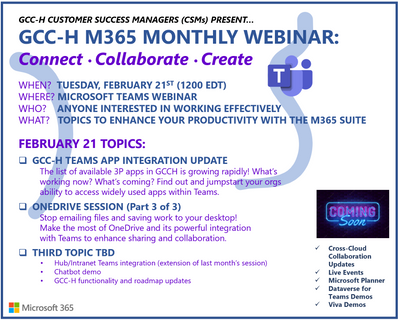
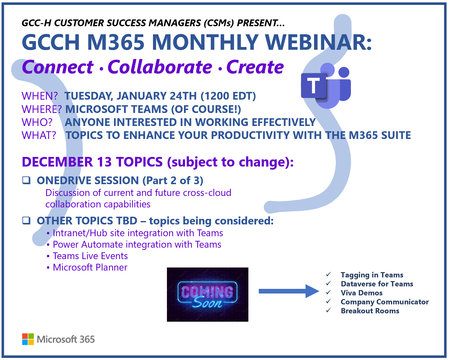
GCC-H Community: Registration is open for the February GCCH M365 Webinar: Connect – Collaborate – Create on Tuesday, February 21, 12-1pm EST. To register, please go here. Once registered, you will receive a calendar invite. Please forward this email to those who may be interested. Below you will find links to recordings of past webinars.3.4KViews1like0Comments#M365GovCommunityCall October 2021: Still SharePoint, After All These Years!
On October's M365 Government Community Call, we are joined by Amie Seisay and Swetha Sankaran, to discuss none other than SharePoint, after all these years. Also, check in for the latest news for Government community clouds (GCC, GCC-H, and DOD, and Azure Gov), and a list of Government community-related events!2.8KViews1like0Comments