publish
284 TopicsHow and when do I use Frontier Accelerate for Marketplace benefits?
The latest App Advisor guidance shows how Frontier Accelerate for Marketplace can help at every stage: 🔨 Build & Publish: Create and optimize your Marketplace offer. 📈 Grow: Increase visibility and accelerate transactions. ⭐ Differentiate: Access advanced benefits that support long-term growth. Whether you're just getting started or scaling an established Marketplace business, App Advisor can help you find the right resources for your stage. 📖 Read the blog: Frontier Accelerate for Marketplace: New App Advisor Guidance for Software Companies Which stage best describes your Marketplace journey today: Build & Publish, Grow, or Differentiate?Explore App Advisor for details on how Frontier Accelerate for Marketplace can help you sell more
Explore the latest Frontier Accelerate for Marketplace updates available through App Advisor. Learn how software development companies can discover relevant Microsoft Marketplace resources, benefits, and commercialization opportunities that help accelerate solution development, reach new customers, and scale revenue growth through Marketplace.146Views6likes1Comment
Can a reseller set exact customer totals on an Azure private offer?
When we create a multiperiod private offer, we enter our markup as a percentage. Sometimes the customer total Azure calculates is a few cents off the signed quote, even when we use all eight decimal places. Is there a way to set the exact customer price for each period? If not, how are other resellers handling these rounding differences?160Views0likes1CommentMicrosoft Marketplace Partner Digest - August 2026
What's new in Marketplace Convert more buyers into customers Microsoft recently expanded Marketplace listing capabilities with enhancements to free trials and the introduction of an option to request private offers, giving partners more ways to engage buyers at different stages of the purchasing journey. Customers can now discover and evaluate solutions through expanded trial experiences and transition more easily into paid subscription discussions by requesting custom pricing and terms directly from your Marketplace listings. ✨ Help customers evaluate your solution with free trials What's new On July 23 we announced the release of Marketplace enhanced trial capabilities. Customers can try solutions with confidence with the free trials in Microsoft Marketplace. Trials are available for multiple offer types, including SaaS, Azure virtual machines, Dynamics 365, and Power BI offers. New capabilities include: Custom meter trials: Partners can configure trials for SaaS solutions with metered pricing. Flexible trial durations: Partners can now configure SaaS trial durations from 1 to 180 days. Partner analytics: Partners can access SaaS trial analytics - including free trials initiated, active free trials, free trials converted, free trials not converted, and average trial duration - all within Partner Center Insights workspace. Customer discovery and management: Customers can better discover and manage trials. Upgrade to paid subscription during trial: Customers can upgrade to paid subscription at public pricing any time during a SaaS trial. Why it matters With enhanced trial capabilities in Microsoft Marketplace, partners can run self-service trials that make it easier for customers to try before they buy — whether for metered, per-user, or flat-rate pricing offers. Marketplace gives partners one place to manage trials end to end — from provisioning and mid-trial changes to insights — while improving offer discoverability through improved search, filters, and dedicated trial badges. Recommended action Review your Marketplace offers and trial strategy. For eligible SaaS offers, evaluate whether free trials can help you engage with more qualified buyers, faster. 📖 Learn more about free trials for SaaS ⚡ Customers can now request a private offer on Marketplace What’s new As of July 20, you can add a private offer request option directly on your Marketplace product pages. Customer requests are captured as Marketplace leads in referrals workspace and connected customer relationship management (CRM) integrations you’ve setup. This setting is disabled by default. You can easily activate it for applicable public offers. Why it matters More and more customers are seeking customized contracts and subscription pricing and terms tailored to their individual needs. This simple call to action reduces friction and helps you start the conversation with prospective buyers. Recommended action In the Marketplace offers workspace of Partner Center, update each of your offers for which you provide customers private offers. Enable the Request Private Offer setting and republish the offer. Events Recent events Multiparty private offers expand channel growth opportunities in Australia, Japan and South Africa Multiparty private offers continue to help software companies accelerate channel-led sales through Microsoft Marketplace. This past month, we hosted two region-focused Marketplace office hours sessions designed to help partners better understand local market opportunities, engage distributors and resellers, and scale Marketplace transactions through channel ecosystems in Australia and Japan. Whether you're looking to expand an existing Marketplace motion or explore new geographic opportunities, these sessions will provide practical guidance and market-specific insights to help you grow. See a list of currently supported countries/regions. Check out the recorded sessions: • Channel growth in Australia (English) • Channel growth in Japan (Japanese) Helping developers build, monetize, and scale AI solutions with Marketplace Discover how Microsoft Marketplace helps software companies access AI models and developer tools, accelerate application development, and reach customers through Microsoft's global commercial ecosystem. Learn how to monetize applications and agents without building and maintaining your own commerce and distribution infrastructure. Watch the recording Upcoming events Build AI-powered solutions, monetize through Microsoft Marketplace, and scale revenue through Microsoft expertise, skilling, and investments. Frontier Accelerate for Marketplace is an upcoming unified offering for software development companies to bring AI-powered solutions to market, drive customer acquisition and revenue growth, and scale through Microsoft Marketplace with technical guidance, skilling, and investments aligned to every stage of growth. 📆 Join us on August 26th before general availability to learn about the new offering, benefit alignment, migration guidance, and enrollment requirements. Next steps Turn insights into FY27 success — starting today. Ready to carry the momentum forward from MCAPS Start for Partners? Get everything you need to refine and execute your FY27 strategy in the Partner Activation Zone, including session recordings, ready-to-use playbooks, and tools to start building pipeline. Leverage your Marketplace Rewards benefits Discover use cases and how to leverage your Azure sponsorship. With Marketplace Rewards Azure sponsorships, eligible software development companies can increase sales through Microsoft Marketplace by using the sponsorships for customer deployments tied to Marketplace deals—and to offset infrastructure costs from eligible free trial offers. 📍Review the Marketplace Rewards Azure sponsorship policy guide for the latest411Views2likes0Comments
Preview SaaS offer purchase fails at subscription creation
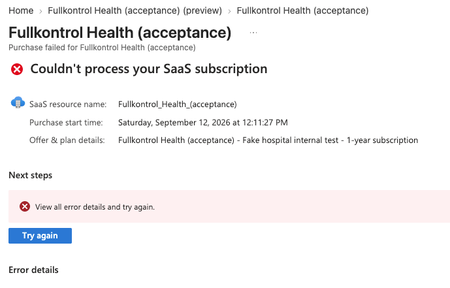
I'm publishing a transactable SaaS offer and testing the purchase flow in preview. Test purchases used to work, and then stopped working with no change on our side that would explain it. The purchase now fails at the final step: "Couldn't process your SaaS subscription" Earlier attempts also returned "400 Bad Request" from the marketplace SaaS service during checkout. Important: this offer previously accepted preview test purchases successfully. Several went through and created subscriptions. The same flow now fails every time, for no apparent reason and with no configuration change on our part. Setup: - Transactable SaaS offer, tested via the Azure portal preview link at the Publisher signoff stage. - Private test plan priced at $0, 1-year term, restricted to my own tenant. What I have already verified and ruled out: - The plan resolves and is selectable. The failure page even shows the correct plan name, so the preview audience and private-plan tenant restriction are working. The failure is at subscription creation, not plan visibility. - Buying subscription is Pay-As-You-Go, spending limit off, Enabled. - Microsoft.SaaS, Microsoft.Marketplace, and Microsoft.MarketplaceOrdering resource providers are all registered. - A valid payment method (credit card) is on the billing profile. - The buyer's market (country) is included in the plan's markets. - Azure Private Marketplace store exists but is disabled, so it is not blocking. - I republished the offer to regenerate a fresh preview link. Preview creation completed successfully. - It fails identically for the Azure account owner, not just a delegated tester. So purchases worked before, every setting I can find is still correct, and it now fails at Microsoft's subscription-creation step. Questions: 1. Has anyone had preview test purchases work and then suddenly start failing with "Couldn't process your SaaS subscription," and found the cause? 2. Is this a known platform-side issue? The republish-with-a-small-edit workaround did not help.
Print/export private offer & terms to a PDF for customer's offline processes?
Hi all, We have a situation where a customer is asking for a 'private offer' to be published to them - which is fine, we have done that. However, their procurement processes don't appears quite up to speed with using 'digital marketplaces' and so their procurement person is asking if we can send them a PDF hardcopy of the 'private offer', so they can send it onwards internally for approvals, before clicking the 'accept and then 'purchase' buttons in Marketplace. It seems that the authority within the customer that needs to approve it, is not actually a person that uses or will log onto the Azure Portal to view and accept the offer... and that a person who will logon to the Azure Portal to 'accept' it, first needs to send a PDF/hardcopy to someone to approve it. Is there a way that we as the ISV can export the 'private offer' to PDF for them, or a way for them to view the private offer in their Azure Portal and to export that to a PDF, so they can use internally for their approval processes?SolvedChoosing the right offer type for your cloud and AI solutions
Whether you're bringing a new AI solution to market or evaluating how to scale an existing application, understanding Marketplace offer types can help you choose the right path to monetization and customer adoption. Check out this short video that compares the capabilities of SaaS offers, Container offers, and Azure managed applications to understand which model best aligns with your architecture, deployment requirements, and customer needs. 168Views2likes0Comments
What’s the best way to differentiate a SaaS offer from a Teams offer in Microsoft Marketplace?
Hey community! Our app is transactable, and we currently have two offers live in Marketplace: Saas and MS Teams offers. However, some of our customers find it confusing and aren’t sure which one they should choose. We also always prefer them chosing Saas so we can track everything via Partner center. What’s the recommended way to structure or differentiate the two offers so the choice is clear for customers? For example, should we use different naming, descriptions, or positioning for each offer? Would really appreciate any best practices or examples from others who have faced it!App ratings are not displayed when a Marketplace listing includes a free trial
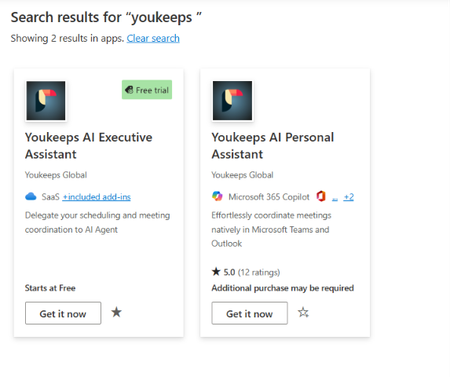
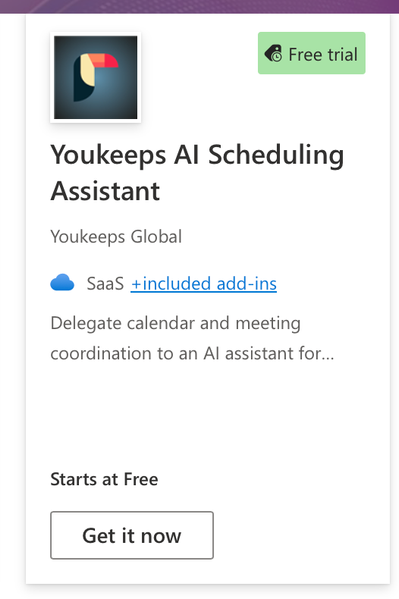
Hi community! We’ve noticed that app ratings are not displayed on Microsoft Marketplace browse and search result cards when an offer includes a Free trial badge. For example, the one listing displays its rating of 3.6 (107 ratings) directly on the card. Youkeeps AI Scheduling Assistant listing has customer ratings, but its card displays the Free trial badge without any rating information. Could you please confirm whether this is expected behavior or a display issue? Is there a way to show both the Free trial badge and the app rating on the listing card?243Views2likes1Comment
Microsoft Templates for Azure Application upload
Hi All, Are there ready to use templates for the documentation that Microsoft is requesting to upload for this offer type - such as Solution and Deployment Architecture, Customer Installation Guide, Customer Onboarding and Configuration Guide, Data Integration Guide. If yes, could someone share the links or the templates. Thank you!