power bi
900 Topics
GLSU Excel add-in fails to load after Office update from Version 2607 to 2608
Our Excel add-in, Process Runner GLSU , fails to load after Microsoft Office updates from Version 2607 to Version 2608. This started August 17, 2026 and is actively growing in scope. Error messages: Excel: Cannot run the macro 'onLoad' VBA: System Error &H80004005 (-2147467259). Unspecified error VBA: Compile error in hidden module: ThisWorkbook Has anyone encountered similar issue with their own custom add-on. If yes, any pointers to fix it. We are seeking help on priority. Thanks, Vrushali Pawale, Sr. Manager, Insightsoftware.597Views0likes1Comment
Office Scripts does not refresh Power BI Query live connections in Excel Online
Hello everyone, I've got the following problem and am nearly going insane because it's causing so much problems 🥲 Summary The Office Scripts method workbook.refreshAllDataConnections() no longer refreshes a live connection to a Power BI Semantic Model in Excel Online. Environment Excel Online Office Scripts Power Automate ("Recurrence" + "Run Office Script") Live connection to a Power BI Semantic Model (Analyze in Excel) Expected behavior Calling workbook.refreshAllDataConnections(); should trigger the same refresh as manually selecting Data → Refresh All in Excel Online. Actual behavior The script completes successfully without any error, but the workbook does not requery the Power BI Semantic Model. Additional observations The same workbook worked correctly for approximately two years. The issue started around mid-July 2026. Manual Data → Refresh All in Excel Online refreshes successfully. Refreshing in Excel Desktop also works correctly. The problem occurs both: when running the Office Script manually from the Automate tab in Excel Online when running the same Office Script from Power Automate ("Run Office Script") This suggests the issue is specific to the Office Scripts implementation of refreshAllDataConnections() rather than the workbook, authentication, or the Power BI connection itself. Steps to reproduce Create an Excel workbook with a live connection to a Power BI Semantic Model. Confirm that manual Data → Refresh All refreshes the data successfully. Create an Office Script containing only: function main(workbook: ExcelScript.Workbook) { // Refresh all data connections workbook.refreshAllDataConnections(); } Run the script. Result The script finishes successfully but no refresh is performed. Expected result The workbook should requery the Power BI Semantic Model exactly as when using the manual Refresh All button in Excel Online.298Views2likes2Comments
Complex formulae with data model
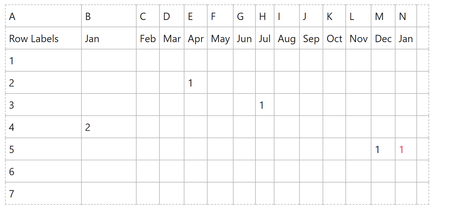
Over the years, I have developed a significant excel data sheet which has gotten slower and slower with time. I have discovered the idea of excel's data model this week and have learnt how to import the data I need from its source CSV to the data model and I now have a power pivot which looks like what I originally had in excel. What I would like to do next, is to replicate some of the formulae I had in excel to calculate if something should be counted or not. I would not want the red one to be counted as this row would have been counted in the previous month. In excel I was using the following formula- =IF(COUNTIF(B5:M4,">0"),SUM(Patient!B5:M5*0),Patient!N5) is there a way of achieving this with the data model or would I have to hardcode this into another sheet? I was trying to avoid doing this to minimise the number of formulae... Many thanks for your help...Solved278Views0likes7Comments
Data Formatting
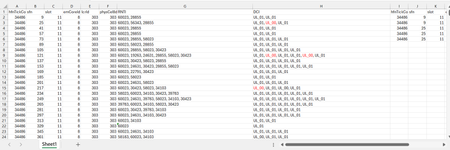
Dear Experts, I have a Data like below :- Each row can have 1 or more RNTIs( seperated by ",") and their DCI( UL_01 or UL_00), I want to put them in a format like in Col - I~P gave examples for the 1st two entries. Attached worksheet. Thanks & Regards Anupam ShrivastavaSolved272Views0likes5CommentsFilter Function or TAKE-DROP Function
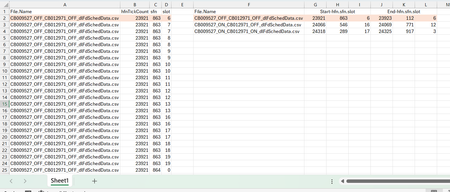
Dear Experts, I have a Data like this:- Column A -> Has the File Names, and Column B,C,D have their corresponding data, In Column F I have the unique File Names and from G/H/I -> I need the start of the hfn/sfn/slot and in J/K/L the end of the hfn/sfn/slot for that File Name as populated , How to achieve this? Thanks & Regards Anupam ShrivastavaSolved419Views0likes8CommentsConditional Formatting or a Specific Filter Rule
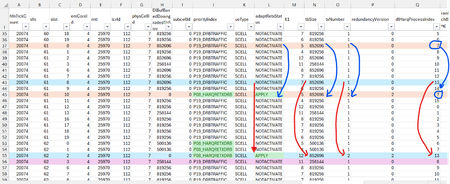
Dear Experts , I have a data like below:- here the Column-O, txNumber can go from 1,2,3 (txNum=2 and 3 means a Retransmission), I want to filter all the pairs for all Transmissions and their corresponding Retransmissions ( either by coloring them all using a conditional formatting) or using a specific filter Rule. How to identify the Transmission and it's corresponding Retransmission for a Specific HarqId( say for dlHarqProcessIndex ==7, the blue color Row-37 is my 1st transmission(txNumber ==1) for the dlHarqProcessIndex==7 with a tbSize of 852696, and adaptRetxStatus == NOTACTIVATE, and it's corresponding 2nd transmission( Retransmission , txNumber==2) Row-45, tbSize remains same(as it's corresponding 1st transmission) in all retransmissions and adaptRetxStatus changes to "APPLY" for all retrans txNumber==2,3) and similarly for other pairs like for dlHarqProcessIndex==13. Attached is the Worksheet.Solved252Views0likes5Comments
Organizational Account authentication problem
I have encountered a new authentication problem using an organizational account with Get Data > From Web. The data source is Dynamics 365 CE on-premises (https://ce.xxx.com/api.data/v9.1), authenticating through ADFS with MFA. This has been working without any issues until recently. When I attempt to refresh the query, I get an ADFS pop-up window for username and password, as expected. However, the window then closes without the expected MFA prompt. The "Access Web content" window does say "You are currently signed in," but does not query successfully, instead displaying the error "We couldn't authenticate with the credentials provided. Please try again." The most distinctive symptom, is that clicking the "Sign in as different user" button does not work. It just quickly opens and closes an empty window, instead of the expected ADFS username/password page. In Power BI Desktop everything works. The connection and query are successful, and the "Sign in as different user" button successfully displays both the initial ADFS username/password window and the subsequent MFA dialog. Excel version: Microsoft® Excel® for Microsoft 365 MSO (Version 2512 Build 16.0.19530.20226) 64-bit562Views0likes1Comment
Power Query - How Do I Count a Number of Entries Based on Another Column?
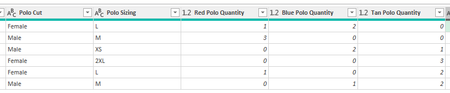
Hello! The title might be a little confusing. Here's the situation. I manage uniforms for my team. I am making a SharePoint list and form that an employee will use to request the uniforms. Then, to give me a digestible table that shows me exactly what I need, I have an Excel Power Query pulling the list in. On the form, instead of having a different entry for each polo in each color, each size, and each cut, I have it separated so that you pick cut, sizing, and color separately. Is there a way to have Power Query pull it to show me, for the screenshot example: Female L Red Polo: 2 Female L Blue Polo: 2 Male M Red Polo: 3 Male M Blue Polo: 1 Male M Tan Polo: 2 So on, and so forth. Is this possible? Thank you!374Views0likes3Comments