outlook for windows
1414 Topics
Smtp connections to Outlook being refused
Over the last 4 or 5 days, SMTP connections to outlook have been refused from two different 3rd party mail apps - Thunderbird and Mailspring. The failures are described as "Time out", "Authenticatoon error" or "connection refused". It had worked happily for years, and nothing at my end changed, except that my Windows 11 did an update. Anyone else having issues? What can I do?62Views0likes1Comment
Another program is trying to access mu outlook data
I have a small app written by myself that accesses the outlook pst file and creates a small window on my desktop with a list of my appointments for the next few days. Recently outlook has started complaining (it had been working for many years) and now blocks access requiring me to click OK in the window it pops up. I can't see any way to stop outlook showing the window or getting it to auto allow my app. Can anybody help me to disable this or get it to allow my app automatically ? If the is a way to access the pst file with admin rights (I currently do it via OLE) I am happy to edit the code.109Views0likes5Comments
New Outlook autocompletes an address that is no longer in use and I can't seem to delete it
Topic says it all, really. Client of mine has a new company and when I type the start of his name Outlook autocompletes for his old company even though it is no longer in my address book and his contact is updated with new information. I seem to recall there used to be an "x" that would let me delete incorrect autocompletes, but I can't find anything and Copilot has no useful suggestions. The autocomplete comes up in both the web version of Outlook--I basically never use this--on my PC which I primarily use, and IOS.2.4KViews4likes4Comments
New Outlook: "Changing the ImapRemoteServerInfo is not allowed" after host migration
Hi everyone! I've migrated my domain/mailbox from one IMAP host to another in May. It cannot be added to New Outlook for Windows — fails instantly with INVALID_CREDENTIALS INTERACTION_REQUIRED, even when I deliberately enter a wrong password (so it's failing before authentication is even attempted). Using DevTools (olk.exe -devtools), the Network tab shows the real rejection from Microsoft's backend: Changing the ImapRemoteServerInfo is not allowed. Attempted to change it from imap.olddomain.sk to imap.newdomain.sk So New Outlook has a cloud-mailbox / connected-account shadow record for this address, pinned to the old host from a previous add attempt, and the backend refuses to update it. What I've confirmed: Webmail and a second mailbox on the same domain/host both work fine → not credentials, not the host. The account does not appear in Settings → Accounts (so I can't use "Remove from all devices" which worked on my first account). It's on no other device or client. App reset didn't help (record is server-side, not local). It's been ~7 weeks, so any 30-day inactivity purge hasn't cleared it How do I get this stuck cloud-mailbox / connected-account record purged when it isn't attached to any removable account? Is there a way to force it, or does this need Microsoft backend action?638Views0likes13Comments
Attachement date of outlook classic
when i download the attachment from old email, the date of the file, should be today date, but that doesn't happen, it appears the old date of when it was created. In a big folder of downloads i cant find it. This happens in outlook 365, outlook 2016 and Outlook 2024 classic with email 365 account. But in Outlook 2019 classic works perfectly it sava with today date. Should be some configuration?141Views0likes3CommentsiCloud for Windows Contacts sync issue with Outlook Classic (Part of M365 package)
I have lost count the amount of times I see iCloud Sync issues cropping up with Outlook Classic (M365) but they never exactly describe the issue I am having. After uninstalling Outlook, iCloud for Windows, re-installing and enabled / disable the AddIn/ re-enable it for iCloud I've run into a brick wall I think So iCloud for Windows partly integrates with Outlook Classic - but I have an issue where the correct Sync'd contacts are appearing in the Contacts tab of Outlook and I enable that as an Address book by ticking the box in Properties. I give it a specific name Then open the main Home page of Outlook and start to create a test mail. If I open the Address Button on the main ribbon I can see the Contacts list name for iCloud and open it. Problem is it is not the correct list. It looks like a very old iCloud Contacts List - but where on earth is Outlook getting this old list from ?. The list is the same name as that one I just gave it under Outlook Contacts management page, but I can never get the correct sync'd iCloud contacts list to appear using the Address Button. Can anyone point me in the direction of where this old iCloud contact list is being stored within Outlook Classic ?. If I remove iCloud for Windows it is still there under the Address Ribbon button. Any help here welcomed !145Views0likes4CommentsPST Export New Functionality in New Outlook For Windows
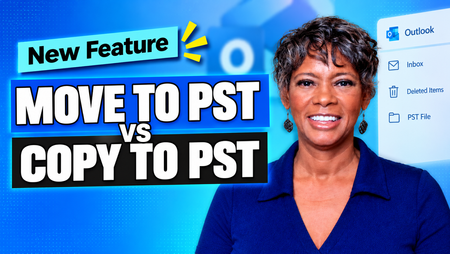
New Outlook for Windows PST Export has received a useful update. You can now choose between: Export Copy to PST (the standard method) Export Move to PST (new) Export Copy to PST is the method we already had. The exported items remain in the mailbox unless you delete them manually. Export Move to PST is different. It exports the items, then automatically moves the originals to the Deleted Items folder. The two options serve different purposes, especially when deciding whether you are creating a backup or archiving content you no longer want to keep in the mailbox. I created a short walkthrough showing the Export PST Move vs. Copy process, Deleted Items behavior, and when to use each option. 👉🏾Watch Video: New Outlook: Move to PST vs Copy to PST — What's New & When to Use It If you use PST files in New Outlook for Windows, I’d be interested in hearing which option you expect to use most: Export Move to PST or Export Copy to PST? For the full PST Export process, - Watch this video: New Outlook PST Export: What You Need to Know in 2026 - Read this blog: How to Export Mailbox to PST from New Outlook (Complete Guide) If this post was helpful, please like it to assist others. traccreations4e-p26 9/12/2026158Views1like0Comments
Classic Outlook Keeps "Not Responding" and freezing
Hi there, I tried to scour for something similar, but I couldn't find anything and/or it didn't work - so here I am - hopefully someone can help. Okay the facts - I use Classic Outlook (CO moving forward) and I run 5 email address in it - 3 are a domain for my company that I run and 2 are POP emails brought in from AOL. I run Windows 11. This is happening to 3 or my 5 work stations, all three are the ones on Windows 11. This started slow a few weeks ago, thought it was just low memory so went through and cleaned up old emails. I am not seeing these issues when using the 2 pop emails - just my company domain ones. Can open CO, taking some extended time but it is getting there. As soon as I try to send an email, reply to an email, change a signature within a new email - it either takes 5-10 minutes to load if we do not click again and just let it sit and think. The second I try and click something or try and scroll while waiting - it goes into 'Not Responding'. Some times it will load after 1 minute and sometimes it just get stuck. I have updated my CO, I tried the advanced 'online repair' through my system, I have tried disabling all my add-ons, I tried deleting my email account from CO and re-loading/logging in, I have checked my graphics card (something on google said to check it for updates), I have ran command prompts to check for internal Windows errors and I have come up short on everything.7.7KViews3likes21Comments