onedrive
657 Topics
Planning a Google Workspace to Microsoft 365 Migration? What Should You Consider?
Hi everyone, Has anyone recently migrated from Google Workspace to Microsoft 365? I’m interested in knowing what challenges you faced during the migration, especially around mailbox data, calendars, contacts, user mapping, or the final cutover process. For those planning the migration, what are the key things you recommend preparing before getting started? Would like to hear your experiences and suggestions.551Views0likes5Comments
New Family Subscription: Flexibility is nice, axing storage (5=>2 TB) is NOT
As you likely all know, MS just announced to change the storage model for Office 365 family subscriptions. Instead of having 5 users with 1TB each there will be 2TB shared space. The email announcement did not talk about families that use more than 2TB. In a chat with the support I just learned: The new flexibilty is nice... but axing storage more than half is terrible! What makes it even worse is that neither I nor ChatGPT could find information what it will cost if I want to continue using 5TB. I do understand that prices are increased from time to time. But making it so shady and intransparent is not what I would expect from a firm like MS...37Views0likes0CommentsAutoSave disabled when opening SharePoint-synced files from Finder after macOS Tahoe 26.6 update
Files stored in SharePoint Online and synchronized locally through OneDrive are opened as local documents when launched from Finder. Office applications display "Saved to my Mac" and AutoSave is turned off by default. However, opening the exact same files through Word/Excel > Open > Sites, or via SharePoint "Open in Desktop App", correctly identifies them as cloud documents. In that scenario, AutoSave is enabled and collaboration/version history features work as expected. Troubleshooting already performed: OneDrive reset and re-linked SharePoint library re-synced Signed out and back into both Office and OneDrive Removed Microsoft credentials from macOS Keychain and re-authenticated Recreated local OneDrive sync relationships Verified OneDrive File Provider extensions are enabled Verified Office applications and OneDrive are fully up to date Tested with newly created files and existing files Tested "Always Keep on This Device" with no change in behavior The issue appears to be specific to the Finder-to-Office launch path after upgrading to macOS Tahoe 26.6. Before upgrading to macOS Tahoe 26.6, opening the same SharePoint-synchronized files directly from Finder correctly preserved cloud document identity and AutoSave was enabled as expected. I discussed this issue in detail with Apple Support, but they quickly dismissed it, saying that the problem is not on Apple's side and that I should contact Microsoft instead.4.2KViews13likes39CommentsOneDrive storage unexpectedly reverted from 30 GB to 15 GB
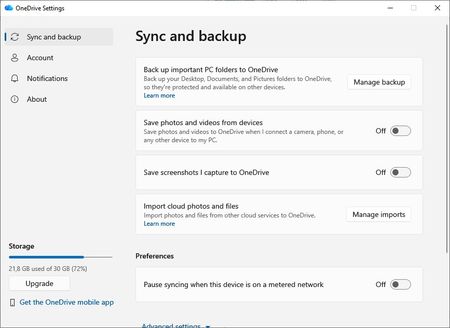
Did Microsoft recently change the storage quota of older OneDrive accounts? I've noticed something rather strange with my OneDrive storage quota, and I'm curious whether anyone else has seen the same behaviour. My account had 15 GB of OneDrive storage for many years. Then, earlier this year, the quota unexpectedly increased to 30 GB. I documented this change on August 9, 2026, when I was investigating some OneDrive issues and noticed Microsoft's move towards the unified Microsoft Cloud Storage system. I did not purchase Microsoft 365 or activate a temporary storage promotion or phone backup offer to obtain the additional storage. The account simply showed 30 GB. Now, months later, the quota has unexpectedly gone back to: 30 GB → 15 GB This is not just a cosmetic change. I currently have approximately 23.8 GB stored in OneDrive, so the account is now showing roughly 159% of the available storage, and OneDrive has stopped synchronizing new files. I have screenshots documenting both the previous 30 GB quota and the current 15 GB quota. What I find particularly interesting is the timing. Microsoft has been consolidating storage under the Microsoft Cloud Storage model, which includes OneDrive and other Microsoft services. Could changes to that system be affecting how older/legacy storage quotas are being assigned to accounts? I'm not assuming that this is necessarily the cause — I'm interested in finding out whether other people have experienced similar quota changes. Has anyone else seen an older OneDrive account change from 30 GB back to 15 GB recently? Or perhaps experienced other unexpected changes to a legacy storage allowance? I'm particularly interested in hearing from users who have had their accounts for many years and had storage above the current standard allocation. I've also opened a support case with Microsoft, so I'm trying to understand whether this is an isolated account issue or something affecting multiple users. Screenshots of the previous 30 GB quota and the current 15 GB quota are attached.119Views0likes1CommentI built a free, open-source M365 security assessment tool - looking for feedback
I work as an IT consultant, and a good chunk of my time is spent assessing Microsoft 365 environments for small and mid-sized businesses. Every engagement started the same way: connect to five different PowerShell modules, run dozens of commands across Entra ID, Exchange Online, Defender, SharePoint, and Teams, manually compare each setting against CIS benchmarks, then spend hours assembling everything into a report the client could actually read. The tools that automate this either cost thousands per year, require standing up Azure infrastructure just to run, or only cover one service area. I wanted something simpler: one command that connects, assesses, and produces a client-ready deliverable. So I built it. What M365 Assess does https://github.com/Daren9m/M365-Assess is a PowerShell-based security assessment tool that runs against a Microsoft 365 tenant and produces a comprehensive set of reports. Here is what you get from a single run: 57 automated security checks aligned to the CIS Microsoft 365 Foundations Benchmark v6.0.1, covering Entra ID, Exchange Online, Defender for Office 365, SharePoint Online, and Teams 12 compliance frameworks mapped simultaneously -- every finding is cross-referenced against NIST 800-53, NIST CSF 2.0, ISO 27001:2022, SOC 2, HIPAA, PCI DSS v4.0.1, CMMC 2.0, CISA SCuBA, and DISA STIG (plus CIS profiles for E3 L1/L2 and E5 L1/L2) 20+ CSV exports covering users, mailboxes, MFA status, admin roles, conditional access policies, mail flow rules, device compliance, and more A self-contained HTML report with an executive summary, severity badges, sortable tables, and a compliance overview dashboard -- no external dependencies, fully base64-encoded, just open it in any browser or email it directly The entire assessment is read-only. It never modifies tenant settings. Only Get-* cmdlets are used. A few things I'm proud of Real-time progress in the console. As the assessment runs, you see each check complete with live status indicators and timing. No staring at a blank terminal wondering if it hung. The HTML report is a single file. Logos, backgrounds, fonts -- everything is embedded. You can email the report as an attachment and it renders perfectly. It supports dark mode (auto-detects system preference), and all tables are sortable by clicking column headers. Compliance framework mapping. This was the feature that took the most work. The compliance overview shows coverage percentages across all 12 frameworks, with drill-down to individual controls. Each finding links back to its CIS control ID and maps to every applicable framework control. Pass/Fail detail tables. Each security check shows the CIS control reference, what was checked, what the expected value is, what the actual value is, and a clear Pass/Fail/Warning status. Findings include remediation descriptions to help prioritize fixes. Quick start If you want to try it out, it takes about 5 minutes to get running: # Install prerequisites (if you don't have them already) Install-Module Microsoft.Graph, ExchangeOnlineManagement -Scope CurrentUser Clone and run git clone https://github.com/Daren9m/M365-Assess.git cd M365-Assess .\Invoke-M365Assessment.ps1 The interactive wizard walks you through selecting assessment sections, entering your tenant ID, and choosing an authentication method (interactive browser login, certificate-based, or pre-existing connections). Results land in a timestamped folder with all CSVs and the HTML report. Requires PowerShell 7.x and runs on Windows (macOS and Linux are experimental -- I would love help testing those platforms). Cloud support M365 Assess works with: Commercial (global) tenants GCC, GCC High, and DoD environments If you work in government cloud, the tool handles the different endpoint URIs automatically. What is next This is actively maintained and I have a roadmap of improvements: More automated checks -- 140 CIS v6.0.1 controls are tracked in the registry, with 57 automated today. Expanding coverage is the top priority. Remediation commands -- PowerShell snippets and portal steps for each finding, so you can fix issues directly from the report. XLSX compliance matrix -- A spreadsheet export for audit teams who need to work in Excel. Standalone report regeneration -- Re-run the report from existing CSV data without re-assessing the tenant. I would love your feedback I have been building this for my own consulting work, but I think it could be useful to the broader community. If you try it, I would genuinely appreciate hearing: What checks should I prioritize next? Which security controls matter most in your environment? What compliance frameworks are most requested by your clients or auditors? How does the report land with non-technical stakeholders? Is the executive summary useful, or does it need work? macOS/Linux users -- does it run? What breaks? I have tested it on macOS, but not extensively. Bug reports, feature requests, and contributions are all welcome on GitHub. Repository: https://github.com/Daren9m/M365-Assess License: MIT (free for commercial and personal use) Runtime: PowerShell 7.x Thanks for reading. Happy to answer any questions in the comments.5.7KViews2likes4Comments
M365 Tenant to Tenant Migration
Hi Community, One of our customer currently migrating some OneDrive DATA from their old tenant to a new one. Customer wants to keep same domain names. So they must first remove them from the old tenant to create them in the new one. But they're afraid to loose the (OneDrive) DATA associated with the accounts when they will be moved to the initial ".ONMICROSOFT.COM" domain (which will happen after domain name removal). Questions: 1. What exactly happens with the accounts of OneDrive DATA once the old domain (wherein it was originally hosted) is removed ? 2. What is the best practice in this context to retrieve any associated DATA during/after migration? They want to check the priority steps knowing that they want to keep its domain name in the new tenant, which mean they'll have to detach the domain from tenant source to create it in target tenant 3. Should they first create a temporary domain where users will be migrated to, remove the domain name from tenant source to free it and create it in target tenant, then create the users ? or can they simply remove the domain name which will cause the existing users belonging to this domain to be automatically moved the initial .ONMICROSOFT.COM domain (with all the dependencies and OneDrive Data) ? Any pointers would be of great help! Many thanks in advance!3.8KViews0likes3CommentsHow to Fix “This File Can’t Be Synced” in OneDrive
A OneDrive sync failure can be deceptively simple. You edit a document, save it, and expect it to appear in the cloud. Instead, OneDrive displays “This file can’t be synced.” The file remains on your computer, but the cloud copy is missing or outdated link to the post77Views0likes0CommentsMac OS 26.7 and M365 Office Applications- upload block errors only on Office applications.
Mac OS 26.7 and M365 Office Applications- upload block errors only on Office applications. When making changes to an Office document like Excel &/or Word using M365 E5 license since September 19th, I have been getting a message stating "Upload blocked" in autosave, the file is being saved to a OneDrive connected services which has a capacity of 5 tb, having a total of about 860,000 items, about 3.2 TB, but the selected items to sync from the OneDrive application is about 180,000. This happens sporadically to only Office application files such as MS Word and Excel. The syncs in the bar menu of OneDrive all show sync and backed up with no errors. As per MS a M365 SharePoint library can hold 30 million items, and view is limited to 5000 items, and I have such libraries with about 20,000 items and I can access them online and have set views to show items in lists less than 5000. MS also states that OneDrive Business can sync up to 300,000 items only even if the capacity is 5 TB and the number of total items cannot exceed 300,000 items. (1) Does anyone know why a OneDrive storage which leases 5tb storage space can only keep 300,000 items, for it to function? (It’s pointless to lease 5tb and be restricted by number of items). (2) Sync is working for PDFs and screenshots but only Office applications are having problems syncing at times or saving with autosave with versions. When I researched with CoPilot Premium running several terminal commands it concluded it is a MS Office bug and MS Support cannot solve the problem despite opening several tickets. The agents as L1 will scope, then it goes to the backend team called “ Escalations” but there remains no solution for crippled services since past 11 days. OneDrive sync logs were provided as well as requested but no followup. (3) If these are hard limitations on M365 to save maximum of only 300,000 items has anyone considered any other cloud services to replace OneDrive for Business? Has anyone else experienced this in the past? Can anyone offer a solution for this? If OneDrive office applications are dysfunctional then how does one operate AI agents or any automation. Any questions please ask. Thank you.226Views0likes4CommentsMicrosoft Draws Hard Line for OneDrive Storage Quotas
After promising essentially unlimited OneDrive for Business storage some years ago, Microsoft is now putting a hard 5 TB limit on what a user can have and forcing tenants who used Microsoft’s own process to expand to 25 TB to reduce account sizes. It’s an unfair approach, especially when viewed together with the launch of a PAYG option for OneDrive storage to allow Microsoft 365 tenants who need a little more to buy that storage. https://office365itpros.com/2026/09/23/onedrive-storage-clampdown/106Views0likes0Comments
OneDrive Storage Space for O365 E3 1-5TB
I just want to clarify on the OneDrive storage space for O365 E3 subscriptions.... As I've found, I can increase storage per users up to 5TB.... The default is set to 1TB. When I'm checking MS sites, for O365 E3 it mention OneDrive 1-5TB. Is there any extra cost when increasing to 5TB for a user with the existing subscription? I assume it is not, but cannot find any clear mention about it. We have 56 O365 E3 licences and I need to increase to 5TB for one user.Solved45KViews0likes6Comments