migration
359 Topics
M365 Tenant to Tenant Migration
Hi Community, One of our customer currently migrating some OneDrive DATA from their old tenant to a new one. Customer wants to keep same domain names. So they must first remove them from the old tenant to create them in the new one. But they're afraid to loose the (OneDrive) DATA associated with the accounts when they will be moved to the initial ".ONMICROSOFT.COM" domain (which will happen after domain name removal). Questions: 1. What exactly happens with the accounts of OneDrive DATA once the old domain (wherein it was originally hosted) is removed ? 2. What is the best practice in this context to retrieve any associated DATA during/after migration? They want to check the priority steps knowing that they want to keep its domain name in the new tenant, which mean they'll have to detach the domain from tenant source to create it in target tenant 3. Should they first create a temporary domain where users will be migrated to, remove the domain name from tenant source to free it and create it in target tenant, then create the users ? or can they simply remove the domain name which will cause the existing users belonging to this domain to be automatically moved the initial .ONMICROSOFT.COM domain (with all the dependencies and OneDrive Data) ? Any pointers would be of great help! Many thanks in advance!3.7KViews0likes3Comments
Need to Restore PST Files to Office 365 Mailboxes - What's the Best Approach
Hey everyone, I have a task coming up where I need to restore several PST files back into Office 365 mailboxes. Haven't done this before at this scale and honestly not sure where to begin. I've looked at Microsoft's native import service through Purview but I have a few concerns: Some of the PST files are quite large — not sure how well it handles that I need to restore only specific folders for some users, not the entire PST I'm worried about data consistency after the restore Would prefer something that doesn't require too many admin roles or complex setup For those who have done PST to Office 365 restores — what approach worked best for you? Any tools, tips, or things to watch out for that you wish you knew before starting?553Views0likes5Comments
Tenant to Tenant Migration from Existing Hybrid Model
Our company was recently acquired, and the desire is to migrate our tenant into theirs. - we are in a Hybrid deployment (1 remaining OnPrem Exchange server** and using AzureAD Sync) - we are a relatively small shop (~51 accounts w/<400GB total in mailboxes, 200GB in OneDrive, very little in SharePoint) - we create users and mailboxes OnPrem and migrate them to O365 and manage them OnPrem **In preparation and testing for this, I have taken our OnPrem Exchange server out of the mailflow, pointed the MX records to O365, disabled the connectors, etc and mail flows perfectly fine. I also created a test user in our LocalAD and synced that account to O365 (didn't create a mailbox on the local Exchange server), assigned licensing and let it create an ExchangeOnline mailbox and that mail flows fine as well. - they are not hybrid - they are using Azure AD Sync. They create and manage users in their local AD and sync them to O365 (same as we do) - they do not have any OnPrem Exchange, so all of their users mailboxes are created in the cloud automatically as licenses are applied. The question is, what is the best approach? We've looked at some third party utilities for the migration that look good, but the concern with that method is what happens then to my local AD and AzureAD Sync; managing the existing users that were created, synced and then migrated; and my local users authenticating to it, etc? Are we going to be able to fully decommission the last Exchange server and not lose the ability to manage our folks. I need them to authenticate to our Local AD so do I then point AzureAD Sync to the domain in the new tenant? We talked about the possibility of simply creating the users manually in the other tenant, then exporting/importing their data to their new accounts (instead of migrating the account itself) to remove the need to maintain an OnPrem Exchange server if the users weren't created locally then migrated. How then does that affect them authenticating to our local AD since as I understand it, you cant sync from AzureAD back to a local AD. What about the possibility (same as what I wrote in BOLD above) of recreating all of the users in my local AD (with a different UPN), not creating mailboxes locally, syncing them to 0365, assigning licensing and letting the ExchangeOnline mailbox be created automatically (no mailbox migration like we are currently doing). Then we could import their PST to their new mailbox. Now, the users WOULD exist in our localAD and when we migrate that new batch of users to the new tenant, we could point AzureAD Sync to the new tenant and it should sync. AND since they never had a mailbox on our OnPrem Exchange server, there would be no need to maintain it. Appreciate any help on working through this!5.7KViews0likes5CommentsTenant to Tentant Migrations - Which Third-Party Providers?
Hi there, We're going to be performing an O365 -> O365 migration for about 250 user accounts. I realise that we need to use third-party tools to do this and I've had experience using BitTitan.com for O365 migrations but the service is quite expensive and so I wondered if there were any other reasonably priced alternatives? We'd be looking at migrating Emails, Contacts, Calendar and personal OneDrives for all users. Thanks Olly8.9KViews0likes9CommentsHas anyone migrated from one Google Workspace to another after a company merger?
Hi all, Our company recently went through a merger and we now have two separate Google Workspace accounts that need to be consolidated into one. I need to move everything across, emails, contacts, calendars and tasks, for all users without anything getting lost in the process. Honestly not sure where to begin. Google's native tools seem limited for something like this and I don't want to start without a solid plan. Has anyone gone through a similar consolidation? How did you handle it and is there anything you wish you had known before starting?487Views0likes3Comments
How much of your Microsoft 365 environment can you actually see at once?
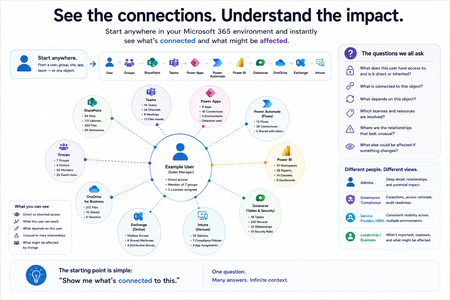
Not how many users you have. Not how many sites, teams, apps or flows you have. How much of it can you actually see connected together? I've been working across Microsoft 365 environments for a while, and I kept running into the same thing. There is no shortage of information. If anything, there is probably too much of it. Users, groups, permissions, SharePoint, Teams, Power Apps, Power Automate, Power BI, Dataverse, OneDrive, Exchange, Intune, licensing, configuration... It's all there. But when you're actually trying to understand how everything fits together, it can be a different story. You open one blade. Find something. Open another. Cross-check it. Go back. Open something else. Before long, you're jumping between different parts of the tenant trying to build the bigger picture in your head. And if you're working with larger environments, that gets difficult pretty quickly. The information isn't necessarily missing. The relationships between the information are what can be difficult to see. That got me thinking about a slightly different question: Instead of "where do I find this information?" "Show me what's connected to this." That's where VisibleState started. Start anywhere. Follow the connections. Imagine starting with a single user. Instead of seeing that user simply as a record with a list of properties, imagine being able to explore the relationships around them: User → Groups → SharePoint → Teams → Power Apps → Power Automate → Power BI → Dataverse → OneDrive → Exchange → Intune Then the questions become different: What does this user have access to? Is that access direct or coming through a group? What resources are connected to them? What depends on something they're associated with? Which licenses are involved? Are there relationships that look unusual? If something changes, what else might be affected? Those questions aren't necessarily about finding another piece of information. They're about putting information that already exists into context. A report can tell you that something exists. A connected view helps you understand what it is connected to. Illustrative example below — not a real customer environment. I'm not suggesting Microsoft 365 doesn't already give us this information Quite the opposite. Microsoft 365 already gives administrators an incredible amount of information and tooling. The thing I've been thinking about is what happens when you want to look across those boundaries. Sometimes I don't want another export. I don't want another list. I don't necessarily want another dashboard. I want to start with something I'm looking at and ask: "What's connected to this?" And then keep following the trail. That's the idea I'm exploring with VisibleState. The interesting part is what happens when you change the viewpoint The same relationships can be useful for completely different reasons. For example: Administrators may want to understand access, permissions and dependencies. Security and governance teams may want to find unusual relationships or exceptions. Compliance teams may need to understand who can access something and why. People managing multiple environments may want a consistent way to understand what's there without rebuilding the picture manually every time. Leadership may not need to see the graph at all. They may simply want to know what's important, what's exposed and what could be affected. It's still the same underlying environment. You're just looking at it from a different angle. And that's where I think things get interesting. Where I'm at with it VisibleState started as something I was building to make my own work easier. I was spending a lot of time investigating environments, tracing access and putting information together for reports. The individual tasks weren't necessarily difficult. It was the jumping between different places and reconstructing the bigger picture that took the time. So I started building something that would let me approach the environment through the relationships instead. It's grown quite a bit from where it started, and I'm continuing to build it. I'm not posting this as a product launch, and I'm not looking for people to sign up. I'm genuinely interested in whether the problem I'm seeing is familiar to other people working with Microsoft 365. So I'm curious... If you could start with any object in your Microsoft 365 environment and immediately see what it's connected to, where would you start? Would it be: Users and access Groups and permissions SharePoint and Teams Power Apps, Power Automate, Power BI and Dataverse Licensing and resources Governance and unusual relationships Something completely different Maybe you've already got a good way of doing this. Maybe you still find yourself jumping between different services and piecing things together manually. Or maybe I'm looking at the problem from the wrong direction. What's the one relationship in your Microsoft 365 environment that you wish you could see instantly?205Views0likes0Comments
Edit/Mass Edit Powerpoint linked file addresses
As the title suggests I'm looking for a way to manually edit or ideally mass edit the address to linked files in powerpoint. For context I play several games where I need to keep track of what builds I have on which character, and sometimes their in-game inventory. Unfortunately the games don't really have the greatest inventory management for the in-game item side of things. In addition the only way sometimes to remember a character's build is to log onto that character and pull up their build page. With enough characters it can be pain remember what I have where even though I enjoy the games themselves. To get around some of the flaws I have powerpoints I use to keep track of certain things like inventory and build. One ppt may have photos of all the current builds for each character, another may have photos of their inventory and so forth. Certainly not ideal but once the initial setup was done, it's been fairly easy to maintain and I only have to update an odd photo here or there if something changes. Which brings me to my potential issue here. I've been keeping the ppts on a thumb drive along with the photos so I can have everything in one place. Recently the drive decided it was done and checked into that silicone repository in the sky and no longer works. Fortunately however I was able to move everything over to a newer drive before the old one finally checked out. While I was able to save my data, I also introduced 2 side effects I wasn't thinking of at the time in my haste to avoid losing everything. When moving everything over I moved things over in batches to avoid taxing the failing drive too hard and placed each batch in its own folder to avoid copying the same thing more than once. So think something like Folder 1, Folder 2, Folder 3, and so on. To conserve on file size of the ppt itself I always chose the option of "Link to File" when inserting the photos to the slides instead of the basic "Insert" or "Insert and Link" options. This means 2 things, the drive location is no longer correct, and the folder location is no longer correct in the links. While I could in theory just change the drive letter and make the folder structure the same again, moving it in batches actually let me organize the raw photos better, but means I now need to correct the addresses for the ppts themselves since the old links no longer work. In the program I know we can go to Info, then press the Edit Links To Files button, and try to change stuff there. The problem is that I can only change one thing at the time there. On top of that if I press the Change Source button, it wants me to find the photo individually vs just chanting the text address of the photo. These wouldn't be issues if it was just a few photos we're talking about as I could just go in, relink by hunting each one and roll. However there are around 250 photos that I would have to do this for, and it would be very tedious. Plus the fact the previews don't work anymore either. (yes i'm one of those kinds of gamers) So what I'm hoping you folks can help me with is a way to edit the text addresses manually for the links. Ideally in mass groups, but I can do it one at the time if I have to. For example let's say I have photo one and it's address looks like "D:\Game1\Character Group1\CharacterA\Build1\Photo1" on the old drive. What I want is a way to change it to say "E:\Game1\Batch1\Character Group1\CharacterA\Build1\Photo1" type of thing. Ideally I'm hoping for a way to change those addresses in mass. If I have to text edit them all one by one, that's still alot faster than having to hunt and relink each photo individually. Thanks in advance for any advice.400Views0likes4CommentsMoving Office 365 Mailboxes to IMAP Servers - What’s the Best Approach
I’ve recently been looking into scenarios where organizations need to move mailboxes from Microsoft 365 to IMAP based email servers, and I noticed this is still a common requirement in many migrations. In most cases, the challenge is not just moving emails, but making sure everything like folder structure, old emails, and user data stays intact without creating too much disruption for users. From what I’ve seen, doing this manually can get very complex, especially when there are multiple mailboxes or large data volumes involved. That’s where migration tools usually come into the picture. Most tools simplify things by handling: 1. Secure connection to Microsoft 365 accounts 2. Bulk mailbox migration 3. Preserving folder hierarchy 4. Reducing downtime during the move 5. Avoiding duplicate data issues One thing I’ve noticed is that running a small pilot migration first always helps. It gives a clear idea of how the actual migration will behave before moving all users. Has anyone here worked on Office 365 to IMAP migration at scale? Would be good to know what approaches or tools worked best in your case and what challenges you faced during the process.478Views0likes2CommentsOffice 365 Mailbox Export to PST - Third Party Tools: What’s Your Experience?
Exporting Office 365 mailboxes to PST is still a common requirement in many Microsoft 365 environments, especially for backup, compliance, and migration scenarios. While Microsoft offers native options like Purview eDiscovery and Outlook export, many administrators also consider third-party tools when dealing with large mailboxes or bulk export requirements. In real-world scenarios, factors like speed, ease of use, permission handling, and consistency of exported data often influence the choice of tool. Some teams prefer native methods for compliance control, while others explore third-party solutions to simplify large-scale or repeated export tasks. For those working with Microsoft 365, what has your experience been with third-party PST export tools? Have they helped in your environment, or do you still rely mainly on Microsoft’s native options?497Views1like3Comments