microsoft lists
1754 TopicsFailed to load current time zone
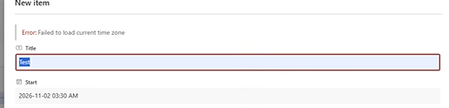
SharePoint List Fails to Save Items After Changing Site Time Zone to "Pacific Time (British Columbia)" British Columbia will move to permanent Daylight Saving Time effective November 1, 2026. As a result, clocks will no longer fall back by one hour and will remain on UTC-07:00 year-round. Microsoft has introduced the new time zone (UTC-07:00) Pacific Time (British Columbia) for this change. As part of this transition, we updated the site's Regional Settings from (UTC-08:00) Pacific Time (Canada/US) to (UTC-07:00) Pacific Time (British Columbia). We have SharePoint lists with Start Date & Time and End Date & Time columns configured as Date and Time fields in multiple sites. Following this change, one specific site is now experiencing an issue where both users and site administrators are unable to save list items. The following error is displayed: "Failed to load current time zone" Additional Details: The issue started immediately after changing the site's Regional Settings. Reverting the site back to Pacific Time (Canada/US) did not resolve the issue. Some other SharePoint sites were updated to the same Pacific Time (British Columbia) setting and continue to work correctly. The affected site contains a calendar view built on a custom SharePoint list. The Start Date and End Date columns are configured as Date/Time fields. Location: Victoria, British Columbia. Has anyone encountered this issue before? Are there any known dependencies related to Regional Settings, Date/Time columns, calendar views, or site time zone configuration that could cause this behavior on a single site while others continue to function normally? Any guidance would be appreciated.Solved677Views1like7CommentsIgnite’26 Spotlight: Announcing Microsoft Baseline security mode 2026 General Availability
Security is Microsoft’s top priority At Microsoft, security is our top priority. Through the Secure Future Initiative (SFI), we're turning lessons learned into stronger security across everything we build and deliver. Customers consistently ask three questions: What is Microsoft’s secure-by-default benchmark for Microsoft 365, Windows, and Azure? How does SFI translate into better security for customers? Is my tenant’s security posture hardened per Microsoft’s recommendations? Microsoft Baseline security mode (BSM) is designed to help answer these questions. It brings Microsoft's recommended security controls, directly to customers out of the box available to the administrators directly in the Microsoft 365 admin center. First introduced at Ignite 2025, BSM takes another major step forward today. Today at Microsoft Ignite 2026, we're announcing that Microsoft Baseline security mode (BSM) 2026 is now generally available, with a phased rollout across all supported Microsoft 365 cloud environments worldwide. Microsoft Baseline Security Mode marks a significant step forward in making security the default, helping organizations move from fragmented security configurations to a more consistent, integrated approach. It is built on Microsoft’s experience operating secure cloud services, responding to incidents, and applying lessons from the Secure Future Initiative (SFI). BSM combines ease of use with advanced capabilities to help harden your Microsoft cloud services’ security posture, every day, week, and year, with minimal effort. BSM is a Continuous Journey Microsoft Baseline security mode is not a one-time feature; it is an evolving standard. We continue to regularly strengthen the baseline with additional configurations across Microsoft cloud services. BSM 2025 marked the first milestone, starting with Microsoft 365 and Entra. BSM 2026 expands coverage to Purview, Intune, and Dynamics 365, with Azure and Windows in private preview. Future releases are expected to expand the baseline across Microsoft cloud services. Here’s what’s new in BSM 2026 compared with BSM 2025: Expanded with more workloads: BSM 2026 extends protection beyond the original five BSM 2025 workloads (Office, SharePoint, Teams, Exchange, and Entra) to include: o Microsoft Intune o Microsoft Purview o Dynamics 365 o Azure (in Private Preview), and o Windows (in Private Preview). New Applications category: In addition to the three categories that BSM already has, BSM 2026 now covers what applications can do, how they access data, and which permissions they hold. With Applications added, Baseline security mode 2026 spans four categories: o Applications o Authentication o Devices & Endpoints o Files Expanded coverage within the existing categories: New recommendations include stronger macro security and blocking native COM add-ins in Office, requiring multifactor authentication (MFA) for guest users, requiring dual admin consent for critical Intune operations, disabling classic SharePoint page creation and more. Enable Baseline security mode in the Microsoft 365 admin center As Global Administrator, you can navigate to: Microsoft 365 admin center → Org Settings → Security & Privacy → Baseline security mode to get started with BSM. BSM 2026 introduces 24 new settings. Administrators can apply each setting or run them in simulation mode to evaluate potential impact within their tenant. BSM provides flexibility and control, enabling administrators to manage each setting independently. This phased approach is designed to help administrators transition to secure-by-default configurations. Let’s deep dive into some of the BSM 2026 settings. Microsoft Baseline security mode 2026 settings Applications The Applications category in BSM 2026 addresses what apps can do, how they access data, and the permissions they hold. In BSM 2026 we are making generally available 16 applications settings. Highlights are below. For the full list see the Microsoft baseline security mode – Learn article New apps require assignment of the tenants allowed to access them (Entra) Allowing applications to span multiple tenants is a security risk. With this Entra setting, admins are empowered to control the tenants that a given app is allowed to be instantiated. Block COM add-ins that aren't on the admin allow list (Office) In the same fashion as Apps, admins can control the list of COM add-ins that are allowed in their organization. Require external users to wait in the lobby before joining meetings (Teams) Security risk increases when external users are brought into the workforce as the policy drift might happen for them. Much like there are controls for secure collaboration, for secure Teams meetings admins can now require externals users to wait in the lobby before joining meetings. Disable guest users from having eDiscovery roles (Purview) Purview eDiscovery roles are highly privileged, allowing users to search a broad range of Microsoft 365 content and export the results. Assigning these roles to external guests poses a significant risk unless those guests have been vetted and explicitly authorized for this access. This BSM 2026 setting blocks external guests from holding eDiscovery roles by default. Block creation and editing of classic pages in SharePoint sites (SharePoint) This setting prevents users from creating new classic SharePoint pages or editing existing ones, including publishing, wiki, and web part pages. Existing published pages remain viewable the setting does not delete them. It helps reduce risks from harmful script injection and unsupported legacy customizations while encouraging adoption of modern SharePoint experiences. Report applications without Exchange App RBAC permissions (Exchange) This setting identifies applications accessing Exchange without Exchange App RBAC (role-based access control) permissions, giving administrators visibility into apps that may have overly broad access. These insights help administrators prioritize permission reviews and identify opportunities to limit app access to the mailboxes they need. Require scoped access to files and sites for High Privileged Applications (HPA) (SharePoint) This setting requires highly privileged applications to use a defined, limited scope when accessing OneDrive and SharePoint files and sites, rather than relying on unrestricted, organization-wide access. It helps reduce the risk of unauthorized access and data leakage from broadly permissioned apps. Authentication The Authentication category in BSM strengthens how users and apps sign in, helping reduce credential theft, account takeover, and access through outdated authentication methods. In BSM 2026 we are making generally available 4 authentication settings: Don't allow Microsoft 365 trial tenants to federate with your organization (Teams) Block external apps from using pre-authenticated tokens to access OneDrive and SharePoint content (SharePoint) Enable Continuous Access Evaluation (CAE) (Dynamics 365) Require MFA (multi-factor-authentication) for guests and external users (Entra) BSM 2025 we brought in MFA for admin accounts and upleveling that baseline for external users. This setting is designed to significantly reduce the risk from external access across Microsoft 365 services, including Exchange, SharePoint, OneDrive, Teams, and Microsoft 365 apps. To strengthen your security posture, we strongly recommend requiring MFA for external users. Devices & Endpoints Stronger device security starts with hardening through a device management soluion like Intune. The Devices & Endpoints category introduces four critical Intune security settings to strengthen device protection: Alert users when a new device is enrolled (Intune) Require a device compliance policy (Intune) Restrict the number of devices a user can enroll (Intune) Require a second admin to approve sensitive actions (Intune) The key safeguard: Two admins, one critical action. Sensitive Intune changes require a second administrator's approval, helping prevent unauthorized or accidental changes. Azure – now part of Microsoft Baseline security mode (Private Preview) Microsoft Baseline security mode expands to include seven settings across Azure Storage and Azure Key Vault, now available in Private Preview. The Azure Storage settings require secure transfer, prevent anonymous public access, enforce a minimum TLS version, and prevent Shared Key authorization; the Azure Key Vault settings restrict public network access and require purge protection and soft delete. Together, these settings provide an Azure Policy-based foundation that gives administrators visibility into security posture and workload impact before enrolling ready scopes for enforcement. Learn more about Azure settings -part of Microsoft Baseline security mode. Enroll in the preview https://aka.ms/M365BaselineSecurityModeEnroll Windows – now part of Microsoft Baseline security mode (Private Preview) Microsoft Baseline security mode expands to include three Windows settings, enable virtualization-based security (VBS), enable secure boot, and enable the security processor, now available in Private Preview. The VBS setting isolates security-sensitive operations from the main operating system; the secure boot setting helps prevent malicious software from loading at startup; and the security processor setting uses dedicated hardware to help protect sensitive data, including credentials and keys. Together, these settings provide a foundation that gives administrators visibility into Windows security posture and helps strengthen device protections. Learn more about Windows baseline protection – part of Microsoft Baseline security mode. Enroll in the preview https://aka.ms/M365BaselineSecurityModeEnroll BSM enhancements to support your security journey (Private Preview) In response to your feedback, BSM introduces four new features in private preview to help administrators review security posture, share progress, and put configurations in context. Preview features are available to a limited set of customers and may change before general availability. Action oriented dashboard. Review your BSM security posture through a dashboard focused on the settings that need attention. Downloadable security and compliance reports. Download reports to support security reviews and compliance discussions, and share a view of your BSM posture with stakeholders. Regulatory framework mapping. View BSM settings in the context of regulatory frameworks to support compliance and audit conversations. BSM does not guarantee compliance with any law or regulatory framework. Customers remain responsible for their own compliance obligations. Geo locations (for Multi-Geo tenants). Bring geographic context into your review of BSM posture across Multi-Geo environments. Enroll in the preview https://aka.ms/M365BaselineSecurityModeEnroll Figure 7. Baseline security mode dashboard showing posture summaries, category progress, and regulatory framework coverage. On the roadmap: BSM 2025 as the default for all new Microsoft 365 tenants As part of strengthening our customers’ secure-by-default posture, BSM 2025 will become the default configuration for all new Microsoft 365 tenants. Following its announcement at Ignite 2025, we strongly encourage existing Microsoft 365 and Entra customers to opt in to all BSM 2025 settings. On-Premises Baseline security mode As outlined in early November 2026 here, we are making new investments to reduce On-Premises security risks. Within the Secure pillar of the on-premises security initiative, we’re hardening the products themselves through On-Premises Baseline Security Mode, starting with supported Exchange Server, SharePoint Server, and Skype for Business Server workloads. On-Premises Baseline Security Mode is designed to make the default security posture stronger, reducing the number of recommended security settings administrators must configure and maintain manually. For supported on-premises server workloads, it starts with a validated and tested secure-by-default configuration from initial deployment, while preserving administrator control. To learn more, check out: New Investments to Reduce On-Premises Security Risk | Microsoft Community Hub Get started To get started with Microsoft Baseline security mode 2026, as it rolls out, sign in with your global admin account to Microsoft 365 admin portal and open Baseline security mode settings. If you are new to Microsoft 365, learn how to try or buy a Microsoft 365 subscription. With built-in dashboards and telemetry, BSM provides visibility into security configurations and a predictable, secure-by-default foundation to help organizations of all sizes reduce legacy risks, strengthen protection, and support compliance and audit readiness References: Microsoft baseline security mode – Learn article Microsoft Secure Future Initiative Azure Baseline security mode – Learn more Windows baseline protection – Ignite announcement Microsoft Corporate adopts BSM - https://aka.ms/msd-baselinesecuritymode Need help. Engage with FastTrack – https://aka.ms/BSMFastTrack Join us at Ignite in our sessions: LTG1168: The foundation of Trusted AI: SharePoint security and resiliency, Thurs 11/19, 9:00-9:15 AM, Moscone South | The Hub, Lightning Talk 2 BRK211 - Secure and Govern Microsoft Copilot and Cowork, Thurs 11/19, 11:30 AM - 12:15 PM, Marriott Marquis | Lower B2, Yerba Buena Salon 9 Thank you!2.3KViews0likes0Comments
SharePoint Designer 2013
Hello SharePoint Experts, I need some guidance regarding SharePoint Online classic page customization. Our organization is currently using SharePoint Online, and traditionally we have relied on SharePoint Designer 2013 for tasks such as: Editing Classic Pages Modifying Display Forms (DispForm.aspx) Modifying Edit Forms (EditForm.aspx) Customizing List Forms Making page-level changes using ASPX pages However, I am unable to install SharePoint Designer 2013 on my system and would like to understand the available alternatives. Could you please help clarify the following: What is the recommended alternative to SharePoint Designer 2013 for SharePoint Online? How can Classic Pages be edited in SharePoint Online without SharePoint Designer? Is it possible to customize DisplayForm.aspx, EditForm.aspx, and NewForm.aspx without using SharePoint Designer? Can Power Apps be used as a replacement for customized list forms? Are there any supported Microsoft-recommended approaches for customizing classic pages and forms in SharePoint Online? If SharePoint Designer is no longer recommended, what tools are commonly used by SharePoint Online administrators and developers for these scenarios? My objective is to continue maintaining existing classic SharePoint Online sites while following Microsoft's supported and modern approach. Any guidance, best practices, documentation references, or real-world experiences would be greatly appreciated. Thank you in advance for your support.172Views0likes2Comments
Workflow for importing Excel to List
I'm a novice developing a workflow for importing an Excel spreadsheet to a SharePoint list. Have I missed anything? Workflow: Thoroughly clean up the data in Excel before importing to a list. Caution: Excel filters (and list filters) are case-insensitive and ignore superfluous spaces, etc. So we can't rely solely on filter functionality to find messy values. Instead, consider using the EXACT function in Excel like this: =OR(EXACT(A2,"PRIMARY"),EXACT(A2,"SECONDARY")). See this Stack Exchange post for more options: https://sharepoint.stackexchange.com/questions/317576/find-list-values-that-arent-in-the-picklist-choices Or, as a last resort, we could consider importing to an Oracle table and use a GROUP BY query (SQL) to find incorrect values, since that's dead easy in databases. I don't use Access for this because it has the same filtering limitations that Excel and lists have. Manually create an empty list. Or import a blank list from Excel and modify it. Caution: When importing from Excel to a list, the list won't honor the Excel column names for the internal list names, even if the Excel names are clean. The list will generate column names like "field_0" through to "field_30" (or whatever applies). Google suggests importing from Access is an alternative -- the column names should be honored. https://i.sstatic.net/3KoAsrMl.png Caution: The time zone for my SharePoint sites and personal MS list environment is wrong. It's set to Pacific Time, when it should be Eastern Time. Keep an eye on any list date values to ensure they are correct and haven't been automatically changed to a different day. Import the Excel rows/data using Power Automate. For what it's worth, any dates that get imported via PA will be correct, despite the time zone, unlike when importing data from Excel using the list UI. Inspect the imported data, correct the list columns/settings, correct the Excel data, and repeat #3. Do this multiple times -- as many times as it takes.523Views0likes2Comments
Disable incessant nagware popups
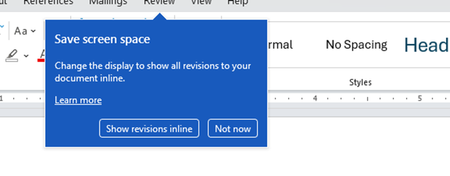
I don't know about everyone else, but I am sick and tired of the nagware pop ups in Word, Excel, PowerPoint, Outlook, etc. Every single product harasses me with pop ups trying to tell me "hey, did you know this feature was here?", "you can do this if you click that", "let me hold your hand through using products you've used for decades even though you don't want daddy Microslop to do that". This is a prime example. I keep getting the same ones again and again and again and everything I've read indicates they should only appear once. But they don't. They keep coming back like a psychotic stalker ex who wants alimony even though you were never married. How do I get this nagware to stop?!691Views1like2CommentsUltimate Polling and Quiz Experience with Polls app: The Replacement for Forms app in Teams meeting
Initially Forms app was launched in Teams - for different experiences based on the sync vs async user scenarios, as it points to polling experience in meetings for quick creation to launch, while it points to survey experience in the context of Teams channel.To provide an intuitive and easy-to-access experience , Polls app was launched - a dedicated app for all your polling and quiz needs in Teams meeting and chat. We are glad to see that hosting an effective and interactive meeting just got easier after the launch of Polls.1.1MViews7likes43Comments
Create a chart in Sharepoint from a sharepoint list
I have created a list in sharepoint. Several columns with various values have been created in this list. We want to use five of these columns where the employees can make a choice for an analysis and we want to turn it into a chart. The different choices that can be made are: Bad, Could be better & Good. Now I'm trying to somehow run a chart out of this but can't get it to work. In your sharepoint site you can make a quick chart from a list. To be able to do this you have to work with a number value in a column in your list. Now I also looked to convert the choice Bad, Could be better & Good to a number, but I don't see any possibility in this. I hope someone can help me with this. Thanks in advance.11KViews0likes4CommentsOneDrive and SharePoint : New Hero Link has arrived
🚀 One Link. Simpler Sharing - Hero Link Microsoft is rolling out a new sharing experience across SharePoint, OneDrive, and Microsoft 365 called the "Hero Link" - (Not Hero Webpart 😀) Instead of creating multiple links for the same file, every file and folder will have a single primary sharing link that can be updated after it's been shared. ✅ One consistent sharing experience ✅ Update permissions without creating a new URL ✅ Change link access at any time ✅ Reduce sharing link sprawl Additional capabilities include: 🔹 People with edit access can reshare and add additional people. 🔹 Apply folder access changes to this item, allowing folder permissions to flow down to files. 🔹 Existing sharing links will continue to work and appear under Other Links, where you can continue using options such as expiration dates, view-only access, and edit permissions. Admins can also configure default link audiences at the site level to match different sharing requirements. The rollout begins in October 2026. 🎥 I've also recorded a step-by-step walkthrough of the new Hero Link experience so you can see exactly how it works in practice. https://youtu.be/HdXgfVy4fl4 3.5KViews1like0Comments
Hyperlinking List gallery view on SP
I have a list that is full of training courses and i want to make it so that when a user select one of them, it will hyperlink to the corresponding hyperlink. I could do an powerapp, but wanted to see if there is a way to do this via list webpart on a SP page. Can't use event webpart since there are no set dates, some are on demand.258Views0likes2Comments
SharePoint List Web Part - major caching issues
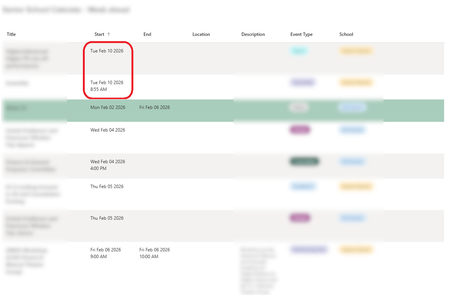
Hi All, I've spent a lot of time building a List based company calendar in our SharePoint Intranet Portal, and the calendar itself is working great, however I'm having no end of headaches with the List Web Part. (not just for this calendar, but all list web parts for that matter) The calendar has a Start and End field - both are Date and Time fields. A custom view is created for use with the List Web Part to embed an "upcoming week" view, this is based on a filter which checks both Start and End dates to see whether an event exists within or spans the date range from today to 7 days in the future, so it is a rolling 7 day window. This is based on a number of filter criteria which include [Today] and [Today]+6. The view also has a sort criteria to sort based on the Start (Date/Time) field. This all works fine when previewing the view within the list itself - at midnight the results update to include events from the day that is now 7 days in the future which were previously excluded. So the view itself is working fine. However the same view in a List Web part on another page suffers from a ridiculous amount of browser side (?) caching, to the point that it is basically broken and unusable. When I open the page the next day in a browser (even if the browser was closed) one of three things happens, somewhat at random: The events 7 days in the future (which just came into filter scope today) just don't appear until a forced page reload is done. The events 7 days in the future do appear but they are sorted incorrectly, appearing at the TOP when the date sort order should show them at the BOTTOM. Sometimes 2 happens but the event is shown with the Start and End Date/Time fields empty - so not only is it at the wrong end of the list it doesn't even show a date at all until the page is refreshed. Here is a picture showing the sort order being incorrect as in case 2: When these various problems happen a full CTRL-F5 browser refresh always updates the list to be complete, up to date and sorted correctly, however, if after that you click away from the page and follow a link to return to it OR press a regular F5 refresh it goes back to being incorrect! It takes many page reloads or a lot of time to pass (hours) before it finally settles down and gives the correct results every time. Then the next day the same caching problems happen again. If you go to a new browser or PC the same problems happen again, suggesting this is browser side caching not something at the servers. While the actual content of the list items update in real-time if you edit the list content in another page (which is pretty cool) the "result set" of list items (which items should or should not be seen) is heavily cached, and the sorting is unreliable. Has anyone else found a solution to this ? I have already done things like disabling offline mode for the list, (this only seems to affect caching of the actual data in the list items, not caching of filter results) etc and I cannot find a solution. The only thing I know which would probably work, as I have had to use this approach on another list is to extend the date range of the filter criteria for the view further into the future, then filter out the extra days using json code in "format view - however AFAIK you can only selectively hide rows like this if you use a custom rowFormatter, which means you have to fully re-implement the standard view including hard coding all the columns you want and it still won't look quite the same. This is a lot of work and maintenance overhead in the future to work around a caching problem that shouldn't exist in the first place. Any thoughts appreciated as a lot of time and effort has gone into building an entire calendar system around a SharePoint List, only to find that the list web part just doesn't work properly.1.2KViews0likes2Comments