developer
1622 Topics
Supported App-Only APIs for SharePoint Site Access and Group Membership (No PowerShell)?
a { text-decoration: none; color: #464feb; } tr th, tr td { border: 1px solid #e6e6e6; } tr th { background-color: #f5f5f5; } I am trying to determine the supported approach for retrieving SharePoint Site Owners, Members, and Visitors (effective user access) in an App-Only (Application Permissions) scenario without using PowerShell. Specifically, I am building an MCP tool that needs to: Check whether a specific user has access to a particular SharePoint site. Retrieve the list of users who have access to a SharePoint site, especially through the SharePoint Owners, Members, and Visitors groups. From my understanding, Microsoft Graph can be used to enumerate SharePoint sites and permissions, but retrieving the actual membership of the associated SharePoint groups does not appear to be fully supported through Graph alone. Most recommendations I have found suggest using SharePoint REST APIs, CSOM, or PnP-based solutions. My questions are: How can I retrieve SharePoint Site Owners, Members, and Visitors (effective user access) in an App-Only scenario without using PowerShell? Are there any supported Microsoft Graph APIs (including Beta APIs), SharePoint REST APIs, SDKs, Python libraries, CSOM, or other approaches that can provide this information? Can a backend service implemented entirely in code (without PowerShell execution) determine: Whether a specific user has access to a SharePoint site? The users belonging to the site's Owners, Members, and Visitors groups? The reason for asking is that I am developing a backend service, and invoking PowerShell from the application is not a practical option. I am looking for a supported API/SDK-based solution that can be implemented directly in code using App Registration permissions only.36Views0likes1Comment
Build AI-powered apps without creating a vector database
How do you build AI-powered applications that can reason over enterprise content while maintaining security, compliance, and governance? The latest SharePoint Embedded post explores how the https://devblogs.microsoft.com/microsoft365dev/build-ai-powered-apps-without-creating-a-vector-database?utm_source=social-M365dev can make it easier to ground AI experiences in content stored within customers' Microsoft 365 tenants. We also look at the SharePoint Embedded MCP Server (preview), an open-source developer tool that enables AI coding assistants like GitHub Copilot in Visual Studio Code or the CLI, Claude, Cursor, and Azure AI Foundry to help provision, configure, and manage SharePoint Embedded applications using natural language. Together, these capabilities help developers: Ground AI on enterprise content Avoid managing a separate vector database Respect Microsoft 365 security and compliance controls Accelerate development with AI-powered tooling https://devblogs.microsoft.com/microsoft365dev/build-ai-powered-apps-without-creating-a-vector-database?utm_source=social-M365dev to learn how to build the next generation of intelligent, enterprise-ready applications.32Views0likes0Comments
Ability to schedule email of SharePoint post
We've started using SharePoint to create and send mass emails in our organization, but its a huge pain that I can't schedule them ahead of time to send at a specific time/date. Could you work on creating a way to schedule not just the publishing of a SharePoint news post, but when it is shared via email? That would be amazing.198Views1like3Comments
SharePoint List Web Part - major caching issues
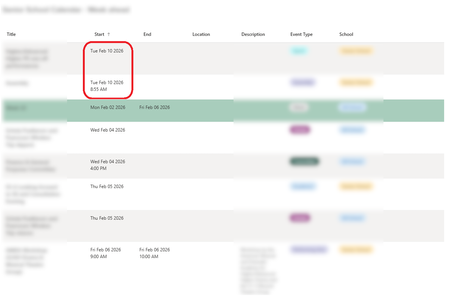
Hi All, I've spent a lot of time building a List based company calendar in our SharePoint Intranet Portal, and the calendar itself is working great, however I'm having no end of headaches with the List Web Part. (not just for this calendar, but all list web parts for that matter) The calendar has a Start and End field - both are Date and Time fields. A custom view is created for use with the List Web Part to embed an "upcoming week" view, this is based on a filter which checks both Start and End dates to see whether an event exists within or spans the date range from today to 7 days in the future, so it is a rolling 7 day window. This is based on a number of filter criteria which include [Today] and [Today]+6. The view also has a sort criteria to sort based on the Start (Date/Time) field. This all works fine when previewing the view within the list itself - at midnight the results update to include events from the day that is now 7 days in the future which were previously excluded. So the view itself is working fine. However the same view in a List Web part on another page suffers from a ridiculous amount of browser side (?) caching, to the point that it is basically broken and unusable. When I open the page the next day in a browser (even if the browser was closed) one of three things happens, somewhat at random: The events 7 days in the future (which just came into filter scope today) just don't appear until a forced page reload is done. The events 7 days in the future do appear but they are sorted incorrectly, appearing at the TOP when the date sort order should show them at the BOTTOM. Sometimes 2 happens but the event is shown with the Start and End Date/Time fields empty - so not only is it at the wrong end of the list it doesn't even show a date at all until the page is refreshed. Here is a picture showing the sort order being incorrect as in case 2: When these various problems happen a full CTRL-F5 browser refresh always updates the list to be complete, up to date and sorted correctly, however, if after that you click away from the page and follow a link to return to it OR press a regular F5 refresh it goes back to being incorrect! It takes many page reloads or a lot of time to pass (hours) before it finally settles down and gives the correct results every time. Then the next day the same caching problems happen again. If you go to a new browser or PC the same problems happen again, suggesting this is browser side caching not something at the servers. While the actual content of the list items update in real-time if you edit the list content in another page (which is pretty cool) the "result set" of list items (which items should or should not be seen) is heavily cached, and the sorting is unreliable. Has anyone else found a solution to this ? I have already done things like disabling offline mode for the list, (this only seems to affect caching of the actual data in the list items, not caching of filter results) etc and I cannot find a solution. The only thing I know which would probably work, as I have had to use this approach on another list is to extend the date range of the filter criteria for the view further into the future, then filter out the extra days using json code in "format view - however AFAIK you can only selectively hide rows like this if you use a custom rowFormatter, which means you have to fully re-implement the standard view including hard coding all the columns you want and it still won't look quite the same. This is a lot of work and maintenance overhead in the future to work around a caching problem that shouldn't exist in the first place. Any thoughts appreciated as a lot of time and effort has gone into building an entire calendar system around a SharePoint List, only to find that the list web part just doesn't work properly.865Views0likes2CommentsJoin Microsoft and M-Files on Sept 23: Content readiness for AI and Agents webinar
What does it take to get your content ready for Microsoft Copilot and Agentic AI? Join M-Files and Microsoft for the “https://aka.ms/SPEmbedded/Webinar/M-Files-20260923” webinar on September 23, 2pm ET, to find out. Ian Story, Principal Product Manager, Microsoft, will be presenting with Cheryl McKinnon (Principal Analyst, Forrester) and Ryan Barry (Vice President of Strategic Operations & Corporate Development, M-Files). Together they'll explore what it takes to make enterprise content ready for the next generation of AI-powered applications and agents. https://aka.ms/SPEmbedded/Webinar/M-Files-20260923 In this webinar, you’ll hear practical perspectives on how to: Assess content readiness: Identify the quality, governance, access, and discoverability gaps that can limit Copilot and agent outcomes. Build a trusted knowledge foundation: Keep content secure, compliant, and permission-aware while making it easier for AI to retrieve the right information. Reduce fragmentation: Bring content and context together so users and agents can work with higher precision. Prepare for agentic workflows: Move beyond static document storage toward intelligent, adaptive content experiences that support reasoning and action. See you there!168Views0likes0Comments
Sharepoint view level permissions
Hello, I’m facing an issue in SharePoint. I have a main list where I need to create two views one for “A” users and another for “B” users. What should change is, for example, that “A” users can only see column “A” and “B” users can only see column “B”. And being sensitive data, they shouldn't be able see each other's columns. Using different lists is the only viable way I currently see this working, which i don't really want since this requires a lot more of work, unless someone can suggest a better solution. Note that currently I'm using two different pages inside the same website for user's "A" and "B". Thank you very much.1.1KViews1like2Commentspnp-modern-search does not work in the local SharePoint workbench
Version used 4.9.0 (SPFx 1.15.0) Describe the bug The solution works correctly when deployed using the .sppkg package in SharePoint Online, but it does not work in the local SharePoint workbench. There are two related issues: When running gulp serve, the build/runtime reports an error related to BANNEDUSERNAME/sp-webpart-workbench/lib/api/, suggesting a failure in loading or resolving the local workbench API module. When adding the web part to the local workbench page, the web part fails to render with the following error: Error: Cannot find module './15.js' The second error appears to be related to a missing or incorrectly resolved chunk/module during bundle loading. The issue only occurs in the local workbench. The deployed .sppkg solution in SharePoint Online works correctly. Node.js version: 16.8.0 (compatible with SPFx 1.15.0). Dependencies installed via npm install without errors. To Reproduce Clone the repository Run npm install Run gulp serve Open the local SharePoint workbench Add the web part to the page Observe: Error during gulp serve related to BANNEDUSERNAME/sp-webpart-workbench/lib/api/ Web part fails to load with Cannot find module './15.js' Expected behavior The web part should load and render correctly in the local workbench without module resolution errors. Desktop : Browser: Chrome Node.js: 16.8.0 SPFx: 1.15.0233Views0likes2CommentsSPFx webpart not displaying after insert webpart (error below)
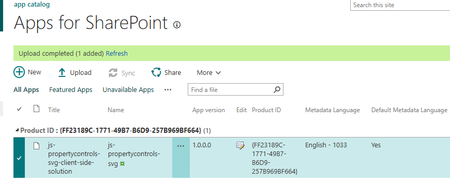
I deployed my SPFx webpart successfully to my site, however after inserting it on a page I get the following error: Uncaught (in promise) Error: Script error for "ea2f4f01-db05-44e9-8900-22d9ef8d632f_0.0.1/SvgGhostWebPartStrings" https://requirejs.org/docs/errors.html#scripterror at makeError (eval at V (sp-pages-assembly_en-us_12745640b376ada2f337a0ad84b60ffc.js:233:13154), <anonymous>:5:1843) at HTMLScriptElement.onScriptError (eval at V (sp-pages-assembly_en-us_12745640b376ada2f337a0ad84b60ffc.js:233:13154), <anonymous>:5:17037) Below is an image of the webpart uploading successfully485Views0likes3Comments
Recycle Bin and Site Content Hidden for Site Members and Site Visitors
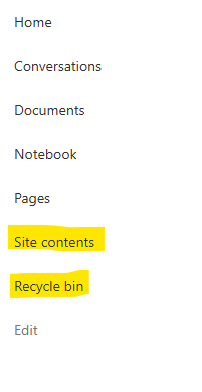
I posted this before but made a mistake with my write up, so I am reposting. I have a requirement that the Recycle bin and Site Contents should be be hidden from the Site Members and Site Visitors. Please how can I achieve this because the Server Infrastructure activation is not working for me. Any workarounds? Please help764Views0likes1Comment