deployment
35 Topics
How much of your Microsoft 365 environment can you actually see at once?
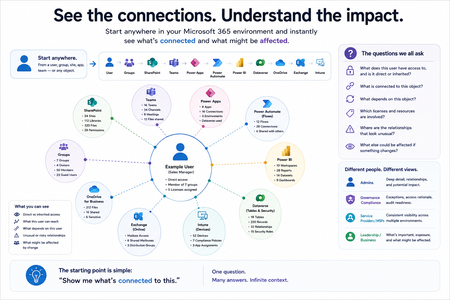
Not how many users you have. Not how many sites, teams, apps or flows you have. How much of it can you actually see connected together? I've been working across Microsoft 365 environments for a while, and I kept running into the same thing. There is no shortage of information. If anything, there is probably too much of it. Users, groups, permissions, SharePoint, Teams, Power Apps, Power Automate, Power BI, Dataverse, OneDrive, Exchange, Intune, licensing, configuration... It's all there. But when you're actually trying to understand how everything fits together, it can be a different story. You open one blade. Find something. Open another. Cross-check it. Go back. Open something else. Before long, you're jumping between different parts of the tenant trying to build the bigger picture in your head. And if you're working with larger environments, that gets difficult pretty quickly. The information isn't necessarily missing. The relationships between the information are what can be difficult to see. That got me thinking about a slightly different question: Instead of "where do I find this information?" "Show me what's connected to this." That's where VisibleState started. Start anywhere. Follow the connections. Imagine starting with a single user. Instead of seeing that user simply as a record with a list of properties, imagine being able to explore the relationships around them: User → Groups → SharePoint → Teams → Power Apps → Power Automate → Power BI → Dataverse → OneDrive → Exchange → Intune Then the questions become different: What does this user have access to? Is that access direct or coming through a group? What resources are connected to them? What depends on something they're associated with? Which licenses are involved? Are there relationships that look unusual? If something changes, what else might be affected? Those questions aren't necessarily about finding another piece of information. They're about putting information that already exists into context. A report can tell you that something exists. A connected view helps you understand what it is connected to. Illustrative example below — not a real customer environment. I'm not suggesting Microsoft 365 doesn't already give us this information Quite the opposite. Microsoft 365 already gives administrators an incredible amount of information and tooling. The thing I've been thinking about is what happens when you want to look across those boundaries. Sometimes I don't want another export. I don't want another list. I don't necessarily want another dashboard. I want to start with something I'm looking at and ask: "What's connected to this?" And then keep following the trail. That's the idea I'm exploring with VisibleState. The interesting part is what happens when you change the viewpoint The same relationships can be useful for completely different reasons. For example: Administrators may want to understand access, permissions and dependencies. Security and governance teams may want to find unusual relationships or exceptions. Compliance teams may need to understand who can access something and why. People managing multiple environments may want a consistent way to understand what's there without rebuilding the picture manually every time. Leadership may not need to see the graph at all. They may simply want to know what's important, what's exposed and what could be affected. It's still the same underlying environment. You're just looking at it from a different angle. And that's where I think things get interesting. Where I'm at with it VisibleState started as something I was building to make my own work easier. I was spending a lot of time investigating environments, tracing access and putting information together for reports. The individual tasks weren't necessarily difficult. It was the jumping between different places and reconstructing the bigger picture that took the time. So I started building something that would let me approach the environment through the relationships instead. It's grown quite a bit from where it started, and I'm continuing to build it. I'm not posting this as a product launch, and I'm not looking for people to sign up. I'm genuinely interested in whether the problem I'm seeing is familiar to other people working with Microsoft 365. So I'm curious... If you could start with any object in your Microsoft 365 environment and immediately see what it's connected to, where would you start? Would it be: Users and access Groups and permissions SharePoint and Teams Power Apps, Power Automate, Power BI and Dataverse Licensing and resources Governance and unusual relationships Something completely different Maybe you've already got a good way of doing this. Maybe you still find yourself jumping between different services and piecing things together manually. Or maybe I'm looking at the problem from the wrong direction. What's the one relationship in your Microsoft 365 environment that you wish you could see instantly?224Views0likes0Comments
Why am I not getting Comcast emails on my iPhone?
Hi everyone, I’m trying to convert several pictures on my iPhone into PDF files so I https://comcast-support-usa-94hq.bolt.host/ can email or upload them more easily. Sometimes I need to combine the pictures into a single PDF, but I also need to batch-convert them so that each picture becomes a separate PDF. I’ve seen suggestions about using the Files app or the Print menu, but I haven’t found a way to do this with either option. Is there a built-in way to do this on an iPhone, or can it be done through OneDrive or another Microsoft app? I’d like the pictures to remain in the correct order and stay clear without making the PDF unnecessarily large. Any advice would be appreciated. Thanks!169Views0likes0Comments
Word/PowerPoint are not suitable replacements for Publisher
I’m writing following the guidance that Word and PowerPoint can be used as replacements for Publisher. This feedback is based on completing a real production document, not theoretical use Having just completed a fairly complex, layout-heavy technical document, I thought it only fair to share how that works in practice. In theory, I can see the logic: Word handles documents PowerPoint handles layouts Therefore, between the two, everything should be covered Unfortunately, in reality, this appears to be more of a theoretical exercise than a practical solution. Publisher was clearly designed for: Fixed, page-based layouts Precise positioning of objects Efficient alignment of mixed content (text, images, tables) Producing consistent, professional multi-page documents By comparison: Word is admirably committed to reminding you that it would prefer everything to flow freely, regardless of whether you want it to or not PowerPoint, while better behaved, does seem to assume every page is a standalone slide rather than part of a structured document Both tools can, with enough persistence, be persuaded into doing the job. However, this involves a level of manual intervention, workaround, and general negotiation with the software that feels somewhat at odds with modern productivity software. To put it simply: They are not replacements in any meaningful, real-world sense. The end result can be achieved, but the process is unnecessarily time-consuming, fragile, and prone to unexpected layout changes—particularly when precision actually matters. Replacing a purpose-built publishing tool with two applications that were never designed for that role gives the impression that this use case has been… optimistically simplified. I would strongly encourage Microsoft to either: Provide a genuine page-layout solution within the Office suite, or Enhance existing applications so they can support fixed-layout publishing without constant workarounds At present, the gap left by Publisher is very noticeable for anyone producing structured documents beyond basic text. I appreciate the direction of Microsoft 365 overall, but in this particular area, the experience feels less like an evolution and more like working around a missing tool. Regards Andy588Views1like2Comments
Cannot update M365-Mac to 16.105.1?
Anyone else having an issue with this? Current Channel-Preview update (only 25-30MB per update) is failing with Outlook and Word (previously, PPT and XLS were fine). It takes forever to update ... then fails. Note that another computer which previously (early last week?) was fine. "Solution" is changing to beta channel (which comes with risk) to bypass and go direct to 16.106 (which updates fine/super fast; under 2 minutes). Doesn't matter internet connection and attempted to do this over a period of 4 days - tried hotel (duh), hotspot (less duh - 250-600mbps), Starlink (400+ Mbps) and home fiber (2Gbps).1KViews2likes4CommentsUnified Company Calendar for Mixed Microsoft 365 and Non-365 Users – 2025
Seeking a Shared Calendar Solution for Mixed Microsoft 365 and Non-365 Users I’m working on a solution to create a shared company calendar that everyone in our organization can view, while keeping editing permissions limited to a few selected individuals. The challenge: Some of our team members do not use Microsoft 365, and I’d like them to still be able to subscribe to or view the calendar and receive updates. Ideally, this should work without requiring full Microsoft accounts. I initially considered using an ICS-based calendar, but it seems Microsoft 365 Group calendars don’t support sharing via ICS links. I also explored creating a Group calendar as suggested in other threads, but ran into issues making it accessible to external users or those without 365 accounts. For context, I’m a Global Admin, so I have full access to configure settings in the Microsoft 365 Admin Center and Exchange if needed. We’re a small business, and our main goal is to have a centralized calendar for vacation schedules and company-wide events. It should be simple to access and maintain, with a focus on collaboration and accessibility across the board. What I’m looking for: A calendar that’s viewable by all, including non-M365 users Editable only by a few delegated team members Compatible with Microsoft 365, but not dependent on it for basic access Any tools, workarounds, or best practices that have worked for others in similar hybrid environments484Views0likes2Comments
Actual list of updated features in Microsoft 365
As a trainer, it is infuriating that there is no single site that list what has been updated/added/modified when an update is applied in Office. I used to go to https://learn.microsoft.com/en-us/officeupdates/current-channel, which was great. Now, all that displays is bug fixes or security updates. Can anyone provide a site which lists what has been done or added to Office? I should not have to subscribe and watch YouTube channels to find out about things like REGEXEXTRACT or TRIMRANGE, Trim operators, etc. For example, last week the pin for documents in the backstage on Open turned into a star. I figured that out, yet it would be nice to look at a list in one area. I should not have to find things out on the fly or in a class and say, "Oh. They changed that." That's ridiculous. Any help is appreciated.667Views0likes1Comment365 developer program reaction
Hi All, all we know in 365 we have developer program. It's really use full. But unfortunately last year due to family I not use it regularly. So the trail period not extended got expired. I am trying to re active the account. In the dashboard we gave delete profiles. Once we click it's saw after 24 hour you can join and get 60 days trail again. But if I came after 24 hour it's going to the registration process. Once it's done it's reducing to the old dashboard page whenever I have the expired profile. Please help me with re activate my account. Thanks Kannan N119Views0likes0Comments
Prepare-PlacesEnablement script fails with "Cannot overwrite variable false because it is read-only"
From the instructions on https://learn.microsoft.com/en-us/deployoffice/places/deployment-guide-for-places PS C:\Users\Administrator> Install-Script -Name Prepare-PlacesEnablement -RequiredVersion 1.0 Untrusted repository You are installing the scripts from an untrusted repository. If you trust this repository, change its InstallationPolicy value by running the Set-PSRepository cmdlet. Are you sure you want to install the scripts from 'PSGallery'? [Y] Yes [A] Yes to All [N] No [L] No to All [S] Suspend [?] Help (default is "N"): a PS C:\Users\Administrator> Prepare-PlacesEnablement WriteError: C:\Users\Administrator\Documents\PowerShell\Scripts\Prepare-PlacesEnablement.ps1:52 Line | 52 | [bool]$PlacesMobileApp = $false, | ~~~~~~~ | Cannot overwrite variable false because it is read-only or constant. PS C:\Users\Administrator> Script contents: <#PSScriptInfo .VERSION 1.0 .GUID 4426682f-fed2-47fe-9a75-7d61f1764139 .AUTHOR jayam .COMPANYNAME .COPYRIGHT .TAGS .LICENSEURI .PROJECTURI .ICONURI .EXTERNALMODULEDEPENDENCIES .REQUIREDSCRIPTS .EXTERNALSCRIPTDEPENDENCIES .RELEASENOTES .PRIVATEDATA #> <# .DESCRIPTION This script enables the groups created by the PreparePlacesGroups script with their corresponding Places features #> Param() param ( [Alias("Places Web", "Places Web App")] [bool]$PlacesWebApp = $true, [Alias("Places Advanced Features", "PlacesPremium")] [bool]$PlacesAdvancedFeatures = $false, [Alias("Places Mobile", "PlacesMobile")] [bool]$PlacesMobileApp = $false, [Alias("Places Analytics Users", "AnalyticsUsers")] [bool]$PlacesAnalytics = $false ) $modules = Get-Module $placesInstalled = $false Environment is Server 2022 PowerShell 7.4.3 Exchange Tentant is a couple of years old.Solved4.4KViews0likes26Comments