conditional access
741 Topics
Android 12 Sign-In Issue with HP Corporate Accounts via Intune Company Portal
Since yesterday, HP employees using older mobile operating systems (Ex. Android 12) have been unable to access Microsoft Outlook and Microsoft Teams on their smart devices. When launching Outlook or Teams, users are prompted to install the Microsoft Intune Company Portal app for authentication and device compliance. However, the latest version of this app appears to require a newer operating system version and is not supported on older devices. As a result, users with devices running Android 12 or earlier cannot complete the authentication process and are unable to use Outlook or Teams. ■ Please provide additional details 1) The issue started yesterday and affects employees using older Android and iOS versions. 2) On iOS devices, users can typically resolve the issue by upgrading to a newer iOS version. 3) However, some Android devices cannot be upgraded further due to manufacturer limitations. 4) For example, Samsung Galaxy Note 10 officially supports Android 12 as its final OS version and cannot be upgraded to Android 13 or later. 5) Because of this limitation, affected Android users are unable to install or use the required Microsoft Intune Company Portal app, which prevents access to Microsoft Outlook and Microsoft Teams. 6) This issue may impact multiple HP employees who are using Android devices that do not support Android 13 or later. Example affected device: Samsung Galaxy Note 10 (Android 12) Affected applications: Microsoft Outlook, Microsoft Teams, and Microsoft Intune Company Portal Business impact: Users cannot access corporate email, messaging, and collaboration services from their mobile devices. I have already posted this issue on the Microsoft Feedback Portal: https://feedbackportal.microsoft.com/feedback/idea/7bba2697-a2a2-f111-85ce-7c1e529382f4 However, this issue cannot be reproduced when using a personal Microsoft account. It only occurs when using an HP corporate email account because HP requires the use of the Microsoft Intune Company Portal app for authentication and device compliance. Since the problem appears to be related to the Intune Company Portal rather than Outlook or Teams themselves, I would like to post this issue here and seek guidance on resolving the Intune Company Portal authentication and compatibility issue affecting Android 12 devices.51Views0likes2Comments
Problems identifying managed iOS devices when using APP
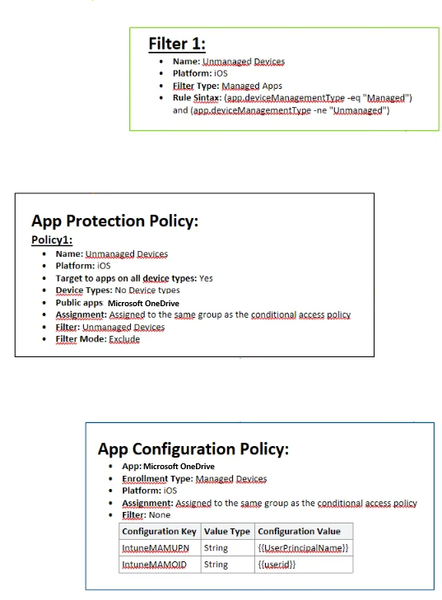
Hello, As the title says i am having a hard time getting this to work. We have been using APP for a long time, but it has not been necessary for us to have different policies for managed (we only use iOS) and unmanaged devices (all mobile device types). Now i want to remove APP from managed devices all together, and only enforce this on unmanaged devices (BYOD) Please see attached image of how it is configured today. I also have an CA policy which requires APP when using MS apps, where i have added and "Filter for devices" exclude with following syntax: device.enrollmentProfileName -contains "iOS standard profile" (which cover our enrollment profiles, both are fully managed) When enrolling a managed device, APP still is enforced. Does anyone have any tips? I wanted to try here before submitting a ticket to MS. As far as i have found out , the app.devicemanagmenttype is the only rule that can be used to filter managed devices when used with APP.175Views0likes1Comment
Intune partner compliance onboarding
Hello, We develop a MDM solution and we would like to become device compliance partner to offer our customers conditionnal access functionality. After filling twice (the first time almost two month ago) the form "Intune partner compliance onboarding request" whose link is available on this page https://learn.microsoft.com/en-us/intune/device-security/compliance/third-party-partners, we didn't get any reply to our request. Would you know if there is any other way to integrate this partnership ? Any contact or anything to get some news about our request ? Thank you for your help. Best regards,166Views0likes2CommentsUnexpected button behaviour when using the prompt=create parameter in Entra External ID user flows
Hi, In a recent workload, I'm assisting a client to implement Entra External ID for streamlined authorization as well as single sign-on for associated registered external facing third-party applications for external customer users through their Entra External ID identity, as well as assisting the client with auth branding and other UI customizations, and preparing Entra ID federation custom OIDC providers and configuration for enabling SSO with organizational internal and remote work- and school accounts etc. The sign-up / create account experience is of importance to the client, as a rather substantial amount of users are expected to sign-up via self-service sign-up following having received an invite via another app. To ensure that the user lands on the create account view, in order to minimize the number of steps and actions the users need to take to get there, the prompt=create parameter is used to pre-select the sign-up/register experience in the user flows UI. Having stress-tested the user flows and experience recently, we noticed that in a specific scenario, some UI elements behave in a manner that could be described as unexpected, and even though a workaround has mitigated it to some extent, the behaviour of some elements could probably be improved a bit to ensure an even more consistent user experience in the built-in user flows. Specifically, if the user flow is invoked with the prompt parameter set, the user lands on the create account screen as expected, however, unless custom CSS modification is applied, the Back button that would typically be there, as if having arrived there from the initial sign-in screen where it’s also displayed. If pressing the Back button displayed on the Create account view when having navigated there with the prompt=create set in the /authorize request, pressing the button seemingly doesn’t have any impact or result in any action, one can click it, but nothing happens. I'd suspect it's perhaps a "remnant" from if the flow is invoked without any prompt parameter set, or with prompt=login set, but when prompt=create is set, there is no state/page history in the UI to navigate back to, as no previous page has been displayed or rendered yet and added to the history, and the Back button click thus doesn’t have any effect. In general, I think buttons that don't have any tangible action should not be displayed, also, if prompt=login is set, the Back button isn't shown then either on the very initial user flow view shown then, so it would seem the built-in user flows actually already follow such approach in fact, but not when the prompt=create has been set, thus causing some inconsistency in the UI that users could notice unless custom CSS styling is applied. The expected behaviour for our business case would be that if prompt=create is set, then, similar to the prompt=login, no Back button should be displayed, or, if shown, it should result in some navigation (perhaps something like javascript.go(-1), but that could/would be dependent on from where the user arrived, e.g., going back a step in the browser history won't work if the user clicked a link from an invite email ) and preferably not be non-actionable. Furthermore, on the topic of the Back button and its behaviour when the prompt=create parameter is set, there is another case at which we observed some unexpected button behaviour as well, that could probably benefit from some attention. At a specific second scenario, it seems that the Continue button is displayed without providing any action, and when clicking the Back button then, clicking it seemingly resets the "create account", state likely set by the prompt=create initially, and instead switches the flow back to the sign-in state, which can at least affect the display text of some subsequent buttons shown in later steps in the UI. The user arrives at a built-in Entra External ID user flow /authorize endpoint, with the prompt=create query parameter set The user triggers the OTP challenge by entering an email address to verify the email address The user receives the OTP code but enters it incorrectly, i.e., doesn't copy the full code length of eight digits, and instead enters/pastes six of the eight code digits. The UI then shows an error message that the code could not be used/validated, and the email address field is displayed again with the email address that was used for the verification attempt prefilled. If the user clicks the Continue button at this stage, nothing happens. If the user clicks the Back button instead (given that it’s not hidden), it shows the same view one more time, with the Back and Continue buttons at the bottom. However, if the user clicks the Continue button this time, it works and a new code is sent. On the next screen, where the newly sent code can be entered, instead of a button named "Continue", it will now instead show a button with the text "Sign-in" (it would seem like the create account state has gotten lost somewhere along the way at this point, perhaps when the back button in the step 5 above was pressed). If one omits the prompt=create parameter, or when using prompt=login, things seem to work fine, the above occurs when the prompt=create is set. The reason why is the prompt=create is used is due to a business requirement to try to minimize the steps, especially in conjunction with the registration/sign-up, as far a possible when signing up. We have opted for the built-in user flows, not the self-hosted native authentication UI pages, for this project, and then as I understand it, it is the prompt=create parameter that can/should be used to enable the user to land directly on the registration page without having to navigate there manually via the sign-up link, that is otherwise shown on the initial sign-in page. It would thus be great if the prompt=create parameter could have some attention (or perhaps if a dedicated sign-up user flow type could be added potentially, even though that would perhaps warrant some update to the user flow app linking as well, as my understanding is that one user flow can be linked to one app registration at a time currently) to avoid that some buttons become unresponsive when the parameter is used, or falls back to sign-in, to improve the built-in user flows further, as the prompt=create fulfils the business requirement well otherwise. If there would be any further/follow-up questions on the above, e.g., to clarify the requirement, or further explain the reproduction steps and behaviour observed, or anything else, please tell, and I'll ensure to get back as soon as possible. Also, would someone have some input on potential other/additional ways to pre-select the create account/sign-up experience, that would naturally be much appreciated as well, thanks! Regards Kristoffer93Views0likes0Comments
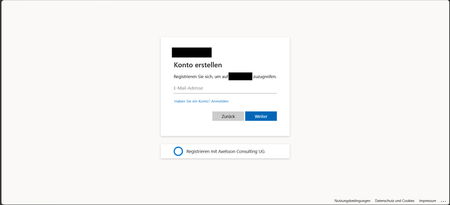
Can the built-in "No account? Create one" link redirect to a custom sign-up page?
I'm using Microsoft Entra External ID with a built-in sign-in/sign-up user flow. On the Microsoft-hosted sign-in page, the "No account? Create one" link always redirects users to the default Entra sign-up page. I already have a custom registration page and would like this built-in link to redirect to my custom URL instead. Is there any supported way to customize the destination of this link in a built-in user flow? If not, could someone confirm whether this behavior is fixed by design? Thanks!119Views0likes2CommentsAndroid Fully Managed devices treated as personal after AD password change
Hello! We have a huge problem... We have recently observed an issue in our organization affecting Android Fully Managed devices. After users change their domain password, within 1–3 days Conditional Access starts blocking access to Outlook and Teams. The system appears to treat the device as non-corporate, even though in Intune the device is still present, marked as corporate, and fully functional. It synchronizes both manually and automatically, and remote actions can be executed without any issues. However, when users open Outlook or Teams, they receive messages such as “We need to secure your device” and “Install the Intune app from Google Play,” which does not make sense because Intune is already installed on the device. When opening the Intune app, users see a “Update your password” prompt. After selecting it, they are redirected to a device registration screen. Previously, it was sometimes possible to complete this process (although we did not understand why it was required), but recently re-registration consistently fails. The user clicks “Register,” and the process spins indefinitely without completing. This issue is very difficult to troubleshoot. Device logs are not particularly helpful, and all users have Microsoft Authenticator configured. The problem appears randomly across users with no clear pattern—some devices were enrolled over a year ago, others just a month ago. The only clue we have found so far points to a potential issue with the broker authentication token, but we do not know how to verify or resolve this, nor why it is happening in the first place. We have been experiencing this issue since around January this year, but we noticed a significant increase in cases this month. In addition, there are more and more devices that can no longer be re‑registered from within the Intune app. Has anyone encountered a similar issue or can provide guidance on how to investigate or fix this?261Views0likes2CommentsMigrating frontline mobile devices: Identity considerations for assigned and shared devices
By: Carol Burns - Principal Product Manager | Microsoft Intune and Sucheta Gawade, Microsoft MVP (Azure & Security / Intune) Practitioner perspective from Sucheta Gawade, Microsoft MVP (Azure & Security / Intune), with deep experience in secure frontline mobility, including regulated healthcare environments. In previous articles in this series, we focused on understanding the reality of your frontline device estate and preparing for real-world testing through stakeholder alignment. One of the most critical areas to get right during the testing phase is identity and security, particularly given the often fast-paced, shift-based nature of frontline work, where organizations must account for the distinct requirements and challenges of devices assigned to a single individual versus devices shared across multiple users or shifts. Identity decisions directly affect security posture, sign‑in experience, operational support overhead, and worker productivity. Getting them wrong is one of the most common reasons pilots stall or fail. This article explores how to think about identity on frontline devices by distinguishing between assigned and shared usage models, clarifying when individual sign-in is required, and highlighting patterns to avoid such as shared accounts and passwords. Start by distinguishing device usage models Frontline mobile devices generally fall into one of two broad categories. Assigned devices Assigned devices are issued to a specific individual, often for the duration of their role. These devices: Typically require persistent access to user‑specific data Align with user‑based identity, Microsoft Entra ID Conditional Access, and audit controls. Enable greater accountability and traceability by associating activity with an individual user rather than a shared credential. Common examples include: A doctor using an individually assigned clinical tablet, where uninterrupted access to patient data and clinical systems is essential and actions must always be attributable to a named identity A field engineer assigned a single device that retains configuration, credentials, and offline content across jobs and locations An inspector or supervisor using an assigned device for approvals, reporting, and decision‑making that requires traceability Shared devices Shared devices are used by multiple people across shifts or tasks. These scenarios introduce additional identity complexity and generally fall into two distinct models. Shared devices without user sign-in (task or kiosk-based) Some frontline devices exist to perform a narrow, often repetitive task and don’t require sign in with a user account. Typical examples include: Retail price-check devices used on the shop floor to scan an item and display its current price or stock availability, with no need for access to personal or user-specific information Environmental monitoring devices used to read and record temperature or humidity in a storage area, ward, or vehicle, where the task is simple, repetitive, and not tied to an individual user identity Warehouse or facility scanning devices used for a narrow operational task such as scanning an asset, bin, or location code to confirm status, location, or completion of a step in a process In these cases: Devices are locked down to a specific task No user-specific data is stored, and access is limited to the minimum required for the task “When a device is truly task-only, removing sign-in friction is a huge win, but only if we’re aware what data the device can access. When things like patient context or personalized tasks enter the picture, identity becomes required” - Sucheta Gawade, Microsoft MVP Shared devices with individual user sign-in Organizations are increasingly digitizing and modernizing frontline workflows end-to-end. Paper processes and simple apps give way to connected systems, manual handovers are replaced with digital task lists, and workers begin to rely on mobile devices as their primary interface from completing tasks. As roles evolve, workers are expected to: Receive tasks, schedules, and updates digitally Communicate with supervisors and peers using collaboration tools such as Microsoft Teams Capture information at the point of work rather than transcribing later Interact with workflows that are increasingly automated or assisted by AI, such as guided steps, data validation, or suggested actions This shift delivers clear productivity and quality benefits, but it also means access must now be tied to individual identity to protect sensitive data, support auditability, and prevent information from being carried over between users. Common scenarios include: Retail store associates rotating across shifts, moving from paper schedules and verbal handovers to digital task lists, real-time communications, and collaboration tools such as Microsoft Teams Nurses sharing mobile devices in a hospital ward, where paper notes and whiteboards are replaced with secure access to patient-linked applications, care coordination tools, and role-based alerts Logistics workers signing in to shared devices to complete role-based tasks, capture data at the point of work, and interact with AI-assisted workflows. Don’t use shared credentials, always prefer individual sign-in Shared credentials may seem like a shortcut in frontline environments, but they undermine accountability and make policy enforcement and incident response significantly harder. “Shared credentials feel ‘efficient’ until your first incident. You lose auditability, Conditional Access becomes meaningless, and investigations turn into guesswork. Individual identity is the only scalable model.” -Sucheta Gawade, Microsoft MVP If access involves corporate systems or sensitive data, each worker should use their individual credentials to sign in, even on a shared device. Identity decision checklist for frontline devices Use the checklist to validate identity choices and confirm that the overall security posture matches the way the device is used. Decision area Indicators Use individual sign-in Users access personal or role-specific data. Auditability or compliance is required. Conditional Access or multifactor authentication (MFA) must be enforced. Applications rely on user identity. Use kiosk-style or device-only identity Devices perform a single task. No user-specific or sensitive organizational data is accessed. Workflows are entirely device-centric. Speed and simplicity outweigh personalization. Avoid entirely Shared usernames or passwords. Reused local accounts across shifts. MFA exclusions that weaken security without compensating controls. Choosing the right sign‑in experience The challenge in frontline environments is balancing: Security requirements Speed of access Ease of use across shifts “Frontline setups may fail because the sign-in flow doesn’t match reality. If authentication takes 60 seconds and the worker has to do it 30 times a shift, they’ll find a workaround.” -Sucheta Gawade, Microsoft MVP Typing complex usernames and passwords repeatedly during a shift is often impractical on mobile devices. QR code authentication is one effective option for shared frontline devices, but it’s not the only supported approach. For other supported methods, see Microsoft Entra authentication methods overview. QR code authentication Microsoft Entra QR code authentication is designed for frontline workers to sign-in efficiently on shared Android and iOS/iPadOS devices without repeatedly entering usernames and passwords. Note: For individually assigned devices, phishing-resistant, passwordless authentication methods are the recommended approach, such as Passkeys. QR code authentication enables workers to sign in using a unique QR code and a personal numeric PIN. This approach: Eliminates typed usernames and passwords Preserves individual identity Works well for shared devices with frequent user turnover Integration with Microsoft Intune, Managed Home Screen and Conditional Access QR code authentication should always be: Scoped to specific users and devices Combined with Conditional Access policies Evaluated during real‑world testing to ensure the right balance of usability and security Security posture and Conditional Access for frontline devices Individual identity is a critical foundation for stronger security posture, but it’s not enough on its own. Frontline device security also depends on management, data and app protection, session handling, and access policies that reflect the actual usage model. Conditional Access is an important part of securing frontline environments, but its effectiveness depends on aligning policies to the actual device and identity model in use. To ensure that the QR code authentication method can only be used by the frontline workers it’s intended for, create a custom authentication methods policy, which you can use in a dedicated Conditional Access policy. That Conditional Access policy should then be scoped to the group of users (frontline workers) who should log on using the QR code authentication method, and have the Require authentication strength control configured, which targets the custom authentication strength for "QR Code" which was previously created. During real‑world testing: Validate that design and controls support the intended usage model Ensure policies don’t block legitimate workflows Confirm sessions, access, and user targeting behave as expected These decisions should also be validated in practice: can users sign in and out reliably across shifts, is personal data cleared between sessions, and does the chosen experience match the pace of frontline work? Summary This article walks through how identity choices shape security, usability, and day-to-day success for frontline mobile devices. It explains the difference between assigned and shared devices, when individual sign-in is needed, and why shared credentials can create risk. It also highlights QR code authentication and Conditional Access as practical ways to keep each worker’s identity protected while making sign-in simple enough for fast-paced frontline workflows. What’s next in the series In the next article, we’ll focus on Microsoft Intune enrollment models, exploring how different enrollment approaches support—or constrain—the identity and usage patterns discussed here, including their role in protecting session identity, enforcing the intended sign-in model, and preventing one user’s access or data from carrying over to the next. As always, we welcome your feedback and experience. If you’ve navigated identity decisions for shared or frontline devices, share your advice and lessons learned in the comments, or reach out to us on X @IntuneSuppTeam. For more guidance across frontline scenarios, explore our broader From the Frontlines series on frontline worker management with Microsoft Intune. Join our community! Discuss real-world scenarios, get expert guidance, connect with peers, and influence the future of Microsoft Security products. Learn more at aka.ms/JoinIntuneCommunity.1KViews2likes1Comment
Allow Teams desktop on unmanaged Windows, but block Outlook desktop using Entra conditional access
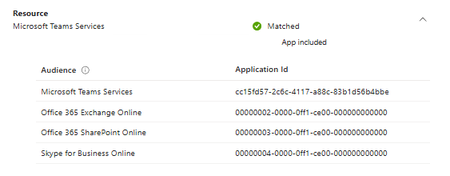
I need to allow Teams to run on non Intuned devices but not allow Outlook desktop to be available I am looking for a solution for Windows and Mac and ideally linux as well The issue is Ig I have Office 365 Exchange Online as my resource, it blocks Microsoft Team Services as well How can I fix this203Views1like2Comments
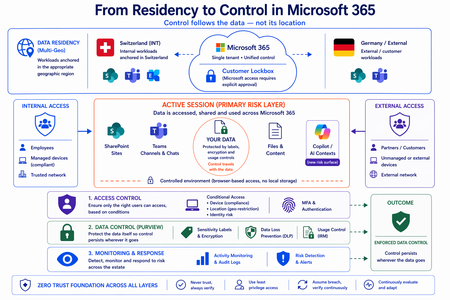
Why “Data in Switzerland” Is Not Enough
Moving from Residency to Control in Microsoft 365 Every conversation about data sovereignty in regulated industries tends to start the same way: “We use Multi-Geo. The data stays in Switzerland.” It’s the right starting point. Microsoft 365 Multi-Geo allows organizations to place selected workloads - SharePoint sites, OneDrive accounts, Teams data, or Exchange mailboxes - into specific regions, including Switzerland, while maintaining a single global tenant. This makes it possible to align sensitive data with regulatory or customer requirements without fragmenting the overall environment. But it only answers one question: Where is the data stored? It does not answer who accessed the data, from where, under which conditions, or what happened after access. That is where the real problem begins. A scenario that happens every day A Swiss engineering firm stores sensitive project documentation in Switzerland using Multi-Geo. An external contractor - working from an unmanaged device outside Switzerland - is granted access to review a file. The document opens. The data is now on a screen in an unknown location, on a device with no compliance posture, in a session with no restrictions. From the platform’s perspective, residency was enforced. From a sovereignty perspective, control was lost the moment access was granted without conditions. The file never left Switzerland. But sovereignty did. Residency is static. Control is not. The moment a document is opened, storage location stops being the relevant boundary. The file is no longer just “in Switzerland.” It moves instantly across endpoints and browsers, collaboration tools like Teams, external users and partners, and increasingly AI-driven contexts. The infrastructure remains unchanged. The data does not. From the platform’s perspective, everything is working as designed - access was granted, residency was enforced - and control was lost. Most “data in Switzerland” strategies fail at exactly this moment: when the data is used. The shift: from location to conditions If data sovereignty is the goal, the question must change. Not “Where is the data stored?” but: Under which conditions can data be accessed and used? This shift fundamentally changes the architecture. Control must be applied across three distinct layers - and all three must be connected. Layer 1: Access is conditional, not static Conditional Access extends control beyond authentication and turns it into continuous evaluation. Access decisions can depend on: Device compliance Location (geo-restriction) Identity and risk signals Multi-Geo ensures data is placed correctly. Conditional Access ensures it is reachable only under defined conditions. The two must work together - residency without access governance is an incomplete control. Layer 2: The session is the real risk surface Even with strict access controls, risk remains. A session is an exposure surface by design. During an active session, data is viewed, copied, shared, processed by applications, and connected to AI prompts. The gap does not appear at storage or authentication. It appears during active usage - inside the session. This is the layer most architectures do not explicitly address. Controls must extend into the session itself: limiting data transfer and replication, restricting interaction patterns, and enforcing policies in real time. Access is no longer a one-time event. It becomes continuously governed. This becomes even more critical as AI assistants consume content across SharePoint, Teams, Exchange, and other Microsoft 365 services. The question is no longer only where the source document resides - but whether the AI interaction itself is governed by the same access and protection controls as direct access. Layer 3: The document becomes the control point The most durable control does not sit in the network or in the session. It sits in the data itself. In regulated industries, organizations often arrive at this architecture having first evaluated sovereign or national encryption solutions. The decision to rely on native Microsoft 365 Purview encryption rather than a separate layer comes down to integration: AES-256 protection operating natively at file, user, and SharePoint level - including geo-based access restrictions - without an additional system to maintain. When protection is applied directly to the document through Microsoft Purview: Sensitivity labels define classification - automatically assigned based on content Encryption enforces access - AES-256, bound to the file itself IRM controls usage - view, copy, print, share, and presentation rights DLP governs movement across services - preventing data from leaving defined boundaries Dynamic watermarking tracks exposure - applied on open, view, or print At that point, access is enforced by the file, usage restrictions travel with it, and control persists regardless of location. The document becomes the perimeter. Platform control: limiting provider access One dimension often overlooked in sovereignty discussions is platform access itself. Even a perfectly configured tenant is only as sovereign as the controls placed on the operator. Customer Lockbox ensures that even Microsoft support cannot access customer data without explicit, logged, time-bound approval. Every access request is visible, auditable, and subject to customer veto. Data control applies not only to users - but also to the platform operating the service. Enforcement requires an integrated architecture Most organizations already have the required capabilities: Multi-Geo, Conditional Access, session control, Purview (labels, encryption, DLP, IRM), and monitoring. The issue is not capability. It is fragmentation. In practice, fragmentation looks like this: residency is configured in one project, Conditional Access policies are managed by a different team, and Purview labels were applied during a compliance initiative that never connected to the access layer. The tools exist. The signals do not flow between them. When designed as a single architecture: Data is placed intentionally - residency aligned to regulatory requirements Access is governed by context - device, location, and identity evaluated continuously Usage is controlled dynamically - session-level restrictions enforced in real time Protection is embedded in the document - encryption and IRM travel with the file Signals are connected across the platform - monitoring feeds access policy, not just audit logs “Data in Switzerland” becomes not just a statement - but an enforceable system property. Closing thought Placing data in Switzerland is the right first step. Multi-Geo makes it possible, even in global environments. But residency alone is not control. Data residency answers where information is stored. Data sovereignty requires proving who can access it, under which conditions, and what controls remain in place after access is granted. In Microsoft 365, sovereignty is no longer defined by geography alone. It is defined by the ability to enforce control wherever the data travels.