compliance
2 TopicsCybersecurity in 2026: Is Zero Trust Enough to Defend Against AI-Powered Threats?
As cyber threats become more sophisticated, organizations are increasingly adopting Zero Trust architectures, identity-based security, and AI-powered threat detection. But an important question remains: Are our existing security strategies evolving fast enough to address the next generation of cyberattacks? Microsoft has developed a comprehensive security ecosystem through Microsoft Defender XDR, Microsoft Sentinel, Microsoft Entra ID, and Microsoft Intune. These technologies provide powerful capabilities for identity protection, endpoint security, threat detection, and incident response. However, attackers are also leveraging automation, generative AI, and increasingly sophisticated social engineering techniques. I'd like to open a discussion around five important questions: 1. Zero Trust implementation: Are organizations genuinely implementing Zero Trust principles, or are many simply deploying security products without changing their underlying security architecture? 2. AI-powered threats: How prepared are Microsoft security environments to detect AI-assisted phishing, identity attacks, and automated intrusion attempts? 3. Microsoft Defender and Sentinel: What practical improvements have security teams experienced by integrating Microsoft Defender XDR with Microsoft Sentinel? 4. Identity as the new perimeter: With hybrid workforces and cloud-based infrastructure, should identity security now take priority over traditional network perimeter protection? 5. Autonomous security operations: How much authority should AI-powered security agents have to investigate threats, isolate devices, disable accounts, or initiate incident response actions without human approval? One of my biggest concerns is that organizations may invest heavily in cybersecurity tools while overlooking the fundamentals: visibility, configuration management, access governance, employee awareness, and incident response readiness. Security is no longer just about preventing unauthorized access. It's about building resilient systems that can detect, contain, recover from, and continuously adapt to emerging threats. I'd be interested to hear from security architects, SOC analysts, Microsoft MVPs, and IT administrators: What do you consider the biggest cybersecurity challenge facing Microsoft-based enterprise environments today, and what practical steps should organizations prioritize in 2026? Looking forward to your insights and real-world experiences.328Views0likes3Comments
Start strong with MCSB v2
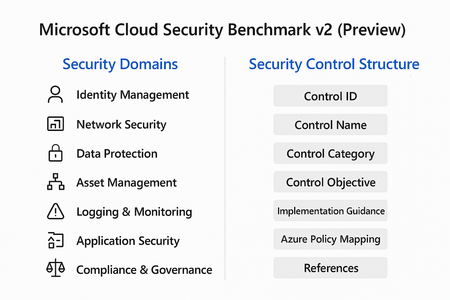
Cloud adoption is accelerating, but so are threats. Organizations often rush to deploy workloads without a clear security baseline, leaving critical gaps that attackers can exploit. Enter Microsoft Cloud Security Benchmark (MCSB) v2, now in public preview, designed to help you start well-protected and evolve securely. What Is Microsoft Cloud Security Benchmark v2? MCSB v2 is a comprehensive set of best practices and controls for securing cloud resources across Azure and hybrid environments. It aligns with: Industry standards: NIST, CIS, ISO Microsoft Secure Future Initiative (SFI) Zero Trust principles This benchmark provides prescriptive guidance for identity, network, data, and workload security helping organizations establish a strong foundation before customizing for their unique needs. Security Domains in MCSB v2 The benchmark organizes guidance into security domains, each representing a critical area of cloud security: Identity Management MFA enforcement, Conditional Access, privileged identity management. Network Security Segmentation, firewall rules, private endpoints. Data Protection Encryption at rest and in transit, key management. Asset Management Resource inventory, tagging, and governance. Logging & Monitoring Centralized logging, alerting, and SIEM integration. Incident Response Playbooks, automation, and escalation workflows. Application Security Secure coding practices, vulnerability scanning. Compliance & Governance Policy enforcement, regulatory alignment. Security Control Structure Each control in MCSB v2 follows a structured format for clarity and implementation: Control ID: Unique identifier for tracking. Control Name: Descriptive title (e.g., “Enable MFA for all users”). Control Category: Maps to a security domain. Control Objective: What the control aims to achieve. Implementation Guidance: Detailed steps for configuration. Azure Policy Mapping: Built-in policy definitions for automation. References: Links to Microsoft Learn and industry standards. This structure ensures consistency, traceability and ease of adoption across large environments. Integration with Azure Policy & Defender for Cloud One of the most powerful aspects of MCSB v2 is its native integration with Azure governance and security tools: Azure Policy Pre-built policy initiatives mapped to MCSB controls. Enables policy-as-code for automated enforcement across subscriptions. Supports compliance dashboards for visibility and reporting. Microsoft Defender for Cloud Monitors compliance against MCSB controls in real time. Provides secure score and recommendations for remediation. Integrates with workflows for alerting and automation. How to Get Started Review the Benchmark Explore the full guidance here: https://learn.microsoft.com/en-us/security/benchmark/azure/overview Apply Built-In Policies Use Azure Policy initiatives mapped to MCSB controls for quick enforcement. Monitor Compliance Leverage Microsoft Defender for Cloud to track adherence and remediate gaps. Tune for Your Needs Start with the baseline, then customize based on workload sensitivity and business requirements. Best Practices for Organizations Enable MFA and Conditional Access for all identities. Segment networks and enforce least privilege. Encrypt data at rest and in transit using Azure-native capabilities. Enable Defender for Cloud for continuous posture management. Automate compliance with policy-as-code. Cloud security isn’t static. Threats evolve, and so should your defenses. MCSB v2 gives you a future-ready foundation that scales with your business and integrates with Microsoft’s security ecosystem.585Views2likes0Comments