billing
14 Topics
How can a Microsoft for Startups user escalate unexpected Claude Marketplace billing?
I have approximately ₹9.49 lakh of Microsoft for Startups Azure credits remaining. I deployed Anthropic Claude through Microsoft Foundry and later received invoice G183537293 for ₹70,716.76 because the Claude Marketplace usage was not covered by the sponsorship credits. I understand the eligibility rule now. My question is about escalation. Azure Billing has told me Marketplace adjustments are handled by the publisher. Anthropic has told me Azure Marketplace billing is processed through Microsoft. I have therefore been redirected between both parties. I also found a previous Microsoft for Startups case involving similar unintended Claude/Foundry usage where the customer reported receiving a $1,000 special-exception credit: https://learn.microsoft.com/en-us/answers/questions/5728641/azure-ai-foundry-presents-third-party-ai-models-as?utm_source=chatgpt.com Is there a Microsoft for Startups, Marketplace billing, or Foundry escalation team authorized to review a one-time goodwill credit in this situation? I am specifically looking for the correct escalation path, not asking the Q&A community to access or modify my invoice.166Views2likes3Comments
$17,493 in Undisclosed Marketplace Charges with No Cost Visibility, No Recourse, No Accountability
I'm a co-founder of a 13-person startup in the Microsoft for Startups Founders Hub program. I'm posting here because after two months of support tickets, calls, and emails across both Microsoft and Anthropic, I have been unable to get anyone with decision-making authority to address this issue. I'm hoping this reaches someone at Microsoft who can help, and that other affected founders in the program will share their experiences. What happened: In February 2026, we deployed Claude Opus 4.6 and Sonnet 4.6 through Azure AI Foundry as part of a migration of our AI infrastructure. We are active users of our Azure sponsorship credits and assumed, as anyone would, that these models were covered the same way Azure OpenAI models are. There was no indication otherwise during deployment. In early March, we received our first invoice: $1,078.07 (invoice G144899694, billing period 02/01–02/28). We were shocked, but we paid it immediately and removed all Anthropic model deployments from our account to prevent further charges. It didn't matter. On April 9, we received a second invoice: $16,414.94 (invoice G151890529, billing period 03/01–03/31). Despite removing the deployments in mid-March, charges had already accumulated for the first half of the month. We are unable to pay this invoice. Our total exposure across both invoices is $17,493.01. Why we had no way to prevent this: No billing distinction at deployment. Azure AI Foundry presents all models (Microsoft-native and third-party) in the same unified interface. There is no warning, label, or confirmation step indicating that certain models are excluded from sponsorship credits. No cost visibility whatsoever. The Azure AI Foundry monitoring dashboard has an "Estimated Cost" section that is completely blank for these models, with a disclaimer: "Cost monitoring is available for Foundry Models sold directly by Azure only." We could see token counts but had zero visibility into what we were being charged. Token counts that don't explain the charges. The dashboards show our Claude Opus 4.6 deployment used 63.4M tokens and our Sonnet 4.6 deployments used roughly 170M tokens combined. At published rates, that should be in the low thousands, not $17,500. My analysis shows the dashboard hides billions of cached tokens (prompt caching reads and writes) that are invisible in the monitoring UI but account for the vast majority of the bill. There is no view in Azure that provides a breakdown of these charges by token type. No alerts or notifications. There were no cost alerts, no threshold warnings, and no notifications at any point. No indication in any Azure portal that charges were hitting our credit card. There was no line item, no pending charge, no Marketplace spend summary - nothing anywhere in the Azure ecosystem that showed dollars accumulating against our payment method for these deployments. What happened when we asked for help: Azure Support (TrackingID#2603090040002936): After a month-long wait, a support engineer told us Microsoft cannot issue credits for Marketplace charges and directed us to Anthropic. The first version of the response email referenced "Azure DDoS Protection Standard" instead of our actual issue, suggesting the volume of similar cases in the queue. Anthropic: Their AI support bot responded within one minute with a blanket statement and closed the ticket four hours later. I escalated, but have still not received a response over a month later. Microsoft for Startups Team (TrackingID#2604070040009778): Told us they cannot apply Marketplace charges against sponsorship credits and referred us to a Marketplace billing contact. Azure Marketplace billing contact: Pending response. The pattern is clear: Microsoft directs us to Anthropic. Anthropic directs us to Microsoft. The Microsoft for Startups team directs us to Azure Marketplace billing. No one takes responsibility. What I'm asking for: A full refund of $17,493.01 across invoices G144899694 and G151890529 That Microsoft implement clear billing warnings in Azure AI Foundry before deploying models that are excluded from sponsorship credits. That Microsoft provide actual cost visibility in the monitoring dashboard for all models deployed through AI Foundry, not just first-party models. To other founders in the program: If you have experienced this same issue, please reply to this thread. I know I'm not alone because this has been covered by The Register, InfoWorld, and Computerworld, and at least 20 founders have signed a Change.org petition about it. The more founders who come forward with specific amounts and case numbers, the harder this is to ignore. We joined Microsoft for Startups because the program was supposed to help early-stage companies manage infrastructure costs during the most financially vulnerable period of our growth. Instead, the program's own platform generated charges within 2 weeks that exceed the total sponsorship credits we've consumed over the past year, with no visibility, no warning, and no path to resolution. With Further Inc. | Microsoft for Startups Founders Hub Azure Support TrackingID #2603090040002936 Startup Support TrackingID #2604070040009778630Views2likes6Comments
Unexpected ₹147K Claude charges despite active Microsoft for Startups sponsorship
Hi Microsoft for Startups team and community, I am a Microsoft for Startups participant using an Azure Sponsorship subscription. I recently discovered unexpected charges from Anthropic Claude through Microsoft Foundry. The Claude usage was billed as Marketplace/SaaS charges instead of being deducted from my Microsoft for Startups Azure sponsorship credits. My Azure Sponsorship credit is still active and has a substantial unused balance. However, my Azure Cost Analysis currently shows approximately ₹491K in September charges, with approximately ₹475K categorized as SaaS, primarily related to Claude. I currently have an invoice amount of approximately ₹147K due. I stopped the Claude deployments as soon as I discovered the charges to prevent further usage. I contacted Azure Billing Support multiple times, but the requests were closed with a message saying that the issue falls outside Billing and Subscription Support because it involves Marketplace/third-party services. I was directed to Marketplace refund resources instead. I also tried to contact Microsoft for Startups support. I was previously instructed by the Microsoft for Startups team to use the Founders Hub support portal, but my account now redirects to the newer Microsoft for Startups experience in Azure, where I cannot find the documented startup program support option. I need help getting this escalated to the appropriate Microsoft for Startups or Marketplace team for an actual review. Specifically, I would like to know: What is the correct support channel for this situation? Can Microsoft review the unexpected Claude charges? Is a discretionary credit, refund, or billing adjustment possible given the circumstances? I can provide screenshots showing my active sponsorship, remaining Azure credits, Claude charges, and invoice privately if required. Thank you.97Views0likes0Comments
AADSTS5000228 - Locked Out of Trial Tenant
I created a free trial tenant, and was immediately locked out. Upon doing research, I basically discovered that the tenant is locked due to unknown reasons, and I have to contact support. I have tried calling 4 different support numbers a total of 8 times. I have never made it through the laughable automated phone system to a real person, I eventually get hung up on for no reason. I've tried creating chats from personal accounts to basically just be told to log in with my new tenant account and submit a ticket. I can't log in, I would love to be able to log in. I am at a loss for what to do. I can't open a case. I can't call a number. I can't log in. Does anyone have any advice on how to get this taken care of? At this point, I just want to cancel the tenant so when the auto-renew comes up, it doesn't charge my card.270Views0likes1Comment
Where is the Teams Pay-As-You-Go Calling Plan for GCC Tenant License
Currently we are using Direct Routing for Teams calling and want to transition to a Teams pay-as-you-go (PAYG) calling plan for GCC license. Unfortunately, direct purchase through Microsoft 365 Admin Center "Microsoft Online Subscription Agreement" (MOSA) billing account is not available; and the license does not appear on our reseller "Microsoft Customer Agreement" (MCA) billing account price list. https://www.microsoft.com/licensing/docs/documents/download/Modern%20Work%20FAQ_Microsoft%20Teams_July2024.pdfhttps://www.microsoft.com/licensing/docs/documents/download/Modern%20Work%20FAQ_Microsoft%20Teams_July2024.pdf) (last updated July 29, 2024), item 103 states pay-as-you-go calling plan is available for GCC. Has anyone successfully purchased a Teams PAYG calling plan for GCC license since the implementation of the new Microsoft billing experience?Granular Billing for Azure Data Factory
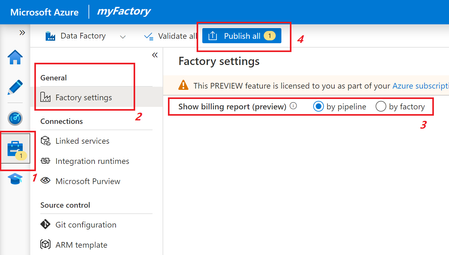
In this blog, Charlie Zhu walks you through the new granular billing option for Azure Data Factory and helps you better understand pipeline costs. We are bringing clarity and transparency into data pipelines operations with built-in per pipeline billing report so that you will know exactly how much each pipeline costs you.27KViews9likes20CommentsMicrosoft Defender for Servers and Cost Management and Billing
There is currently no way to itemize the total cost of Defender for Servers at the Virtual Machine level. When The Defender for Servers Plan is enabled at the Azure subscription, billing for all servers in the subscription is rolled up to a total amount at the subscription. It is not possible in Cost Management and Billing to see the cost for the Defender for Servers Plan for a particular Virtual Machine resource or resource group.6.2KViews0likes5Comments
Live Monitoring Billable Network Out for Current Day
Hi All, Problem Unable to monitor network usage for the current day for a subscription or resource group to identify the number of bytes which are billable. More Info I am looking for a way to query the Network Out for selected resources to identify how much data has gone in and out for the current day. The reason for doing so is to identify if any users on a system are moving huge amounts of data out of a resource in order to prevent/notify large billable data transfers as they are happening. Clarification I am aware that Data Out + Billable Data metrics can be queried for a resource group or subscription after the day has ended, I am looking for a way to do this for the current day. Cheers, Stu2.6KViews0likes6Comments