azure openai
33 TopicsAdding a Fallback Model to Hermes with Microsoft Foundry
So the plan was simple. Leave the Bedrock configuration untouched, then wire Microsoft Foundry in behind it as a fallback, so Hermes always has somewhere else to go when the primary provider is not responding. A few other reasons pushed me towards Foundry in particular: Redundancy that does not need me. If Bedrock is throttled or out of quota, I want Hermes to fail over on its own rather than waiting for me to notice. A catalogue I already pay for. Foundry puts the latest GPT models next to open-weight and partner models in one place, so I can pick a model that suits the task instead of settling for whatever a single provider happens to offer. Enterprise controls out of the box. Region pinning, private networking, content filters and per-deployment quota all sit in the same portal, which makes the setup far easier to defend to a security reviewer. Learning the mechanics before I need them. Working out how Hermes handles a provider chain is much nicer on a quiet Tuesday than during a live outage. Here is the short version, if you are deciding whether to read on. Time: about thirty minutes if nothing goes wrong. Cost: pay-as-you-go tokens only, and none at all while the fallback sits idle. Result: an assistant that keeps answering when your primary provider stops. Before you start, you will need three things: a machine with Hermes already installed and a working primary provider configured, an Azure subscription with access to Microsoft Foundry in a region you can actually deploy into, and enough quota in that region to create a deployment. One thing that made this easy to justify: Foundry deployments bill per token on the standard pay-as-you-go tier. A fallback provider that never gets invoked costs nothing beyond the requests it actually serves, so the insurance is close to free until the day you need it. Chat surface (CLI, messaging) → Hermes Gateway → Primary Amazon Bedrock → Fallback Microsoft Foundry Figure 1: Where the fallback sits. Every request goes through the Hermes gateway to the primary provider; only when that provider is unavailable does the chain continue to Microsoft Foundry. Part 1: Deploying a Model on Microsoft Foundry The first half of this job happens entirely inside the Microsoft Foundry portal and has nothing to do with Hermes yet. All you are really doing here is making sure your Azure subscription can serve a model, and that you hold an endpoint and key Hermes can authenticate with later. 1. Deploy model in Foundry → 2. Copy endpoint + key → 3. hermes fallback add → 4. Authenticate → 5. Select models, test Figure 2: The whole setup in five moves. The first two happen in the Microsoft Foundry portal (orange); the rest happen on the Hermes machine (blue). Go to Microsoft Foundry > Build > Models > Deploy > Deploy a base model. You can deploy a fine-tuned model instead if you already have one, which works just as well with Hermes. Check the region shown at the top of the portal before you commit, because both model availability and deployment quota differ from one region to the next. Then deploy the model you have selected: In this case I deployed gpt-5.6-sol, which is the model Hermes will fall back to. The choice was deliberate rather than exciting. My primary model on Bedrock is a general-purpose chat model, and a fallback is only useful if the answers it gives feel like a continuation of the same conversation rather than a different assistant wearing the same name. The gpt-5.6-sol deployment matches that behaviour closely, it was available in the region I wanted to pin, and the quota I was granted comfortably covers a day of normal use. If a fallback surprises you the first time it fires, it is the wrong fallback. Once the deployment finishes, open it and take note of two values: the target endpoint URI and the API key. Copy both somewhere safe now, because you will be pasting them into Hermes in the next part. If your organisation rotates keys on a schedule, use a key with the longest life you are allowed, since a fallback secured with a credential that expires quietly stops being a fallback. What to copy Where it lives in the portal Where Hermes asks for it Target endpoint URI Deployment > Endpoint > Target URI "Endpoint" prompt in hermes fallback add API key Deployment > Endpoint > Key "API key" prompt, or choose Entra ID instead Deployment name Deployment > Details > Name Shown in the model list Hermes returns Region Top of the portal, next to the resource Must match the region you deployed into Figure 3: Everything Hermes will ask for, and where to find each value before you leave the portal. Part 2: Adding Foundry to Hermes as a Fallback With the Foundry side sorted, everything from here happens in the Hermes CLI. One thing worth knowing before you start: this is the fallback command, not the primary model command, so your existing Bedrock configuration is left completely alone. Nothing in this section can break what is already working, which makes it a good one to try on a live setup. Run the Hermes fallback command: When Hermes asks which provider to add, choose Azure Foundry. The picker still carries the old name; it is the same service that the portal now calls Microsoft Foundry. Paste the target endpoint URI from your deployment, then authenticate with the API key you copied earlier. Hermes also offers Microsoft Entra ID at this prompt, which is the better option if your organisation would rather not have a static key sitting on the machine. If authentication fails here, check the endpoint before you start suspecting the key. In my experience the endpoint is wrong far more often than the credential is, usually because the deployment name at the end of the URI does not match the deployment you actually created. Once authentication succeeds, Hermes lists the deployments your Foundry resource exposes and asks which ones you want to use. You can select more than one, and the order is not cosmetic: Hermes walks down the chain from top to bottom whenever the provider above is unavailable. Treat that list as a priority order, not a shopping basket. What happens to the primary What Hermes does What you see in the chat Responds normally Routes every request to the primary and never touches the chain Nothing. The fallback stays idle Throttled or out of quota Retries the next provider down the chain on the same request A reply, served by the fallback model Endpoint unreachable Keeps failing over on each new request until the primary recovers Slightly different tone and latency, but a working assistant Every provider fails Returns the error rather than hanging An error worth chasing with hermes status Figure 4: The chain in practice. The fallback only earns its keep in the middle two rows, which is exactly why it is easy to forget you configured it. Part 3: Promoting Foundry to the Primary Model At this stage Foundry is sitting in the back seat as a backup. I wanted to reverse the arrangement and make Foundry the primary while Bedrock slides down into the fallback slot, partly because I preferred keeping day-to-day traffic inside my Azure subscription, and partly because I wanted proof the chain works in both directions. Before promotion After promotion Primary: Amazon Bedrock → Primary: Microsoft Foundry Fallback: Microsoft Foundry → Fallback: Amazon Bedrock Figure 5: The promotion, in effect. Nothing is added or removed; the two providers simply trade places in the chain. There is no dedicated "promote" command in Hermes, so the manual route is a short sequence of steps rather than a single instruction: Select the fallback provider/model as the new primary: hermes model Remove the now-duplicate model from the fallback chain: hermes fallback remove Optionally add the old primary model as a fallback: hermes fallback add Restart the messaging gateway: hermes gateway restart Verify the result: hermes status / hermes fallback list That sequence works, and it is good to know what is happening underneath. But since I already had a working provider configured, I would rather just ask Hermes to rearrange itself. This is the part I genuinely enjoy about the tool: the configuration is something you can talk to, not only something you type commands at. Prompt: Okay now please make the model I configured on Microsoft Foundry into the main model, and make the Bedrock one the fallback model! Hermes rewrites the provider chain on its own and confirms the swap once it is done, which is a great deal less error-prone than running the five commands by hand. Part 4: Testing the Switch Configuration you have not tested is just an assumption with extra steps, so the next thing is to confirm Hermes really is talking to Foundry. Type /model when running Hermes to bring up the model picker. You will be prompted to select a provider first. Pick the Microsoft Foundry entry, then choose the specific deployment from the list underneath it. The active model should switch straight away. Send it a plain "Hello" to check that the deployment actually responds, rather than just looking correct in the menu. Appearing in a dropdown and serving a request are two very different things. A second test is worth the thirty seconds it costs: run hermes status to confirm which provider is live, then hermes fallback list to confirm the chain is ordered the way you intended. The picker tells you what you selected; those two commands tell you what Hermes will actually do at three in the morning. Part 5: The Obstacle, and What It Actually Taught Me Every walkthrough has the part the author quietly leaves out. Here is mine: the wrinkle was not the model, it was capacity. My first attempt deployed into the region closest to me out of habit, and the portal turned it down because there was no capacity left for that model at the tier I asked for. The model was clearly listed in the catalogue; being listed and being deployable in your region, on your subscription, at your quota, are three separate questions. Redeploying in a different region fixed it in a couple of minutes, but it meant the endpoint URI changed, which in turn meant the value I had already pasted into Hermes was stale. Re-running hermes fallback add against the new endpoint sorted it out. The lesson is cheap enough to hand over for free: check quota and regional capacity for your specific subscription before you design a walkthrough, a demo or a production fallback around one deployment. In the Foundry portal, Management then Quota shows exactly what you have been granted per region and per model family, which is the only list that matters. Symptom Likely cause Fix Deployment rejected in the portal No capacity for that model at the tier you asked for, in that region Deploy in another region, or drop to a smaller tier Hermes rejects the credential Endpoint URI does not match the deployment you created Re-copy the target URI from the deployment, not the resource Provider authenticates but lists nothing Key belongs to a different Foundry resource Check you are in the right resource, then re-run hermes fallback add Fallback never fires Chain ordered the wrong way round hermes fallback list, then reorder Figure 6: The four things that went wrong, or nearly did, and what fixed each one. There is a silver lining worth stating plainly. Because the fallback chain was already in place, a deployment that refused to come up did not take the assistant down with it. That is precisely the scenario this whole exercise was meant to cover, and it turned up on day one without me having to simulate it. Command Cheat Sheet Everything used in this walkthrough, collected in one place: hermes fallback add: attach a provider to the fallback chain hermes fallback remove: drop a provider from the chain hermes fallback list: show the chain in priority order hermes model: set the primary model hermes gateway restart: restart the messaging gateway after a change hermes status: confirm which provider is currently live /model: switch models from inside a running session Conclusion Adding Microsoft Foundry as a fallback behind my existing Bedrock setup took an afternoon, and most of that was spent recovering from a regional capacity limit I should have checked first. The work itself is small: deploy a model, copy the endpoint and key, run hermes fallback add, authenticate, pick your deployments. The payoff is that Hermes no longer depends on one provider staying healthy. Three things are worth carrying away from this: Check quota, not just the catalogue. The Foundry catalogue shows what Microsoft offers. It does not show what your subscription and region can actually deploy today. Confirm that first, before you build anything on top of a specific deployment. Order your fallback chain deliberately. Hermes works down the list from top to bottom, so the sequence you choose during setup is the failover policy you are going to live with. Put the model you actually trust at the top. Treat the endpoint as part of the credential. Redeploying in a new region changes the endpoint URI, and a fallback pointed at an endpoint that no longer exists is not a fallback. Re-run the setup whenever the deployment moves. The switch from Bedrock primary to Foundry primary also proved the chain runs in both directions, which is the real point. Provider redundancy is only useful if you have watched it work. Next on my list is deliberately breaking the primary provider to confirm the failover triggers on its own, without me typing a single command. If you run this against a different model, region or provider pairing, I would genuinely like to know how it went, particularly if your quota experience was better than mine. Drop it in the comments.333Views0likes0CommentsSigning in to Microsoft Foundry from OpenClaw using Azure AD: a smoother way to bring your models in
This post is a quick update to walk through the new flow. If you read the previous one, think of this as the easier path I wish I had the first time round. If you have not seen the original, you can find it here: Integrating Microsoft Foundry with OpenClaw: Step by Step Model Configuration | Microsoft Community Hub Pre-requisite: You will need the Azure CLI (azure-cli) installed on your machine. The official install guide for Linux is here: https://learn.microsoft.com/en-us/cli/azure/install-azure-cli-linux?view=azure-cli-latest I am on Linux so I went the Homebrew route, which keeps things simple. The formula is here: https://formulae.brew.sh/formula/azure-cli Microsoft also has official docs covering the Homebrew/Linuxbrew install: https://learn.microsoft.com/en-us/cli/azure/install-azure-cli-macos?view=azure-cli-latest#install-with-homebrew Once Homebrew is ready, run this in your terminal: brew install azure-cli Why this matters: Before this update, every Foundry model you wanted to use in OpenClaw needed its own API key and endpoint pasted into the config. It worked, but it was tedious, and keys are easy to leak if you are copying them around. The Azure AD path solves both problems. You authenticate as yourself (or a service principal), OpenClaw asks Azure for the list of Foundry resources you have access to, and it brings the models in automatically. Signing in to Microsoft Foundry from OpenClaw via Azure AD A device-code OAuth handshake replaces the old static-API-key flow. OpenClaw delegates auth to the local Azure CLI; the CLI handles the browser-side sign-in, holds the resulting tokens, and refreshes them silently. OpenClaw then walks the Azure resource graph, subscriptions → Foundry resources → model deployments and registers each model into its own config. No API keys move through OpenClaw at any point. Sequence diagram of the OAuth 2.0 device-authorization flow as orchestrated by OpenClaw. Phases 1–3 establish identity (the developer authenticates once, in a real browser, against Azure AD). Phases 4–5 perform service discovery (OpenClaw walks the ARM resource hierarchy, subscriptions → Foundry accounts → model deployments and persists the result to a local provider config). After registration, every model call OpenClaw makes against Foundry reuses the same Azure-CLI-managed token cache: tokens refresh transparently, and access is gated by the Foundry resource's RBAC assignments rather than a static API key. Dashed lines denote return values; the teal line in step 7 marks the single token-issuance event the rest of the system pivots on. Walking through the new flow: Start with the command to onboard openclaw as if you were setting up OpenClaw for the first time: openclaw onboard Kick things off with the OpenClaw onboard command, the same one you would use when setting up OpenClaw for the first time. When it prompts you, choose update values. Next, you will be asked to configure your models. Scroll down a little and you will see Microsoft Foundry listed as a supported provider. Pick it. From here, you have two options. You can sign in with an API key, which is what I covered in the previous blog post, or you can sign in through Azure AD. The Azure AD path is easier and more secure, so that is the one we will use. OpenClaw will give you a URL and a device code. Copy the URL into your browser and use the code to complete the sign in. (This is where the az CLI from the pre-requisite section earns its keep.) If everything worked, you should see a success prompt similar to this: Once you are signed in, OpenClaw will ask you to pick the Azure subscription that your Microsoft Foundry resource lives in. Pick the subscription, then pick the Foundry resource where your models are deployed. And that is pretty much it. All the models you have deployed to that Foundry resource get pulled into OpenClaw automatically. Compared to the old way of pasting API keys and endpoints one by one, this is a huge time saver, and you do not have to babysit any keys. From here you can start using your Foundry-deployed models inside OpenClaw straight away: Wrapping up The Azure AD sign-in option in OpenClaw is one of those small updates that quietly removes a real pain point. If you have ever juggled multiple Foundry endpoints and rotated keys across them, you already know why. With this flow, you sign in once, your models show up, and you can get back to actually building. If you have not tried OpenClaw with Microsoft Foundry yet, this is a good time to give it a go. And if you were holding off because of the key management overhead, that excuse is gone now. References Previous post on integrating Microsoft Foundry with OpenClaw using API keys: Integrating Microsoft Foundry with OpenClaw: Step by Step Model Configuration | Microsoft Community Hub Install the Azure CLI on Linux: https://learn.microsoft.com/en-us/cli/azure/install-azure-cli-linux?view=azure-cli-latest Install the Azure CLI on macOS: https://learn.microsoft.com/en-us/cli/azure/install-azure-cli-macos?view=azure-cli-latest#install-with-homebrew Homebrew formula for azure-cli: https://formulae.brew.sh/formula/azure-cli404Views0likes0CommentsBuild AI RAG Apps with LangChain, Azure DocumentDB and Microsoft Foundry: Step-by-Step Guide
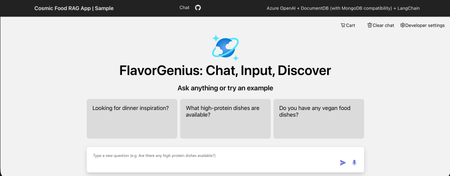
Scenario Imagine you are building your company’s RAG chat application using Microsoft Foundry - Azure OpenAI and orchestrating the flow with LangChain. The chat experience works, but now it needs to be grounded in your company’s data. You generate embeddings and want to store and query them without adding another database or complex sync pipeline. Instead of stitching services together, you use Azure DocumentDB (with MongoDB compatibility) with built-in vector search to store your JSON data and embeddings in one place. You deploy the app to Azure App Service and quickly compare vector search alone versus a full RAG pipeline, sharing it with your team for testing. What will you learn? In this blog, you'll learn to: Create an Azure DocumentDB (with MongoDB compatibility) resource. Create an embeddings and a chat deployment in Microsoft Foundry Azure OpenAI portal. Create an Azure App Service website with continuous deployment from GitHub. Configure Azure App Service application settings to enable communication between Azure resources. Configure GitHub workflow to work successfully. What is the main objective? Build AI Powered RAG Application using LangChain, Microsoft Foundry Azure OpenAI, and Azure DocumentDB (with MongoDB compatibility): Step-by-Step Guide Prerequisites An Azure subscription. If you don’t already have one, you can sign up for an Azure free account. For students, you can use the free Azure for Students offer which doesn’t require a credit card only your school email. A GitHub account. Summary of the steps: Step 1: Create an Azure DocumentDB (with MongoDB compatibility) resource Step 2: Create a Microsoft Foundry - Azure OpenAI resource and Deploy chat and embedding Models Step 3: Create an Azure App Service and Deploy the RAG Chat Application Step 1: Create an Azure DocumentDB (with MongoDB compatibility) resource In this step, you'll: Open the Azure Portal. Create an Azure DocumentDB (with MongoDB compatibility) resource. Open the Azure Portal 1. Visit the Azure Portal https://portal.azure.com in your browser and sign in. Now you are inside the Azure portal! Create a new Azure DocumentDB (with MongoDB compatibility) resource In this step, you create an Azure DocumentDB (with MongoDB compatibility) resource to store your data, vector embedding, and perform vector search. 1. Type documentdb in the search bar at the top of the portal page and select Azure DocumentDB (with MongoDB compatibility) from the available options. 2. Select Create from the toolbar to start provisioning your new cluster. 3. Add the following information to create a resource: What Value Subscription Use your preferred subscription. It's advised to use the same subscription across all the resources that communicate with each other on Azure. Resource group Select Create new to create a new resource group. Enter a unique name for the resource group. Cluster name Enter a globally unique name. Location Select a region close to you for the best response time. For example, Select UK South. MongoDB version Select the latest available version of MongoDB 4. Select Configure to configure your cluster tier. 5. Add the following information to configure the cluster tier. You can scale it up later: What Value Cluster tier Select M25 tier, 2 (Burstable) vCores. Storage Select 32 GiB. 6. Select Save. 7. Enter the cluster Admin Username and Password and store them in a secure location. 8. Select Next to configure the networking settings. 9. Select Allow Public Access from Azure services and resources within the Azure to this cluster. 10. Select Add current IP address to the firewall rules to allow local access to the cluster. 11. Select Review + create. 12. Confirm your configuration settings and select Create to start provisioning the resource. Note: The cluster creation can take up to 10 minutes. It's recommended to move on with the rest of the steps and get back to it later. Step 2: Create a Microsoft Foundry - Azure OpenAI resource and Deploy chat and embedding Models In this step, you'll: Create a Microsoft Foundry Azure OpenAI resource. Create chat and embedding model deployments. Create an Azure OpenAI resource In this step, you create an Azure OpenAI Service resource that enables you to interact with different large language models (LLMs). 1. Type openai in the search bar at the top of the portal page and select Azure OpenAI from the available options. 2. Select Create from the toolbar then select Azure OpenAI to provision a new Azure OpenAI resource. 3. Add the following information to create a resource: What Value Subscription Use the same subscription you used to apply for Azure OpenAI access. Resource group Use the resource group you created in the previous step. Region Select a region close to you for the best response time. For example, Select UK South. Name Enter a globally unique name. Pricing tier Select S0. Currently, this is the only available pricing tier. 4. Now that the basic information is added, select Next to confirm your details and proceed to the next page. 5. Select Next to confirm your network details. 6. Select Next to confirm your tag details. 7. Confirm your configuration settings and select Create to start provisioning the resource. Wait for the deployment to finish. 8. After the deployment finishes, select Go to resource to inspect your created resource. Here, you can manage your resource and find important information like the endpoint URL and API keys. Create chat and embedding model deployments In this step, you create an Azure OpenAI embedding model deployment and a chat model deployment. Creating a deployment on your previously provisioned resource allows you to generate text embeddings (i.e. numerical representation for text) and have a natural language conversation with your data. 1. Select Go to Foundry portal from the toolbar to open the studio. 2. Select Deployments from the Shared resources left side menu to go to the deployments tab. 3. Select + Deploy model from the toolbar then select Deploy base model from the options. A Deploy model window opens. 4. Type gpt-4o-mini to search for the model then select it then select Use model. 5. Select Continue with existing setup to proceed to next step. 6. Refresh page and repeat previous steps to select the model then select Confirm. 7. Review selected options then select Deploy. 8. Select + Deploy model from the toolbar then select Deploy base model from the options. A Deploy model window opens. 9. Type text-embedding-3-small to search for the model then select it then select Confirm. 10. Review selected options then select Deploy. Step 3: Create an Azure App Service and Deploy the RAG Chat Application In this step, you'll: Fork the sample repository on GitHub. Create an Azure App Service resource with a deployment from GitHub. Modify Azure App Service Application settings in the Azure portal. Configure the workflow to deploy your application from GitHub. Test the website before and after adding the data. Fork the Sample Repository on GitHub In this step, you create a copy from the source code on your GitHub account to be able to edit it and use it later. 1. Visit the sample github.com/Azure-Samples/Cosmic-Food-RAG-app in your browser and sign in. 2. Select Fork from the top of the sample page. 3. Select an owner for the fork then, select Create fork. Create an Azure App Service resource with a deployment from GitHub In this step, you create an Azure App service resource and connect it with your GitHub account to deploy a Python application. 1. Type app service in the search bar at the top of the portal page and select App Services from the available options. 2. Select Create Web App from the toolbar to start provisioning a new web application. 3. Add the following information to fill in the basic configuration of the application: What Value Subscription Use the same subscription you used to apply for Azure OpenAI access. Resource group Use the same resource group you created before. Name Enter a unique name for your website. For example, cosmic-food-rag. Publish? Select Code. This option specifies whether your deployment consists of code or a container. Runtime stack Select Python 3.12. Operating System Select Linux. Region Select UK South. This is the region where the rest of the resources you created reside. 4. Add the following information to create the app service plan. You can scale it up later: What Value Linux Plan Select a pre-existing plan or create a new plan. Pricing Plan Select Basic B1. 5. Select Deployment from the toolbar to move to the deployment configuration tab. 6. Add the following information to enable continuous deployment from GitHub: What Value Continuous deployment Select Enable. GitHub account Select your GitHub account. Organization Select your organization. If you are using your personal account then select it. Repository Select Cosmic-Food-RAG-app. Branch Select main. 7. Select Review + create. 8. Confirm your configuration settings and select Create to start provisioning the resource. Wait for the deployment to finish. 9. After the deployment finishes, select Go to resource to inspect your created resource. Here, you can manage your resource and find important information like the application settings and logs. Modify Azure App service Application settings in the Azure portal In this step, you configure the Application settings to make the website able to communicate with other cloud resources. 1. In the Web App resource, select Environment variables from the left side menu. 2. Select + Add to add new environment variables to the function configuration. 3. Add the following names and values one by one and select Ok. Make sure to add your own values. These application settings are for the Azure OpenAI resources that you created: What Value OPENAI_API_VERSION 2024-10-21 AZURE_OPENAI_CHAT_DEPLOYMENT_NAME gpt-4o-mini AZURE_OPENAI_CHAT_MODEL_NAME gpt-4o-mini AZURE_OPENAI_EMBEDDINGS_DEPLOYMENT_NAME text-embedding-3-small AZURE_OPENAI_EMBEDDINGS_MODEL_NAME text-embedding-3-small AZURE_OPENAI_EMBEDDINGS_DIMENSIONS 1536 AZURE_OPENAI_DEPLOYMENT_NAME <azureOpenAiResourceName> AZURE_OPENAI_ENDPOINT https://<azureOpenAiResourceName>.openai.azure.com/ AZURE_OPENAI_API_KEY <azureOpenAiResourceKey> You can get the Azure OpenAI key from the Azure OpenAI resource page. Select Keys and Endpoint from the Resource Management section and copy any of the available keys. These application settings are for Azure DocumentDB (with MongoDB compatibility): AZURE_COSMOS_USERNAME <documentUsername> AZURE_COSMOS_PASSWORD <documentPassword> AZURE_COSMOS_CONNECTION_STRING mongodb+srv://<user>:<password>@<clusterName>.global.mongocluster.cosmos.azure.com/?tls=true&authMechanism=SCRAM-SHA-256&retrywrites=false&maxIdleTimeMS=120000 You can get the DocumentDB connection string from the Azure DocumentDB (with MongoDB compatibility) resource page. Select Connection strings and copy the connection string. Make sure to replace the user and password with the ones you created. These application settings are new and are used for resources that will be created when the application starts you can use any value for them: AZURE_COSMOS_DATABASE_NAME <documentDatabaseName> ex. CosmicDB AZURE_COSMOS_COLLECTION_NAME <documentContainerName> ex. CosmicFoodCollection AZURE_COSMOS_INDEX_NAME <documentIndexName> ex. CosmicIndex 4. Select Apply to save your newly added environment variables. 5. Select Configuration then Stack settings to edit the application startup command. 6. Type entrypoint.sh in the startup command field then select Apply. Configure the Workflow to deploy your application from GitHub In this step, you modify the GitHub deployment workflow to point to the folder that contains the application. 1. Visit your forked repository on GitHub and notice the failing workflow. 2. Open the workflow file .github/workflows/main_cosmic-food-rag.yml. 3. Open the file and select the pen icon to edit it. 4. Modify line 41 from . to src/. 5. Remove the optional Local Build Section since the application already has tests that cover this part. 6. Add this section to Install Node 22 and build the static frontend. 7. Select Commit changes, and review your commit message and description. Select Commit changes. The final workflow file should look like this: # Docs for the Azure Web Apps Deploy action: https://github.com/Azure/webapps-deploy # More GitHub Actions for Azure: https://github.com/Azure/actions # More info on Python, GitHub Actions, and Azure App Service: https://aka.ms/python-webapps-actions name: Build and deploy Python app to Azure Web App - cosmic-food-rag on: push: branches: - main workflow_dispatch: jobs: build: runs-on: ubuntu-latest permissions: contents: read #This is required for actions/checkout steps: - uses: actions/checkout@v4 - name: Set up Node 22 uses: actions/setup-node@v6 with: node-version: 22 - name: Install Node Packages & Build Static Site run: cd frontend && npm install && npm run build # By default, when you enable GitHub CI/CD integration through the Azure portal, the platform automatically sets the SCM_DO_BUILD_DURING_DEPLOYMENT application setting to true. This triggers the use of Oryx, a build engine that handles application compilation and dependency installation (e.g., pip install) directly on the platform during deployment. Hence, we exclude the antenv virtual environment directory from the deployment artifact to reduce the payload size. - name: Upload artifact for deployment jobs uses: actions/upload-artifact@v4 with: name: python-app path: | src/ !antenv/ # 🚫 Opting Out of Oryx Build # If you prefer to disable the Oryx build process during deployment, follow these steps: # 1. Remove the SCM_DO_BUILD_DURING_DEPLOYMENT app setting from your Azure App Service Environment variables. # 2. Refer to sample workflows for alternative deployment strategies: https://github.com/Azure/actions-workflow-samples/tree/master/AppService deploy: runs-on: ubuntu-latest needs: build permissions: id-token: write #This is required for requesting the JWT contents: read #This is required for actions/checkout steps: - name: Download artifact from build job uses: actions/download-artifact@v4 with: name: python-app - name: Login to Azure uses: azure/login@v2 with: client-id: ${{ secrets.AZUREAPPSERVICE_CLIENTID_5672547ED09F46D59DD431ACF5A29F28 }} tenant-id: ${{ secrets.AZUREAPPSERVICE_TENANTID_0059913572C8467882D3999D0E0DD5B8 }} subscription-id: ${{ secrets.AZUREAPPSERVICE_SUBSCRIPTIONID_7C42E3352C5D47F084CB0CD14F549D27 }} - name: 'Deploy to Azure Web App' uses: azure/webapps-deploy@v3 id: deploy-to-webapp with: app-name: 'cosmic-food-rag' slot-name: 'Production' 8. Select Actions to review the workflow run status. Test the website before and After adding the data In this step, you test the application before adding the data, add the data, and test again. 1. Select the workflow name to open it and get the website URL. 2. Select any of the suggested messages or type your own and it should respond with No results found. 3. Navigate to your Azure App Service resource page and select SSH then select Go to open a new SSH page. 4. In the SSH terminal, run these commands: uv sync --active uv run --active ./scripts/add_data.py --file="./data/food_items.json" 5. Navigate back to the live website and type in the chat message Do you have any vegan food dishes? and it should respond with the correct answer now. Congratulations!! You successfully built the full application. Clean Up Once you finish experimenting on Microsoft Azure you might want to delete the resources to not consume any more money from your subscription. You can delete the resource group and it will delete everything inside it or delete the resources one by one that's totally up to you. Conclusion Congratulations! You've learned how to create an Azure DocumentDB (with MongoDB compatibility) cluster, how to create a Microsoft Foundry - Azure OpenAI resource, how to deploy an embedding model and a chat model from the Foundry portal, how to create an Azure App Service and configure continuous deployment with GitHub, and how to modify application settings to enable the communication across Azure resources. By using these technologies, you can build a RAG chat application with the option to perform vector search too over your own data and provide grounded (relevant) responses. Next steps Documentation Azure OpenAI in Microsoft Foundry models Understand embeddings in Azure OpenAI in Microsoft Foundry Models (classic) Azure DocumentDB (with MongoDB compatibility) documentation Integrated vector store in Azure DocumentDB LangChain Python documentation Training Content Develop generative AI apps in Azure Found this useful? Share it with others and follow me to get updates on: Twitter (twitter.com/john00isaac) LinkedIn (linkedin.com/in/john0isaac) Feel free to share your comments and/or inquiries in the comment section below.. See you in future demos!569Views1like1CommentStop Drawing Architecture Diagrams Manually: Meet the Open-Source AI Architecture Review Agents
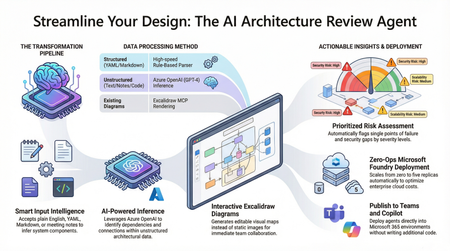
Designing and documenting software architecture is often a battle against static diagrams that become outdated the moment they are drawn. The Architecture Review Agent changes that by turning your design process into a dynamic, AI-powered workflow. In this post, we explore how to leverage Microsoft Foundry Hosted Agents, Azure OpenAI, and Excalidraw to build an open-source tool that instantly converts messy text descriptions, YAML, or README files into editable architecture diagrams. Beyond just drawing boxes, the agent acts as a technical co-pilot, delivering prioritized risk assessments, highlighting single points of failure, and mapping component dependencies. Discover how to eliminate manual diagramming, catch security flaws early, and deploy your own enterprise-grade agent with zero infrastructure overhead.18KViews7likes5CommentsIntegrating Microsoft Foundry with OpenClaw: Step by Step Model Configuration
Step 1: Deploying Models on Microsoft Foundry Let us kick things off in the Azure portal. To get our OpenClaw agent thinking like a genius, we need to deploy our models in Microsoft Foundry. For this guide, we are going to focus on deploying gpt-5.2-codex on Microsoft Foundry with OpenClaw. Navigate to your AI Hub, head over to the model catalog, choose the model you wish to use with OpenClaw and hit deploy. Once your deployment is successful, head to the endpoints section. Important: Grab your Endpoint URL and your API Keys right now and save them in a secure note. We will need these exact values to connect OpenClaw in a few minutes. Step 2: Installing and Initializing OpenClaw Next up, we need to get OpenClaw running on your machine. Open up your terminal and run the official installation script: curl -fsSL https://openclaw.ai/install.sh | bash The wizard will walk you through a few prompts. Here is exactly how to answer them to link up with our Azure setup: First Page (Model Selection): Choose "Skip for now". Second Page (Provider): Select azure-openai-responses. Model Selection: Select gpt-5.2-codex , For now only the models listed (hosted on Microsoft Foundry) in the picture below are available to be used with OpenClaw. Follow the rest of the standard prompts to finish the initial setup. Step 3: Editing the OpenClaw Configuration File Now for the fun part. We need to manually configure OpenClaw to talk to Microsoft Foundry. Open your configuration file located at ~/.openclaw/openclaw.json in your favorite text editor. Replace the contents of the models and agents sections with the following code block: { "models": { "providers": { "azure-openai-responses": { "baseUrl": "https://<YOUR_RESOURCE_NAME>.openai.azure.com/openai/v1", "apiKey": "<YOUR_AZURE_OPENAI_API_KEY>", "api": "openai-responses", "authHeader": false, "headers": { "api-key": "<YOUR_AZURE_OPENAI_API_KEY>" }, "models": [ { "id": "gpt-5.2-codex", "name": "GPT-5.2-Codex (Azure)", "reasoning": true, "input": ["text", "image"], "cost": { "input": 0, "output": 0, "cacheRead": 0, "cacheWrite": 0 }, "contextWindow": 400000, "maxTokens": 16384, "compat": { "supportsStore": false } }, { "id": "gpt-5.2", "name": "GPT-5.2 (Azure)", "reasoning": false, "input": ["text", "image"], "cost": { "input": 0, "output": 0, "cacheRead": 0, "cacheWrite": 0 }, "contextWindow": 272000, "maxTokens": 16384, "compat": { "supportsStore": false } } ] } } }, "agents": { "defaults": { "model": { "primary": "azure-openai-responses/gpt-5.2-codex" }, "models": { "azure-openai-responses/gpt-5.2-codex": {} }, "workspace": "/home/<USERNAME>/.openclaw/workspace", "compaction": { "mode": "safeguard" }, "maxConcurrent": 4, "subagents": { "maxConcurrent": 8 } } } } You will notice a few placeholders in that JSON. Here is exactly what you need to swap out: Placeholder Variable What It Is Where to Find It <YOUR_RESOURCE_NAME> The unique name of your Azure OpenAI resource. Found in your Azure Portal under the Azure OpenAI resource overview. <YOUR_AZURE_OPENAI_API_KEY> The secret key required to authenticate your requests. Found in Microsoft Foundry under your project endpoints or Azure Portal keys section. <USERNAME> Your local computer's user profile name. Open your terminal and type whoami to find this. Step 4: Restart the Gateway After saving the configuration file, you must restart the OpenClaw gateway for the new Foundry settings to take effect. Run this simple command: openclaw gateway restart Configuration Notes & Deep Dive If you are curious about why we configured the JSON that way, here is a quick breakdown of the technical details. Authentication Differences Azure OpenAI uses the api-key HTTP header for authentication. This is entirely different from the standard OpenAI Authorization: Bearer header. Our configuration file addresses this in two ways: Setting "authHeader": false completely disables the default Bearer header. Adding "headers": { "api-key": "<key>" } forces OpenClaw to send the API key via Azure's native header format. Important Note: Your API key must appear in both the apiKey field AND the headers.api-key field within the JSON for this to work correctly. The Base URL Azure OpenAI's v1-compatible endpoint follows this specific format: https://<your_resource_name>.openai.azure.com/openai/v1 The beautiful thing about this v1 endpoint is that it is largely compatible with the standard OpenAI API and does not require you to manually pass an api-version query parameter. Model Compatibility Settings "compat": { "supportsStore": false } disables the store parameter since Azure OpenAI does not currently support it. "reasoning": true enables the thinking mode for GPT-5.2-Codex. This supports low, medium, high, and xhigh levels. "reasoning": false is set for GPT-5.2 because it is a standard, non-reasoning model. Model Specifications & Cost Tracking If you want OpenClaw to accurately track your token usage costs, you can update the cost fields from 0 to the current Azure pricing. Here are the specs and costs for the models we just deployed: Model Specifications Model Context Window Max Output Tokens Image Input Reasoning gpt-5.2-codex 400,000 tokens 16,384 tokens Yes Yes gpt-5.2 272,000 tokens 16,384 tokens Yes No Current Cost (Adjust in JSON) Model Input (per 1M tokens) Output (per 1M tokens) Cached Input (per 1M tokens) gpt-5.2-codex $1.75 $14.00 $0.175 gpt-5.2 $2.00 $8.00 $0.50 Conclusion: And there you have it! You have successfully bridged the gap between the enterprise-grade infrastructure of Microsoft Foundry and the local autonomy of OpenClaw. By following these steps, you are not just running a chatbot; you are running a sophisticated agent capable of reasoning, coding, and executing tasks with the full power of GPT-5.2-codex behind it. The combination of Azure's reliability and OpenClaw's flexibility opens up a world of possibilities. Whether you are building an automated devops assistant, a research agent, or just exploring the bleeding edge of AI, you now have a robust foundation to build upon. Now it is time to let your agent loose on some real tasks. Go forth, experiment with different system prompts, and see what you can build. If you run into any interesting edge cases or come up with a unique configuration, let me know in the comments below. Happy coding!12KViews2likes2CommentsHow to Set Up Claude Code with Microsoft Foundry Models on macOS
Introduction Building with AI isn't just about picking a smart model. It is about where that model lives. I chose to route my Claude Code setup through Microsoft Foundry because I needed more than just a raw API. I wanted the reliability, compliance, and structured management that comes with Microsoft's ecosystem. When you are moving from a prototype to something real, having that level of infrastructure backing your calls makes a significant difference. The challenge is that Foundry is designed for enterprise cloud environments, while my daily development work happens locally on a MacBook. Getting the two to communicate seamlessly involved navigating a maze of shell configurations and environment variables that weren't immediately obvious. I wrote this guide to document the exact steps for bridging that gap. Here is how you can set up Claude Code to run locally on macOS while leveraging the stability of models deployed on Microsoft Foundry. Requirements Before we open the terminal, let's make sure you have the necessary accounts and environments ready. Since we are bridging a local CLI with an enterprise cloud setup, having these credentials handy now will save you time later. Azure Subscription with Microsoft Foundry Setup - This is the most critical piece. You need an active Azure subscription where the Microsoft Foundry environment is initialized. Ensure that you have deployed the Claude model you intend to use and that the deployment status is active. You will need the specific endpoint URL and the associated API keys from this deployment to configure the connection. An Anthropic User Account - Even though the compute is happening on Azure, the interface requires an Anthropic account. You will need this to authenticate your session and manage your user profile settings within the Claude Code ecosystem. Claude Code Client on macOS - We will be running the commands locally, so you need the Claude Code CLI installed on your MacBook. Step 1: Install Claude Code on macOS The recommended installation method is via Homebrew or Curl, which sets it up for terminal access ("OS level"). Option A: Homebrew (Recommended) brew install --cask claude-code Option B: Curl curl -fsSL https://claude.ai/install.sh | bash Verify Installation: Run claude --version. Step 2: Set Up Microsoft Foundry to deploy Claude model Navigate to your Microsoft Foundry portal, and find the Claude model catalog, and deploy the selected Claude model. [Microsoft Foundry > My Assets > Models + endpoints > + Deploy Model > Deploy Base model > Search for "Claude"] In your Model Deployment dashboard, go to the deployed Claude Models and get the "Endpoints and keys". Store it somewhere safe, because we will need them to configure Claude Code later on. Configure Environment Variables in MacOS terminal: Now we need to tell your local Claude Code client to route requests through Microsoft Foundry instead of the default Anthropic endpoints. This is handled by setting specific environment variables that act as a bridge between your local machine and your Azure resources. You could run these commands manually every time you open a terminal, but it is much more efficient to save them permanently in your shell profile. For most modern macOS users, this file is .zshrc. Open your terminal and add the following lines to your profile, making sure to replace the placeholder text with your actual Azure credentials: export CLAUDE_CODE_USE_FOUNDRY=1 export ANTHROPIC_FOUNDRY_API_KEY="your-azure-api-key" export ANTHROPIC_FOUNDRY_RESOURCE="your-resource-name" # Specify the deployment name for Opus export CLAUDE_CODE_MODEL="your-opus-deployment-name" Once you have added these variables, you need to reload your shell configuration for the changes to take effect. Run the source command below to update your current session, and then verify the setup by launching Claude: source ~/.zshrc claude If everything is configured correctly, the Claude CLI will initialize using your Microsoft Foundry deployment as the backend. Once you execute the claude command, the CLI will prompt you to choose an authentication method. Select Option 2 (Antrophic Console account) to proceed. This action triggers your default web browser and redirects you to the Claude Console. Simply sign in using your standard Anthropic account credentials. After you have successfully signed in, you will be presented with a permissions screen. Click the Authorize button to link your web session back to your local terminal. Return to your terminal window, and you should see a notification confirming that the login process is complete. Press Enter to finalize the setup. You are now fully connected. You can start using Claude Code locally, powered entirely by the model deployment running in your Microsoft Foundry environment. Conclusion Setting up this environment might seem like a heavy lift just to run a CLI tool, but the payoff is significant. You now have a workflow that combines the immediate feedback of local development with the security and infrastructure benefits of Microsoft Foundry. One of the most practical upgrades is the removal of standard usage caps. You are no longer limited to the 5-hour API call limits, which gives you the freedom to iterate, test, and debug for as long as your project requires without hitting a wall. By bridging your local macOS terminal to Azure, you are no longer just hitting an API endpoint. You are leveraging a managed, compliance-ready environment that scales with your needs. The best part is that now the configuration is locked in, you don't need to think about the plumbing again. You can focus entirely on coding, knowing that the reliability of an enterprise platform is running quietly in the background supporting every command.1.5KViews1like0CommentsBuilding with Azure OpenAI Sora: A Complete Guide to AI Video Generation
In this comprehensive guide, we'll explore how to integrate both Sora 1 and Sora 2 models from Azure OpenAI Service into a production web application. We'll cover API integration, request body parameters, cost analysis, limitations, and the key differences between using Azure AI Foundry endpoints versus OpenAI's native API. Table of Contents Introduction to Sora Models Azure AI Foundry vs. OpenAI API Structure API Integration: Request Body Parameters Video Generation Modes Cost Analysis per Generation Technical Limitations & Constraints Resolution & Duration Support Implementation Best Practices Introduction to Sora Models Sora is OpenAI's groundbreaking text-to-video model that generates realistic videos from natural language descriptions. Azure AI Foundry provides access to two versions: Sora 1: The original model focused primarily on text-to-video generation with extensive resolution options (480p to 1080p) and flexible duration (1-20 seconds) Sora 2: The enhanced version with native audio generation, multiple generation modes (text-to-video, image-to-video, video-to-video remix), but more constrained resolution options (720p only in public preview) Azure AI Foundry vs. OpenAI API Structure Key Architectural Differences Sora 1 uses Azure's traditional deployment-based API structure: Endpoint Pattern: https://{resource-name}.openai.azure.com/openai/deployments/{deployment-name}/... Parameters: Uses Azure-specific naming like n_seconds, n_variants, separate width/height fields Job Management: Uses /jobs/{id} for status polling Content Download: Uses /video/generations/{generation_id}/content/video Sora 2 adapts OpenAI's v1 API format while still being hosted on Azure: Endpoint Pattern: https://{resource-name}.openai.azure.com/openai/deployments/{deployment-name}/videos Parameters: Uses OpenAI-style naming like seconds (string), size (combined dimension string like "1280x720") Job Management: Uses /videos/{video_id} for status polling Content Download: Uses /videos/{video_id}/content Why This Matters? This architectural difference requires conditional request formatting in your code: const isSora2 = deployment.toLowerCase().includes('sora-2'); if (isSora2) { requestBody = { model: deployment, prompt, size: `${width}x${height}`, // Combined format seconds: duration.toString(), // String type }; } else { requestBody = { model: deployment, prompt, height, // Separate dimensions width, n_seconds: duration.toString(), // Azure naming n_variants: variants, }; } API Integration: Request Body Parameters Sora 1 API Parameters Standard Text-to-Video Request: { "model": "sora-1", "prompt": "Wide shot of a child flying a red kite in a grassy park, golden hour sunlight, camera slowly pans upward.", "height": "720", "width": "1280", "n_seconds": "12", "n_variants": "2" } Parameter Details: model (String, Required): Your Azure deployment name prompt (String, Required): Natural language description of the video (max 32000 chars) height (String, Required): Video height in pixels width (String, Required): Video width in pixels n_seconds (String, Required): Duration (1-20 seconds) n_variants (String, Optional): Number of variations to generate (1-4, constrained by resolution) Sora 2 API Parameters Text-to-Video Request: { "model": "sora-2", "prompt": "A serene mountain landscape with cascading waterfalls, cinematic drone shot", "size": "1280x720", "seconds": "12" } Image-to-Video Request (uses FormData): const formData = new FormData(); formData.append('model', 'sora-2'); formData.append('prompt', 'Animate this image with gentle wind movement'); formData.append('size', '1280x720'); formData.append('seconds', '8'); formData.append('input_reference', imageFile); // JPEG/PNG/WebP Video-to-Video Remix Request: Endpoint: POST .../videos/{video_id}/remix Body: Only { "prompt": "your new description" } The original video's structure, motion, and framing are reused while applying the new prompt Parameter Details: model (String, Optional): Your deployment name prompt (String, Required): Video description size (String, Optional): Either "720x1280" or "1280x720" (defaults to "720x1280") seconds (String, Optional): "4", "8", or "12" (defaults to "4") input_reference (File, Optional): Reference image for image-to-video mode remix_video_id (String, URL parameter): ID of video to remix Video Generation Modes 1. Text-to-Video (Both Models) The foundational mode where you provide a text prompt describing the desired video. Implementation: const response = await fetch(endpoint, { method: 'POST', headers: { 'Content-Type': 'application/json', 'api-key': apiKey, }, body: JSON.stringify({ model: deployment, prompt: "A train journey through mountains with dramatic lighting", size: "1280x720", seconds: "12", }), }); Best Practices: Include shot type (wide, close-up, aerial) Describe subject, action, and environment Specify lighting conditions (golden hour, dramatic, soft) Add camera movement if desired (pans, tilts, tracking shots) 2. Image-to-Video (Sora 2 Only) Generate a video anchored to or starting from a reference image. Key Requirements: Supported formats: JPEG, PNG, WebP Image dimensions must exactly match the selected video resolution Our implementation automatically resizes uploaded images to match Implementation Detail: // Resize image to match video dimensions const targetWidth = parseInt(width); const targetHeight = parseInt(height); const resizedImage = await resizeImage(inputReference, targetWidth, targetHeight); // Send as multipart/form-data formData.append('input_reference', resizedImage); 3. Video-to-Video Remix (Sora 2 Only) Create variations of existing videos while preserving their structure and motion. Use Cases: Change weather conditions in the same scene Modify time of day while keeping camera movement Swap subjects while maintaining composition Adjust artistic style or color grading Endpoint Structure: POST {base_url}/videos/{original_video_id}/remix?api-version=2024-08-01-preview Implementation: let requestEndpoint = endpoint; if (isSora2 && remixVideoId) { const [baseUrl, queryParams] = endpoint.split('?'); const root = baseUrl.replace(/\/videos$/, ''); requestEndpoint = `${root}/videos/${remixVideoId}/remix${queryParams ? '?' + queryParams : ''}`; } Cost Analysis per Generation Sora 1 Pricing Model Base Rate: ~$0.05 per second per variant at 720p Resolution Scaling: Cost scales linearly with pixel count Formula: const basePrice = 0.05; const basePixels = 1280 * 720; // Reference resolution const currentPixels = width * height; const resolutionMultiplier = currentPixels / basePixels; const totalCost = basePrice * duration * variants * resolutionMultiplier; Examples: 720p (1280×720), 12 seconds, 1 variant: $0.60 1080p (1920×1080), 12 seconds, 1 variant: $1.35 720p, 12 seconds, 2 variants: $1.20 Sora 2 Pricing Model Flat Rate: $0.10 per second per variant (no resolution scaling in public preview) Formula: const totalCost = 0.10 * duration * variants; Examples: 720p (1280×720), 4 seconds: $0.40 720p (1280×720), 12 seconds: $1.20 720p (720×1280), 8 seconds: $0.80 Note: Since Sora 2 currently only supports 720p in public preview, resolution doesn't affect cost, only duration matters. Cost Comparison Scenario Sora 1 (720p) Sora 2 (720p) Winner 4s video $0.20 $0.40 Sora 1 12s video $0.60 $1.20 Sora 1 12s + audio N/A (no audio) $1.20 Sora 2 (unique) Image-to-video N/A $0.40-$1.20 Sora 2 (unique) Recommendation: Use Sora 1 for cost-effective silent videos at various resolutions. Use Sora 2 when you need audio, image/video inputs, or remix capabilities. Technical Limitations & Constraints Sora 1 Limitations Resolution Options: 9 supported resolutions from 480×480 to 1920×1080 Includes square, portrait, and landscape formats Full list: 480×480, 480×854, 854×480, 720×720, 720×1280, 1280×720, 1080×1080, 1080×1920, 1920×1080 Duration: Flexible: 1 to 20 seconds Any integer value within range Variants: Depends on resolution: 1080p: Variants disabled (n_variants must be 1) 720p: Max 2 variants Other resolutions: Max 4 variants Concurrent Jobs: Maximum 2 jobs running simultaneously Job Expiration: Videos expire 24 hours after generation Audio: No audio generation (silent videos only) Sora 2 Limitations Resolution Options (Public Preview): Only 2 options: 720×1280 (portrait) or 1280×720 (landscape) No square formats No 1080p support in current preview Duration: Fixed options only: 4, 8, or 12 seconds No custom durations Defaults to 4 seconds if not specified Variants: Not prominently supported in current API documentation Focus is on single high-quality generations with audio Concurrent Jobs: Maximum 2 jobs (same as Sora 1) Job Expiration: 24 hours (same as Sora 1) Audio: Native audio generation included (dialogue, sound effects, ambience) Shared Constraints Concurrent Processing: Both models enforce a limit of 2 concurrent video jobs per Azure resource. You must wait for one job to complete before starting a third. Job Lifecycle: queued → preprocessing → processing/running → completed Download Window: Videos are available for 24 hours after completion. After expiration, you must regenerate the video. Generation Time: Typical: 1-5 minutes depending on resolution, duration, and API load Can occasionally take longer during high demand Resolution & Duration Support Matrix Sora 1 Support Matrix Resolution Aspect Ratio Max Variants Duration Range Use Case 480×480 Square 4 1-20s Social thumbnails 480×854 Portrait 4 1-20s Mobile stories 854×480 Landscape 4 1-20s Quick previews 720×720 Square 4 1-20s Instagram posts 720×1280 Portrait 2 1-20s TikTok/Reels 1280×720 Landscape 2 1-20s YouTube shorts 1080×1080 Square 1 1-20s Premium social 1080×1920 Portrait 1 1-20s Premium vertical 1920×1080 Landscape 1 1-20s Full HD content Sora 2 Support Matrix Resolution Aspect Ratio Duration Options Audio Generation Modes 720×1280 Portrait 4s, 8s, 12s ✅ Yes Text, Image, Video Remix 1280×720 Landscape 4s, 8s, 12s ✅ Yes Text, Image, Video Remix Note: Sora 2's limited resolution options in public preview are expected to expand in future releases. Implementation Best Practices 1. Job Status Polling Strategy Implement adaptive backoff to avoid overwhelming the API: const maxAttempts = 180; // 15 minutes max let attempts = 0; const baseDelayMs = 3000; // Start with 3 seconds while (attempts < maxAttempts) { const response = await fetch(statusUrl, { headers: { 'api-key': apiKey }, }); if (response.status === 404) { // Job not ready yet, wait longer const delayMs = Math.min(15000, baseDelayMs + attempts * 1000); await new Promise(r => setTimeout(r, delayMs)); attempts++; continue; } const job = await response.json(); // Check completion (different status values for Sora 1 vs 2) const isCompleted = isSora2 ? job.status === 'completed' : job.status === 'succeeded'; if (isCompleted) break; // Adaptive backoff const delayMs = Math.min(15000, baseDelayMs + attempts * 1000); await new Promise(r => setTimeout(r, delayMs)); attempts++; } 2. Handling Different Response Structures Sora 1 Video Download: const generations = Array.isArray(job.generations) ? job.generations : []; const genId = generations[0]?.id; const videoUrl = `${root}/${genId}/content/video`; Sora 2 Video Download: const videoUrl = `${root}/videos/${jobId}/content`; 3. Error Handling try { const response = await fetch(endpoint, fetchOptions); if (!response.ok) { const error = await response.text(); throw new Error(`Video generation failed: ${error}`); } // ... handle successful response } catch (error) { console.error('[VideoGen] Error:', error); // Implement retry logic or user notification } 4. Image Preprocessing for Image-to-Video Always resize images to match the target video resolution: async function resizeImage(file: File, targetWidth: number, targetHeight: number): Promise<File> { return new Promise((resolve, reject) => { const img = new Image(); const canvas = document.createElement('canvas'); const ctx = canvas.getContext('2d'); img.onload = () => { canvas.width = targetWidth; canvas.height = targetHeight; ctx.drawImage(img, 0, 0, targetWidth, targetHeight); canvas.toBlob((blob) => { if (blob) { const resizedFile = new File([blob], file.name, { type: file.type }); resolve(resizedFile); } else { reject(new Error('Failed to create resized image blob')); } }, file.type); }; img.onerror = () => reject(new Error('Failed to load image')); img.src = URL.createObjectURL(file); }); } 5. Cost Tracking Implement cost estimation before generation and tracking after: // Pre-generation estimate const estimatedCost = calculateCost(width, height, duration, variants, soraVersion); // Save generation record await saveGenerationRecord({ prompt, soraModel: soraVersion, duration: parseInt(duration), resolution: `${width}x${height}`, variants: parseInt(variants), generationMode: mode, estimatedCost, status: 'queued', jobId: job.id, }); // Update after completion await updateGenerationStatus(jobId, 'completed', { videoId: finalVideoId }); 6. Progressive User Feedback Provide detailed status updates during the generation process: const statusMessages: Record<string, string> = { 'preprocessing': 'Preprocessing your request...', 'running': 'Generating video...', 'processing': 'Processing video...', 'queued': 'Job queued...', 'in_progress': 'Generating video...', }; onProgress?.(statusMessages[job.status] || `Status: ${job.status}`); Conclusion Building with Azure OpenAI's Sora models requires understanding the nuanced differences between Sora 1 and Sora 2, both in API structure and capabilities. Key takeaways: Choose the right model: Sora 1 for resolution flexibility and cost-effectiveness; Sora 2 for audio, image inputs, and remix capabilities Handle API differences: Implement conditional logic for parameter formatting and status polling based on model version Respect limitations: Plan around concurrent job limits, resolution constraints, and 24-hour expiration windows Optimize costs: Calculate estimates upfront and track actual usage for better budget management Provide great UX: Implement adaptive polling, progressive status updates, and clear error messages The future of AI video generation is exciting, and Azure AI Foundry provides production-ready access to these powerful models. As Sora 2 matures and limitations are lifted (especially resolution options), we'll see even more creative applications emerge. Resources: Azure AI Foundry Sora Documentation OpenAI Sora API Reference Azure OpenAI Service Pricing This blog post is based on real-world implementation experience building LemonGrab, my AI video generation platform that integrates both Sora 1 and Sora 2 through Azure AI Foundry. The code examples are extracted from production usage.1.4KViews0likes0CommentsConfigure Embedding Models on Azure AI Foundry with Open Web UI
Introduction Let’s take a closer look at an exciting development in the AI space. Embedding models are the key to transforming complex data into usable insights, driving innovations like smarter chatbots and tailored recommendations. With Azure AI Foundry, Microsoft’s powerful platform, you’ve got the tools to build and scale these models effortlessly. Add in Open Web UI, a intuitive interface for engaging with AI systems, and you’ve got a winning combo that’s hard to beat. In this article, we’ll explore how embedding models on Azure AI Foundry, paired with Open Web UI, are paving the way for accessible and impactful AI solutions for developers and businesses. Let’s dive in! To proceed with configuring the embedding model from Azure AI Foundry on Open Web UI, please firstly configure the requirements below. Requirements: Setup Azure AI Foundry Hub/Projects Deploy Open Web UI – refer to my previous article on how you can deploy Open Web UI on Azure VM. Optional: Deploy LiteLLM with Azure AI Foundry models to work on Open Web UI - refer to my previous article on how you can do this as well. Deploying Embedding Models on Azure AI Foundry Navigate to the Azure AI Foundry site and deploy an embedding model from the “Model + Endpoint” section. For the purpose of this demonstration, we will deploy the “text-embedding-3-large” model by OpenAI. You should be receiving a URL endpoint and API Key to the embedding model deployed just now. Take note of that credential because we will be using it in Open Web UI. Configuring the embedding models on Open Web UI Now head to the Open Web UI Admin Setting Page > Documents and Select Azure Open AI as the Embedding Model Engine. Copy and Paste the Base URL, API Key, the Embedding Model deployed on Azure AI Foundry and the API version (not the model version) into the fields below: Click “Save” to reflect the changes. Expected Output Now let us look into the scenario for when the embedding model configured on Open Web UI and when it is not. Without Embedding Models configured. With Azure Open AI Embedding models configured. Conclusion And there you have it! Embedding models on Azure AI Foundry, combined with the seamless interaction offered by Open Web UI, are truly revolutionizing how we approach AI solutions. This powerful duo not only simplifies the process of building and deploying intelligent systems but also makes cutting-edge technology more accessible to developers and businesses of all sizes. As we move forward, it’s clear that such integrations will continue to drive innovation, breaking down barriers and unlocking new possibilities in the AI landscape. So, whether you’re a seasoned developer or just stepping into this exciting field, now’s the time to explore what Azure AI Foundry and Open Web UI can do for you. Let’s keep pushing the boundaries of what’s possible!2.4KViews0likes0CommentsBuilding a Basic Chatbot with Azure OpenAI
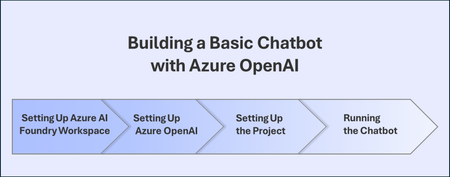
Overview In this turorial, we'll build a simple chatbot that uses Azure OpenAI to generate responses to user queries. To create a basic chatbot, we need to set up a language model resource that enables conversation capabilities. In this tutorial, we will: Set up the Azure OpenAI resource using the Azure AI Foundry portal. Retrieve the API key needed to connect the resource to your chatbot application. Once the API key is configured in your code, you will be able to integrate the language model into your chatbot and enable it to generate responses. By the end of this tutorial, you'll have a working chatbot that can generate responses using the Azure OpenAI model. Signing In and Setting Up Your Azure AI Foundry Workspace Signing In to Azure AI Foundry Open the Azure AI Foundry page in your web browser. Login to your Azure account. If you don't have an account, you can sign up. Setting Up Your Azure AI Foundry Workspace Select + Create project to create a new project. Perform the following tasks: Enter Project name. It must be a unique value. Select Hub you'd like to use (create a new one if needed). Select Create. Setting Up the Azure OpenAI Resource in Azure AI Foundry In this step, you'll learn how to set up the Azure OpenAI resource in Azure AI Foundry. Azure OpenAI is a pre-trained language model that can generate responses to user queries. We'll be using it in our chatbot. Select Models + endpoints from the left side menu. On this page, you can deploy language models and set up Azure AI resources. In this step, we will deploy the Azure OpenAI GPT-4 language model. Select + Deploy model. Select Deploy base model. In this tutorial, we will deploy the GPT-4o model. Select GPT-4o. Select Confirm. Select Deploy. The model will be deployed. Once the deployment is complete, you will see the model listed on the Models + endpoints page. Now that the model is deployed, you can retrieve the API key needed to connect the model to your chatbot application. Select the model you deployed on the Models + endpoints page. ` On the model details page, you can view information about the model, including the API key. We will come back this page later to add the required information into the environment variables. Setting Up the Project and Install the Libraries Now, you will create a folder to work in and set up a virtual environment to develop a program. Creating a Folder to Work Inside It Open a terminal window and type the following command to create a folder named basic-chatbot in the default path. mkdir basic-chatbot Type the following command inside your terminal to navigate to the basic-chatbot folder you created. cd basic-chatbot Creating a Virtual Environment Type the following command inside your terminal to create a virtual environment named .venv. python -m venv .venv Type the following command inside your terminal to activate the virtual environment. .venv\Scripts\activate.bat NOTE If it worked, you should see (.venv) before the command prompt. Installing the Required Packages Type the following commands inside your terminal to install the required packages. openai: A Python library that provides integration with the Azure OpenAI API. python-dotenv: A Python library for managing environment variables stored in an .env file. pip install openai python-dotenv Setting up the Project in Visual Studio Code To create a basic chatbot program, you will need two files: example.py: This file will contain the code to interact with Azure resources. .env: This file will store the Azure credentials and configuration details. NOTE Purpose of the .env File The .env file is essential for storing the Azure information required to connect and use the resources you created. By keeping the Azure credentials in the .env file, you can ensure a secure and organized way to manage sensitive information. Setting Up example.py File Open Visual Studio Code. Select File from the menu bar. Select Open Folder. Select the basic-chatbot folder that you created, which is located at C:\Users\yourUserName\basic-chatbot. In the left pane of Visual Studio Code, right-click and select New File to create a new file named example.py. Add the following code to the example.py file to import the required libraries. from openai import AzureOpenAI from dotenv import load_dotenv import os # Load environment variables from the .env file load_dotenv() # Retrieve environment variables AZURE_OPENAI_ENDPOINT = os.getenv("AZURE_OPENAI_ENDPOINT") AZURE_OPENAI_API_KEY = os.getenv("AZURE_OPENAI_API_KEY") AZURE_OPENAI_MODEL_NAME = os.getenv("AZURE_OPENAI_MODEL_NAME") AZURE_OPENAI_CHAT_DEPLOYMENT_NAME = os.getenv("AZURE_OPENAI_CHAT_DEPLOYMENT_NAME") AZURE_OPENAI_API_VERSION = os.getenv("AZURE_OPENAI_API_VERSION") # Initialize Azure OpenAI client client = AzureOpenAI( api_key=AZURE_OPENAI_API_KEY, api_version=AZURE_OPENAI_API_VERSION, base_url=f"{AZURE_OPENAI_ENDPOINT}/openai/deployments/{AZURE_OPENAI_CHAT_DEPLOYMENT_NAME}" ) print("Chatbot: Hello! How can I assist you today? Type 'exit' to end the conversation.") while True: user_input = input("You: ") if user_input.lower() == "exit": print("Chatbot: Ending the conversation. Have a great day!") break response = client.chat.completions.create( model=AZURE_OPENAI_MODEL_NAME, messages=[ {"role": "system", "content": "You are a helpful assistant."}, {"role": "user", "content": user_input} ], max_tokens=200 ) print("Chatbot:", response.choices[0].message.content.strip()) Setting Up .env File To set up your development environment, we will create a .env file and store the necessary credentials directly. NOTE Complete folder structure: └── YourUserName . └── basic-chatbot . ├── example.py . └── .env In the left pane of Visual Studio Code, right-click and select New File to create a new file named .env. Add the following code to the .env file to include your Azure information. AZURE_OPENAI_API_KEY=your_azure_openai_api_key AZURE_OPENAI_ENDPOINT=https://your_azure_openai_endpoint AZURE_OPENAI_MODEL_NAME=your_model_name AZURE_OPENAI_CHAT_DEPLOYMENT_NAME=your_deployment_name AZURE_OPENAI_API_VERSION=your_api_version Retrieving Environment Variables from Azure AI Foundry Now, you will retrieve the required information from Azure AI Foundry and update the .env file. Go to the Models + endpoints page and select your deployed model. On the Model Details page, copy the following information in to the .env file.: AZURE_OPENAI_API_KEY AZURE_OPENAI_ENDPOINT AZURE_OPENAI_MODEL_NAME AZURE_OPENAI_CHAT_DEPLOYMENT_NAME Paste this information into the .env file in the respective placeholders. Running the Chatbot Program Type the following command inside your terminal to run the program and see if it can answer questions. python example.py Interact with the chatbot by typing your questions or messages. The chatbot will generate responses based on the Azure OpenAI model you deployed. NOTE You can find the full example of this chatbot, including the code and .env template, in my GitHub repository: GitHub Repository3.3KViews2likes1CommentEnhancing E-Commerce Product Search with Vector Similarity in Azure Cosmos DB
Learn how to implement vector similarity search in your e-commerce API using Azure Cosmos DB and TypeScript. Boost search accuracy and user experience with advanced embedding techniques and scalable NoSQL solutions.1.6KViews0likes0Comments