azure front door
70 TopicsAzure Front Door: Implementing lessons learned following October outages
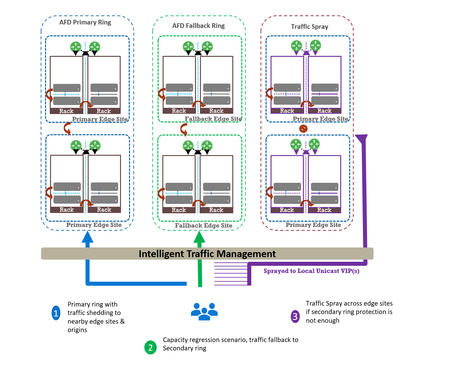
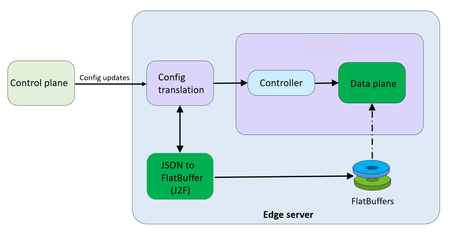
Abhishek Tiwari, Vice President of Engineering, Azure Networking Amit Srivastava, Principal PM Manager, Azure Networking Varun Chawla, Partner Director of Engineering Link to Part 2 - Azure Front Door Resiliency Series Link to Part 3 - Azure Front Door Resiliency Series Introduction Azure Front Door is Microsoft's advanced edge delivery platform encompassing Content Delivery Network (CDN), global security and traffic distribution into a single unified offering. By using Microsoft's extensive global edge network, Azure Front Door ensures efficient content delivery and advanced security through 210+ global and local points of presence (PoPs) strategically positioned closely to both end users and applications. As the central global entry point from the internet onto customer applications, we power mission critical customer applications as well as many of Microsoft’s internal services. We have a highly distributed resilient architecture, which protects against failures at the server, rack, site and even at the regional level. This resiliency is achieved by the use of our intelligent traffic management layer which monitors failures and load balances traffic at server, rack or edge sites level within the primary ring, supplemented by a secondary-fallback ring which accepts traffic in case of primary traffic overflow or broad regional failures. We also deploy a traffic shield as a terminal safety net to ensure that in the event of a managed or unmanaged edge site going offline, end user traffic continues to flow to the next available edge site. Like any large-scale CDN, we deploy each customer configuration across a globally distributed edge fleet, densely shared with thousands of other tenants. While this architecture enables global scale, it carries the risk that certain incompatible configurations, if not contained, can propagate broadly and quickly which can result in a large blast radius of impact. Here we describe how the two recent service incidents impacting Azure Front Door have reinforced the need to accelerate ongoing investments in hardening our resiliency, and tenant isolation strategy to mitigate likelihood and the scale of impact from this class of risk. October incidents: recap and key learnings Azure Front Door experienced two service incidents; on October 9 th and October 29 th , both with customer-impacting service degradation. On October 9 th : A manual cleanup of stuck tenant metadata bypassed our configuration protection layer, allowing incompatible metadata to propagate beyond our canary edge sites. This metadata was created on October 7 th , from a control-plane defect triggered by a customer configuration change. While the protection system initially blocked the propagation, the manual override operation bypassed our safeguards. This incompatible configuration reached the next stage and activated a latent data-plane defect in a subset of edge sites, causing availability impact primarily across Europe (~6%) and Africa (~16%). You can learn more about this issue in detail at https://aka.ms/AIR/QNBQ-5W8 On October 29 th : A different sequence of configuration changes across two control-plane versions produced incompatible metadata. Because the failure mode in the data-plane was asynchronous, the health checks validations embedded in our protection systems were all passed during the rollout. The incompatible customer configuration metadata successfully propagated globally through a staged rollout and also updated the “last known good” (LKG) snapshot. Following this global rollout, the asynchronous process in data-plane exposed another defect which caused crashes. This impacted connectivity and DNS resolutions for all applications onboarded to our platform. Extended recovery time amplified impact on customer applications and Microsoft services. You can learn more about this issue in detail at https://aka.ms/AIR/YKYN-BWZ We took away a number of clear and actionable lessons from these incidents, which are applicable not just to our service, but to any multi-tenant, high-density, globally distributed system. Configuration resiliency – Valid configuration updates should propagate safely, consistently, and predictably across our global edge, while ensuring that incompatible or erroneous configuration never propagate beyond canary environments. Data plane resiliency - Additionally, configuration processing in the data plane must not cause availability impact to any customer. Tenant isolation – Traditional isolation techniques such as hardware partitioning and virtualization are impractical at edge sites. This requires innovative sharding techniques to ensure single tenant-level isolation – a must-have to reduce potential blast radius. Accelerated and automated recovery time objective (RTO) – System should be able to automatically revert to last known good configuration in an acceptable RTO. In case of a service like Azure Front Door, we deem ~10 mins to be a practical RTO for our hundreds of thousands of customers at every edge site. Post outage, given the severity of impact which allowed an incompatible configuration to propagate globally, we made the difficult decision to temporarily block configuration changes in order to expedite rollout of additional safeguards. Between October 29 th to November 5 th , we prioritized and deployed immediate hardening steps before opening up the configuration change. We are confident that the system is stable, and we are continuing to invest in additional safeguards to further strengthen the platform's resiliency. Learning category Goal Repairs Status Safe customer configuration deployment Incompatible configuration never propagates beyond Canary · Control plane and data plane defect fixes · Forced synchronous configuration processing · Additional stages with extended bake time · Early detection of crash state Completed Data plane resiliency Configuration processing cannot impact data plane availability Manage data-plane lifecycle to prevent outages caused by configuration-processing defects. Completed Isolated work-process in every data plane server to process and load the configuration. January 2026 100% Azure Front Door resiliency posture for Microsoft internal services Microsoft operates an isolated, independent Active/Active fleet with automatic failover for critical Azure services Phase 1: Onboarded critical services batch impacted on Oct 29 th outage running on a day old configuration Completed Phase 2: Automation & hardening of operations, auto-failover and self-management of Azure Front Door onboarding for additional services March 2026 Recovery improvements Data plane crash recovery in under 10 minutes Data plane boot-up time optimized via local cache (~1 hour) Completed Accelerate recovery time < 10 minutes March 2026 Tenant isolation No configuration or traffic regression can impact other tenants Micro cellular Azure Front Door with ingress layered shards June 2026 This blog is the first in a multi-part series on Azure Front Door resiliency. In this blog, we will focus on configuration resiliency—how we are making the configuration pipeline safer and more robust. Subsequent blogs will cover tenant isolation and recovery improvements. How our configuration propagation works Azure Front Door configuration changes can be broadly classified into three distinct categories. Service code & data – these include all aspects of Azure Front Door service like management plane, control plane, data plane, configuration propagation system. Azure Front Door follows a safe deployment practice (SDP) process to roll out newer versions of management, control or data plane over a period of approximately 2-3 weeks. This ensures that any regression in software does not have a global impact. However, latent bugs that escape pre-validation and SDP rollout can remain undetected until a specific combination of customer traffic patterns or configuration changes trigger the issue. Web Application Firewall (WAF) & L7 DDoS platform data – These datasets are used by Azure Front Door to deliver security and load-balancing capabilities. Examples include GeoIP data, malicious attack signatures, and IP reputation signatures. Updates to these datasets occur daily through multiple SDP stages with an extended bake time of over 12 hours to minimize the risk of global impact during rollout. This dataset is shared across all customers and the platform, and it is validated immediately since it does not depend on variations in customer traffic or configuration steps. Customer configuration data – Examples of these are any customer configuration change—whether a routing rule update, backend pool modification, WAF rule change, or security policy change. Due to the nature of these changes, it is expected across the edge delivery / CDN industry to propagate these changes globally in 5-10 mins. Both outages stemmed from issues within this category. All configuration changes, including customer configuration data, are processed through a multi-stage pipeline designed to ensure correctness before global rollout across Azure Front Door’s 200+ edge locations. At a high level, Azure Front Door’s configuration propagation system has two distinct components - Control plane – Accepts customer API/portal changes (create/update/delete for profiles, routes, WAF policies, origins, etc.) and translates them into internal configuration metadata which the data plane can understand. Data plane – Globally distributed edge servers that terminate client traffic, apply routing/WAF logic, and proxy to origins using the configuration produced by the control plane. Between these two halves sits a multi-stage configuration rollout pipeline with a dedicated protection system (known as ConfigShield): Changes flow through multiple stages (pre-canary, canary, expanding waves to production) rather than going global at once. Each stage is health-gated: the data plane must remain within strict error and latency thresholds before proceeding. Each stage’s health check also rechecks previous stage’s health for any regressions. A successfully completed rollout updates a last known good (LKG) snapshot used for automated rollback. Historically, rollout targeted global completion in roughly 5–10 minutes, in line with industry standards. Customer configuration processing in Azure Front Door data plane stack Customer configuration changes in Azure Front Door traverse multiple layers—from the control plane through the deployment system—before being converted into FlatBuffers at each Azure Front Door node. These FlatBuffers are then loaded by the Azure Front Door data plane stack, which runs as Kubernetes pods on every node. FlatBuffer Composition: Each FlatBuffer references several sub-resources such as WAF and Rules Engine schematic files, SSL certificate objects, and URL signing secrets. Data plane architecture: o Master process: Accepts configuration changes (memory-mapped files with references) and manages the lifecycle of worker processes. o Workers: L7 proxy processes that serve customer traffic using the applied configuration. Processing flow for each configuration update: Load and apply in master: The transformed configuration is loaded and applied in the master process. Cleanup of unused references occurs synchronously except for certain categories à October 9 outage occurred during this step due to a crash triggered by incompatible metadata. Apply to workers: Configuration is applied to all worker processes without memory overhead (FlatBuffers are memory-mapped). Serve traffic: Workers start consuming new FlatBuffers for new requests; in-flight requests continue using old buffers. Old buffers are queued for cleanup post-completion. Feedback to deployment service: Positive feedback signals readiness for rollout.Cleanup: FlatBuffers are freed asynchronously by the master process after all workers load updates à October 29 outage occurred during this step due to a latent bug in reference counting logic. The October incidents showed we needed to strengthen key aspects of configuration validation, propagation safeguards, and runtime behavior. During the Azure Front Door incident on October 9 th , that protection system worked as intended but was later bypassed by our engineering team during a manual cleanup operation. During this Azure Front Door incident on October 29 th , the incompatible customer configuration metadata progressed through the protection system, before the delayed asynchronous processing task resulted in the crash. Configuration propagation safeguards Based on learnings from the incidents, we are implementing a comprehensive set of configuration resiliency improvements. These changes aim to guarantee that any sequence of configuration changes cannot trigger instability in the data plane, and to ensure quicker recovery in the event of anomalies. Strengthening configuration generation safety This improvement pivots on a ‘shift-left’ strategy where we want to ensure that we catch regression early before they propagate to production. It also includes fixing the latent defects which were the proximate cause of the outage. Fixing outage specific defects - We have fixed the control-plane defects that could generate incompatible tenant metadata under specific operation sequences. We have also remediated the associated data-plane defects. Stronger cross-version validation - We are expanding our test and validation suite to account for changes across multiple control plane build versions. This is expected to be fully completed by February 2026. Fuzz testing - Automated fuzzing and testing of metadata generation contract between the control plane and the data plane. This allows us to generate an expanded set of invalid/unexpected configuration combinations which might not be achievable by traditional test cases alone. This is expected to be fully completed by February 2026. Preventing incompatible configurations from being propagated This segment of the resiliency strategy strives to ensure that a potentially dangerous configuration change never propagates beyond canary stage. Protection system is “always-on” - Enhancements to operational procedures and tooling prevent bypass in all scenarios (including internal cleanup/maintenance), and any cleanup must flow through the same guarded stages and health checks as standard configuration changes. This is completed. Making rollout behavior more predictable and conservative - Configuration processing in the data plane is now fully synchronous. Every data plane issue due to incompatible meta data can be detected withing 10 seconds at every stage. This is completed. Enhancement to deployment pipeline - Additional stages during roll-out and extended bake time between stages serve as an additional safeguard during configuration propagation. This is completed. Recovery tool improvements now make it easier to revert to any previous version of LKG with a single click. This is completed. These changes significantly improve system safety. Post-outage we have increased the configuration propagation time to approximately 45 minutes. We are working towards reducing configuration propagation time closer to pre-incident levels once additional safeguards covered in the Data plane resiliency section below are completed by mid-January, 2026. Data plane resiliency The data plane recovery was the toughest part of recovery efforts during the October incidents. We must ensure fast recovery as well as resilience to configuration processing related issues for the data plane. To address this, we implemented changes that decouple the data plane from incompatible configuration changes. With these enhancements, the data plane continues operating on the last known good configuration—even if the configuration pipeline safeguards fail to protect as intended. Decoupling data plane from configuration changes Each server’s data plane consists of a master process which accepts configuration changes and manages lifecycle of multiple worker processes which serve customer traffic. One of the critical reasons for the prolonged outage in October was that due to latent defects in the data plane, when presented with a bad configuration the master process crashed. The master is a critical command-and-control process and when it crashes it takes down the entire data plane, in that node. Recovery of the master process involves reloading hundreds of thousands of configurations from scratch and took approximately 4.5 hours. We have since made changes to the system to ensure that even in the event of the master process crash due to any reason - including incompatible configuration data being presented - the workers remain healthy and able to serve traffic. During such an event, the workers would not be able to accept new configuration changes but will continue to serve customer traffic using the last known good configuration. This work is completed. Introducing Food Taster: strengthening config propagation resiliency In our efforts to further strengthen Azure Front Door’s configuration propagation system, we are introducing an additional configuration safeguard known internally as Food Taster which protects the master and worker processes from any configuration change related incidents, thereby ensuring data plane resiliency. The principle is simple: every data-plane server will have a redundant and isolated process – the Food Taster – whose only job is to ingest and process new configuration metadata first and then pass validated configuration changes to active data plane. This redundant worker does not accept any customer traffic. All configuration processing in this Food Taster is fully synchronous. That means we do all parsing, validation, and any expensive or risky work up front, and we do not move on until the Food Taster has either proven the configuration is safe or rejected it. Only when the Food Taster successfully loads the configuration and returns “Config OK” does the master process proceed to load the same config and then instruct the worker processes to do the same. If anything goes wrong in the Food Taster, the failure is contained to that isolated worker; the master and traffic-serving workers never see that invalid configuration. We expect this safeguard to reach production globally in January 2026 timeframe. Introduction of this component will also allow us to return closer to pre-incident level of configuration propagation while ensuring data plane safety. Closing This is the first in a series of planned blogs on Azure Front Door resiliency enhancements. We are continuously improving platform safety and reliability and will transparently share updates through this series. Upcoming posts will cover advancements in tenant isolation and improvements to recovery time objectives (RTO). We deeply value our customers’ trust in Azure Front Door. The October incidents reinforced how critical configuration resiliency is, and we are committed to exceeding industry expectations for safety, reliability, and transparency. By hardening our configuration pipeline, strengthening safety gates, and reinforcing isolation boundaries, we’re making Azure Front Door even more resilient so your applications can be too.19KViews25likes15CommentsRevolutionizing hyperscale application delivery and security: The New Azure Front Door edge platform
In this introductory blog to the new Azure Front Door next generation platform, we will go over the motivations, design choices and learnings from this undertaking which helped us successfully achieve massive gains in scalability, security and resiliency.7.1KViews12likes0CommentsAzure Web Application Firewall: WAF config versus WAF policy
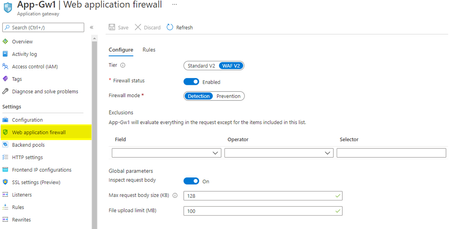
In this blog, we will explore the feature variations when deploying Azure Web Application Firewall (WAF) on Azure Application Gateway using WAF config or WAF policy. We will also show how WAF policies differ between Azure WAF for Azure Front Door and Azure Application Gateway deployments.21KViews8likes3Comments
Protect against React RSC CVE-2025-55182 with Azure Web Application Firewall (WAF)
Please subscribe to this blog as we will be updating the suggested rules as new attack permutations are found. On December 3, 2025, the React team disclosed a critical remote code execution (RCE) vulnerability in React Server Components (RSC), tracked as CVE-2025-55182. The vulnerability allows an unauthenticated attacker to send a specially crafted request to an RSC “Server Function” endpoint and potentially execute arbitrary code on the server. This vulnerability affects applications using React RSC in the following versions: 19.0.0 19.1.0 19.1.1 19.2.0 Patched versions are available, and all customers are strongly encouraged to update immediately. About CVE-2025-55182 According to the React security advisory, the issue stems from unsafe deserialization within React Server Components, where server function payloads were not adequately validated. When exploited, an attacker can execute arbitrary code on the server without authentication. The NVD entry classifies this vulnerability as Critical, with a CVSS score of 10.0, due to its ease of exploitation and the potential impact on server-side execution. All organizations using React Server Components — or frameworks that embed RSC capabilities such as Next.js, React Router (RSC mode), Waku, @parcel/rsc, @vitejs/plugin-rsc, or rwsdk — should consider themselves potentially exposed until the relevant patches are applied. Azure WAF Mitigation to CVE-2025-55182 The primary and most effective mitigation for this vulnerability is to upgrade any unpatched React versions to the latest security-patched releases. Mitigation on WAF on Application Gateway or Application Gateway for Containers If you are using the latest and recommended Default Rule Set (DRS) 2.1, or the previous Core Rule Set (CRS) 3.2, a new CVE-specific managed rule is available in Azure Web Application Firewall (WAF) for Application Gateway and Application Gateway for Containers. Please ensure this rule is enabled and retains its default Anomaly Score–based action: Rule ID: 99001018 (DRS 2.1) or 800115 (CRS 3.2) Rule description: Attempted React2Shell remote code execution exploitation (CVE-2025-55182) This CVE-specific rule has also been added to CRS 3.1. However, for enhanced and more comprehensive protection specifically against CVE-2025-55182, we strongly recommend upgrading to DRS 2.1, which includes additional detection coverage and tuning for this vulnerability. If you are using CRS 3.0, there is no built-in CVE-specific protection for CVE-2025-55182, and upgrading to DRS 2.1 is strongly advised. If upgrading is not currently possible, you may implement custom WAF rules to detect this exploit pattern using a Block action. Any custom rules should be validated in a test or staging environment before being enforced in production. Custom rules definition for WAF on Application Gateway and Application Gateway for Containers: "customRules": [ { "name": "cve202555182", "priority": 1, "ruleType": "MatchRule", "action": "Block", "matchConditions": [ { "matchVariables": [ { "variableName": "PostArgs" } ], "operator": "Contains", "negationConditon": false, "matchValues": [ "constructor", "__proto__", "prototype", "_response" ], "transforms": [ "Lowercase", "UrlDecode", "RemoveNulls" ] }, { "matchVariables": [ { "variableName": "RequestHeaders", "selector": "next-action" } ], "operator": "Any", "negationConditon": false, "matchValues": [], "transforms": [] } ], "skippedManagedRuleSets": [], "state": "Enabled" }, { "name": "cve202555182ver2", "priority": 100, "ruleType": "MatchRule", "action": "Block", "matchConditions": [ { "matchVariables": [ { "variableName": "PostArgs" } ], "operator": "Contains", "negationConditon": false, "matchValues": [ "constructor", "__proto__", "prototype", "_response" ], "transforms": [ "Lowercase", "UrlDecode", "RemoveNulls" ] }, { "matchVariables": [ { "variableName": "RequestHeaders", "selector": "rsc-action-id" } ], "operator": "Any", "negationConditon": false, "matchValues": [], "transforms": [] } ], "skippedManagedRuleSets": [], "state": "Enabled" } ], Adding these custom rules may fail if your WAF runs on the old WAF engine. In this case, we strongly recommend upgrading your WAF policy to the next-generation WAF engine by moving to a newer ruleset: either to the latest DRS 2.1 which includes the built-in managed rule (preferred) or to the previous CRS 3.2, then apply the custom rules described above. If upgrading your ruleset version is not an option, and your WAF remains on the old WAF engine, you can instead use the following alternative rules: "CustomRules": [ { "Name": "cve202555182", "Priority": 1, "RuleType": "MatchRule", "MatchConditions": [ { "MatchVariables": [ { "VariableName": "PostArgs" } ], "Operator": "Contains", "MatchValues": [ "constructor", "__proto__", "prototype", "_response" ], "Transforms": [ "Lowercase", "UrlDecode", "RemoveNulls" ] }, { "MatchVariables": [ { "VariableName": "RequestHeaders", "Selector": "next-action" } ], "Operator": "Regex", "MatchValues": [ "." ], "Transforms": [] } ], "Action": "Block" }, { "Name": "cve202555182ver2", "Priority": 2, "RuleType": "MatchRule", "MatchConditions": [ { "MatchVariables": [ { "VariableName": "PostArgs" } ], "Operator": "Contains", "MatchValues": [ "constructor", "__proto__", "prototype", "_response" ], "ATransforms": [ "Lowercase", "UrlDecode", "RemoveNulls" ] }, { "MatchVariables": [ { "VariableName": "RequestHeaders", "Selector": "rsc-action-id" } ], "Operator": "Regex", "MatchValues": [ "." ], "Transforms": [] } ], "Action": "Block" } ] Mitigation for WAF on Azure Front Door: If you are using WAF on Azure Front Door, you can create custom WAF rules to detect this exploit pattern. These custom rules are configured with a Block action. We recommend validating them in a test or staging environment before enforcing them in production. "customRules": [ { "name": "cve202555182", "enabledState": "Enabled", "priority": 1, "ruleType": "MatchRule", "rateLimitDurationInMinutes": 1, "rateLimitThreshold": 100, "matchConditions": [ { "matchVariable": "RequestHeader", "selector": "next-action", "operator": "Any", "negateCondition": false, "matchValue": [], "transforms": [] }, { "matchVariable": "RequestHeader", "selector": "content-type", "operator": "Contains", "negateCondition": false, "matchValue": [ "multipart/form-data", "application/x-www-form-urlencoded" ], "transforms": [ "Lowercase" ] }, { "matchVariable": "RequestBody", "operator": "Contains", "negateCondition": false, "matchValue": [ "constructor", "__proto__", "prototype", "_response" ], "transforms": [ "Lowercase", "UrlDecode", "RemoveNulls" ] } ], "action": "Block", "groupBy": [] }, { "name": "cve202555182ver2", "enabledState": "Enabled", "priority": 2, "ruleType": "MatchRule", "rateLimitDurationInMinutes": 1, "rateLimitThreshold": 100, "matchConditions": [ { "matchVariable": "RequestHeader", "selector": "rsc-action-id", "operator": "Any", "negateCondition": false, "matchValue": [], "transforms": [] }, { "matchVariable": "RequestHeader", "selector": "content-type", "operator": "Contains", "negateCondition": false, "matchValue": [ "multipart/form-data", "application/x-www-form-urlencoded" ], "transforms": [ "Lowercase" ] }, { "matchVariable": "RequestBody", "operator": "Contains", "negateCondition": false, "matchValue": [ "constructor", "__proto__", "prototype", "_response" ], "transforms": [ "Lowercase", "UrlDecode", "RemoveNulls" ] } ], "action": "Block", "groupBy": [] } ] You can find more information about Custom Rules on Azure WAF for Application Gateway here or for Azure Front Door here. Changelog 1/19/2026 5:00 PST - Updated built-in managed rule for CRS 3.2 and CRS 3.1 on WAF for Application Gateway 12/20/2025 11:00 PST - Updated built-in managed rule on WAF for Application Gateway and Application Gateway for Containers 12/7/2025 23:30 PST - Updated custom rules to detect additional attack permutation 12/5/2025 17:45 PST - Updated custom rules to include additional transform "RemoveNulls".16KViews7likes1CommentIntroducing Layered Ingress Sharding: Achieving Single-Tenant Isolation in Multi-Tenant Services
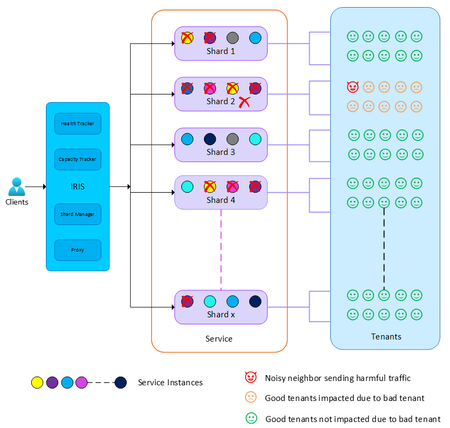
Abhishek Tiwari, Vice President of Engineering, Azure Networking Amit Srivastava, Partner Director of PM, Azure Networking Varun Chawla, Partner Director of Engineering, Azure Networking Links to the three-part AFD blog series: Part 1 Part 2 Part 3 Why Multi‑Tenant Isolation Is Still Hard at Hyperscale Modern cloud platforms thrive on multitenancy. By sharing infrastructure across tenants, services like Azure Front Door (AFD) can deliver massive scale, global reach, and cost efficiency. At hyperscale, however, this efficiency comes with a hard truth: rare failures are inevitable, and their blast radius matters more than their frequency. When hundreds of thousands of tenants share a global data plane, a single misbehaving tenant, configuration regression, or zero-day exploit can turn a low probability event into a high impact outage. Over the years, the industry has developed many protections — rate limiting, circuit breakers, fair share scheduling, crash protection, and various sharding strategies. These techniques dramatically reduce average case risk, but they still struggle to bound worst case impact. In particular, they fall short of delivering what customers intuitively expect: single tenant isolation semantics (the guarantee that one tenant’s failure does not affect another) without requiring dedicated per-tenant infrastructure. At Azure Front Door, we’ve been working on a new architectural approach that directly targets worst case blast radius. Today, I’m excited to introduce Layered Ingress Sharding, a sharding strategy designed to enable single tenant fault isolation for largescale multitenant services. From Traditional Sharding to Ingress Sharding Traditional partitioning assigns each tenant to a fixed shard. This limits blast radius, but tenants in the same shard can still experience complete outages when that shard fails. Shuffle sharding improves on this by assigning each tenant to a subset of instances, where subsets partially overlap, dramatically reducing the probability of widespread impact. However, shuffle sharding still allows 100% availability loss for tenants in the affected shard, relies heavily on client retries, and introduces nontrivial capacity loss in overlapping shards. To address these limitations, we introduced Ingress Sharding. With ingress sharding, an ingress controller, which we call IRIS (Intelligent Routing with Ingress Sharding), sits directly on the data path. Ingress sharding uses shuffle sharding to construct shards from service instances; IRIS operates on top of these shards to perform tenant-aware, capacity-aware routing rather than introducing a new shard construction algorithm. IRIS identifies the tenant for each incoming connection and deterministically maps that tenant to a shard. Instead of relying on clients to retry when a shard is unhealthy, IRIS actively: Monitors the health of service instances Tracks available capacity in real time Retries and reroutes traffic internally Steers traffic away from unhealthy or overloaded instances Dynamically expands the set of service instances used for oversized tenants when sustained load exceeds a single shard’s capacity In effect, IRIS turns shard selection into a real-time, capacity-aware decision that is reevaluated for every new connection. This moves fault resilience and load balancing inside the platform, rather than pushing that burden onto clients. Ingress sharding significantly improves isolation and resilience, but on its own, a tenant can still experience a complete loss of availability if all instances in its shard are affected. Introducing Layers: Isolation Through Independence Layered Sharding adds a new dimension to multitenant isolation. In Layered Sharding, the service is divided into multiple independent layers. A layer represents an independent serving dimension of the system capable of handling tenant traffic independently. This technique was developed to reduce blast radius by changing how tenants are assigned across shards, rather than changing the underlying shard construction within a single layer. A key design goal is that layered sharding is orthogonal to the underlying sharding strategy. It works with existing approaches, whether that is standard partitioning-based sharding, shuffle sharding, or other shard assignment schemes used within a layer. Within each layer: Service instances are grouped into shards using an existing sharding technique (for example, traditional partitioning or shuffle sharding) Each tenant is assigned to a shard independently in that layer Crucially, tenant-to-shard assignments are randomized and independent across layers. This independence is what gives layered sharding its isolation properties, regardless of the specific sharding algorithm used within a single layer. The definition of a layer itself is intentionally flexible and service dependent. In Azure Front Door, each server naturally acts as one layer. In other services, a layer might correspond to a cluster, a scale unit, a fault domain, or even a regional partition — any unit capable of serving tenant traffic independently while preserving uniform load distribution. The result is powerful: even if a tenant’s traffic causes failures in one shard in one layer, it is statistically unlikely that the same tenant will collide with the same peers across many layers. Instead of experiencing a full outage, other tenants see at most a small, transient reduction in capacity, often invisible with standard retry behavior. Layered sharding alone already reduces availability impact across tenants. But when combined with ingress sharding, it enables something fundamentally stronger. Layered Ingress Sharding Layered Ingress Sharding integrates two complementary ideas: Layered Sharding spreads tenants across many independent layers with randomized shard assignments. Ingress Sharding dynamically routes traffic to healthy service instances across layers using real‑time health and capacity signals. The key blast radius reduction that enables single tenant isolation comes from the combination of independent shard randomization across layers with active, intelligent traffic steering. When a tenant misbehaves due to harmful traffic, a bad configuration, or an unknown vulnerability, IRIS detects unhealthy service instances and automatically routes traffic to healthy shards in other layers. Because shard assignments are independent, IRIS can always find unaffected capacity for well-behaved tenants. The resulting behavior is a fundamental shift in multitenant failure dynamics: Outages remain localized to the misbehaving tenant Healthy tenants continue to serve traffic Blast radius shrinks from fleetwide to tenant-local In effect, a shared multi‑tenant system begins to behave like it has single tenant‑ isolation semantics, without abandoning multitenancy. Why the Math Works The guarantees behind layered ingress sharding are not heuristic, they’re statistical. Because tenant-to-shard assignments are randomized independently across layers, the probability that two tenants repeatedly collide in the same shard follows a binomial distribution. With production representative configurations, tens of layers and shuffle-sharded service instances, the probability that an arbitrary tenant experiences a user-visible failure due to another tenant drops below what standard client retries already mask. Instead of asking “Can a noisy neighbor impact me?”, the system answers “What is the probability that a single connection attempt is unlucky across all layers?” and that probability decreases exponentially as the number of layers increases. This allows us to trade catastrophic outages for rare, isolated, and standard retry-mitigated events. A Hidden Benefit: Identifying Bad Tenants Layered ingress sharding provides an additional, powerful side benefit: automated identification of misbehaving tenants. Because shard assignments are computed independently across layers, a tenant that is consistently responsible for failures appears as a common factor across impacted shards and service instances. By correlating signals across layers, the platform can accurately identify the offending tenant and apply targeted mitigations such as isolation, throttling, or traffic steering without relying on coarse-grained circuit breakers that penalize everyone. This dramatically improves response time under high load or adversarial conditions while preserving availability for unaffected tenants. Beyond Azure Front Door While Layered Ingress Sharding was developed in the context of Azure Front Door, the underlying principle is broadly applicable. Any large‑scale multi‑tenant system that: Serves many tenants from shared infrastructure Can distribute traffic uniformly across independent layers Can enforce shard-level isolation within each layer can benefit from this approach. Layers don’t have to be servers they could be clusters, scale units, or regional partitions. The key is independent assignment across layers combined with intelligent ingress routing. We believe this pattern represents a reusable architectural strategy for building resilient, hyperscale, multi‑tenant services. Closing Thoughts Multi‑tenancy doesn’t have to mean shared fate. Layered Ingress Sharding shows that by combining probabilistic isolation with intelligent ingress routing, we can build systems where failures are expected, bounded, and automatically contained, even at hyperscale. Rather than eliminating failure, this approach mathematically constrains its impact. And in large‑scale multi‑tenant platforms, that distinction makes all the difference.Azure Front Door: Resiliency Series – Part 2: Faster recovery (RTO)
Abhishek Tiwari, Vice President of Engineering, Azure Networking Amit Srivastava, Partner Director of PM, Azure Networking Varun Chawla, Partner Director of Engineering, Azure Networking Karthik Uthaman, Principal Engineer, Azure Networking In Part 1 of this blog series, we outlined our four‑pillar strategy for resiliency in Azure Front Door: configuration resiliency, data plane resiliency, tenant isolation, and accelerated Recovery Time Objective (RTO). Together, these pillars help Azure Front Door remain continuously available and resilient at global scale. Part 1 focused on the first two pillars: configuration and data plane resiliency. Our goal is to make configuration propagation safer, so incompatible changes never escape pre‑production environments. We discussed how incompatible configurations are blocked early, and how data plane resiliency ensures the system continues serving traffic from a last‑known‑good (LKG) configuration even if a bad change manages to propagate. We also introduced ‘Food Taster’, a dedicated sacrificial process running in each edge server’s data plane, that pretests every configuration change in isolation, before it ever reaches the live data plane. In this post, we turn to the recovery pillar. We describe how we have made key enhancements to the Azure Front Door recovery path so the system can return to full operation in a predictable and bounded timeframe. For a global service like Azure Front Door, serving hundreds of thousands of tenants across 210+ edge sites worldwide, we set an explicit target: to be able to recover any edge site – or all edge sites – within approximately 10 minutes, even in worst‑case scenarios. In typical data plane crash scenarios, we expect recovery in under a second. Repair status The first blog post in this series mentioned the two Azure Front Door incidents from October 2025 – learn more by watching our Azure Incident Retrospective session recordings for the October 9 th incident and/or the October 29 th incident. Before diving into our platform investments for improving our Recovery Time Objectives (RTO), we wanted to provide a quick update on the overall repair items from these incidents. We are pleased to report that the work on configuration propagation and data plane resiliency is now complete and fully deployed across the platform (in the table below, “Completed” means broadly deployed in production). With this, we have reduced configuration propagation latency from ~45 minutes to ~20 minutes. We anticipate reducing this even further – to ~15 minutes by the end of April 2026, while ensuring that platform stability remains our top priority. Learning category Goal Repairs Status Safe customer configuration deployment Incompatible configuration never propagates beyond ‘EUAP or canary regions’ Control plane and data plane defect fixes Forced synchronous configuration processing Additional stages with extended bake time Early detection of crash state Completed Data plane resiliency Configuration processing cannot impact data plane availability Manage data-plane lifecycle to prevent outages caused by configuration-processing defects. Completed Isolated work-process in every data plane server to process and load the configuration. Completed 100% Azure Front Door resiliency posture for Microsoft internal services Microsoft operates an isolated, independent Active/Active fleet with automatic failover for critical Azure services Phase 1: Onboarded critical services batch impacted on Oct 29 th outage running on a day old configuration Completed Phase 2: Automation & hardening of operations, auto-failover and self-management of Azure Front Door onboarding for additional services March 2026 Recovery improvements Data plane crash recovery in under 10 minutes Data plane boot-up time optimized via local cache (~1 hour) Completed Accelerate recovery time < 10 minutes April 2026 Tenant isolation No configuration or traffic regression can impact other tenants Micro cellular Azure Front Door with ingress layered shards June 2026 Why recovery at edge scale is deceptively hard To understand why recovery took as long as it did, it helps to first understand how the Azure Front Door data plane processes configuration. Azure Front Door operates in 210+ edge sites with multiple servers per site. The data plane of each edge server hosts multiple processes. A master process orchestrates the lifecycle of multiple worker processes, that serve customer traffic. A separate configuration translator process runs alongside the data plane processes, and is responsible for converting customer configuration bundles from the control plane into optimized binary FlatBuffer files. This translation step, covering hundreds of thousands of tenants, represents hours of cumulative computation. A per edge server cache is kept locally at each server level – to enable a fast recovery of the data plane, if needed. Once the configuration translator process produces these FlatBuffer files, each worker processes them independently and memory-maps them for zero-copy access. Configuration updates flow through a two-phase commit: new FlatBuffers are first loaded into a staging area and validated, then atomically swapped into production maps. In-flight requests continue using the old configuration, until the last request referencing them completes. The data process recovery is designed to be resilient to different failure modes. A failure or crash at the worker process level has a typical recovery time of less than one second. Since each server has multiple such worker processes which serve customer traffic, this type of crash has no impact on the data plane. In the case of a master process crash, the system automatically tries to recover using the local cache. When the local cache is reused, the system is able to recover quickly – in approximately 60 minutes – since most of the configurations in the cache were already loaded into the data plane before the crash. However, in certain cases if the cache becomes unavailable or must be invalidated because of corruption, the recovery time increases significantly. During the October 29 th incident, a data plane crash triggered a complete recovery sequence that took approximately 4.5 hours. This was not because restarting a process is slow, it is because a defect in the recovery process invalidated the local cache, which meant that “restart” meant rebuilding everything from scratch. The configuration translator process then had to re-fetch and re-translate every one of the hundreds of thousands of customer configurations, before workers could memory-map them and begin serving traffic. This experience has crystallized three fundamental learnings related to our recovery path: Expensive rework: A subset of crashes discarded all previously translated FlatBuffer artifacts, forcing the configuration translator process to repeat hours of conversion work that had already been validated and stored. High restart costs: Every worker on every node had to wait for the configuration translator process to complete the full translation, before it could memory-map any configuration and begin serving requests. Unbounded recovery time: Recovery time grew linearly with total tenant footprint rather than with active traffic, creating a ‘scale penalty’ as more tenants onboarded to the system. Separately and together, the insight was clear: recovery must stop being proportional to the total configuration size. Persisting ‘validated configurations’ across restarts One of the key recovery improvements was strengthening how validated customer configurations are cached and reused across failures, rather than rebuilding configuration states from scratch during recovery. Azure Front Door already cached customer configurations on host‑mounted storage prior to the October incident. The platform enhancements post outage focused on making the local configuration cache resilient to crashes, partial failures, and bad tenant inputs. Our goal was to ensure that recovery behavior is dominated by serving traffic safely, not by reconstructing configuration state. This led us to two explicit design goals… Design goals No category of crash should invalidate the configuration cache: Configuration cache invalidation must never be the default response to failures. Whether the failure is a worker crash, master crash, data plane restart, or coordinated recovery action, previously validated customer configurations should remain usable—unless there is a proven reason to discard it. Bad tenant configuration must not poison the entire cache: A single faulty or incompatible tenant configuration should result in targeted eviction of that tenant’s configuration only—not wholesale cache invalidation across all tenants. Platform enhancements Previously, customer configurations persisted to host‑mounted storage, but certain failure paths treated the cache as unsafe and invalidated it entirely. In those cases, recovery implicitly meant reloading and reprocessing configuration for hundreds of thousands of tenants before traffic could resume, even though the vast majority of cached data was still valid. We changed the recovery model to avoid invalidating customer configurations, with strict scoping around when and how cached entries are discarded: Cached configurations are no longer invalidated based on crash type. Failures are assumed to be orthogonal to configuration correctness unless explicitly proven otherwise. Cache eviction is granular and tenant‑scoped. If a cached configuration fails validation or load checks, only that tenant’s configuration is discarded and reloaded. All other tenant configurations remain available. This ensures that recovery does not regress into a fleet‑wide rebuild due to localized or unrelated faults. Safety and correctness Durability is paired with strong correctness controls, to prevent unsafe configurations from being served: Per‑tenant validation on load: Each cached tenant configuration is validated during the ‘load and verification’ phase, before being promoted for traffic serving. Therefore, failures are contained to that tenant. Targeted re‑translation: When validation fails, only the affected tenant’s configuration is reloaded or reprocessed. Therefore, the cache for other tenants is left untouched. Operational escape hatch: Operators retain the ability to explicitly instruct a clean rebuild of the configuration cache (with proper authorization), preserving control without compromising the default fast‑recovery path. Resulting behavior With these changes, recovery behavior now aligns with real‑world traffic patterns - configuration defects impact tenants locally and predictably, rather than globally. The system now prefers isolated tenant impact, and continued service using last-known-good over aggressive invalidation, both of which are critical for predictable recovery at the scale of Azure Front Door. Making recovery scale with active traffic, not total tenants Reusing configuration cache solves the problem of rebuilding configuration in its entirety, but even with a warm cache, the original startup path had a second bottleneck: eagerly loading a large volume of tenant configurations into memory before serving any traffic. At our scale, memory-mapping, parsing hundreds of thousands of FlatBuffers, constructing internal lookup maps, adding Transport Layer Security (TLS) certificates and configuration blocks for each tenant, collectively added almost an hour to startup time. This was the case even when a majority of those tenants had no active traffic at that moment. We addressed this by fundamentally changing when configuration is loaded into workers. Rather than eagerly loading most of the tenants at startup across all edge locations, Azure Front Door now uses an Machine Learning (ML)-optimized lazy loading model. In the new architecture, instead of loading a large number of tenant configurations, we only load a small subset of tenants that are known to be historically active in a given site, we call this the “warm tenants” list. The warm tenants list per edge site is created through a sophisticated traffic analysis pipeline that leverages ML. However, loading the warm tenants is not good enough, because when a request arrives and we don’t have the configuration in memory, we need to know two things. Firstly, is this a request from a real Azure Front Door tenant – and, if it is, where can I find the configuration? To answer these questions, each worker maintains a hostmap that tracks the state of each tenant’s configuration. This hostmap is constructed during startup, as we process each tenant configuration – if the tenant is in the warm list, we will process and load their configuration fully; if not, then we will just add an entry into the hostmap where all their domain names are mapped to the configuration path location. When a request arrives for one of these tenants, the worker loads and validates that tenant’s configuration on demand, and immediately begins serving traffic. This allows a node to start serving its busiest tenants within a few minutes of startup, while additional tenants are loaded incrementally only when traffic actually arrives—allowing the system to progressively absorb cold tenants as demand increases. The effect on recovery is transformative. Instead of recovery time scaling with the total number of tenants configured on a server, it scales with the number of tenants actively receiving traffic. In practice, even at our busiest edge sites, the active tenant set is a small fraction of the total. Just as importantly, this modified form of lazy loading provides a natural failure isolation boundary. Most Edge sites won’t ever load a faulty configuration of an inactive tenant. When a request for an inactive tenant with an incompatible configuration arrives, impact is contained to a single worker. The configuration load architecture now prefers serving as many customers as quickly as possible, rather than waiting until everything is ready before serving anyone. The above changes are slated to complete in April 2026 and will bring our RTO from the current ~1 hour to under 10 minutes – for complete recovery from a worst case scenario. Continuous validation through Game Days A critical element of our recovery confidence comes from GameDay fault-injection testing. We don’t simply design recovery mechanisms and assume they work—we break the system deliberately and observe how it responds. Since late 2025, we have conducted recurring GameDay drills that simulate the exact failure scenarios we are defending against: Food Taster crash scenarios: Injecting deliberately faulty tenant configurations, to verify that they are caught and isolated with zero impact on live traffic. In our January 2026 GameDay, the Food Taster process crashed as expected, the system halted the update within approximately 5 seconds, and no customer traffic was affected. Master process crash scenarios: Triggering master process crashes across test environments to verify that workers continue serving traffic, that the Local Config Shield engages within 10 seconds, and that the coordinated recovery tool restores full operation within the expected timeframe. Multi-region failure drills: Simulating simultaneous failures across multiple regions to validate that global Config Shield mechanisms engage correctly, and that recovery procedures scale without requiring manual per-region intervention. Fallback test drills for critical Azure services running behind Azure Front Door: In our February 2026 GameDay, we simulated the complete unavailability of Azure Front Door, and successfully validated failover for critical Azure services with no impact to traffic. These drills have both surfaced corner cases and built operational confidence. They have transformed recovery from a theoretical plan into tested, repeatable muscle memory. As we noted in an internal communication to our team: “Game day testing is a deliberate shift from assuming resilience to actively proving it—turning reliability into an observed and repeatable outcome.” Closing Part 1 of this series emphasized preventing unsafe configurations from reaching the data plane, and data plane resiliency in case an incompatible configuration reaches production. This post has shown that prevention alone is not enough—when failures do occur, recovery must be fast, predictable, and bounded. By ensuring that the FlatBuffer cache is never invalidated, by loading only active tenants, and by building safe coordinated recovery tooling, we have transformed failure handling from a fleet-wide crisis into a controlled operation. These recovery investments work in concert with the prevention mechanisms described in Part 1. Together, they ensure that the path from incident detection to full service restoration is measured in minutes, with customer traffic protected at every step. In the next post of this series, we will cover the third pillar of our resiliency strategy: tenant isolation—how micro-cellular architecture and ingress-layered sharding can reduce the blast radius of any failure to a small subset, ensuring that one customer’s configuration or traffic anomaly never becomes everyone’s problem. We deeply value our customers’ trust in Azure Front Door. We are committed to transparently sharing our progress on these resiliency investments, and to exceed expectations for safety, reliability, and operational readiness.2.8KViews5likes0CommentsAzure Network Security Demo Lab Environment with new updates. v2.1
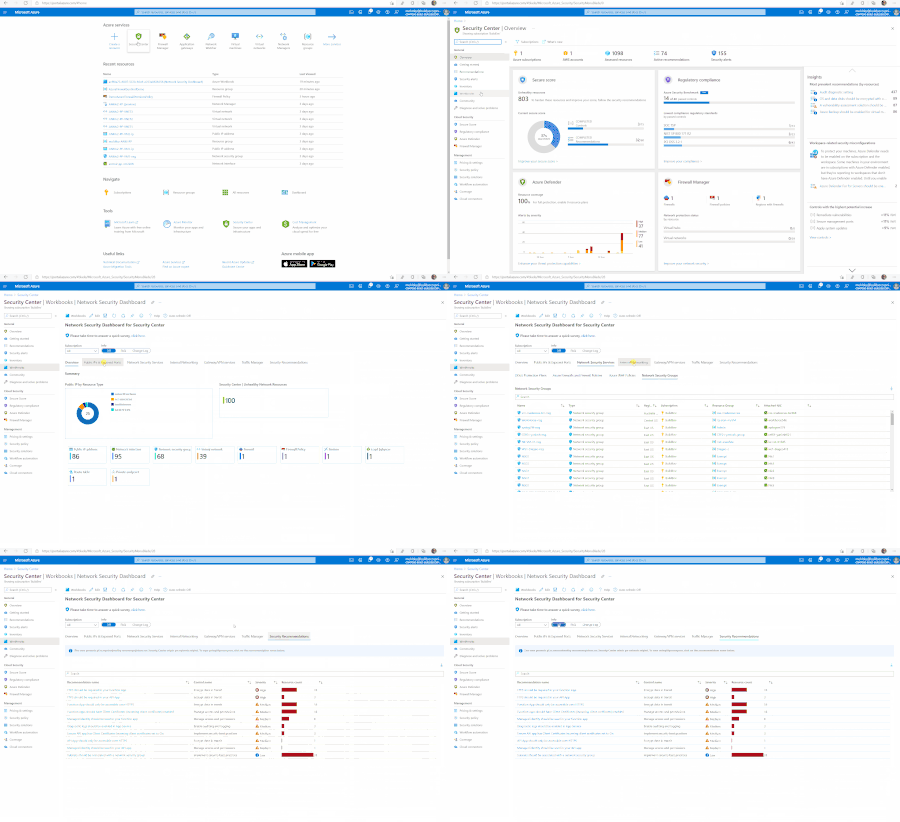
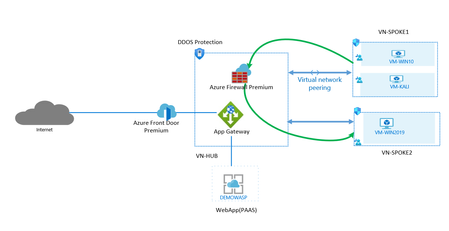
Announcing our new Network Security Demo lab environment. This blog post provides information about the updated demo lab environment version 2.1 in our Github Repository. You can learn the new features and POC scenarios you can now set out to validate. This lab environment contains the recently GA Azure Firewall premium with Firewall Manager and Azure Frontdoor Premium.8.1KViews5likes4Comments