artificial intelligence
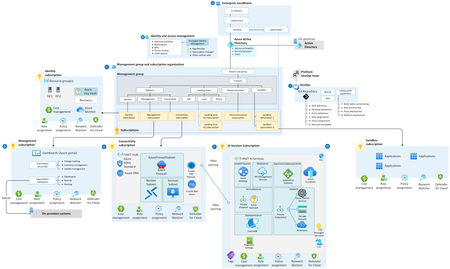
89 TopicsAzure OpenAI Landing Zone reference architecture
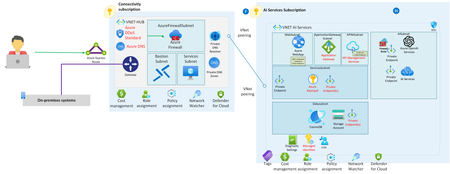
In this article, delve into the synergy of Azure Landing Zones and Azure OpenAI Service, building a secure and scalable AI environment. Unpack the Azure OpenAI Landing Zone architecture, which integrates numerous Azure services for optimal AI workloads. Explore robust security measures and the significance of monitoring for operational success. This journey of deploying Azure OpenAI evolves alongside Azure's continual innovation.216KViews45likes21CommentsSecurity Best Practices for GenAI Applications (OpenAI) in Azure
This article presents an in-depth guide on security best practices for GenAI applications that use LLM models within the Azure platform. Aimed at developers and system administrators, it explores the essentials for maintaining the confidentiality, integrity, and availability of LLMs such as Azure OpenAI. It delves into practical measures for addressing security challenges, including data breaches, misuse of AI, and regulatory compliance, while also emphasizing the role of a shared responsibility model in cloud security. The guide provides a comprehensive roadmap for implementing layered security strategies, encryption protocols, access controls, and monitoring practices to ensure the robust security of LLM applications in Azure.75KViews20likes0CommentsEmpowering AI: Building and Deploying Azure AI Landing Zones with Terraform
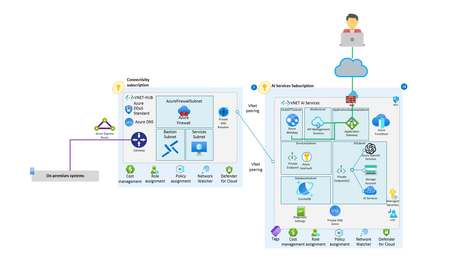
Discover the power of deploying Azure AI Landing Zones with Terraform. Explore best practices, secure connectivity, and streamlined access to Azure AI services. Learn to create a strong cloud foundation, optimize performance, and ensure governance for your AI solutions. Join us on this practical journey to harness the true capabilities of AI.31KViews9likes17CommentsDemystifying Azure OpenAI Networking for Secure Chatbot Deployment
Embark on a technical exploration of Azure's networking features for building secure chatbots. In this article, we'll dive deep into the practical aspects of Azure's networking capabilities and their crucial role in ensuring the security of your OpenAI deployments. With real-world use cases and step-by-step instructions, you'll gain practical insights into optimizing Azure and OpenAI for your projects.28KViews7likes9Comments
Leverage Large Language Models such as ChatGPT for your Ecommerce System
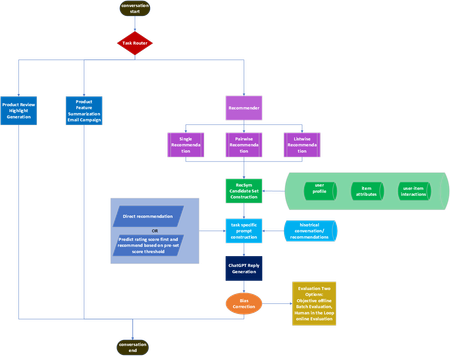
This solution guide presents a novel approach that leverages Large Language Models, such as ChatGPT, to address the limitations found in traditional recommendation methods. Traditional methods are typically task-specific and therefore require corresponding data to train distinct models for various applications. These methods often lack generalization capabilities and underperform in cold start situations.28KViews2likes0CommentsReducing the Environmental Impact of Generative AI: a Guide for Practitioners
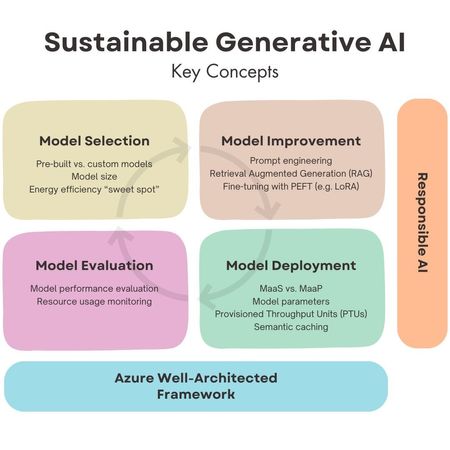
Discover how to harness the power of generative AI while minimising its environmental impact in this comprehensive guide for technical practitioners. From selecting the right foundation models and optimising fine-tuning processes to leveraging retrieval augmented generation (RAG) and mastering prompt engineering, we explore key strategies for sustainable AI development and deployment. By following best practices and making informed decisions at each stage of the AI lifecycle, you can effectively integrate generative AI into your products, services, and operations while prioritising energy efficiency, reducing carbon footprint, and promoting responsible resource management. Dive in to learn how to unlock the potential of generative AI without compromising on sustainability.22KViews5likes0CommentsOptimize Azure OpenAI Applications with Semantic Caching
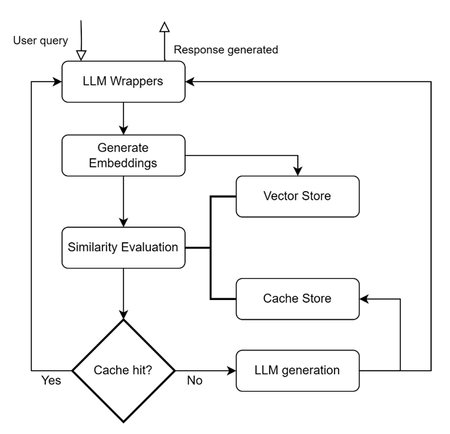
One of the ways to optimize cost and performance of LLMs is to cache the llm responses, this is sometimes referred to as “semantic caching”. In this blog, we will discuss the approaches, benefits, common scenarios and key considerations for using semantic caching.20KViews2likes2Comments
Accelerating Enterprise AI Adoption with Azure AI Landing Zone
Introduction As organizations across industries race to integrate Artificial Intelligence (AI) into their business processes and realize tangible value, one question consistently arises — where should we begin? Customers often wonder: What should the first steps in AI adoption look like? Should we build a unified, enterprise-grade platform for all AI initiatives? Who should guide us through this journey — Microsoft, our partners, or both? This blog aims to demystify these questions by providing a foundational understanding of the Azure AI Landing Zone (AI ALZ) — a unified, scalable, and secure framework for enterprise AI adoption. It explains how AI ALZ builds on two key architectural foundations — the Cloud Adoption Framework (CAF) and the Well-Architected Framework (WAF) — and outlines an approach to setting up an AI Landing Zone in your Azure environment. Foundational Frameworks Behind the AI Landing Zone 1.1 Cloud Adoption Framework (CAF) The Azure Cloud Adoption Framework is Microsoft’s proven methodology for guiding customers through their cloud transformation journey. It encompasses the complete lifecycle of cloud enablement across stages such as Strategy, Plan, Ready, Adopt, Govern, Secure, and Manage. The Landing Zone concept sits within the Ready stage — providing a secure, scalable, and compliant foundation for workload deployment. CAF also defines multiple adoption scenarios, one of which focuses specifically on AI adoption, ensuring that AI workloads align with enterprise cloud governance and best practices. 1.2 Well-Architected Framework (WAF) The Azure Well-Architected Framework complements CAF by providing detailed design guidance across five key pillars: Reliability Security Cost Optimization Operational Excellence Performance Efficiency AI Landing Zones integrate these design principles to ensure that AI workloads are not only functional but also resilient, cost-effective, and secure at enterprise scale. Understanding Azure Landing Zones To understand an AI Landing Zone, it’s important to first understand Azure Landing Zones in general. An Azure Landing Zone acts as a blueprint or foundation for deploying workloads in a cloud environment — much like a strong foundation is essential for constructing a building or bridge. Each workload type (SAP, Oracle, CRM, AI, etc.) may require a different foundation, but all share the same goal: to provide a consistent, secure, and repeatable environment built on best practices. Azure Landing Zones provide: A governed, scalable foundation aligned with enterprise standards Repeatable, automated deployment patterns using Infrastructure as Code (IaC) Integrated security and management controls baked into the architecture To have more insightful understanding of Azure Landing zone architecture pls visit the official link here and refer diagram below: The Role of Azure AI Foundry in AI Landing Zones Azure AI Foundry is emerging as Microsoft’s unified environment for enterprise AI development and deployment. It acts as a one-stop platform for building, deploying, and managing AI solutions at scale. Key components include: Foundry Model Catalog: A collection of foundation and fine-tuned models Agent Service: Enables model selection, tool and knowledge integration, and control over data and security Search and Machine Learning Services: Integrated capabilities for knowledge retrieval and ML lifecycle management Content Safety and Observability: Ensures responsible AI use and operational visibility Compute Options: Customers can choose from various Azure compute services based on control and scalability needs: Azure Kubernetes Service (AKS) — full control App Service and Azure Container Apps — simplified management Azure Functions — fully serverless option What Is Azure AI Landing Zone (AI ALZ)? The Azure AI Landing Zone is a workload-specific landing zone designed to help enterprises deploy AI workloads securely and efficiently in production environments. Key Objectives of AI ALZ Accelerate deployment of production-grade AI solutions Embed security, compliance, and resilience from the start Enable cost and operational optimization through standardized architecture Support repeatable patterns for multiple AI use cases using Azure AI Foundry Empower customer-centric enablement with extensibility and modularity By adopting the AI ALZ, organizations can move faster from proof-of-concept (POC) to production, addressing common challenges such as inconsistent architectures, lack of governance, and operational inefficiencies. Core Components of AI Landing Zone The AI ALZ is structured around three major components: Design Framework – Based on the Cloud Adoption Framework (CAF) and Well-Architected Framework (WAF). Reference Architectures – Blueprint architectures for common AI workloads. Extensible Implementations – Deployable through Terraform, Bicep, or (soon) Azure Portal templates using Azure Verified Modules (AVM). Together, these elements allow customers to quickly deploy a secure, standardized, and production-ready AI environment. Customer Readiness and Discovery A common question during early customer engagements is: “Can our existing enterprise-scale landing zone support AI workloads, or do we need a new setup?” To answer this, organizations should start with a discovery and readiness assessment, reviewing their existing enterprise-scale landing zone across key areas such as: Identity and Access Management Networking and Connectivity Data Security and Compliance Governance and Policy Controls Compute and Deployment Readiness Based on this assessment, customers can either: Extend their existing enterprise-scale foundation, or Deploy a dedicated AI workload spoke designed specifically for Azure AI Foundry and enterprise-wide AI enablement. Attached excel contains the discovery question to enquire about customer current setup and propose a adoption plan to reflect architecture changes if any. The Journey Toward AI Adoption The AI Landing Zone represents the first critical step in an organization’s AI adoption journey. It establishes the foundation for: Consistent governance and policy enforcement Security and networking standardization Rapid experimentation and deployment of AI workloads Scalable, production-grade AI environments By aligning with CAF and WAF, customers can be confident that their AI adoption strategy is architecturally sound, secure, and sustainable. Conclusion The Azure AI Landing Zone provides enterprises with a structured, secure, and scalable foundation for AI adoption at scale. It bridges the gap between innovation and governance, enabling organizations to deploy AI workloads faster while maintaining compliance, performance, and operational excellence. By leveraging Microsoft’s proven frameworks — CAF and WAF — and adopting Azure AI Foundry as the unified development platform, enterprises can confidently build the next generation of responsible, production-grade AI solutions on Azure. Get Started Ready to start your AI Landing Zone journey? Microsoft can help assess your readiness and accelerate deployment through validated reference implementations and expert-led guidance. To help organizations accelerate deployment, Microsoft has published open-source Azure AI Landing Zone templates and automation scripts in Terraform and Bicep that can be directly used to implement the architecture described in this blog. 👉 Explore and deploy the Azure AI Landing Zone(Preview) on GitHub: https://github.com/Azure/AI-Landing-Zones15KViews5likes9CommentsAzure OpenAI and Call Center Modernization
Much has been written about the powerful use cases enabled by Azure OpenAI. One such example is the transformation of the modern call center as their operators evaluate the potential of using artificial intelligence and natural language processing to optimize their processes and improve customer interactions. In this article, we describe a deployment where Azure OpenAI serves as a platform to assist human agents. Existing systems such as conversational chatbots, interactive voice response (IVR), and customer relationship management (CRM) all remain and complement the new system.15KViews1like0Comments