app advisor
25 TopicsGrow your sales on Marketplace: App Advisor helps you understand improvements to negotiated deals
Want to dive into the details of negotiated deals and how to create them? Head to App Advisor: https://aka.ms/GrowMySales Not all customers buy apps in the same way. Some need negotiated pricing. Others have specific contract or billing requirements. Some want to buy through a trusted channel partner. Microsoft Marketplace already supports these scenarios through negotiated deals. Now, several new capabilities make those motions more flexible, accessible, and scalable. How do I sell more apps and agents? The best way to sell more apps and agents is to expand your sales footprint, not build more. This means making your apps and agents available through private offers, negotiated deals, and selling through channel partners. These types of deals have always given you flexibility, but new releases have improved their functionality. No matter how you’re selling, chances are good that you could grow your sales with at least one type of private offer (each detailed in App Advisor) Sell directly without another party → to-customer private offer. Bring a channel partner into a direct customer deal → Multi-party private offers (MPO). Authorize partners to repeatedly resell your offer → Resale enabled offers (REO). Sell through a customer's Cloud Solution Provider → CSP private offer. What changed for negotiated deals Over the last two months, Microsoft has improved capabilities and availability of several types of negotiated deals: Request private offer: Customers can now initiate a conversation about customized pricing and terms directly from an eligible Marketplace listing. Partners configure this when publishing an offer and a button appears on the listing for customers to reach out, reducing the gap between discovering an offer and beginning a negotiated sale. Custom contract lengths: Software companies can create eligible private offers with nonstandard contract lengths defined in months, including terms such as 18 months, with support extending up to 10 years for eligible SaaS and Professional Services scenarios. This helps align Marketplace transactions more closely with contracts negotiated with customers. Flexible billing: Eligible private offers can use customized billing schedules rather than forcing the transaction into a standard cadence. Current Microsoft documentation supports up to 70 installments and terms up to 120 months/10 years in supported scenarios. Expanded MPO reach: After expanding into 30 European countries earlier in the year, MPO expanded to Australia, Japan, and South Africa last month, creating more opportunities for software companies and channel partners to collaborate on Marketplace transactions. Expanded REO reach: REO expanded to New Zealand, extending the channel-led resale model into another market. What comes next Interested in expanding your sales footprint with minimal overhead? Follow along in this series as we discuss each type of private offer and advantages of each. To get started today, explore your negotiated selling options with App Advisor: https://aka.ms/GrowMySales115Views4likes0CommentsBuild a repeatable Marketplace growth engine with App Advisor to sell more
Publishing your offer is only the beginning. Learn how App Advisor helps software development companies build a repeatable Marketplace growth engine with curated go-to-market guidance, Marketplace Insights, AI-powered optimization, and proven best practices that drive long-term visibility, engagement, and revenue growth.190Views3likes0CommentsUse App Advisor to Avoid 5 Common Mistakes and Sell More on Microsoft Marketplace
Common pitfalls when building your business around apps or agents and how App Advisor guides a curated, self-service journey prioritizing clarity at every stage, action over information, and scale without friction.181Views2likes0CommentsClarity at every stage: App Advisor turns Marketplace complexity into action
For software development companies, the Microsoft Marketplace journey isn’t always linear. It’s a series of decisions: what to build, how to package it, how to publish, and how to sell it, each with real dependencies and real friction.163Views4likes0CommentsWhy some apps reach revenue faster than others—and how App Advisor helps close the gap
Your team is working hard to build powerful apps, agents, AI solutions, and industry-specific offerings designed to solve real customer problems. The challenge is getting those solutions to market—and generating revenue at scale—as quickly186Views5likes0CommentsAccelerate your AI or agent build to sell on Marketplace with Quick-Start Development Toolkit
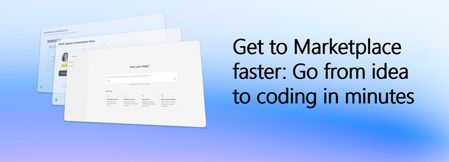
Want to skip right to coding in minutes? Start with the interactive wizard in App Advisor Building AI products quickly is becoming table stakes. Building them in a way that supports scalability, repeatability, and a path to commercialization is where software companies create advantage. The challenge now is reducing the time between identifying an opportunity and getting developers working inside a proven structure that supports real deployment outcomes. That’s where the AI, agentic, and Copilot branch of the Quick-Start Development Toolkit helps. Embedded directly within App Advisor, Quick-Start Development Toolkit helps software companies move from concept to implementation faster using guided development patterns, trusted architectures, deployable reference code, and practical resources designed to reduce friction across the development process. Build AI & agentic products faster without starting from scratch Development teams often know the customer scenario they want to solve. What slows momentum is deciding where to begin, selecting architecture patterns, and aligning implementation decisions across teams. The Quick-Start Development Toolkit helps remove that uncertainty. By answering a few focused questions about what you want to build, who it serves, and the products you’re building with, you’re matched with a development pattern designed to accelerate execution. Each development pattern includes: Self-serve, click-to-deploy reference code aligned to your scenario, Sample solution architecture to help visualize products and reduce guesswork, and Practical how-to resources and implementation guidance to overcome friction points, Everything is structured to support faster decision making and help teams move confidently into development. Accelerate development with purpose-built AI accelerators The AI and agent branch of Quick-Start Development Toolkit includes development accelerators designed around high-value scenarios, so your team can spend less time assembling foundations and more time building differentiated experiences. Each of these accelerators is built and fully maintained by Microsoft experts, so you can be confident your code template isn’t stale. Our most popular accelerators include: Multi-Agent Custom Automation Engine Accelerator: Delegate complex, repetitive tasks to AI agents that act on your behalf—executing work efficiently, reducing manual effort, and ensuring results align with your organization's standards. Conversation Knowledge Mining Accelerator: Improve contact center performance with AI-powered conversation intelligence—analyzing audio and text data on a large scale to show insights, improve service, and drive smarter decisions. Accelerate agentic applications for Unified Data Foundations (with Microsoft Fabric): Accelerate decision making at scale with secure, agentic AI built on a unified data foundation with two use cases for sales performance and customer insights. Each pattern includes common use cases, related resources, and pathways to adjacent scenarios so teams can continue progressing without losing momentum. The goal is to help your team move from experimentation to a product that can be packaged, deployed, and prepared for customers. You can see more of our accelerators here Coming this week: The Microsoft IQ solution accelerator leverages a shared intelligence layer to unify data, knowledge, and workflows, enabling AI-powered insights and coordinated actions for measurable business outcomes. Build with Microsoft Marketplace outcomes in mind Development choices shape commercial outcomes. Starting with trusted architecture and structured implementation guidance can help reduce redesign cycles later when preparing to package, publish, and scale. Quick-Start Development Toolkit helps software companies: Shorten time from idea to deployable AI product, Improve alignment across implementation decisions, Reduce development overhead through reusable foundations, and Create repeatable pathways toward publishing and selling. When development starts with clarity, commercialization becomes easier. Keep moving forward with App Advisor Quick-Start Development Toolkit is embedded within App Advisor because building is only one stage of the journey. App Advisor helps connect decisions across design, development, publishing, and growth so teams can continue moving forward with less context switching and more confidence. As your solution evolves, App Advisor provides curated, step-by-step guidance to help you prepare for Marketplace readiness and make the next decision faster. Ready to start? Explore Quick-Start Development Toolkit Start where you need help with App Advisor226Views4likes1CommentImprove Marketplace outcomes with AI-powered listing recommendations in App Advisor
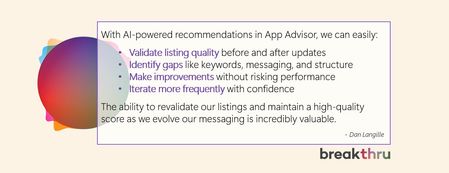
Over the past two decades working in the Microsoft partner ecosystem, I’ve seen how much effort it can take for small software development teams to navigate the path from building solutions to publishing to selling successfully enough to build a business around the products we work hard to build. What stands out to me now, however, is how much that experience has become more streamlined and actionable. App Advisor is one of the clearest demonstrations of Microsoft’s commitment to helping software development companies succeed, and in many ways, it represents the pinnacle of that evolution. Selling through Microsoft Marketplace has always been a high-impact growth channel for our team at Breakthru. But like many software companies, we’ve had to balance speed with precision—especially when it comes to optimizing listings that directly drive demand. With App Advisor—and now AI-powered Marketplace listing recommendations—we’re able to continuously improve how we show up in Marketplace without introducing risk or guesswork. We have more control and clarity than we have ever had before. Want to try the AI-recommendations for your listing? Go to aka.ms/ImproveMyListing Why App Advisor became a core part of how we operate I’ve been working in the Microsoft partner ecosystem for over 20 years. That’s a lot of technological changes. Over that time, however, Microsoft has never wavered from enabling partners with resources to build and grow. In fact, Microsoft has historically provided so much information, it was sometimes challenging to find the most relevant next step. After all, knowing what to do is one thing, knowing how to do it correctly and when is another. App Advisor closes that gap. It doesn’t just point you in the right direction. It meets you where you are and helps you get to where you need to go next. What makes App Advisor especially valuable for us is how practical and actionable it is. Instead of relying on external consultants or piecing together information across different resources, we can go directly to App Advisor and get clear, structured guidance. That saves time, reduces ambiguity, and helps us execute with more confidence across everything from publishing to sales motions. As it has evolved, it’s become more than a resource. It’s a system that helps you: Understand how to build, publish, and sell effectively Navigate Marketplace requirements without relying on external consultants Improve your execution across the entire lifecycle What’s new: AI-powered Marketplace listing recommendations The latest addition—AI-powered Marketplace listing recommendations—builds directly on that foundation. For us, Marketplace listings are a primary driver of inbound demand. In the Teams App Store, especially, visibility translates directly into installs, usage signals, and ultimately sales conversations. That raises the stakes. Any change to a listing—new messaging, updated screenshots, revised positioning—can impact uptick and performance. Historically, we were averse to making any changes. Now, that dynamic has changed. With AI-powered recommendations, we know what performs well, and as a result we can easily: Validate listing quality before and after updates Identify gaps in areas like keywords, messaging, and structure Make improvements without risking performance regression Iterate more frequently with confidence The ability to revalidate our listings and maintain a high-quality score as we evolve our messaging is incredibly valuable. What this means in practice This isn’t just about optimization. It’s about a different kind of operational fluency. Instead of treating our Marketplace listings as a static asset, we treat it as dynamic, continuously improving service. For example, this new App Advisor feature helped us identify that we needed to improve our key words. While our listings were strong in structure and clarity, optimizing key words would improve discoverability. That’s the kind of targeted feedback that drives meaningful outcomes. It not only shortens the feedback loop significantly but also removes uncertainty from the process. How this fits into the bigger picture What stands out most is how this feature fits into the broader App Advisor experience. It’s not a standalone tool. It’s part of a system designed to help software companies: Build with Marketplace readiness in mind Publish with clarity and compliance Sell with stronger positioning and visibility That continuity matters. It ensures that what you build, how you position it, and how you present it in Marketplace are all aligned from the start. If you’re already selling through Marketplace—or planning to—this is, in my twenty-plus-year experience with Microsoft, one of the fastest ways to improve outcomes without adding overhead. Review your current listings and run them through the AI-powered recommendations. You’ll quickly see where to focus. Ready to get started? aka.ms/AppAdvisor Explore how to optimize your listing and improve Marketplace performance today: aka.ms/ImproveMyListing275Views3likes0CommentsMicrosoft Marketplace 101: Insights from high performing software development company sellers
Microsoft Marketplace is probably the one topic that can give 'AI' a run for its money in terms of the number of mentions on LinkedIn, on cloud hyperscaler blogs, and in Partner Ecosystem presentations. But ask the average SaaS seller what a marketplace is, and you’ll probably get a different answer every time. That’s because marketplaces have become more than just a listing catalog, it’s now a pervasive commerce platform across the entire B2B Software purchase process. Jay McBain @ Omdia described Cloud Marketplaces as the "epicenter of partnerships, co-selling and co-innovation” and we see that play out at Microsoft. The combination of Microsoft's co-sell model and Microsoft Marketplace has created the platform for modern procurement and modern partnerships. Today, Microsoft Marketplace: Impacts all personas and incentives – from customers commercial incentives, to software company program sale incentives, channel partner benefits, and hyperscaler seller compensation models Enhances B2B purchase processes for customers – Streamlining supplier onboarding, to internal FinOps, to governance and guardrails on purchasing Brings agility to the sales process for software companies and channel partners – from pricing and quoting, budget allocation, billing & payments, right through to co-selling and go-to-market. With this level of impact, it’s not surprising that Microsoft Marketplace represents a significant growth opportunity for software companies. Customers are increasingly transacting through Marketplace as they align Azure commitments with third-party software purchases and adopt a more “marketplace-first” procurement approach. Research shows 69% of partners report larger deals and 75% close deals faster (Omdia), reinforcing the role of Marketplace as a strategic channel for enterprise software procurement. So, if you are a seller at a Microsoft SaaS software company and you want to take advantage of this opportunity, here are my five top learnings for high performance software sellers! This article assumes you are running your SaaS software platform on Microsoft Azure and you are already transactable in Marketplace. If you aren't, there are plenty of great resources for software companies to help get you there, and I have summarized them here: New Software Company Partner Guide. LEARNING 1 - Understand the customer benefits of Microsoft Marketplace and weave it into your customer proposal: This is about understanding the bigger picture of Marketplace for Microsoft customers, as the benefits go way beyond an individual transaction. The average enterprise is managing over 600 applications (Source - Zylo) and >60% of these applications being purchased outside of IT. Marketplace is a great way for customers to scale and bring efficiency across their B2B Software estate, giving them: Rapid access (find, try, buy) to software and AI innovation they need to run their business, Governance and guardrails for each purchase – so you are never compromising control and compliance. Streamlined procurement – onboarding suppliers in minutes using their Microsoft Agreement, invoicing and payment terms, Improved cloud economics – aligning the cloud consumption with your software company spend can unlock additional P&L impacting benefits, If you need to get up to speed on these aspects, check out: Microsoft Marketplace 101 - Top Customer Questions. LEARNING 2 - Understand how Microsoft partners can help you scale and close customer opportunities: Microsoft has always been a partner led organization. Today we have 500,000 partners globally ranging from a small start-up in a garage, to the largest Global Systems Integrator. These partners play different roles in our customers helping them transform and compete in the AI era through Microsoft Cloud & AI technologies. The great news for you is that we have empowered Microsoft channel partners and sales partners to sell Marketplace solutions. So, think about how you can use channel partners to (i). expand your reach, (ii). drive new opportunities or (iii). accelerate deal closure. We have a range of different models to support your channel led motions in our customers, including: Multi-party private offers (MPO) - Partner led sales agents for individual transactions. Resale enabled offers (REO) - Nominated and enabled partner representative by geo. Cloud solution provider (CSP) resellers - to scale into SMB/Corporate Accounts via a managed service provider For each opportunity, understand who the incumbent Microsoft partner is, and how you can use these mechanisms to accelerate your deal. Or better still, if you are looking to explore a more proactive partnership, check out the 1000s of Partners that are building Marketplace practices to support customers and software companies. Examples include Bytes, Softcat, CDW, Trustmarque, Crayon, Computacenter etc. LEARNING 3 - Accelerate your deal closure by including Microsoft programs and incentives into your customer proposal: Here are the most commonly used accelerators used by software company sellers to close deals: If you are marketplace transactable: Marketplace Rewards - Azure Sponsorship Credits - A performance related benefit that provides up to $400k in Azure Sponsorship Credits. These credits can be used as a deal sweetener with your Marketplace transaction and passed on to the customer for consumption. Up to 40% of transactions involve these credits today. If you are IP co-sell ready: Azure Benefit Eligible - This enables customers to decrement their Microsoft Azure Consumption Commitments (MACC) with eligible Marketplace purchases. By aligning their cloud consumption with their software company spend, it can unlock additional P&L impacting benefits. More than 85% of MACC customers buy via Marketplace. Microsoft IP co-sell incentive - This enables Microsoft sellers to get paid on the license value sold via Microsoft Marketplace. It also allows eligible Marketplace transactions to contribute to retiring Microsoft seller quota, helping accelerate deal alignment between partners and Microsoft field teams. If you have a Certified Software Designation (CSD): Marketplace Rewards - Azure Sponsorship Credits - If you come CSD Certified, Microsoft extends this benefit to $1M. These credits can be used as a deal sweetener with your Marketplace transaction and passed on to the customer for consumption. Customer Migrate & Modernize Incentive - This partner incentive is used to drive migrations to Microsoft Azure. Cash incentives vary based project size, but Microsoft will pay up to $200k per opportunity for NEW customer migrations to Microsoft Azure. High-performing software companies and sellers will combine these incentives into their proposals to help drive customer acquisition success. LEARNING 4 - Know your Microsoft customer Three things I urge every software company Seller to do as part of their Marketplace and co-sell conversations: Know your customer 1 - Understand the customer's Marketplace Propensity Score to help prioritize your opportunities Marketplace Propensity Scoring (combined with your co-Sell conversations) has proven a powerful tool for prioritizing pipeline and accelerating sales cycles. Offered as a Marketplace Rewards benefit, propensity scoring provides you with a score that ranks your pipeline prospects by their likelihood (0 to 100) to transact through Marketplace. The score is based on a number of factors including their commercials, existing spend and transaction volumes, relationship metrics etc. Access the benefit at: Microsoft Marketplace Rewards Know your customer 2 - Enable more tailored offers for customers by updating your MEDDIC, MEDDPICC or BANT qualification questions with these Marketplace qualifiers: Are they a Microsoft customer? This means they have agreed Microsoft terms and conditions to enable Marketplace transactions. Are they a Managed Microsoft Customer? This opens up the possibility of selling with Microsoft. What Microsoft segment/industry are they in? This opens up sales play alignment, industry go-to-market etc. How do they buy Microsoft Azure today? This helps navigate potential commercials, incentives and programs, purchase routes and the role of channel partners. Does the customer have a Microsoft Azure Consumption Commitment (MACC)? This could unlock the MACC benefit of Azure Benefit Eligible which allows customers to decrement marketplace purchases. What is the status of their Microsoft Azure Consumption Commitment (MACC)? Are they ahead or behind of their consumption commitment? Is it coming up for renewal? This is all about getting access to planned Azure budgets at the right time. Is there an incumbent Microsoft partner in the customer and what role do they play? It is forecasted that 60% of ALL marketplace sales will involve a channel partner, so get them involved early in the process. Know Your Customer 3 - Use the Partner Center referral process to engage incentivized Microsoft sellers and gain customer intelligence: Submitting your referrals via Partner Center will enable you to engage incentivized Microsoft sellers directly. For most Microsoft sellers, Microsoft Marketplace and co-sell deals are critical for how they will make their Azure quota. Help could include: Navigate and increase your visibility with the customer's buyers Gain insights on the customer's Azure commitments, Understand the partner landscape in the customer Potentially find ways to combine sales motions to drive bigger/better outcomes for all. Build this discipline with every opportunity is a key characteristic of a high-performance software company seller. LEARNING 5 - Celebrate and amplify Microsoft co-sell/Marketplace success The best Microsoft Marketplace and co-sell partners treat Microsoft as a customer. They market to the Microsoft sales and go-to-market teams the success they are driving, which in turn is driving further engagement and activity. Work with your aligned Microsoft Partner Development Manager to create a regular drumbeat of communication or use your Marketplace Rewards GTM benefits to amplify your success with the Microsoft sales teams. Need more help? Speak to your Partner Development Manager or aligned engagement manager Check out App Advisor for a guided experience on the journey for software development companies. Let me know your feedback or if you have any additional recommendations. Thanks Lee Corbett - EMEA ISV Recruit & Grow Lead239Views0likes0Comments