ai agents
8 Topics
Governance is becoming agentic, too: How enterprises can operate AI at scale
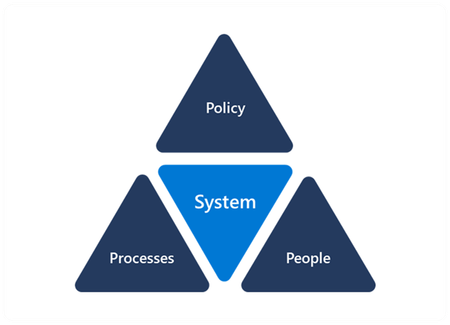
Organizations have spent the past few years trying to get people building with AI. That effort is working: Agents are moving beyond experimentation and into real business processes. For IT teams, this kind of successful adoption creates a new set of questions. What agents exist across the organization? Who owns them and what systems and data can they access? How are they being used, and what do they cost to operate? Are they healthy? And how do you know when an agent’s risk profile or behavior changes? These questions get harder as the agent estate of an organization grows. Agents may be built by different teams or on different platforms. Some may operate outside the Microsoft ecosystem entirely. Their capabilities can also change as they connect to new data and tools. We’ve been thinking a lot about this challenge as we prepare for the Microsoft Power Platform Conference (PPCC) in October 2026. One idea comes up again and again: Scaling agents doesn’t just mean governing more things. It requires changing how governance itself works. Inventories, reviews, and administrator controls remain important. But they need to become part of a more continuous operating model. I see that evolution in three parts: observe continuously, respond proportionately, and automate where appropriate. Observe continuously You can’t govern what you can’t see. And when it comes to agents, visibility means more than maintaining an inventory. It means understanding each agent in context: its ownership, identity, access, usage, health, and behavior. It is important to note that that context isn’t static. A maker or admin could give an agent access to a new tool or data source. They could change the agent's owner. The way people use it in production may reveal something about the build that wasn’t apparent during development. And, of course, usage of that agent (hopefully) will grow over time. That makes observability, defined as visibility into agent activity and behavior through telemetry, an ongoing requirement. Then, at enterprise scale, there’s the question of coverage. In my experience, many enterprises plan to build agents in multiple places. They may be built with Microsoft platforms like Copilot Studio, third-party platforms, and/or custom development. This is where cross-platform management layers like Microsoft Agent 365 become especially important. A shared agent control plane—that is, a common layer for managing and governing agents across platforms—makes observability actionable across the agent estate, rather than leaving signals isolated within individual platforms. IT can use those signals to detect changes such as risk, usage, cost, and health over time. isualize how agents fit into the broader ecosystem, connect with other agents, and perform over time to simplify monitoring and resolve issues quickly. At PPCC, the Agent 365: Securely Managing and Governing Agents at Scale workshop will go deeper into the controls and operating practices behind this model. If these are questions you’re working through in your organization, I hope you’ll join us there. Respond proportionately Once you have signals, the next question is what you do with them. Not every agent represents the same level of risk. An agent that answers employee questions from approved internal documentation is very different from one that can access sensitive data and take actions in a production system. They shouldn’t necessarily go through the same governance process. At enterprise scale, treating every agent identically creates problems in both directions. Too little oversight introduces unnecessary risk. Too much can create bottlenecks for scenarios that fit established policies. A more scalable approach is to align the response with the risk. Identity, permissions, data access, autonomy, and available actions all provide useful context. Organizations can use that content to determine which policies apply and where additional review is appropriate. For example, imagine an agent gains access to a new data source. That change is a signal. What’s the appropriate response? If the new access falls within established policies and risk boundaries, the agent may not need additional intervention. If it introduces a higher level of risk—such as access to sensitive data—it could trigger stronger controls or human review. This type of program might look something like this: The important shift seen with this approach is that governance becomes less dependent on applying the same manual process to every agent. Instead, organizations can establish patterns for different levels and types of risk. That makes governance more predictable for builders, too. Teams know the boundaries they’re working within, while higher-risk agents can receive additional scrutiny. We’re applying this principle inside Microsoft as well. At PPCC, How Microsoft Does IT: Managing and Governing Agents with Risk-Aligned Oversight will share how we’re approaching risk-aligned agent governance across Copilot Studio, Agent 365, Microsoft Defender, and Microsoft Purview. Automate where appropriate Once you can observe changes and determine the appropriate response, the next question is: Does a person need to execute that response every time? At enterprise scale, the answer increasingly needs to be no. Many governance decisions are repeatable. Organizations already know the policies they want to enforce, the boundaries agents should operate within, and the conditions that require additional review. This is where I think governance starts to become agentic, too. One useful way I’ve found to think about it is as a continuous loop: Observe → assess → act → escalate At a high level, this loop represents how a more automated governance framework can work. Basically, in such a framework: The governance system detects a relevant signal and evaluates it against the context and policies the organization has established. When the appropriate response is clear, an automated control can act. When the situation falls outside those boundaries or requires judgment, it can be escalated to a person. The goal isn’t to automate every governance decision, but rather to automate the decisions we already know how to make. People will continue to be responsible for setting policies, defining risk tolerances, and deciding where human judgment is required. The objective here is to let automation handle more of the repeatable work inside those boundaries. In practice, that changes the job of IT teams and Centers of Excellence (CoEs). Instead of inspecting and configuring agents one at a time, they can spend more of their effort designing how governance operates: defining trusted patterns, establishing risk thresholds, and deciding when human intervention is required. You can see some of this shift from visibility toward action at PPCC. The Agentic Governance: Secure, Govern, and Operate Your Power Platform at Scale session will explore real-time inventory and telemetry alongside automated controls and security, using the Power Platform API as an extensibility layer for enterprise governance. Governance must evolve with the agent estate The goal isn’t a future where people disappear from agent governance. It’s one where their attention is used more deliberately. As agents become more capable, the systems around them need to become better at sensing change. As the estate grows, oversight needs to reflect actual risk. And as routine governance work increases, organizations need to decide what can be handled through established policy and what needs human judgment and accountability. That is the shift I mean when I say governance is becoming agentic, too. And we’re only beginning to explore what that operating model can look like at enterprise scale. If you’re working through these questions in your own organization, we’ll be digging into them throughout PPCC. Here are a few sessions and workshops I recommend: Sessions Governance of All Your Agents at Scale How Microsoft Does IT: Managing and Governing Agents with Risk-Aligned Oversight Observability and Governance for Your Third-Party Agents with Minimal Configuration and Maximum Control Secure by Design: Preparing Agents for Production and Scale Governance First, Agents at Scale: How Wells Fargo Built Copilot Studio Agents in a Regulated Bank Workshops Agent 365: Securely Managing and Governing Agents at Scale Mastering Governance at Scale: Unlock the Full Potential of Your Power Platform and Agent Estate Nobody Knows How Many Agents You Have278Views0likes0CommentsMore powerful agents and workflows for autonomous business processes: Introducing a new harness for Copilot Studio
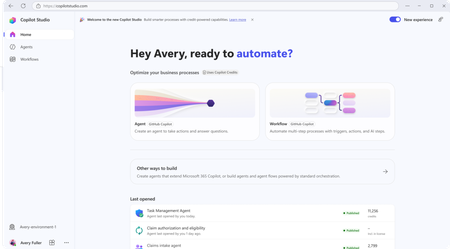
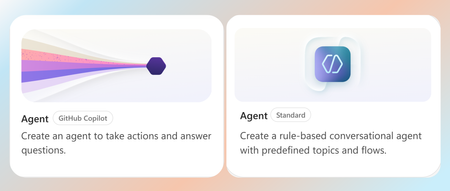
Over the past two months, we’ve been previewing a new capability within Copilot Studio that lets you build agents capable of taking on more complex business processes. Today, we’re excited to share that this capability is now generally available for production use and to introduce its new name: the GitHub Copilot harness in Copilot Studio. Meet the GitHub Copilot harness The GitHub Copilot harness gives Copilot Studio the coding and reasoning capabilities behind our most advanced agent experiences (like Copilot Cowork and the GitHub Copilot coding agent). This means your agents can now handle work that used to be out of reach, including processes that have many steps, many sources, and ambiguous decision points. The new harness is built for complex, long-horizon work using the latest frontier reasoning models like Opus 5, GPT-5.6 Sol, and Fable 5. It can plan, reason through dynamic problems, run an agentic loop, use skills, integrate workflows, connect to tools and agents in other platforms, and produce rich, multi-part outputs. In our own testing with real world business process evals, Copilot Studio shows significant performance and quality gains when using the GitHub Copilot harness. Improvements in multi-tool use, file analysis, code analysis, and knowledge quality mean these agents are more capable of taking on your most complex business processes. To help you build these more capable agents, we’re also delivering new experiences for makers building agents with the GitHub Copilot harness. The agent designer is more intuitive for authoring, putting the most important tools right within reach to make authoring faster, while retaining full agent lifecycle management features. Then, the workflow designer gives a visual canvas to understand and edit workflows, including adding agent nodes and running workflow evals. And soon, natural language authoring will let you describe your business goal and assemble the right combination of agents and workflows through a multi-turn conversation. Agents running on the GitHub Copilot harness use usage-based billing for all work, regardless of Microsoft 365 Copilot licensing. You pay for your agent’s usage based on the models you choose, the organizational context and tools you add, and runtime used. Certain AI-driven maker experiences, like natural language authoring, evaluations, and testing, will also fall under usage-based billing if building with the GitHub Copilot harness. You can learn more about Copilot Studio usage-based billing here. Continued Support for Copilot Chat and Standard harnesses Adding a new harness does not change the ones you already rely on. Different harnesses can be optimized for different outcomes, so rather than relying on a single one-size-fits-all approach, Copilot Studio now lets you choose the harness that best fits your scenario. This means Copilot Studio supports three harnesses today: The Copilot Chat harness, which uses the same harness as Microsoft 365 Copilot Chat and is ideal for customizing Copilot Chat experiences. The Standard harness, which most agents built in Copilot Studio use today and is great for conversational agents with rules-based topics. The new GitHub Copilot harness, which uses the power of GitHub Copilot SDK to automate complex, agentic business processes. We will continue to support the Copilot Chat and Standard harnesses in Copilot Studio for both existing agents and authoring of new agents. Microsoft 365 Copilot licensed users continue to benefit from fair use of Copilot Chat or Standard harness agents included in their Microsoft 365 Copilot license. For all other usage, the Copilot Chat and Standard harnesses will continue to be billed using the existing fixed rate card. Get started today The GitHub Copilot harness is generally available now, and you can start creating these agents directly from the Copilot Studio homepage. We can’t wait to see what you build. Share your thoughts using the feedback control in the top right corner of the product. Your input directly shapes what we build—and how you build—next. Try Copilot Studio today!46KViews10likes12CommentsManaging apps built in Copilot Studio
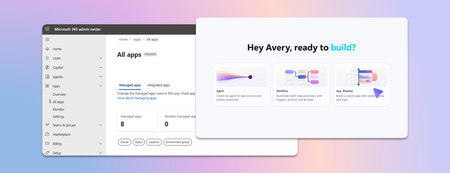
Last week we announced app building in Copilot Studio and Copilot Cowork. Makers can now describe business outcomes and produce full-stack apps with built-in source control, deployment stages, and version isolation—all on Microsoft-hosted infrastructure that requires no infrastructure provisioning, hosting configuration, or deployment pipeline. With those capabilities built in, your administrative scope is narrower and more familiar. Apps are created in the maker's personal developer environment following the environment routing policies you already have. That means things like connector permissions and data policies apply to an app both while it is being built and after it is published. Apps also access connected data on behalf of the signed-in user, which means publishing or sharing an app never grants anyone access to data they could not already reach. With these new capabilities, there are three things that every admin should be thinking about: Review your app estate Control cost with credit caps Choose where makers can build apps Review your app estate Published apps are inventoried in the Microsoft 365 admin center. Each app shows: Who built it Its lifecycle state Which data sources and connectors it uses Which policies apply to it Usage and operational metrics From the same experience, you can also block or disable a published app, remove a connector, bring an app back within policy, control whether it can be shared, and retire apps that are no longer used. Control cost with credit caps Building and running apps are both charged through Copilot Credits usage-based billing, and are metered as two separate services. This distinction lets you manage maker cost and app runtime cost independently. Build consumption varies with the language model used, the complexity of the app, and how much iteration is involved. Runtime consumption, on the other hand, varies with the volume and complexity of the tasks the app processes. At runtime, if the user holds a Power Apps Premium license, usage is included within existing request limits. Beyond those limits, or without a license, usage bills through Copilot Credits. You can learn more by reviewing the Copilot Credits licensing guide. As an admin, you can define credit cap policies to manage your costs. For both maker and runtime usage, caps are set per user, and the controls are managed through usage-based billing. For makers, think of a cap as a per-user budget: you can set the same budget for everyone, or different budgets for groups of users, such as departments that carry separate budgets of their own. Choose where makers can build apps By default, app creation is available to all users in both Copilot Studio and Copilot Cowork. However, you may want to limit where people can build apps. To do so: In the Microsoft 365 admin center, navigate to Apps, then Overview, and find ‘Choose where people can make apps’. Two paths appear: Copilot Studio, where makers build directly, which is on by default and recommended Copilot Cowork, where people create apps through chat, with availability managed by your organization's participation in the Frontier program Note that turning a path off prevents new apps being created that way. However, apps that are already published through that path will continue to run. Key takeaways for managing apps built in Copilot Studio The Microsoft 365 admin center is the one place to review the app estate, adjust app policies, and decide which creation paths stay open. Set credit caps as per-user budgets today, uniformly or by group, and plan for environment-level caps as project budgets when they arrive. Decide who is accountable for overseeing published apps before makers start publishing, as you would for any other application estate. Go to the Microsoft 365 admin center1.1KViews0likes0Comments
White paper: Choosing between the GitHub Copilot and Standard harnesses in Copilot Studio
The Standard harness and GitHub Copilot harness are two authoring and runtime options within Microsoft Copilot Studio. A harness is the operating layer between the model and the agent’s configuration. It determines how the model receives context, uses instructions and tools, interprets results, and moves through a task toward completion. Put simply, the model provides the reasoning capability, while the harness equips and directs it. Both harnesses are built for task-based, multi-step agents that create real business value, but they are suited to different scenarios. The Standard harness supports consistent, reliable execution of bounded business processes, while the GitHub Copilot harness extends these capabilities to longer-running, coordination-heavy, and reasoning-intensive work at a larger scale. This paper explains the key differences, tradeoffs, and scenarios to help you choose which harness is right for your business process. Read the full paper by clicking the PDF attachment below.5.5KViews0likes2Comments