admin
2308 Topics
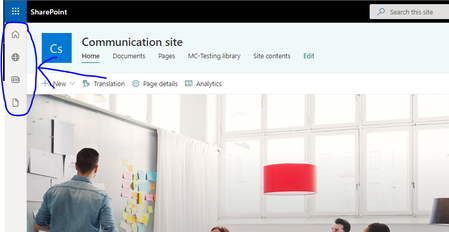
SharePoint Online site template that includes multiple languages when is created?
I have one site template , but the multilanguage must be created page by page with translate option, ¿is there one way to create a template english/spanish to be ready from start , that the user can only create site from template and be ready with two or more languages?19Views0likes1Comment
"Your organization's policies do not allow you to share with these users" error when sharing an item
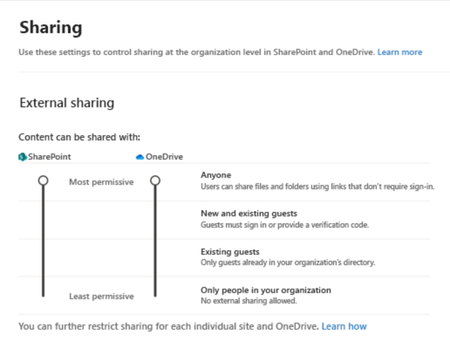
Hi, I have a OneDrive folder that contains multiple subfolders. Each of these subfolders needs to be shared to different people and I would like those people to be able to share those folders as well without me having to add each new email address myself. A person to whom I shared "folder A" with tried to share it with an external email address and got the following error: "Your organization's policies do not allow you to share with these users" error when sharing an item or site in SharePoint Online or OneDrive for Business" I followed the steps provided in https://learn.microsoft.com/en-us/sharepoint/troubleshoot/sharing-and-permissions/organization-policies-do-not-allow-you-to-share-with-users-error but my organisation external sharing parameters were already set to "Anyone" as seen below. Does this mean that people in the organisation can not share folders that require a log in? Thank you in advance for the help. Pedro1.3KViews0likes2Comments
Advice for creating and migrating to a SharePoint Intranet
Hi all, I'm relatively new to SharePoint Online, having done a course in it and mostly self-practice since then, but I've never had to create an intranet for a company before and I just got a new job where one of my tasks is to create an intranet for a client using SharePoint Online. (I'm essentially a paid intern.) Before I give you the rundown, here is the premise and 'heads up': I'm aware of the different types of sites, such as Communication and Team sites which include M365 Groups, as well as the sites that don't include M365 Groups (for niche purposes I've heard.) I'm aware of the ability to set different permission levels at site level, library/list level, file/folder level, user level (though this is not recommended I've heard), and group level. I'm also aware (but not familiar with) Azure AD and having the ability to set separate permissions in the database for internal and external users, as well as https://learn.microsoft.com/en-us/sharepoint/sharepoint-azureb2b-integration Here's the rundown: The client has only ever used Windows File Explorer for document storage and email for sharing, never any cloud services. They want to switch to using cloud services as they are a new company and would like to set up an intranet for all their employees-to-come when they grow more. Currently, afaik, they are about 5 strong with 2 of those being the founders. We are trying to set up a SharePoint Online intranet for them where they ideally have separate places for each department, and within those departments they have a section each one can store restricted documents and collaboration in. (For example, HR restricted files would not be accessible by anyone but HR employees and CEO potentially, Finances would have reports only accountants and Managers/CEO could see etc.) The other sections of their departments can be accessible to anyone within the company, but not externally, for when they need to collaborate on things as a company. (Not sure if this is best practice though?) Suggestions on intranet structure using different SharePoint sites would be helpful. On the point of sharing, I have been trying to figure out the best way to be able to allow one of the founders, for example, to share a restricted document with one person for a limited time that is outside the company, but they need to be authenticated. This whole process kind of goes over my head. From what I've seen, the default permission setting for a SharePoint site/library can be set to a group or level you choose (the CEO/Founders level for example) but if they, on the off chance, need to send a single document to a contractor for say 6 months, is there a way to do this with permissions and Azure AD? I've read through https://learn.microsoft.com/en-us/microsoft-365/solutions/setup-secure-collaboration-with-teams?view=o365-worldwide, but I think I could use some extra help if possible. I could use the motto of "Muck around and find out", but I want to do a good job and save time with as few logic/set up mistakes as I can, hence my question here. Thanks in advance for taking the time to read this and reply if you do. (If this isn't the correct forum to ask this, please point me to a place I can ask in.)3.3KViews0likes3CommentsSites with long file path length
I have a big problem to solve with SharePoint online Teams sites where data was migrated from On-Prem file shares and there are more items with a long file path length than we are able to fix. In some directories, it has gotten better but employees didn't listen to us when we told them to start creating less nested folders, shorter file and folder name and to try and fix older directories. In the beginning around 2 years ago, we migrated everything and turned on OneDrive sync and found out quickly how that wasn't going to work for one department, so we then told them to work out of the browser which seemed to solve the problem. Well, not everyone kept working from only the browser and more and more people continued to get OneDrive sync issues. Now I have ran some reports to get the actual file path length for some of the sites. For the biggest site, I show the largest file path length at 397, and I figured 220 would give a good starting point to have OneDrive successfully sync without errors given that OneDrive and File Explorer will add extra characters in the path. Starting at 220 characters, there are more than 61,000 affected files with a path ranging from 220 - 397, and more than 107,000 starting at 200 characters. The first problem to solve is to get the department to stop naming files in this way and stop creating all the nested folders. They need to establish a better naming convention. The second problem to solve is fixing as many of these as possible, but with this many items to correct it seems impossible. Has anyone worked on a SP online site to programmatically fix something like this to reduce the path length? Even trying this with a script sounds impossible, but there has to be something that can be done to help? Right??319Views0likes1CommentRemote Event Receivers retirement update in SharePoint Online
Remote Event Receivers are retiring as part of the announced SharePoint Add-In and Azure ACS retirements in SharePoint Online, but we've listened to your feedback and provided an option that will stay longer available and we're further improving webhooks to be a better alternative for Remote Event Receivers11KViews4likes34CommentsI don't want 100 different SharePoint sites. How to create private teams w/o a new site?
Guys. WTF. I've inherited a problem where a company of 50 people has 100 sharepoint sites - because users created different Teams for different projects, and Microsoft makes it incredibly opaque what this actually means. Now we have 100 SharePoint sites, many of which are unused, but all of which appear in the list of sites in 365AC. The structure we WANT is 1 Sharepoint site for our 1 org, but multiple locations within that site, and multiple groups for multiple projects. I THOUGHT what could work was converting the excess Teams into Private Channels. But I have now learned that private channels ALSO create SharePoint sites, because _______. Most confusingly, all of these sharepoint 'sites' DO exist within our main SharePoint website - they're just pages (but not 'pages') pretending to be a fresh sharepoint website. This confuses the **** out of people, the way they've redefined what a 'site' is, what a 'team' is, etc. This is genuinely hot garbage, and it's suddenly clear to me why people always push back on using SharePoint over OneDrive. Recommendations for... not having this disaster? Making a structure that is intuitive and doesn't redefine what a site and page are, and allows you to have private locations for management or projects, but DOESN'T create a 'site' within the main 'site', with it's OWN 'documents', and it's own 'Notebook' (which isn't a document) and it's own 'Conversations' (which are NOT conversations), and it's own 'pages'? I don't work with dumb people - these are very technical people. But even our main SharePoint guy is mystified by these interactions. Does it make more sense in another language? If anyone at Microsoft is reading - the english term 'site', comes from the word 'website', which generally refers to a distinct web service with a distinct domain name. These contained different webPAGES.. When websites started existing off a shared domain name, like company1.sharepoint.com and company2.sharepoint.com - this confused people, but they put up with it, because it was relatively easy to explain the tech behind this - having websites under a single site, that wasn't too hard to understand. But what SharePoint seems to do, is extend this practice into absolute hysteria, where a particular webPAGE of a webSITE is ALSO a site, but also is a TEAM, or COULD be a CHANNEL. OR it could be a PAGE - WHO knows? If it's a TEAM, that TEAM could have CONVERSATIONS, which aren't actually Team Conversations - they're EMAILS. But this is fine, because all CONVERSATIONS of a TEAM done in TEAMS are actually stored as EMAILS so really those, CONVERSATIONS should be CONVERSATIONS... So why aren't these conversations in Teams between a Team that are stored as Emails not showing in the Conversations which show emails within that Team? aefggaddadsfasd1KViews4likes7CommentsRecycle Bin and Site Content Hidden for Site Members and Site Visitors
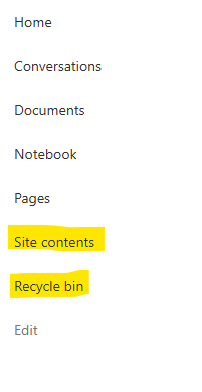
I posted this before but made a mistake with my write up, so I am reposting. I have a requirement that the Recycle bin and Site Contents should be be hidden from the Site Members and Site Visitors. Please how can I achieve this because the Server Infrastructure activation is not working for me. Any workarounds? Please help603Views0likes1CommentSharePoint Showcase: 5 Ways Organizations Improve Business Processes with Copilot in SharePoint
AI becomes most impactful when it helps with the work teams already do every day. The challenge is rarely a lack of information. It is turning trusted information into a clear, repeatable process without starting from scratch each time. That is where Copilot in SharePoint can help. It works with the content and structure already in SharePoint, including sites, pages, lists, libraries, and files. Teams can ask questions, compare and summarize content, organize information, create outputs, and turn repeatable multi-step processes into reusable skills. The examples below are based on real customer scenarios from organizations exploring Copilot in SharePoint. To protect customer confidentiality, organization names and identifying details have been generalized. What matters is the pattern: start with trusted SharePoint content, define the work that needs to happen, keep people in control, and make the process easier to repeat.2.2KViews0likes0Comments
Custom Formatter for Read-Only Fields conditional based on other columns
Hello! Does anyone know if it's possible with the fieldsettings, readonly formatting, to make it conditional based on a Person field? It's a multi people field if that makes a difference? I ideally want to make certain fields read only based on who is viewing it (without having to use a Power App customised form!). This is what I want (but I know the syntax is likely all wrong!) but not sure if it's possible to use an IF statement with boolean statements? { "sections": [ {} ], "fieldsettings": [ { "name": "Comments", "readonly": "=if([$People.email] == me, false, true)" } ] }763Views0likes2Comments