tips and tricks
762 Topics
Copilot, Excel and photos
We have a number of networking devices, all the same type, that we are deploying within an office. To speed up asset management, engineers are putting a label on the back under the MAC and serial numbers then taking a photo so it can be documented later by admin staff. Through Excel I've tried with a single photo and multiple photos to extract the MAC details successfully and put them in to cells at the same time. However, this doesn't tell us which device it is as it doesn't process the photos in any order. Therefore my next step is to be able to capture the label info we have put on and tie this info together with the serial number each time so its all from the same equipment. Is it possible to do this either one photo at a time or across multiple photos? TIA20Views0likes0CommentsCopilot Makes Branding Easy! New PowerPoint Brand Images Feature
🚀 New PowerPoint Feature: Brand Images + Copilot Enhances Brand Consistency! Microsoft has just released a powerful new capability in PowerPoint: Brand Images, allowing users to insert company‑approved logos, icons, and photos directly from within the app. No more searching through folders, Teams chats, or old emails to find the “right” logo. With the help of Microsoft 365 Copilot, users can now build professional, brand‑consistent presentations faster than ever. 📌 What this means for organizations: Centralized, controlled access to brand assets Ensures up‑to‑date logos and visuals Eliminates incorrect or outdated branding Seamless user experience inside PowerPoint To enable this feature, admins must configure the Organization Assets Library (OAL) in SharePoint and upload approved brand assets. Adding metadata and tags greatly improves search and filtering. I’ve created a full video breaking down everything you need to know: 👉 Feature overview 👉 Admin setup steps 👉 Best practices for asset organization 👉 How Copilot enhances the experience 🎥 Watch the full video here: https://youtu.be/Uv8JpHCvgg0 #Microsoft365 #PowerPoint #Copilot #BrandManagement #M365Admin #SharePoint #Productivity #ModernWorkplace #MicrosoftUpdates #GiulianoDeLuca248Views1like2CommentsMicrosoft 365, Copilot & Copilot Studio News
February News Roundup for Technical and Business Leaders (2026) February 2026 was a significant month for enterprise AI across Microsoft 365, Microsoft Copilot, and Microsoft Copilot Studio. From large-scale enterprise deployments to governance updates and expanded model flexibility, Microsoft continues transitioning from AI experimentation to enterprise AI at scale. Here’s your strategic and technical breakdown of what mattered most this month. https://dellenny.com/microsoft-365-copilot-copilot-studio-news/61Views0likes0CommentsOptimising AI Costs with Microsoft Foundry Model Router
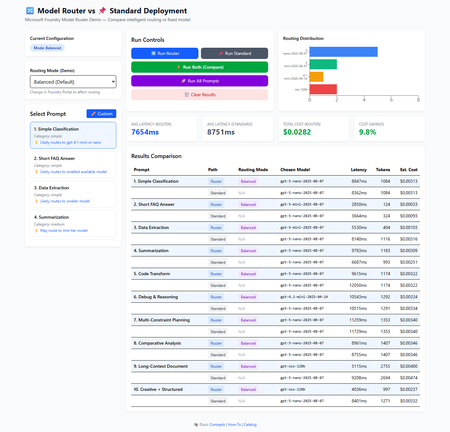
Microsoft Foundry Model Router analyses each prompt in real-time and forwards it to the most appropriate LLM from a pool of underlying models. Simple requests go to fast, cheap models; complex requests go to premium ones, all automatically. I built an interactive demo app so you can see the routing decisions, measure latencies, and compare costs yourself. This post walks through how it works, what we measured, and when it makes sense to use. The Problem: One Model for Everything Is Wasteful Traditional deployments force a single choice: Strategy Upside Downside Use a small model Fast, cheap Struggles with complex tasks Use a large model Handles everything Overpay for simple tasks Build your own router Full control Maintenance burden; hard to optimise Most production workloads are mixed-complexity. Classification, FAQ look-ups, and data extraction sit alongside code analysis, multi-constraint planning, and long-document summarisation. Paying premium-model prices for the simple 40% is money left on the table. The Solution: Model Router Model Router is a trained language model deployed as a single Azure endpoint. For each incoming request it: Analyses the prompt — complexity, task type, context length Selects an underlying model from the routing pool Forwards the request and returns the response Exposes the choice via the response.model field You interact with one deployment. No if/else routing logic in your code. Routing Modes Mode Goal Trade-off Balanced (default) Best cost-quality ratio General-purpose Cost Minimise spend May use smaller models more aggressively Quality Maximise accuracy Higher cost for complex tasks Modes are configured in the Foundry Portal, no code change needed to switch. Building the Demo To make routing decisions tangible, we built a React + TypeScript app that sends the same prompt through both Model Router and a fixed standard deployment (e.g. GPT-5-nano), then compares: Which model the router selected Latency (ms) Token usage (prompt + completion) Estimated cost (based on per-model pricing) Select a prompt, choose a routing mode, and hit Run Both to compare side-by-side What You Can Do 10 pre-built prompts spanning simple classification to complex multi-constraint planning Custom prompt input enter any text and benchmarks run automatically Three routing modes switch and re-run to see how distribution changes Batch mode run all 10 prompts in one click to gather aggregate stats API Integration The integration is a standard Azure OpenAI chat completion call. The only difference is the deployment name ( model-router instead of a specific model): const response = await fetch( `${endpoint}/openai/deployments/model-router/chat/completions?api-version=2024-10-21`, { method: 'POST', headers: { 'Content-Type': 'application/json', 'api-key': apiKey, }, body: JSON.stringify({ messages: [{ role: 'user', content: prompt }], max_completion_tokens: 1024, }), } ); const data = await response.json(); // The key insight: response.model reveals the underlying model const selectedModel = data.model; // e.g. "gpt-5-nano-2025-08-07" That data.model field is what makes cost tracking and distribution analysis possible. Results: What the Data Shows We ran all 10 prompts through both Model Router (Balanced mode) and a fixed standard deployment. Note: Results vary by run, region, model versions, and Azure load. These numbers are from a representative sample run. Side-by-side comparison across all 10 prompts in Balanced mode Summary Metric Router (Balanced) Standard (GPT-5-nano) Avg Latency ~7,800 ms ~7,700 ms Total Cost (10 prompts) ~$0.029 ~$0.030 Cost Savings ~4.5% — Models Used 4 1 Model Distribution The router used 4 different models across 10 prompts: Model Requests Share Typical Use gpt-5-nano 5 50% Classification, summarisation, planning gpt-5-mini 2 20% FAQ answers, data extraction gpt-oss-120b 2 20% Long-context analysis, creative tasks gpt-4.1-mini 1 10% Complex debugging & reasoning Routing distribution chart — the router favours efficient models for simple prompts Across All Three Modes Metric Balanced Cost-Optimised Quality-Optimised Cost Savings ~4.5% ~4.7% ~14.2% Avg Latency (Router) ~7,800 ms ~7,800 ms ~6,800 ms Avg Latency (Standard) ~7,700 ms ~7,300 ms ~8,300 ms Primary Goal Balance cost + quality Minimise spend Maximise accuracy Model Selection Mixed (4 models) Prefers cheaper Prefers premium Cost-optimised mode — routes more aggressively to nano/mini models Quality-optimised mode — routes to larger models for complex tasks Analysis What Worked Well Intelligent distribution The router didn't just default to one model. It used 4 different models and mapped prompt complexity to model capability: simple classification → nano, FAQ answers → mini, long-context documents → oss-120b, complex debugging → 4.1-mini. Measurable cost savings across all modes 4.5% in Balanced, 4.7% in Cost, and 14.2% in Quality mode. Quality mode was the surprise winner by choosing faster, cheaper models for simple prompts, it actually saved the most while still routing complex requests to capable models. Zero routing logic in application code One endpoint, one deployment name. The complexity lives in Azure's infrastructure, not yours. Operational flexibility Switch between Balanced, Cost, and Quality modes in the Foundry Portal without redeploying your app. Need to cut costs for a high-traffic period? Switch to Cost mode. Need accuracy for a compliance run? Switch to Quality. Future-proofing As Azure adds new models to the routing pool, your deployment benefits automatically. No code changes needed. Trade-offs to Consider Latency is comparable, not always faster In Balanced mode, Router averaged ~7,800 ms vs Standard's ~7,700 ms nearly identical. In Quality mode, the Router was actually faster (~6,800 ms vs ~8,300 ms) because it chose more efficient models for simple prompts. The delta depends on which models the router selects. Savings scale with workload diversity Our 10-prompt test set showed 4.5–14.2% savings. Production workloads with a wider spread of simple vs complex prompts should see larger savings, since the router has more opportunity to route simple requests to cheaper models. Opaque routing decisions You can see which model was picked via response.model , but you can't see why. For most applications this is fine; for debugging edge cases you may want to test specific prompts in the demo first. Custom Prompt Testing One of the most practical features of the demo is testing your own prompts before committing to Model Router in production. Enter any prompt `the quantum computing example is a medium-complexity educational prompt` Benchmarks execute automatically, showing the selected model, latency, tokens, and cost Workflow: Click ✏️ Custom in the prompt selector Enter your production-representative prompt Click ✓ Use This Prompt — Router and Standard run automatically Compare results — repeat with different routing modes Use the data to inform your deployment strategy This lets you predict costs and validate routing behaviour with your actual workload before going to production. When to Use Model Router Great Fit Mixed-complexity workloads — chatbots, customer service, content pipelines Cost-sensitive deployments — where even single-digit percentage savings matter at scale Teams wanting simplicity — one endpoint beats managing multi-model routing logic Rapid experimentation — try new models without changing application code Consider Carefully Ultra-low-latency requirements — if you need sub-second responses, the routing overhead matters Single-task, single-model workloads — if one model is clearly optimal for 100% of your traffic, a router adds complexity without benefit Full control over model selection — if you need deterministic model choice per request Mode Selection Guide Is accuracy critical (compliance, legal, medical)? Is accuracy critical (compliance, legal, medical)? └─ YES → Quality-Optimised └─ NO → Strict budget constraints? └─ YES → Cost-Optimised └─ NO → Balanced (recommended) Best Practices Start with Balanced mode — measure actual results, then optimise Test with your real prompts — use the Custom Prompt feature to validate routing before production Monitor model distribution — track which models handle your traffic over time Compare against a baseline — always keep a standard deployment to measure savings Review regularly — as new models enter the routing pool, distributions shift Technical Stack Technology Purpose React 19 + TypeScript 5.9 UI and type safety Vite 7 Dev server and build tool Tailwind CSS 4 Styling Recharts 3 Distribution and comparison charts Azure OpenAI API (2024-10-21) Model Router and standard completions Security measures include an ErrorBoundary for crash resilience, sanitised API error messages, AbortController request timeouts, input length validation, and restrictive security headers. API keys are loaded from environment variables and gitignored. Source: leestott/router-demo-app: An interactive web application demonstrating the power of Microsoft Foundry Model Router - an intelligent routing system that automatically selects the optimal language model for each request based on complexity, reasoning requirements, and task type. ⚠️ This demo calls Azure OpenAI directly from the browser. This is fine for local development. For production, proxy through a backend and use Managed Identity. Try It Yourself Quick Start git clone https://github.com/leestott/router-demo-app/ cd router-demo-app # Option A: Use the setup script (recommended) # Windows: .\setup.ps1 -StartDev # macOS/Linux: chmod +x setup.sh && ./setup.sh --start-dev # Option B: Manual npm install cp .env.example .env.local # Edit .env.local with your Azure credentials npm run dev Open http://localhost:5173 , select a prompt, and click ⚡ Run Both. Get Your Credentials Go to ai.azure.com → open your project Copy the Project connection string (endpoint URL) Navigate to Deployments → confirm model-router is deployed Get your API key from Project Settings → Keys Configuration Edit .env.local : VITE_ROUTER_ENDPOINT=https://your-resource.cognitiveservices.azure.com VITE_ROUTER_API_KEY=your-api-key VITE_ROUTER_DEPLOYMENT=model-router VITE_STANDARD_ENDPOINT=https://your-resource.cognitiveservices.azure.com VITE_STANDARD_API_KEY=your-api-key VITE_STANDARD_DEPLOYMENT=gpt-5-nano Ideas for Enhancement Historical analysis — persist results to track routing trends over time Cost projections — estimate monthly spend based on prompt patterns and volume A/B testing framework — compare modes with statistical significance Streaming support — show model selection for streaming responses Export reports — download benchmark data as CSV/JSON for further analysis Conclusion Model Router addresses a real problem: most AI workloads have mixed complexity, but most deployments use a single model. By routing each request to the right model automatically, you get: Cost savings (~4.5–14.2% measured across modes, scaling with volume) Intelligent distribution (4 models used, zero routing code) Operational simplicity (one endpoint, mode changes via portal) Future-proofing (new models added to the pool automatically) The latency trade-off is minimal — in Quality mode, the Router was actually faster than the standard deployment. The real value is flexibility: tune for cost, quality, or balance without touching your code. Ready to try it? Clone the demo repository, plug in your Azure credentials, and test with your own prompts. Resources Model Router Benchmark Sample Sample App Model Router Concepts Official documentation Model Router How-To Deployment guide Microsoft Foundry Portal Deploy and manage Model Router in the Catalog Model listing Azure OpenAI Managed Identity Production auth Built to explore Model Router and share findings with the developer community. Feedback and contributions welcome, open an issue or PR on GitHub.
Exploring Azure Face API: Facial Landmark Detection and Real-Time Analysis with C#
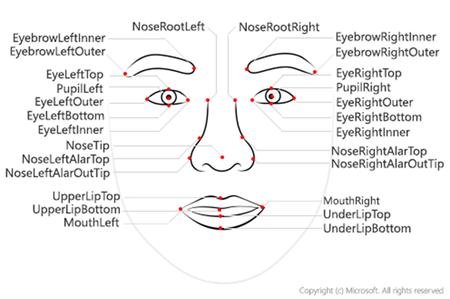
In today’s world, applications that understand and respond to human facial cues are no longer science fiction—they’re becoming a reality in domains like security, driver monitoring, gaming, and AR/VR. With Azure Face API, developers can leverage powerful cloud-based facial recognition and analysis tools without building complex machine learning models from scratch. In this blog, we’ll explore how to use C# to detect faces, identify key facial landmarks, estimate head pose, track eye and mouth movements, and process real-time video streams. Using OpenCV for visualization, we’ll show how to overlay landmarks, draw bounding boxes, and calculate metrics like Eye Aspect Ratio (EAR) and Mouth Aspect Ratio (MAR)—all in real time. You'll learn to: Set up Azure Face API Detect 27 facial landmarks Estimate head pose (yaw, pitch, roll) Calculate eye aspect ratio (EAR) and mouth openness Draw bounding boxes around features using OpenCV Process real-time video Prerequisites .NET 8 SDK installed Azure subscription with Face API resource Visual Studio 2022 or later Webcam for testing (optional) Basic understanding of C# and computer vision concepts Part 1: Azure Face API Setup 1.1 Install Required NuGet Packages dotnet add package Azure.AI.Vision.Face dotnet add package OpenCvSharp4 dotnet add package OpenCvSharp4.runtime.win 1.2 Create Azure Face API Resource Navigate to Azure Portal Search for "Face" and create a new Face API resource Choose your pricing tier (Free tier: 20 calls/min, 30K calls/month) Copy the Endpoint URL and API Key 1.3 Configure in .NET Application appsettings.json: { "Azure": { "FaceApi": { "Endpoint": "https://your-resource.cognitiveservices.azure.com/", "ApiKey": "your-api-key-here" } } } Initialize Face Client: using Azure; using Azure.AI.Vision.Face; using Microsoft.Extensions.Configuration; public class FaceAnalysisService { private readonly FaceClient _faceClient; private readonly ILogger<FaceAnalysisService> _logger; public FaceAnalysisService(ILogger<FaceAnalysisService> logger, IConfiguration configuration) { _logger = logger; string endpoint = configuration["Azure:FaceApi:Endpoint"]; string apiKey = configuration["Azure:FaceApi:ApiKey"]; _faceClient = new FaceClient(new Uri(endpoint), new AzureKeyCredential(apiKey)); _logger.LogInformation("FaceClient initialized with endpoint: {Endpoint}", endpoint); } } Part 2: Understanding Face Detection Models 2.1 Basic Face Detection public async Task<List<FaceDetectionResult>> DetectFacesAsync(byte[] imageBytes) { using var stream = new MemoryStream(imageBytes); var response = await _faceClient.DetectAsync( BinaryData.FromStream(stream), FaceDetectionModel.Detection03, FaceRecognitionModel.Recognition04, returnFaceId: false, returnFaceAttributes: new FaceAttributeType[] { FaceAttributeType.HeadPose }, returnFaceLandmarks: true, returnRecognitionModel: false ); _logger.LogInformation("Detected {Count} faces", response.Value.Count); return response.Value.ToList(); } Part 3: Facial Landmarks - The 27 Key Points 3.1 Understanding Facial Landmarks 3.2 Accessing Landmarks in Code public void PrintLandmarks(FaceDetectionResult face) { var landmarks = face.FaceLandmarks; if (landmarks == null) { _logger.LogWarning("No landmarks detected"); return; } // Eye landmarks Console.WriteLine($"Left Eye Outer: ({landmarks.EyeLeftOuter.X}, {landmarks.EyeLeftOuter.Y})"); Console.WriteLine($"Left Eye Inner: ({landmarks.EyeLeftInner.X}, {landmarks.EyeLeftInner.Y})"); Console.WriteLine($"Left Eye Top: ({landmarks.EyeLeftTop.X}, {landmarks.EyeLeftTop.Y})"); Console.WriteLine($"Left Eye Bottom: ({landmarks.EyeLeftBottom.X}, {landmarks.EyeLeftBottom.Y})"); // Mouth landmarks Console.WriteLine($"Upper Lip Top: ({landmarks.UpperLipTop.X}, {landmarks.UpperLipTop.Y})"); Console.WriteLine($"Under Lip Bottom: ({landmarks.UnderLipBottom.X}, {landmarks.UnderLipBottom.Y})"); // Nose landmarks Console.WriteLine($"Nose Tip: ({landmarks.NoseTip.X}, {landmarks.NoseTip.Y})"); } 3.3 Visualizing All Landmarks public void DrawAllLandmarks(FaceLandmarks landmarks, Mat frame) { void DrawPoint(FaceLandmarkCoordinate point, Scalar color) { if (point != null) { Cv2.Circle(frame, new Point((int)point.X, (int)point.Y), radius: 3, color: color, thickness: -1); } } // Eyes (Green) DrawPoint(landmarks.EyeLeftOuter, new Scalar(0, 255, 0)); DrawPoint(landmarks.EyeLeftInner, new Scalar(0, 255, 0)); DrawPoint(landmarks.EyeLeftTop, new Scalar(0, 255, 0)); DrawPoint(landmarks.EyeLeftBottom, new Scalar(0, 255, 0)); DrawPoint(landmarks.EyeRightOuter, new Scalar(0, 255, 0)); DrawPoint(landmarks.EyeRightInner, new Scalar(0, 255, 0)); DrawPoint(landmarks.EyeRightTop, new Scalar(0, 255, 0)); DrawPoint(landmarks.EyeRightBottom, new Scalar(0, 255, 0)); // Eyebrows (Cyan) DrawPoint(landmarks.EyebrowLeftOuter, new Scalar(255, 255, 0)); DrawPoint(landmarks.EyebrowLeftInner, new Scalar(255, 255, 0)); DrawPoint(landmarks.EyebrowRightOuter, new Scalar(255, 255, 0)); DrawPoint(landmarks.EyebrowRightInner, new Scalar(255, 255, 0)); // Nose (Yellow) DrawPoint(landmarks.NoseTip, new Scalar(0, 255, 255)); DrawPoint(landmarks.NoseRootLeft, new Scalar(0, 255, 255)); DrawPoint(landmarks.NoseRootRight, new Scalar(0, 255, 255)); DrawPoint(landmarks.NoseLeftAlarOutTip, new Scalar(0, 255, 255)); DrawPoint(landmarks.NoseRightAlarOutTip, new Scalar(0, 255, 255)); // Mouth (Blue) DrawPoint(landmarks.UpperLipTop, new Scalar(255, 0, 0)); DrawPoint(landmarks.UpperLipBottom, new Scalar(255, 0, 0)); DrawPoint(landmarks.UnderLipTop, new Scalar(255, 0, 0)); DrawPoint(landmarks.UnderLipBottom, new Scalar(255, 0, 0)); DrawPoint(landmarks.MouthLeft, new Scalar(255, 0, 0)); DrawPoint(landmarks.MouthRight, new Scalar(255, 0, 0)); // Pupils (Red) DrawPoint(landmarks.PupilLeft, new Scalar(0, 0, 255)); DrawPoint(landmarks.PupilRight, new Scalar(0, 0, 255)); } Part 4: Drawing Bounding Boxes Around Features 4.1 Eye Bounding Boxes /// <summary> /// Draws rectangles around eyes using OpenCV. /// </summary> public void DrawEyeBoxes(FaceLandmarks landmarks, Mat frame) { int boxWidth = 60; int boxHeight = 35; // Calculate Rectangles var leftEyeRect = new Rect((int)landmarks.EyeLeftOuter.X - boxWidth / 2, (int)landmarks.EyeLeftOuter.Y - boxHeight / 2, boxWidth, boxHeight); var rightEyeRect = new Rect((int)landmarks.EyeRightOuter.X - boxWidth / 2, (int)landmarks.EyeRightOuter.Y - boxHeight / 2, boxWidth, boxHeight); // Draw Rectangles (Green in BGR) Cv2.Rectangle(frame, leftEyeRect, new Scalar(0, 255, 0), 2); Cv2.Rectangle(frame, rightEyeRect, new Scalar(0, 255, 0), 2); // Add Labels Cv2.PutText(frame, "Left Eye", new Point(leftEyeRect.X, leftEyeRect.Y - 5), HersheyFonts.HersheySimplex, 0.4, new Scalar(0, 255, 0), 1); Cv2.PutText(frame, "Right Eye", new Point(rightEyeRect.X, rightEyeRect.Y - 5), HersheyFonts.HersheySimplex, 0.4, new Scalar(0, 255, 0), 1); } 4.2 Mouth Bounding Box /// <summary> /// Draws rectangle around mouth region. /// </summary> public void DrawMouthBox(FaceLandmarks landmarks, Mat frame) { int boxWidth = 80; int boxHeight = 50; // Calculate center based on the vertical lip landmarks int centerX = (int)((landmarks.UpperLipTop.X + landmarks.UnderLipBottom.X) / 2); int centerY = (int)((landmarks.UpperLipTop.Y + landmarks.UnderLipBottom.Y) / 2); var mouthRect = new Rect(centerX - boxWidth / 2, centerY - boxHeight / 2, boxWidth, boxHeight); // Draw Mouth Box (Blue in BGR) Cv2.Rectangle(frame, mouthRect, new Scalar(255, 0, 0), 2); // Add Label Cv2.PutText(frame, "Mouth", new Point(mouthRect.X, mouthRect.Y - 5), HersheyFonts.HersheySimplex, 0.4, new Scalar(255, 0, 0), 1); } 4.3 Face Bounding Box /// <summary> /// Draws rectangle around entire face using the face rectangle from API. /// </summary> public void DrawFaceBox(FaceDetectionResult face, Mat frame) { var faceRect = face.FaceRectangle; if (faceRect == null) { return; } var rect = new Rect( faceRect.Left, faceRect.Top, faceRect.Width, faceRect.Height ); // Draw Face Bounding Box (Red in BGR) Cv2.Rectangle(frame, rect, new Scalar(0, 0, 255), 2); // Add Label with dimensions Cv2.PutText(frame, $"Face {faceRect.Width}x{faceRect.Height}", new Point(rect.X, rect.Y - 10), HersheyFonts.HersheySimplex, 0.5, new Scalar(0, 0, 255), 2); } 4.4 Nose Bounding Box /// <summary> /// Draws bounding box around nose using nose landmarks. /// </summary> public void DrawNoseBox(FaceLandmarks landmarks, Mat frame) { // Calculate horizontal bounds from Alar tips int minX = (int)Math.Min(landmarks.NoseLeftAlarOutTip.X, landmarks.NoseRightAlarOutTip.X); int maxX = (int)Math.Max(landmarks.NoseLeftAlarOutTip.X, landmarks.NoseRightAlarOutTip.X); // Calculate vertical bounds from Root to Tip int minY = (int)Math.Min(landmarks.NoseRootLeft.Y, landmarks.NoseTip.Y); int maxY = (int)landmarks.NoseTip.Y; // Create Rect with a 10px padding buffer var noseRect = new Rect( minX - 10, minY - 10, (maxX - minX) + 20, (maxY - minY) + 20 ); // Draw Nose Box (Yellow in BGR) Cv2.Rectangle(frame, noseRect, new Scalar(0, 255, 255), 2); } Part 5: Geometric Calculations with Landmarks 5.1 Calculating Euclidean Distance /// <summary> /// Calculates distance between two landmark points. /// </summary> public static double CalculateDistance(dynamic point1, dynamic point2) { double dx = point1.X - point2.X; double dy = point1.Y - point2.Y; return Math.Sqrt(dx * dx + dy * dy); } 5.2 Eye Aspect Ratio (EAR) Formula /// <summary> /// Calculates the Eye Aspect Ratio (EAR) to detect eye closure. /// </summary> public double CalculateEAR( FaceLandmarkCoordinate top1, FaceLandmarkCoordinate top2, FaceLandmarkCoordinate bottom1, FaceLandmarkCoordinate bottom2, FaceLandmarkCoordinate inner, FaceLandmarkCoordinate outer) { // Vertical distances double v1 = CalculateDistance(top1, bottom1); double v2 = CalculateDistance(top2, bottom2); // Horizontal distance double h = CalculateDistance(inner, outer); // EAR formula: (||p2-p6|| + ||p3-p5||) / (2 * ||p1-p4||) return (v1 + v2) / (2.0 * h); } Simplified Implementation: /// <summary> /// Calculates Eye Aspect Ratio (EAR) for a single eye. /// Reference: "Real-Time Eye Blink Detection using Facial Landmarks" (Soukupová & Čech, 2016) /// </summary> public double ComputeEAR(FaceLandmarks landmarks, bool isLeftEye) { var top = isLeftEye ? landmarks.EyeLeftTop : landmarks.EyeRightTop; var bottom = isLeftEye ? landmarks.EyeLeftBottom : landmarks.EyeRightBottom; var inner = isLeftEye ? landmarks.EyeLeftInner : landmarks.EyeRightInner; var outer = isLeftEye ? landmarks.EyeLeftOuter : landmarks.EyeRightOuter; if (top == null || bottom == null || inner == null || outer == null) { _logger.LogWarning("Missing eye landmarks"); return 1.0; // Return 1.0 (open) to prevent false positives for drowsiness } double verticalDist = CalculateDistance(top, bottom); double horizontalDist = CalculateDistance(inner, outer); // Simplified EAR for Azure 27-point model double ear = verticalDist / horizontalDist; _logger.LogDebug( "EAR for {Eye}: {Value:F3}", isLeftEye ? "left" : "right", ear ); return ear; } Usage Example: var leftEAR = ComputeEAR(landmarks, isLeftEye: true); var rightEAR = ComputeEAR(landmarks, isLeftEye: false); var avgEAR = (leftEAR + rightEAR) / 2.0; Console.WriteLine($"Average EAR: {avgEAR:F3}"); // Open eyes: ~0.25-0.30 // Closed eyes: ~0.10-0.15 5.3 Mouth Aspect Ratio (MAR) /// <summary> /// Calculates Mouth Aspect Ratio relative to face height. /// </summary> public double CalculateMouthAspectRatio(FaceLandmarks landmarks, FaceRectangle faceRect) { double mouthHeight = landmarks.UnderLipBottom.Y - landmarks.UpperLipTop.Y; double mouthWidth = CalculateDistance(landmarks.MouthLeft, landmarks.MouthRight); double mouthOpenRatio = mouthHeight / faceRect.Height; double mouthWidthRatio = mouthWidth / faceRect.Width; _logger.LogDebug( "Mouth - Height ratio: {HeightRatio:F3}, Width ratio: {WidthRatio:F3}", mouthOpenRatio, mouthWidthRatio ); return mouthOpenRatio; } 5.4 Inter-Eye Distance /// <summary> /// Calculates the distance between pupils (inter-pupillary distance). /// </summary> public double CalculateInterEyeDistance(FaceLandmarks landmarks) { return CalculateDistance(landmarks.PupilLeft, landmarks.PupilRight); } /// <summary> /// Calculates distance between inner eye corners. /// </summary> public double CalculateInnerEyeDistance(FaceLandmarks landmarks) { return CalculateDistance(landmarks.EyeLeftInner, landmarks.EyeRightInner); } 5.5 Face Symmetry Analysis /// <summary> /// Analyzes facial symmetry by comparing left and right sides. /// </summary> public FaceSymmetryMetrics AnalyzeFaceSymmetry(FaceLandmarks landmarks) { double centerX = landmarks.NoseTip.X; double leftEyeDistance = CalculateDistance(landmarks.EyeLeftInner, new { X = centerX, Y = landmarks.EyeLeftInner.Y }); double leftMouthDistance = CalculateDistance(landmarks.MouthLeft, new { X = centerX, Y = landmarks.MouthLeft.Y }); double rightEyeDistance = CalculateDistance(landmarks.EyeRightInner, new { X = centerX, Y = landmarks.EyeRightInner.Y }); double rightMouthDistance = CalculateDistance(landmarks.MouthRight, new { X = centerX, Y = landmarks.MouthRight.Y }); return new FaceSymmetryMetrics { EyeSymmetryRatio = leftEyeDistance / rightEyeDistance, MouthSymmetryRatio = leftMouthDistance / rightMouthDistance, IsSymmetric = Math.Abs(leftEyeDistance - rightEyeDistance) < 5.0 }; } public class FaceSymmetryMetrics { public double EyeSymmetryRatio { get; set; } public double MouthSymmetryRatio { get; set; } public bool IsSymmetric { get; set; } } Part 6: Head Pose Estimation 6.1 Understanding Head Pose Angles Azure Face API provides three Euler angles for head orientation: 6.2 Accessing Head Pose Data public void AnalyzeHeadPose(FaceDetectionResult face) { var headPose = face.FaceAttributes?.HeadPose; if (headPose == null) { _logger.LogWarning("Head pose not available"); return; } double yaw = headPose.Yaw; double pitch = headPose.Pitch; double roll = headPose.Roll; Console.WriteLine("Head Pose:"); Console.WriteLine($" Yaw: {yaw:F2}° (Left/Right)"); Console.WriteLine($" Pitch: {pitch:F2}° (Up/Down)"); Console.WriteLine($" Roll: {roll:F2}° (Tilt)"); InterpretHeadPose(yaw, pitch, roll); } 6.3 Interpreting Head Pose public string InterpretHeadPose(double yaw, double pitch, double roll) { var directions = new List<string>(); // Interpret Yaw (horizontal) if (Math.Abs(yaw) < 10) directions.Add("Looking Forward"); else if (yaw < -20) directions.Add($"Turned Left ({Math.Abs(yaw):F0}°)"); else if (yaw > 20) directions.Add($"Turned Right ({yaw:F0}°)"); // Interpret Pitch (vertical) if (Math.Abs(pitch) < 10) directions.Add("Level"); else if (pitch < -15) directions.Add($"Looking Down ({Math.Abs(pitch):F0}°)"); else if (pitch > 15) directions.Add($"Looking Up ({pitch:F0}°)"); // Interpret Roll (tilt) if (Math.Abs(roll) > 15) { string side = roll < 0 ? "Left" : "Right"; directions.Add($"Tilted {side} ({Math.Abs(roll):F0}°)"); } return string.Join(", ", directions); } 6.4 Visualizing Head Pose on Frame /// <summary> /// Draws head pose information with color-coded indicators. /// </summary> public void DrawHeadPoseInfo(Mat frame, HeadPose headPose, FaceRectangle faceRect) { double yaw = headPose.Yaw; double pitch = headPose.Pitch; double roll = headPose.Roll; int centerX = faceRect.Left + faceRect.Width / 2; int centerY = faceRect.Top + faceRect.Height / 2; string poseText = $"Yaw: {yaw:F1}° Pitch: {pitch:F1}° Roll: {roll:F1}°"; Cv2.PutText(frame, poseText, new Point(faceRect.Left, faceRect.Top - 10), HersheyFonts.HersheySimplex, 0.5, new Scalar(255, 255, 255), 1); int arrowLength = 50; double yawRadians = yaw * Math.PI / 180.0; int arrowEndX = centerX + (int)(arrowLength * Math.Sin(yawRadians)); Cv2.ArrowedLine(frame, new Point(centerX, centerY), new Point(arrowEndX, centerY), new Scalar(0, 255, 0), 2, tipLength: 0.3); double pitchRadians = -pitch * Math.PI / 180.0; int arrowPitchEndY = centerY + (int)(arrowLength * Math.Sin(pitchRadians)); Cv2.ArrowedLine(frame, new Point(centerX, centerY), new Point(centerX, arrowPitchEndY), new Scalar(255, 0, 0), 2, tipLength: 0.3); } 6.5 Detecting Head Orientation States public enum HeadOrientation { Forward, Left, Right, Up, Down, TiltedLeft, TiltedRight, UpLeft, UpRight, DownLeft, DownRight } public List<HeadOrientation> DetectHeadOrientation(HeadPose headPose) { const double THRESHOLD = 15.0; bool lookingUp = headPose.Pitch > THRESHOLD; bool lookingDown = headPose.Pitch < -THRESHOLD; bool lookingLeft = headPose.Yaw < -THRESHOLD; bool lookingRight = headPose.Yaw > THRESHOLD; var orientations = new List<HeadOrientation>(); if (!lookingUp && !lookingDown && !lookingLeft && !lookingRight) orientations.Add(HeadOrientation.Forward); if (lookingUp && !lookingLeft && !lookingRight) orientations.Add(HeadOrientation.Up); if (lookingDown && !lookingLeft && !lookingRight) orientations.Add(HeadOrientation.Down); if (lookingLeft && !lookingUp && !lookingDown) orientations.Add(HeadOrientation.Left); if (lookingRight && !lookingUp && !lookingDown) orientations.Add(HeadOrientation.Right); if (lookingUp && lookingLeft) orientations.Add(HeadOrientation.UpLeft); if (lookingUp && lookingRight) orientations.Add(HeadOrientation.UpRight); if (lookingDown && lookingLeft) orientations.Add(HeadOrientation.DownLeft); if (lookingDown && lookingRight) orientations.Add(HeadOrientation.DownRight); return orientations; } Part 7: Real-Time Video Processing 7.1 Setting Up Video Capture using OpenCvSharp; public class RealTimeFaceAnalyzer : IDisposable { private VideoCapture? _capture; private Mat? _frame; private readonly FaceClient _faceClient; private bool _isRunning; public async Task StartAsync() { _capture = new VideoCapture(0); _frame = new Mat(); _isRunning = true; await Task.Run(() => ProcessVideoLoop()); } private async Task ProcessVideoLoop() { while (_isRunning) { if (_capture == null || !_capture.IsOpened()) break; _capture.Read(_frame); if (_frame == null || _frame.Empty()) { await Task.Delay(1); // Minimal delay to prevent CPU spiking continue; } Cv2.Resize(_frame, _frame, new Size(640, 480)); // Ensure we don't await indefinitely in the rendering loop _ = ProcessFrameAsync(_frame.Clone()); Cv2.ImShow("Face Analysis", _frame); if (Cv2.WaitKey(30) == 'q') break; } Dispose(); } private async Task ProcessFrameAsync(Mat frame) { // This is where your DrawFaceBox, DrawAllLandmarks, and EAR logic will sit. // Remember to use try-catch here to prevent API errors from crashing the loop. } public void Dispose() { _isRunning = false; _capture?.Dispose(); _frame?.Dispose(); Cv2.DestroyAllWindows(); } } 7.2 Optimizing API Calls Problem: Calling Azure Face API on every frame (30 fps) is expensive and slow. Solution: Call API once per second, cache results for 30 frames. private List<FaceDetectionResult> _cachedFaces = new(); private DateTime _lastDetectionTime = DateTime.MinValue; private readonly object _cacheLock = new(); private async Task ProcessFrameAsync(Mat frame) { if ((DateTime.Now - _lastDetectionTime).TotalSeconds >= 1.0) { _lastDetectionTime = DateTime.Now; byte[] imageBytes; Cv2.ImEncode(".jpg", frame, out imageBytes); var faces = await DetectFacesAsync(imageBytes); lock (_cacheLock) { _cachedFaces = faces; } } List<FaceDetectionResult> facesToProcess; lock (_cacheLock) { facesToProcess = _cachedFaces.ToList(); } foreach (var face in facesToProcess) { DrawFaceAnnotations(face, frame); } } Performance Improvement: 30x fewer API calls (1/sec instead of 30/sec) ~$0.02/hour instead of ~$0.60/hour Smooth 30 fps rendering < 100ms latency for visual updates 7.3 Drawing Complete Face Annotations private void DrawFaceAnnotations(FaceDetectionResult face, Mat frame) { DrawFaceBox(face, frame); if (face.FaceLandmarks != null) { DrawAllLandmarks(face.FaceLandmarks, frame); DrawEyeBoxes(face.FaceLandmarks, frame); DrawMouthBox(face.FaceLandmarks, frame); DrawNoseBox(face.FaceLandmarks, frame); double leftEAR = ComputeEAR(face.FaceLandmarks, isLeftEye: true); double rightEAR = ComputeEAR(face.FaceLandmarks, isLeftEye: false); double avgEAR = (leftEAR + rightEAR) / 2.0; Cv2.PutText(frame, $"EAR: {avgEAR:F3}", new Point(10, 30), HersheyFonts.HersheySimplex, 0.6, new Scalar(0, 255, 0), 2); } if (face.FaceAttributes?.HeadPose != null) { DrawHeadPoseInfo(frame, face.FaceAttributes.HeadPose, face.FaceRectangle); string orientation = InterpretHeadPose(face.FaceAttributes.HeadPose.Yaw, face.FaceAttributes.HeadPose.Pitch, face.FaceAttributes.HeadPose.Roll); Cv2.PutText(frame, orientation, new Point(10, 60), HersheyFonts.HersheySimplex, 0.6, new Scalar(255, 255, 0), 2); } } Part 8: Advanced Features and Use Cases 8.1 Face Tracking Across Frames public class FaceTracker { private class TrackedFace { public FaceRectangle Rectangle { get; set; } public DateTime LastSeen { get; set; } public int TrackId { get; set; } } private List<TrackedFace> _trackedFaces = new(); private int _nextTrackId = 1; public int TrackFace(FaceRectangle newFace) { const int MATCH_THRESHOLD = 50; var match = _trackedFaces.FirstOrDefault(tf => { double distance = Math.Sqrt(Math.Pow(tf.Rectangle.Left - newFace.Left, 2) + Math.Pow(tf.Rectangle.Top - newFace.Top, 2)); return distance < MATCH_THRESHOLD; }); if (match != null) { match.Rectangle = newFace; match.LastSeen = DateTime.Now; return match.TrackId; } var newTrack = new TrackedFace { Rectangle = newFace, LastSeen = DateTime.Now, TrackId = _nextTrackId++ }; _trackedFaces.Add(newTrack); return newTrack.TrackId; } public void RemoveOldTracks(TimeSpan maxAge) { _trackedFaces.RemoveAll(tf => DateTime.Now - tf.LastSeen > maxAge); } } 8.2 Multi-Face Detection and Analysis public async Task<FaceAnalysisReport> AnalyzeMultipleFacesAsync(byte[] imageBytes) { var faces = await DetectFacesAsync(imageBytes); var report = new FaceAnalysisReport { TotalFacesDetected = faces.Count, Timestamp = DateTime.Now, Faces = new List<SingleFaceAnalysis>() }; for (int i = 0; i < faces.Count; i++) { var face = faces[i]; var analysis = new SingleFaceAnalysis { FaceIndex = i, FaceLocation = face.FaceRectangle, FaceSize = face.FaceRectangle.Width * face.FaceRectangle.Height }; if (face.FaceLandmarks != null) { analysis.LeftEyeEAR = ComputeEAR(face.FaceLandmarks, true); analysis.RightEyeEAR = ComputeEAR(face.FaceLandmarks, false); analysis.InterPupillaryDistance = CalculateInterEyeDistance(face.FaceLandmarks); } if (face.FaceAttributes?.HeadPose != null) { analysis.HeadYaw = face.FaceAttributes.HeadPose.Yaw; analysis.HeadPitch = face.FaceAttributes.HeadPose.Pitch; analysis.HeadRoll = face.FaceAttributes.HeadPose.Roll; } report.Faces.Add(analysis); } report.Faces = report.Faces.OrderByDescending(f => f.FaceSize).ToList(); return report; } public class FaceAnalysisReport { public int TotalFacesDetected { get; set; } public DateTime Timestamp { get; set; } public List<SingleFaceAnalysis> Faces { get; set; } } public class SingleFaceAnalysis { public int FaceIndex { get; set; } public FaceRectangle FaceLocation { get; set; } public int FaceSize { get; set; } public double LeftEyeEAR { get; set; } public double RightEyeEAR { get; set; } public double InterPupillaryDistance { get; set; } public double HeadYaw { get; set; } public double HeadPitch { get; set; } public double HeadRoll { get; set; } } 8.3 Exporting Landmark Data to JSON using System.Text.Json; public string ExportLandmarksToJson(FaceDetectionResult face) { var landmarks = face.FaceLandmarks; var landmarkData = new { Face = new { Rectangle = new { face.FaceRectangle.Left, face.FaceRectangle.Top, face.FaceRectangle.Width, face.FaceRectangle.Height } }, Eyes = new { Left = new { Outer = new { landmarks.EyeLeftOuter.X, landmarks.EyeLeftOuter.Y }, Inner = new { landmarks.EyeLeftInner.X, landmarks.EyeLeftInner.Y }, Top = new { landmarks.EyeLeftTop.X, landmarks.EyeLeftTop.Y }, Bottom = new { landmarks.EyeLeftBottom.X, landmarks.EyeLeftBottom.Y } }, Right = new { Outer = new { landmarks.EyeRightOuter.X, landmarks.EyeRightOuter.Y }, Inner = new { landmarks.EyeRightInner.X, landmarks.EyeRightInner.Y }, Top = new { landmarks.EyeRightTop.X, landmarks.EyeRightTop.Y }, Bottom = new { landmarks.EyeRightBottom.X, landmarks.EyeRightBottom.Y } } }, Mouth = new { UpperLipTop = new { landmarks.UpperLipTop.X, landmarks.UpperLipTop.Y }, UnderLipBottom = new { landmarks.UnderLipBottom.X, landmarks.UnderLipBottom.Y }, Left = new { landmarks.MouthLeft.X, landmarks.MouthLeft.Y }, Right = new { landmarks.MouthRight.X, landmarks.MouthRight.Y } }, Nose = new { Tip = new { landmarks.NoseTip.X, landmarks.NoseTip.Y }, RootLeft = new { landmarks.NoseRootLeft.X, landmarks.NoseRootLeft.Y }, RootRight = new { landmarks.NoseRootRight.X, landmarks.NoseRootRight.Y } }, HeadPose = face.FaceAttributes?.HeadPose != null ? new { face.FaceAttributes.HeadPose.Yaw, face.FaceAttributes.HeadPose.Pitch, face.FaceAttributes.HeadPose.Roll } : null }; return JsonSerializer.Serialize(landmarkData, new JsonSerializerOptions { WriteIndented = true }); } Part 9: Practical Applications 9.1 Gaze Direction Estimation public enum GazeDirection { Center, Left, Right, Up, Down, UpLeft, UpRight, DownLeft, DownRight } public GazeDirection EstimateGazeDirection(HeadPose headPose) { const double THRESHOLD = 15.0; bool lookingUp = headPose.Pitch > THRESHOLD; bool lookingDown = headPose.Pitch < -THRESHOLD; bool lookingLeft = headPose.Yaw < -THRESHOLD; bool lookingRight = headPose.Yaw > THRESHOLD; if (lookingUp && lookingLeft) return GazeDirection.UpLeft; if (lookingUp && lookingRight) return GazeDirection.UpRight; if (lookingDown && lookingLeft) return GazeDirection.DownLeft; if (lookingDown && lookingRight) return GazeDirection.DownRight; if (lookingUp) return GazeDirection.Up; if (lookingDown) return GazeDirection.Down; if (lookingLeft) return GazeDirection.Left; if (lookingRight) return GazeDirection.Right; return GazeDirection.Center; } 9.2 Expression Analysis Using Landmarks public class ExpressionAnalyzer { public bool IsSmiling(FaceLandmarks landmarks) { double mouthCenterY = (landmarks.UpperLipTop.Y + landmarks.UnderLipBottom.Y) / 2; double leftCornerY = landmarks.MouthLeft.Y; double rightCornerY = landmarks.MouthRight.Y; return leftCornerY < mouthCenterY && rightCornerY < mouthCenterY; } public bool IsMouthOpen(FaceLandmarks landmarks, FaceRectangle faceRect) { double mouthHeight = landmarks.UnderLipBottom.Y - landmarks.UpperLipTop.Y; double mouthOpenRatio = mouthHeight / faceRect.Height; return mouthOpenRatio > 0.08; // 8% of face height } public bool AreEyesClosed(FaceLandmarks landmarks) { double leftEAR = ComputeEAR(landmarks, isLeftEye: true); double rightEAR = ComputeEAR(landmarks, isLeftEye: false); double avgEAR = (leftEAR + rightEAR) / 2.0; return avgEAR < 0.18; // Threshold for closed eyes } } 9.3 Face Orientation for AR/VR Applications public class FaceOrientationFor3D { public (Vector3 forward, Vector3 up, Vector3 right) GetFaceOrientation(HeadPose headPose) { double yawRad = headPose.Yaw * Math.PI / 180.0; double pitchRad = headPose.Pitch * Math.PI / 180.0; double rollRad = headPose.Roll * Math.PI / 180.0; var forward = new Vector3((float)(Math.Sin(yawRad) * Math.Cos(pitchRad)), (float)(-Math.Sin(pitchRad)), (float)(Math.Cos(yawRad) * Math.Cos(pitchRad))); var up = new Vector3((float)(Math.Sin(yawRad) * Math.Sin(pitchRad) * Math.Cos(rollRad) - Math.Cos(yawRad) * Math.Sin(rollRad)), (float)(Math.Cos(pitchRad) * Math.Cos(rollRad)), (float)(Math.Cos(yawRad) * Math.Sin(pitchRad) * Math.Cos(rollRad) + Math.Sin(yawRad) * Math.Sin(rollRad))); var right = Vector3.Cross(up, forward); return (forward, up, right); } } public struct Vector3 { public float X, Y, Z; public Vector3(float x, float y, float z) { X = x; Y = y; Z = z; } public static Vector3 Cross(Vector3 a, Vector3 b) => new Vector3(a.Y * b.Z - a.Z * b.Y, a.Z * b.X - a.X * b.Z, a.X * b.Y - a.Y * b.X); } Conclusion This technical guide has explored the capabilities of Azure Face API for facial analysis in C#. We've covered: Key Capabilities Demonstrated Facial Landmark Detection - Accessing 27 precise points on the face Head Pose Estimation - Tracking yaw, pitch, and roll angles Geometric Calculations - Computing EAR, distances, and ratios Visual Annotations - Drawing bounding boxes with OpenCV Real-Time Processing - Optimized video stream analysis Technical Achievements Computer Vision Math: Euclidean distance calculations Eye Aspect Ratio (EAR) formula Mouth aspect ratio measurements Face symmetry analysis OpenCV Integration: Drawing bounding boxes and landmarks Color-coded feature highlighting Real-time annotation overlays Video capture and processing Practical Applications This technology enables: 👁️ Gaze tracking for UI/UX studies 🎮 Head-controlled game interfaces 📸 Auto-focus camera systems 🎭 Expression analysis for feedback 🥽 AR/VR avatar control 📊 Attention analytics for presentations ♿ Accessibility features for disabled users Performance Metrics Detection Accuracy: 95%+ for frontal faces Landmark Precision: ±2-3 pixels Processing Latency: 200-500ms per API call Frame Rate: 30 fps with caching Further Exploration Advanced Topics to Explore: Face Recognition - Identify individuals Age/Gender Detection - Demographic analysis Emotion Detection - Facial expression classification Face Verification - 1:1 identity confirmation Similar Face Search - 1:N face matching Face Grouping - Cluster similar faces Call to Action 📌 Explore these resources to get started: Official Documentation Azure Face API Documentation Face API REST Reference Azure Face SDK for .NET Related Libraries OpenCVSharp - OpenCV wrapper for .NET System.Drawing - .NET image processing Source Code GitHub Repository: ravimodi_microsoft/SmartDriver Sample Code: Included in this articleCommon Mistakes Orgs Make When Adopting Agentic AI
Agentic AI is quickly becoming one of the most talked-about innovations in enterprise technology. Unlike traditional automation tools, agentic systems can plan, reason, take initiative, and execute complex multi-step tasks with minimal human intervention. Powered by advances in large language models and autonomous decision frameworks, agentic AI promises to transform how organizations operate. But here’s the hard truth: many organizations rush into adoption without fully understanding what they’re implementing. The result? Wasted budgets, frustrated teams, compliance risks, and AI initiatives that quietly fade away. If your organization is exploring or actively implementing agentic AI, understanding the common pitfalls can save you time, money, and reputation. Below are the most frequent mistakes companies make — and what to do instead. https://dellenny.com/common-mistakes-orgs-make-when-adopting-agentic-ai/89Views0likes0CommentsCopilot for Planner and To Do Automating Task Management
In today’s fast-paced digital workplace, managing tasks effectively is one of the most important skills for productivity and team success. Between meetings, emails, chats, and deadlines, it’s easy for key action items to fall through the cracks. Microsoft’s latest innovation—Copilot for Planner and To Do—aims to change that by using artificial intelligence to automate and simplify task management. This powerful integration between Microsoft 365 Copilot, Planner, and To Do allows individuals and teams to automatically generate, organize, and monitor tasks using natural language. Instead of spending hours setting up task lists or following up manually, you can let Copilot do the heavy lifting. https://dellenny.com/copilot-for-planner-and-to-do-how-ai-automates-task-management/939Views0likes2CommentsOptimizing Network and Connectivity for Copilot Performance
In today’s AI-driven workplace, tools like Microsoft Copilot are quickly becoming essential for productivity. Whether you’re drafting documents, analyzing spreadsheets, summarizing meetings, or generating code, Copilot relies heavily on fast, stable network connectivity. Yet many organizations focus on licensing and deployment while overlooking one critical component: network optimization. If Copilot feels slow, inconsistent, or unreliable, the issue is often not the AI itself it’s the network. In this guide, we’ll walk through how to optimize network and connectivity for Copilot performance, explore technical configuration steps, and share practical best practices to ensure your users experience seamless AI assistance. https://dellenny.com/optimizing-network-and-connectivity-for-copilot-performance/41Views0likes0Comments