Introduction
Retrieval-Augmented Generation (RAG) has become the standard architecture for grounding Large Language Models (LLMs) with enterprise data. By retrieving relevant documents before generating a response, RAG helps reduce hallucinations compared to relying on model knowledge alone.
However, an important limitation remains in most implementations: RAG systems can produce confident-sounding answers even when the underlying data is incomplete, irrelevant, or missing.
This happens when:
• Retrieved documents are loosely related to the query
• The answer exists partially but lacks key details
• Retrieved sources contradict each other
• The query falls entirely outside the knowledge base
In enterprise environments, this behavior carries real risk. A reliable AI system must not only answer well - it must also know when not to answer.
This article presents a practical confidence-aware RAG architecture using three layered strategies: retrieval confidence scoring, citation validation, and LLM-based abstention - all implemented with Azure AI Search and Azure OpenAI.
The Problem: Confident Hallucination
Consider a real-world enterprise scenario. An employee asks:
"What is our company's parental leave policy for contractors?""What is our company's parental leave policy for contractors?"
The knowledge base contains parental leave policies for full-time employees - but nothing specific to contractors. A standard RAG pipeline retrieves the closest matching document and confidently presents full-time employee policy as the answer.
This outcome is worse than returning no answer. The user trusts the system, acts on incorrect information, and the error may not surface until real consequences follow. This pattern is sometimes called hallucination laundering - the RAG architecture creates the appearance of factual grounding while the response is not actually supported by the retrieved evidence.
Fixing this requires deliberate confidence checkpoints at each stage of the pipeline.
Architecture Overview
A standard RAG pipeline follows a simple path:
User Query → Retrieve Documents → Generate Answer
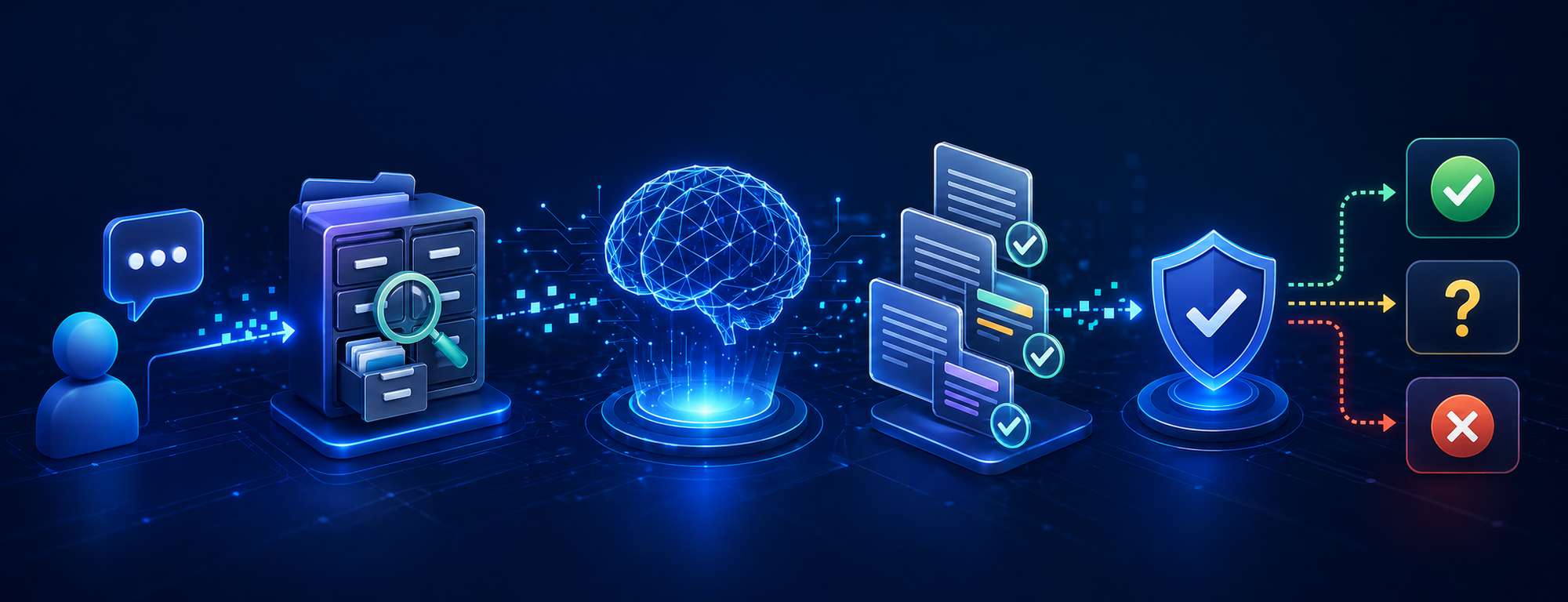
A confidence-aware pipeline adds two explicit decision checkpoints:
Each layer catches failures the previous one may miss. Together, they form a defense-in-depth approach to output reliability.
Strategy 1: Retrieval Confidence Scoring
The first checkpoint evaluates whether retrieved documents are genuinely relevant before passing them to the LLM. Azure AI Search returns a @search.rerankerScore when semantic ranking is enabled - a value on the 0-4 scale that reflects how well each document matches the query intent, not just keyword overlap.
from azure.search.documents import SearchClient
from azure.identity import DefaultAzureCredential

search_client = SearchClient(
    endpoint=AZURE_SEARCH_ENDPOINT,
    index_name="enterprise-knowledge-base",
    credential=DefaultAzureCredential()
)

def retrieve_with_confidence(query: str, threshold: float = 1.5, top_k: int = 5):
    results = search_client.search(
        search_text=query,
        query_type="semantic",
        semantic_configuration_name="default",
        top=top_k,
        select=["content", "title", "source"]
    )

    confident_results = []
    for result in results:
        reranker_score = result.get("@search.rerankerScore", 0)
        if reranker_score >= threshold:
            confident_results.append({
                "content": result["content"],
                "title": result["title"],
                "source": result["source"],
                "score": reranker_score
            })

    return confident_results
If no documents clear the threshold, the pipeline abstains rather than forcing a low-quality answer:
results = retrieve_with_confidence(user_query, threshold=1.5)

if not results:
    return {
        "answer": (
            "I don't have enough information in the knowledge base to answer "
            "this question. Please contact the relevant team for assistance."
        ),
        "status": "abstained_retrieval"
    }
Threshold tuning: Start at 1.5 on the 0-4 scale. Evaluate against a labeled test set and adjust based on your precision/recall requirements. Higher thresholds reduce false positives but may increase abstention on edge cases.
Strategy 2: Citation Validation
Even when retrieval scores are high, the LLM may synthesize information that does not exist in the retrieved context. Citation validation addresses this by requiring the model to ground every factual claim in a specific named source - and then programmatically verifying those citations exist in the retrieved set.
from openai import AzureOpenAI

client = AzureOpenAI(
    api_key=AZURE_OPENAI_API_KEY,
    azure_endpoint=AZURE_OPENAI_ENDPOINT,
    api_version="2025-12-01-preview"
)

ANSWER_WITH_CITATIONS_PROMPT = """
You are an enterprise assistant. Answer the question using ONLY the provided context.

RULES:
1. Every factual claim MUST include a citation in the format [Source: <title>].
2. If the context does not contain enough information, respond with:
   "I don't have sufficient information to answer this question."
3. Do NOT infer, assume, or use knowledge outside the provided context.
4. If context partially answers the question, state what you know
   and explicitly note what information is missing.

Context:
{context}

Question: {question}

Answer:
"""

def generate_answer(question: str, context: str, sources: list) -> dict:
    prompt = ANSWER_WITH_CITATIONS_PROMPT.format(
        context=context, question=question
    )
    response = client.chat.completions.create(
        model=AZURE_DEPLOYMENT_NAME,
        messages=[{"role": "user", "content": prompt}],
        temperature=0
    )
    answer = response.choices[0].message.content.strip()
    validation = validate_citations(answer, sources)
    return {"answer": answer, "citation_check": validation}
The validation function checks that every citation in the answer maps to a document that was actually retrieved:
import re

def validate_citations(answer: str, sources: list) -> dict:
    cited = re.findall(r'\[Source:\s*(.+?)\]', answer)
    source_titles = {s["title"].lower().strip() for s in sources}

    valid, invalid = [], []
    for citation in cited:
        if citation.lower().strip() in source_titles:
            valid.append(citation)
        else:
            invalid.append(citation)

    return {
        "total_citations": len(cited),
        "valid": valid,
        "invalid": invalid,
        "is_trustworthy": len(invalid) == 0 and len(cited) > 0
    }
If is_trustworthy is False, the pipeline flags the response for review or suppresses it:
if not generation["citation_check"]["is_trustworthy"]:

return {

"answer": "I found related information but cannot provide a reliable answer based on the available sources.",

"status": "abstained_citation"

}
Strategy 3: LLM-Based Abstention Scoring
The third layer adds a second LLM call that acts as a quality judge - explicitly evaluating whether the generated answer is well-supported by the retrieved context, independent of citation formatting.
ABSTENTION_JUDGE_PROMPT = """
You are an answer quality judge. Given a question, retrieved context, and a
generated answer, evaluate whether the answer is fully supported by the context.

Respond ONLY in JSON format:
{{
    "verdict": "supported" | "partial" | "unsupported",
    "confidence": <float between 0.0 and 1.0>,
    "reasoning": "<brief explanation>"
}}

Question: {question}
Context: {context}
Answer: {answer}
"""

def judge_answer(question: str, context: str, answer: str) -> dict:
    import json
    prompt = ABSTENTION_JUDGE_PROMPT.format(
        question=question, context=context, answer=answer
    )
    response = client.chat.completions.create(
        model=AZURE_DEPLOYMENT_NAME,
        messages=[{"role": "user", "content": prompt}],
        temperature=0
    )
    return json.loads(response.choices[0].message.content.strip())
Integrate the judge with a confidence threshold of 0.6:
judgement = judge_answer(user_query, context, generation["answer"])

if judgement["verdict"] == "unsupported" or judgement["confidence"] < 0.6:
    return {
        "answer": "I don't have sufficient information to answer this question confidently.",
        "status": "abstained_judge"
    }

if judgement["verdict"] == "partial":
    generation["answer"] += (
        "\n\nNote: This answer may be incomplete. "
        "Some aspects of your question were not covered in the available documents."
    )
End-to-End Pipeline
Combining all three strategies gives a complete confidence-aware pipeline:
def confidence_aware_rag(user_query: str) -> dict:
    # Layer 1: Retrieve with confidence gating
    results = retrieve_with_confidence(user_query, threshold=1.5)
    if not results:
        return {
            "answer": "I don't have enough information in the knowledge base to answer this.",
            "status": "abstained_retrieval"
        }

    context = "\n\n".join(r["content"] for r in results)

    # Layer 2: Generate with citation requirements
    generation = generate_answer(user_query, context, results)
    if not generation["citation_check"]["is_trustworthy"]:
        return {
            "answer": "I found related information but cannot provide a reliable answer.",
            "status": "abstained_citation"
        }

    # Layer 3: Judge the answer
    judgement = judge_answer(user_query, context, generation["answer"])
    if judgement["verdict"] == "unsupported" or judgement["confidence"] < 0.6:
        return {
            "answer": "I don't have sufficient information to answer this question confidently.",
            "status": "abstained_judge"
        }

    if judgement["verdict"] == "partial":
        generation["answer"] += (
            "\n\nNote: This answer may be incomplete. "
            "Some aspects of your question were not covered in available documents."
        )

    return {
        "answer": generation["answer"],
        "status": "answered",
        "confidence": judgement["confidence"],
        "sources": [r["source"] for r in results[:3]]
    }def confidence_aware_rag(user_query: str) -> dict:
    # Layer 1: Retrieve with confidence gating
    results = retrieve_with_confidence(user_query, threshold=1.5)
    if not results:
        return {
            "answer": "I don't have enough information in the knowledge base to answer this.",
            "status": "abstained_retrieval"
        }

    context = "\n\n".join(r["content"] for r in results)

    # Layer 2: Generate with citation requirements
    generation = generate_answer(user_query, context, results)
    if not generation["citation_check"]["is_trustworthy"]:
        return {
            "answer": "I found related information but cannot provide a reliable answer.",
            "status": "abstained_citation"
        }

    # Layer 3: Judge the answer
    judgement = judge_answer(user_query, context, generation["answer"])
    if judgement["verdict"] == "unsupported" or judgement["confidence"] < 0.6:
        return {
            "answer": "I don't have sufficient information to answer this question confidently.",
            "status": "abstained_judge"
        }

    if judgement["verdict"] == "partial":
        generation["answer"] += (
            "\n\nNote: This answer may be incomplete. "
            "Some aspects of your question were not covered in available documents."
        )

    return {
        "answer": generation["answer"],
        "status": "answered",
        "confidence": judgement["confidence"],
        "sources": [r["source"] for r in results[:3]]
    }
Choosing the Right Strategies for Your Use Case
Each strategy adds a layer of safety at a different cost. The right combination depends on the stakes involved in your deployment.
| Strategy | Added Cost | Latency | Best For |
| Retrieval Confidence Scoring | None (uses existing search scores) | None | All RAG applications - this should be universal |
| Citation Validation | Minimal (regex post-processing) | Negligible | Regulated industries, compliance, audit trails |
| LLM Abstention Judge | One additional LLM call | +1-3 seconds | High-stakes decisions - financial, legal, medical |
For most enterprise applications, combining retrieval scoring and citation validation provides a strong baseline with minimal overhead. The judge layer is most valuable when incorrect answers carry significant business or compliance risk.
Threshold calibration
There is a meaningful tradeoff in threshold selection. Setting thresholds too high reduces hallucination but increases abstention - the system may refuse to answer even when reliable information is available. The recommended approach is to build a labeled evaluation set of query/answer pairs, run the pipeline at multiple threshold values, and select the point that meets your precision/recall requirements for the specific domain.
When to Apply This Pattern
Confidence-aware RAG is most valuable in deployments where:
- Data coverage is uneven - the knowledge base may have detailed coverage in some areas and gaps in others, making it difficult to predict when retrieval will be reliable
- Errors carry downstream consequences - healthcare documentation, legal and compliance search, financial reporting, and regulated industries where a wrong answer is worse than no answer
- Users have varying expertise - non-expert users may not recognize a plausible-sounding but incorrect response, making transparent uncertainty signals especially important
- Audit or traceability requirements apply - the ability to trace each answer back to a specific source with a confidence signal supports governance and review workflows
Conclusion
Building a RAG system that retrieves documents and generates responses is relatively straightforward. Building one that understands the limits of its own knowledge requires deliberate design.
The three strategies covered here - retrieval confidence scoring, citation validation, and LLM-based abstention - form a layered defense against the most common failure mode in production RAG systems: the confident, well-formatted, completely unreliable answer.
The most dangerous AI system is not one that fails openly. It is one that fails silently, with confidence.
Teaching your pipeline to say "I don't know" is not a limitation. It is a feature that builds user trust and makes enterprise AI adoption sustainable over time.

 Microsoft