Forum Discussion

Difference between "Devices > Configuration Profiles" and "Endpoint Security > Manage"
 Mar 21, 2022Good point. Security baselines were added before Endpoint security profiles were really introduced. While security profiles are more direct, security baselines follow the same logic to that of baseline templates that are available in GPO. It is meant to be a baseline of security policies which you can deploy and then build over it. Device configuration, endpoint security profiles, security baselines have their own individual purposes and at the end of the day it will come down to organization's requirements.

- KirilMar 24, 2022Steel ContributorSo basically anything that can be configured in "Endpoint security" should be configured using "Endpoint security" policies, and policies which are only availble in "Device configuration" should be configured in "Device configuration".
- NielsScheffersMar 25, 2022Iron Contributor
KirilThat's completely correct.
I'll make it even more precise for you... there's a specific order to this madness and it all comes down to Settings Catalogs. You see, almost everything under Endpoint Security (including baselines) boils down to a Settings Catalog template with a fancy GUI. It looks like this is where Intune is moving, as more and more stuff gets added in this form.
Microsoft actually has an order of preference for you configurations:
- Endpoint Security > Security baselines
- Endpoint Security > Other templates
- Devices > Configuration profiles > Settings Catalog
- Devices > Configuration profiles > Other templates
- Devices > Scripts
This opens up a whole new can of worms when it comes to conflict resolution. All these things can cause conflicts with each other and to make things worse Settings Catalogs (or derivatives) tend to use different names for settings than other configuration profiles.
Luckily though, MEM is getting better and better at telling you when and where a conflict arises.
For more information about Settings Catalogs and the options they give you:
https://docs.microsoft.com/en-us/mem/intune/configuration/settings-catalog
https://docs.microsoft.com/en-us/windows/client-management/mdm/configuration-service-provider-reference
- KirilMar 25, 2022Steel ContributorThank you for your clarification.
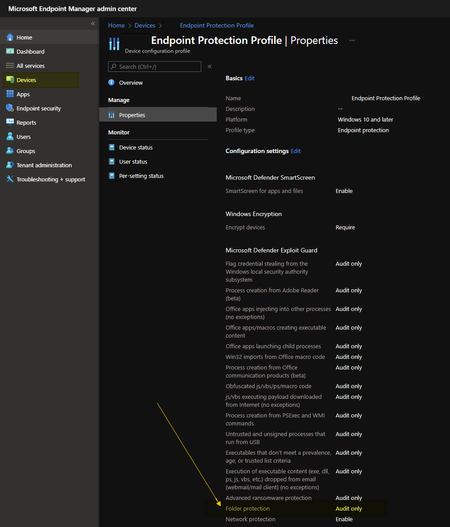
I actually noticed another feature of the order of preference: I had a policy in Endpoint Security > Attack surface reduction about Attack surface reduction rules. I set them to block, but it was not working. There were no conflicts, but no rules were applied to any of the configured devices.
Then I noticed that I had another Endpoint protection profile in Devices > Configuration profiles, which set all ASR rules to "Audit mode". So this profile was preferred, which is fine, but I expected at least to get a conflict when I enabled the policy in Endpoint security. After setting the Device configuration profile to "Not configured", the Endpoint Security policy worked as expected.
