Forum Discussion

Tiered Calculation Formula Help
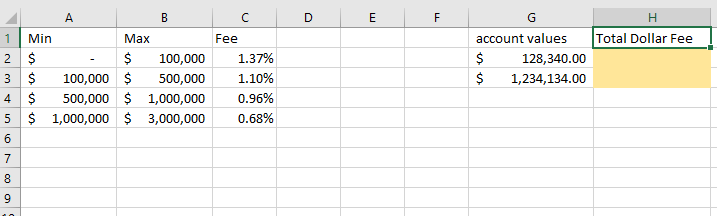

Yes! That is correct.
So.. For an account that is $85000 the fee would be $1164.50
and an account that is $147000 the fee woudl be $1887.00
Thank you for your help!

Before I take any more time delivering the formula (more likely formulas, plural) that you seem to be asking for, I want to make absolutely sure of the business requirement.
Each example you've given has been for account levels at the lower end of the spectrum. The question I asked you most recently had to do with a figure at the high end. Your answer, "yes," that it was to apply each successive level's percentage, in sequence, seemed to me to be unlikely (or "unwise"; take your pick). Why wouldn't that person with the multi-million dollar account just expect--and be given--the lowest rate?
I wrote my question thinking it was an absurd interpretation of "tiered calculation," so, frankly, was surprised when you said "Yes! That is correct." And then, the fact that you responded with examples that were at the bottom end, not taking my $7,654,321 figure and working it through the maze of laddered/tiered percentages, I wondered if you'd really read my question and thought about the implications of doing it that way.
The closest example that comes to mind of another kind of "tiered calculation" is that of the table in our Federal Income Tax instructions where it shows how to take your taxable income and figure the taxes owed. The table (there are various ones for single married, etc, but they all have a similar form not unlike the one you have presented), looks something like the example in the attached sheet. The good thing about that is that you're able (were you to want to write your own formula) to do a single VLOOKUP to go from your taxable income [comparable to your "account value" in this example] to a base rate plus additional percentage for anything above. That is, it's a single lookup value that delivers the entire set of info needed to finish the calculation.
You (your company, your organization) seems to be making this far more complicated than it needs to be, because you're asking for a computation at each level [along with the slightly constricting "it must be a single formula" expectation) when the objective is simply to come up with a descending percentage--the converse of the tax table's increasing percentage--based on an incoming figure to base it on.
So that's why I'm coming back. It IS possible to do what you're asking, but I wonder if it's really truly what you should be asking. I hope that makes sense. And if it really is what you're asking, I'd like to hear "why"--why is somebody insisting on doing it that way? To what extent has thought been given to doing it in a way more comparable to the tax table example attached? It IS far simpler to explain to clients AND far simpler to implement and maintain.