Forum Discussion

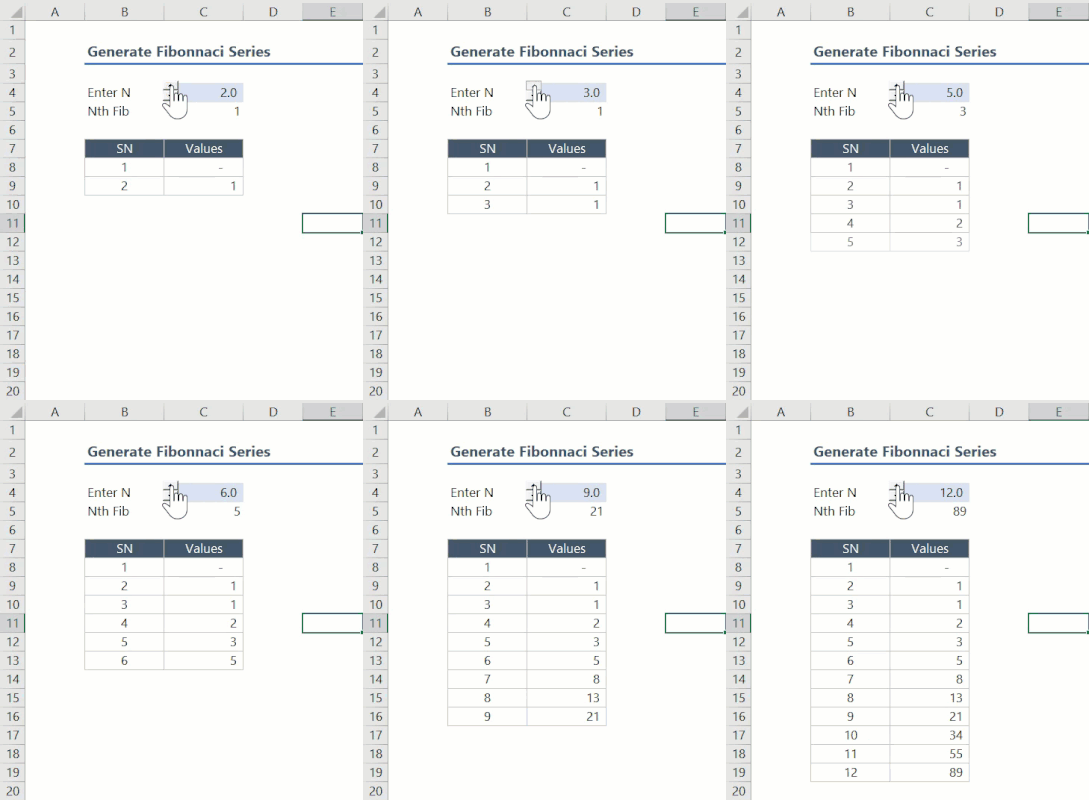
Lambda Example: Generate Fibonacci series

No, like yours it is left stacked. Far more effort would be required for they layout than was needed for the calculation! The main difference is that mine is more primitive in that it uses the recurrence relation from row to row rather that the functional form of the result.
Since you mention it though, how about this?
= REDUCE(1, SEQUENCE(n),
    LAMBDA(triangle,k,
      LET(
        previous, TAKE(triangle, -1),
        left,     HSTACK(previous, {0,0}),
        right,    HSTACK({0,0}, previous),
        triangle, VSTACK(HSTACK(0,triangle), left + right),
        IFERROR(IF(triangle,triangle,""),"")
      )
    )
  )

PeterBartholomew1 OK all this inspired me to bring it back to this topic and create the "classic" fib spiral:
=LET(n,10, LET(a, {1,1;1,0}, IF(n>2,
    DROP(REDUCE({1,1;1,1},SEQUENCE(n-2,,0),LAMBDA(ac,n,
      LET(fibNs,TAKE(ac,1,2),
      fibSp,DROP(ac,1),
      fibNextPair,MMULT(fibNs,a),
      fibNext, INDEX(fibNextPair,1),
      fibNextBlock, SEQUENCE(fibNext,fibNext,fibNext,0),
      fibSpiral, CHOOSE(MOD(n,4)+1,VSTACK(fibSp,fibNextBlock), HSTACK(fibSp,fibNextBlock), VSTACK(fibNextBlock,fibSp),HSTACK(fibNextBlock,fibSp)),
      VSTACK(fibNextPair,fibSpiral)  ))),1),
"n must > 2")))- PeterBartholomew1Apr 25, 2023Silver Contributor
I didn't even think of trying that! How about a bit of conditional formatting?
Every workbook should have one?
 lori_mMay 11, 2023Iron Contributor
Following up on the earlier BigMul idea, it seems one could apply convolution to the digits, e.g. 123*321 could be translated to
=CONVOLVE({1,2,3},{3,2,1})giving {3,8,14,8,3} then carry tens to return 39483. Combining with a simplified version of the davidleal python method above (which appears to come from here ),
def fib(n):
    a,b =  0,1                       # initialise matrix [[a+b,b] ,[b,a]]]
    for rec in bin(n)[3:]:
        a,b = a*a+b*b,b*(2*a+b)      # square of matrix
        if rec=='1' :  a,b = b,a+b   # multiply by initial matrix
    return b
returned values for fib(10000) in agreement to several thousand digits. The FFT convolution method in the attachment is from this gist courtesy of aaltomani
- PeterBartholomew1May 12, 2023Silver Contributor
I must confess, I wouldn't have thought of a convolution to perform multiplication! Convolution appears to be even more versatile than I had thought. The carry step would appear to require a reverse scan (or storing the number from least to most significant digit).