Forum Discussion

How to get the details on the Headers from PDF
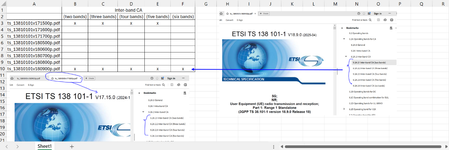
- Jun 15, 2025
With data model we need
- first add another table with unique file names
- Set relationships between it and main table
3. Create new measure as
Bands count:=COUNTA( Table1[Inter band CA(num)] ) + 0Please not, we plus zero to convert blanks to numbers
4. Add KPI to that measure
5. Create PivotTable using
With that icons also will be in totals as well.
Perhaps it's easier to do everything with Power Query
let
    Source = Excel.CurrentWorkbook(){[Name="Table1"]}[Content],
    DeclareType = Table.TransformColumnTypes(
        Source,
        {
              {"File Name", type text}
            , {"Section Number", type text}
            , {"Inter band CA(num)", type text}
        }),
    NameForEmpty = Table.ReplaceValue(
        DeclareType, "", "band",
        Replacer.ReplaceValue,{"Inter band CA(num)"}),
    CountBands = Table.Pivot(
        NameForEmpty,
        List.Distinct(NameForEmpty[#"Inter band CA(num)"]), "Inter band CA(num)",
        "Section Number", List.Count)
in
    CountBands
pivoting inside. With that we have structured table to whic we may apply usual conditional formatting

Icon set conditional formatting doesn't work with blank cells, just ignores them. Was not able to download your file, thus on such sample
Since you use PivotTable, you may create explicit measure and add KPI to it
However, if you use main table only to create PivotTable, status also could be missed, in upper PivotTable combination of column t and row b. But if create separate dim table with values in C, create relationships and use for rows dim table, all works (bottom PivotTable)
See in attached.

- SergeiBaklanJun 13, 2025Diamond Contributor
KPI could be created only base on explicit measure. Most probably you use implicit measure, i.e. drag some field into Values section of PivotTable pane and select proper aggregation.
Instead in Power Pivot create new measure, for it KPI shall be available. Creating them you may use in PivotTable measure value, goal and status. Actually you need only Status shown as icons.
- anupambit1797Jun 15, 2025Steel Contributor
Sorry, SergeiBaklan , for I am taking more time to understand , and not able to grasp the concept.. what I did is as below(attaching the file again)
Step 1) Created the measure, from the Table1 {Also , in Power pivot why we see two groups of the fields? one with the "File Name" "Inter band CA(num)" "Section Number" and the one with "Table1[File Name]" , "Table1[Inter band CA(num)]" and "Table1[Section Number]"?
Step-2) Then I created a Measure like this
Step-3), I can see the KPI( Measure) created in my Pivot as below, but when I select "Status" nothing happens
Attaching my Worksheet again,
Br,
Anupam
- SergeiBaklanJun 15, 2025Diamond Contributor
With data model we need
- first add another table with unique file names
- Set relationships between it and main table
3. Create new measure as
Bands count:=COUNTA( Table1[Inter band CA(num)] ) + 0Please not, we plus zero to convert blanks to numbers
4. Add KPI to that measure
5. Create PivotTable using
With that icons also will be in totals as well.
Perhaps it's easier to do everything with Power Query
let
    Source = Excel.CurrentWorkbook(){[Name="Table1"]}[Content],
    DeclareType = Table.TransformColumnTypes(
        Source,
        {
              {"File Name", type text}
            , {"Section Number", type text}
            , {"Inter band CA(num)", type text}
        }),
    NameForEmpty = Table.ReplaceValue(
        DeclareType, "", "band",
        Replacer.ReplaceValue,{"Inter band CA(num)"}),
    CountBands = Table.Pivot(
        NameForEmpty,
        List.Distinct(NameForEmpty[#"Inter band CA(num)"]), "Inter band CA(num)",
        "Section Number", List.Count)
in
    CountBands
pivoting inside. With that we have structured table to whic we may apply usual conditional formatting