Forum Discussion

Excel Challenge
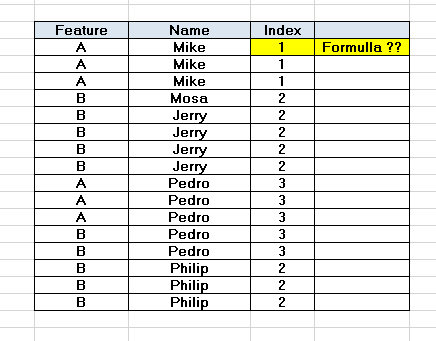
- Jul 07, 2020
=MMULT(--(COUNTIFS($B$2:$B$17,B2,$A$2:$A$17,{"A","B"})>0),{1;2})

MMULT is a function I'd not seen before.
Frankly, the Help text on the function isn't very helpful in understanding it. Can you explain how it's working here to solve the question asked by @Jalal_1988

I'm not good at explaining MMULT(). So I have to refer to the support page. The key text is: The result is an array with the same number of rows as array1 and the same number of columns as array2.
array1 has one row (and two columns) and array2 has one column (and two rows). So the output is an array with one row and one column.
- mtarlerJul 07, 2020Silver Contributor
Detlef_Lewin that is a clever solution
mathetes mmulti() stands for matrix multiply which goes back to linear algebra days.
I started to try and explain it here but you would be much better served with a website designed to teach it like https://www.google.com/url?sa=t&rct=j&q=&esrc=s&source=web&cd=&cad=rja&uact=8&ved=2ahUKEwj2y6HcmrzqAhUFLs0KHfvBDbUQFjAAegQIAhAB&url=https%3A%2F%2Fwww.mathsisfun.com%2Falgebra%2Fmatrix-multiplying.html&usg=AOvVaw2H0BMrqG1AOypxo5VF-pz8
- mathetesJul 07, 2020Gold Contributor
Thanks for that link. I'm printing the page now for careful study.....and then I'll keep my eyes open for opportunities to apply MMULTI. It's in the using that it'll really (finally) make sense.
 JMB17Jul 07, 2020Bronze Contributor
One use can be to create an array of subtotals for use in an array formula or lookup formula where, for whatever reason, you don't/can't have a subtotal helper column. So, if you had numbers in A1:A10, and entered this in B1:B10, you would get a subtotal array (credit to Harlan Grove):
=MMULT(--(ROW(A1:A10)>=TRANSPOSE(ROW(A1:A10))),A1:A10)
I'm not an expert on it's use, but I've used it in situations where I needed an OR criteria in an array calculation, but it had to be condensed into a single dimension array (instead of leaving it 2D and multiplying it out-sometimes the other parts of the formula were also OR criteria with different dimensions and the normal array multiplication wouldn't work and MMULT was more compact than the usual array addition I would use for OR).
Here's an example file of using mmult on a 2D data table with multiple OR criteria in both dimensions.
