Forum Discussion

Access Analytic Power Query challenge: Ticket list
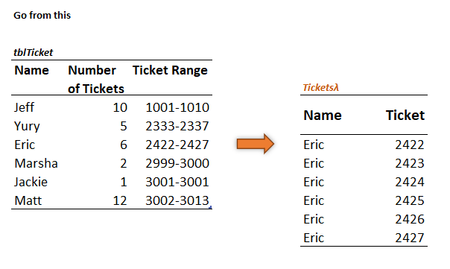

This is my second attempt and I think a bit more refined than the first attempt.
'TixStack' - I've used MAP with two arrays (Number, Range). I've extracted the starting ticket # from 'range' and with the help of SEQUENCE and 'number', I generate the series of tickets. String 'em up when done and then split into rows.
=LET(m,MAP(number,range,LAMBDA(e,f,TEXTJOIN(",",,SEQUENCE(e,,TEXTBEFORE(f,"-"))))),joined,TEXTJOIN(",",,m),1*TEXTSPLIT(joined,,","))
NameStack - Repeat each person's name as indicated by 'number'. Join them with commas, split into rows while ignoring blanks from extra commas.
=LET(RepNames,REPT(name&",",number),joined,TEXTJOIN(",",,RepNames),TEXTSPLIT(joined,,",",1))
Roll the above along with a header into 'BigTicket'
=LAMBDA(stack1,stack2,VSTACK({"Name","Ticket"},HSTACK(stack1,stack2)))
Call at the sheet level:
=BigTicket(NameStack,TixStack)
I shall now take a step back and review your solution. Thanks for providing this challenge!

I have every sympathy with your approach. It is not the answer that is interesting, it is the challenge and the process of reaching a solution. Only then do alternative approaches become interesting, especially so if they add to one's own skillset for future deployment.
I will post again on this thread because I went on to address another PQ/BI challenge on Wyn Hopkins site to see whether standard Excel formulas. I got a somewhat messy solution to a somewhat messy problem - par for the course. Then I realised that my 'scan over records' Lambda function was equally applicable to the new problem. In each case the problem-specific part was processing a single record. The calling Lambda helper function will simply stack the output from each record.
- PeterBartholomew1Nov 24, 2022Silver Contributor
I have tracked back to the earlier PQ Challenge!
Power Query Cost Allocation Challenge - YouTube
I first tried to solve it as a 'one off'. Then I decided to change track and reuse the 'Scan Table' helper function as part of the solution. It didn't make the solution any shorter but, by working record by record, I was able to include the sequence letters "A","B","C" that I had ignored before.
- Patrick2788Nov 25, 2022Silver Contributor
I think there may be some similarities (The second solution in the sheet) in our approach to 'unpivoting' the data but we differ in creating the array for 'row labels' (To use a PivotTable term).
'ReShape
=LAMBDA(header,range,LET(
    n, MAX(COUNTIF(TAKE(range, , 1), UNIQUE(TAKE(range, , 1)))),
    team, TAKE(range, , 2),
    StackA, CHOOSEROWS(team, INT(SEQUENCE(ROWS(team) * n, , 1, 1 / n))),
    StackB, WRAPROWS(TOCOL(DROP(range, , 2)), 2),
    matrix, HSTACK(StackA, StackB),
    filtered, FILTER(matrix, TAKE(StackB, , 1) <> 0),
    VSTACK(header, filtered))
On a side note, I did fiddle around with recursive stacking earlier (Ticket challenge) but at this point I don't see a benefit in using recursion with LAMBDA 'support' functions available. My perception of recursion at the moment is that it was a solution at a time when LAMBDA had been unveiled but the 'support' and shaping functions were not yet available. I don't see it as the best option (nor the most efficient), but I don't mind being proven wrong if someone can convince me!
- PeterBartholomew1Nov 25, 2022Silver Contributor
re: Side note.
I, too, user recursion very rarely. I believe the time it comes into its own is when one has a termination criterion but little knowledge of how many steps will be required to satisfy the condition. Examples might include minimising a non-linear objective function or integrating ordinary differential equations using a variable step length method. Things I might try one day, but have yet to tackle. I think lori_m may have a more informed opinion as well as some examples.
- Patrick2788Nov 23, 2022Silver Contributor
One thing I'm learning from your solution and running several timings (Your solution is a bit quicker than mine), is the fact SCAN (and REDUCE, for that matter) are quicker than MAP. I've ran SCAN/REDUCE/MAP on arrays with 10,000 elements and MAP was 'slowest'.
I thought it might have been map with 2 arrays that did it. Here's the basic example I tested:
=MAP(arrD,arrE,LAMBDA(d,e,IF(d>e,"yes","no")))The MAP calc times with 1 array were nearly identical.
By the way, the timer I'm using, MicroTimer() is from:
Excel performance - Improving calculation performance | Microsoft Learn
If there's a better timer available, I'm open to suggestions.
- PeterBartholomew1Nov 23, 2022Silver Contributor
That is a surprise! I would have backed MAP as being the faster.
As for the timing routine, I think we are using the same code. Mine is part of Charles Williams's FastExcel but the article looked very familiar in style and content. It turned out that Charles is the lead author.
As an aside, I was the warm-up act for Charles at the 2019 EuSpRIG conference. I gave a half hour presentation showing dynamic arrays at a time when they still had shock value. Charles then gave a half-day training session explaining the intracacies of pair-wise lifting etc.