Forum Discussion

SYSTEM CENTER IMPLEMENTATION & LICENSING Guide

Hi narayandas4one.
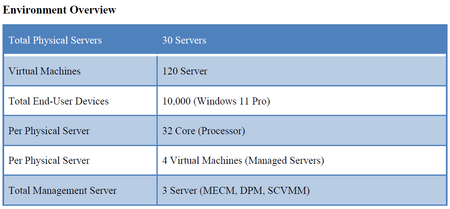
based on the environment you shared, here’s how System Center licensing is typically calculated. (As always, final confirmation should be done against Microsoft Product Terms and your reseller/LSP, but the logic below is the standard model.)
1) What counts for System Center licensing
System Center is licensed for the endpoints being managed:
- Server Management Licenses (Server MLs) for servers running server OS OSEs (physical hosts and/or VMs).
- Client Management Licenses (Client MLs / CMLs) for devices running non-server OS (Windows 10/11 endpoints). https://www.microsoft.com/en-us/licensing/product-licensing/system-center
Also, Server MLs (Standard or Datacenter) include the full System Center “suite” components (ConfigMgr, DPM, SCOM, VMM, Service Manager, Orchestrator) and they aren’t sold separately. https://www.microsoft.com/en-us/licensing/product-licensing/system-center
2) Server ML sizing for your 30 physical servers
System Center server management is core-based:
- License all physical cores on each managed server
- Minimum 8 cores per CPU and 16 cores per server https://www.microsoft.com/en-us/licensing/product-licensing/system-center
Your case (assuming each of the 30 physical servers is 32 cores):
- Total physical cores = 30 × 32 = 960 cores
Now choose edition based on virtualization rights:
Option A: System Center Datacenter (best for highly virtualized hosts)
- Once all cores are licensed, you can manage unlimited OSEs/VMs on that host
- Required core coverage: 960 cores total (30 × 32)
Option B: System Center Standard (best for lightly virtualized hosts)
- A fully-licensed server can manage 2 OSEs/VMs; for more VMs you “stack” licenses (re-license the same cores again)
- You reported ~4 VMs per host, so you typically need 2× Standard coverage per host:
- Per host: 32 cores × 2 = 64 core licenses worth
- Total: 30 × 64 = 1,920 cores worth of Standard licensing
In short: with ~4 VMs per host, you’re roughly comparing 960 cores (Datacenter) vs 1,920 cores (Standard stacked), and you pick based on commercial convenience/cost.
(Optional note: Microsoft also documents “licensing by virtual machine” scenarios for management, but eligibility/requirements depend on your agreement and Software Assurance/subscription context, so most customers keep it simple with the physical-core model.) https://www.microsoft.com/licensing/guidance/Core-based-licensing-models
3) Client ML (CML) sizing for your 10,000 Windows 11 devices
If you plan to manage Windows 11 endpoints with System Center (typically Configuration Manager), you need Client Management Licenses. Microsoft provides three Client ML types:
- Per User ML
- Per OSE ML
- Device ML (via Core CAL Suite or Enterprise CAL Suite)
With the data provided (device count only), the straightforward answer is:
- 10,000 Client MLs if licensing per device/OSE
OR - # of users if licensing per user (not enough info to calculate from your message)
Important: if your organization already owns Microsoft Intune–included licensing, Microsoft states that most licenses that include Intune also grant rights to use Microsoft Configuration Manager (while the subscription is active). That can materially change whether you need to buy separate ConfigMgr Client MLs, so it’s worth checking your current M365/EMS/Intune entitlements. https://learn.microsoft.com/en-us/intune/intune-service/fundamentals/licenses
4) Management servers (MECM / DPM / SCVMM)
You generally don’t buy extra “System Center suite server licenses” just because you have 3 management servers. The Server MLs include rights related to the management server components as part of the suite.
(Separate topic: you still need to license the underlying Windows Server OS and any SQL Server usage beyond what’s permitted as runtime/supporting rights, based on your architecture.)

Dear Simone_Termine
Thank you for your detailed response. Your explanation helped clarify several concepts; however, a few points remain uncertain, and I would appreciate further guidance:
- Server ML vs. System Center Standard License
- Is Server ML different from the System Center Standard License:
- How many System Center Licenses are required to deploy four Management Servers on VMs (two VMs per host)?
- Additionally, how many Server ML (Managed VMs) would be required to cover 120 Managed Virtual Machines (each with 8 cores)?
- If Server ML is not different:
- Does this mean I only need to purchase 2 Management Licenses (covering four VMs) plus 60 additional Standard licenses again to cover 120 Virtual Machines?
- In this case, are the 60 additional licenses provided as paper licenses, license keys, or in another format?
- Is Server ML different from the System Center Standard License:
- Nature of Server ML
- Could you confirm whether Server ML is considered a paper license or something else?
- Simplified Calculation Request
- In straightforward terms, could you please calculate the required number of:
- System Center Licenses (Management Licenses) for deploying four servers as System Center components (MECM, SCVMM, DPM, etc.), with each host dedicated to two components.
- Server ML licenses required to manage 120 Virtual Machines.
- In straightforward terms, could you please calculate the required number of:
Your clarification on these points will help us finalize our licensing requirements with. About CML and SA I am clear now.
Regards
Narayan Das
- Dec 20, 2025
To keep it simple, below is a straightforward example calculation that should address your question at a practical level.
Assumptions
- System Center 2022 Standard
- All VMs have 8 cores
- Core-based licensing (1 license per 2 cores)
System Center Components (4 Management Server VMs)
- 4 VMs × 8 cores
- 8 ÷ 2 = 4 licenses per VM
Required licenses:
4 × 4 = 16 System Center StandardManaged Workloads (120 Virtual Machines)
- 120 VMs × 8 cores
- 8 ÷ 2 = 4 licenses per VM
Required licenses:
120 × 4 = 480 System Center Standard (Server ML)Summary
Management Servers: 16 Standard
120 Managed VMs: 480 Standard
Total: 496 System Center Standard licensesNote: “Server ML” is not a separate product; it refers to the System Center Standard license.
This calculation follows Microsoft’s published licensing rules; for final confirmation in your specific agreement, it’s still best to check with a Microsoft licensing partner.
- narayandas4oneDec 20, 2025Tin Contributor
Thank you for your response. However, I must respectfully disagree with your assumptions outlined below:
Assumptions Provided (Taken from your above comment)
- System Center 2022 Standard
- All VMs have 8 cores
- Core-based licensing (1 license per 2 cores), not clear this point? how?
What we understood from Microsoft Official Documentation is
- Minimum 8 cores per CPU
- Minimum 16 cores per server
- Core-based licesing (2 16-pack core license covers four VMs), right?
My primary concern remains around Server ML. For example, if I purchase two System Center Standard licenses to deploy four management servers and intend to manage 120 VMs, what exactly must be procured for those 120 VMs? Is Server ML a paper license similar to Client ML (CML), or does it involve a product key or another entitlement? This distinction is unclear, and even our vendor has not been able to provide a definitive answer.
Environment Summary
- Four Management Servers (planned purchase: 2 System Center Standard Licenses)
- 1000 Client MLs (paper licenses) for Windows 11
- 120 VMs requiring Server MLs, as per Microsoft guidance
Based on my current understanding, the requirement would be:
- 1000 CMLs for windows client machines
- 2 Standard Licenses for the four management servers
- 60 Server MLs (as mentioned per server requires 2 License, we have 120 VMs, means 120/2=60)
However, the nature of the Server ML—whether it is a paper license, product key, or another form of entitlement—remains unclear to me. Where can I find the pricing of Server ML?
In simple words, I need below,
1- Pricing for 2 System Center License
2- Pricing for 1000 CMLs
3- Pricing of 60 Server MLs
4 - Pricing of Software Assurance
Pricing should be for three years.
