Forum Discussion

New to Access
- Jun 26, 2026
The direct answer is "yes, that's how relational databases work."
But I suspect there's a deeper question behind that. You need advice on structuring your tables to make that work.
You'll need to star with learning about Database Normalization. That is the process of creating and relating tables to model your business. Here's an introductory article.
I like the YouTube videos here as well.
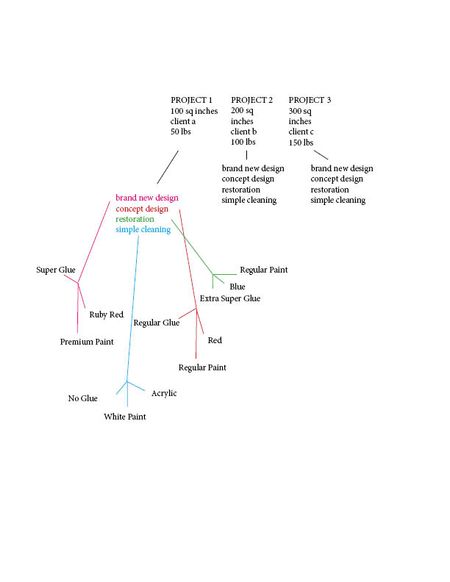
You need one table for each entity, or thing, you need to track. That will include Projects. The fields in that table will be the attributes of importance about each project. Name of the project, primary medium (textile, paper, wood, etc.), size, among others.
Another table will be Clients. The fields in that table will be the attributes needed to uniquely identify each client, e.g. first and last names.
Depending on the relationship between Projects and Clients, you might attach a Client attribute to the Projects table, or you might need a third table if two or more Clients can jointly purchase a project and you need to record both.
Another table will be Media. That's going to be a lookup table for the types of media your projects use, see above.Another will be additional materials. Another lookup, this one for things like glue and paint.
There will, no doubt be several other tables. I don't have enough information about the business you are modeling to know what they all would be.
Make sure you invest sufficient time and study to learn the proper, normalized table design and design a set of tables that you think you'll need. Share that with us. We'll help you refine it.
Once the tables are in place, querying against them for the kinds of information you specify will be very straightforward. But that comes only after the tables are done right.

The direct answer is "yes, that's how relational databases work."
But I suspect there's a deeper question behind that. You need advice on structuring your tables to make that work.
You'll need to star with learning about Database Normalization. That is the process of creating and relating tables to model your business. Here's an introductory article.
I like the YouTube videos here as well.
You need one table for each entity, or thing, you need to track. That will include Projects. The fields in that table will be the attributes of importance about each project. Name of the project, primary medium (textile, paper, wood, etc.), size, among others.
Another table will be Clients. The fields in that table will be the attributes needed to uniquely identify each client, e.g. first and last names.
Depending on the relationship between Projects and Clients, you might attach a Client attribute to the Projects table, or you might need a third table if two or more Clients can jointly purchase a project and you need to record both.
Another table will be Media. That's going to be a lookup table for the types of media your projects use, see above.
Another will be additional materials. Another lookup, this one for things like glue and paint.
There will, no doubt be several other tables. I don't have enough information about the business you are modeling to know what they all would be.
Make sure you invest sufficient time and study to learn the proper, normalized table design and design a set of tables that you think you'll need. Share that with us. We'll help you refine it.
Once the tables are in place, querying against them for the kinds of information you specify will be very straightforward. But that comes only after the tables are done right.