Recent Discussions

WDSI Submission Review Has Been Pending for 10 Days
I submitted the application I developed to WDSI for review because the Microsoft Defender SmartScreen warning appears when running it. I would like the application to be added to the virus database so that this warning no longer appears, but the review has still not been completed after 10 days. Could you please help me? Submission ID: 61955163-f60b-4141-aafa-cd4afe171996 Link: https://www.microsoft.com/en-us/wdsi/submission/61955163-f60b-4141-aafa-cd4afe17199636Views0likes1Comment
Device* tables missing from Advanced Hunting schema despite M365 E5 license
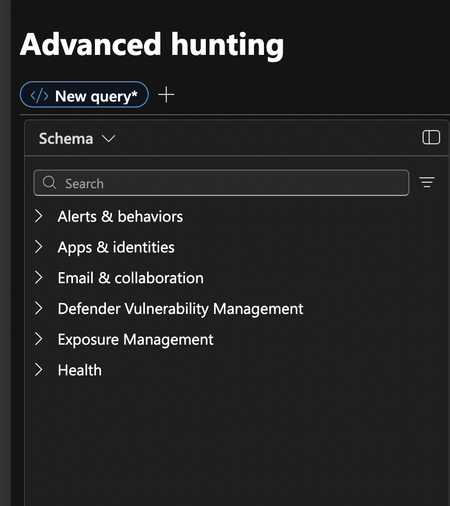
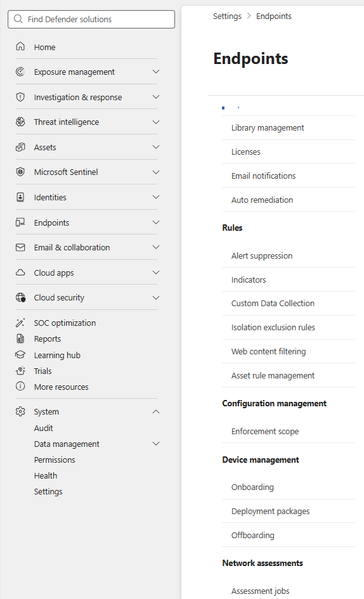
We have an M365 E5 trial (with Microsoft Defender for Endpoint service plan enabled) and a standalone Defender for Cloud Apps trial on the same tenant. Two devices are onboarded and show as Active in Device Inventory. one Windows 11 VM hosted on mac m4 and one Windows Server 2019 Azure VM. The issue: the entire Devices section is missing from the Advanced Hunting schema. No DeviceInfo, DeviceNetworkEvents, DeviceEvents, DeviceProcessEvents, etc. The schema only shows Alerts & behaviors, Apps & identities, Email & collaboration, Defender Vulnerability Management, and Exposure Management. Additionally: - The device Timeline tab does not appear on device pages (not in visible tabs or overflow menu) - "Go hunt" from a device page only generates a query against IdentityLogonEvents, not any Device* tables - Settings → Microsoft Defender XDR does not show an "Advanced hunting" option for managing data sources - The MDE Client Analyzer on the Azure VM passes all EDR cloud connectivity checks (CnC, Cyber, AutoIR, SampleUpload, MdeConfigMgr all Succeeded 200) - Settings → Endpoints → Optional features loads with all toggles including the Defender for Cloud Apps integration - Cloud Discovery via MDA works (discovered apps visible on the device page) - The Tenant ID and Org ID shown in XDR settings are different values The tenant originally had only the Defender for Cloud Apps standalone trial. The E5 trial was added afterward. It appears the MDE data source was never deployed/activated in Defender XDR despite the license and onboarding being in place. I've opened a support case but wanted to ask here as well, has anyone resolved this issue? I've found several older posts describing the same problem but none with a confirmed fix. Any guidance would be appreciated.59Views0likes0Comments
EnableConvertWarnToBlock will not enable - stays False
We have a GPO applied to Windows 11 Pro machine - fully patched and onboarded to MDE. The GPO enables "EnableConvertWarnToBlock" as follows: The GPO is applied to the machine and the following registry key is populated: But when I check the status on the client - it will not enable: I have enabled troubleshooting mode and disabled tamper protection in case this is blocking but nothing seems to work. Its as if MDAV/MDE is not even looking/reading that registry key. Anyone else have the same issue or ideas on resolution?202Views0likes5Comments
Location of Defender for Identity Entry in Defender Tables
Our GRC group wants an automated report on windows servers and workstations over 7 days old not onboarded for Defender for Endpoint. A change in our environment (not sure if it was MS or us) has caused an additional entry in a column named "DiscoverySources" for Defender for Identity. It's my understanding that D4I is only used on domain controllers, but we get entries on non-DCs as well. This identifier does not appear on the device dashboard, nor can I add it in with the custom column tab. Furthermore, if a machine requires onboarding for D4E, it will show them both in the same column, it separates them with a comma in the same field. Right now, I have to do this process manually and with the overhead involved, it takes me about 30 minutes to run the reports, filter out the false positives and forward them to the appropriate staff. They want this every day, and I can't do this operationally. I'd welcome the opportunity to create a Logic App based on a query to perform this function and route it. Can someone point me in the direction of the table which contains the DiscoverSources column? I haven't been able to find it. That would help me to perform the necessary KQL and Logic App to automate this process. Long time listener. First time publisher. Thanks68Views0likes1CommentDefender Device Groups
Hello everyone, I need some help creating a device group in Defender. I can't find anything related to Groups inside Microsoft Security. I'd read that it's possible to create one inside the Permissions tab, but I can't figure out how. Someone can explain what's the process?137Views0likes4Comments
Inconsistent Microsoft Defender Behaviour
Hi everyone, We have an issue whereby across several intune managed devices with identical defender AV policy, signature version, and platform version, we've found inconsistent detection/remediation behaviour. Some devices block malicious files instantly on download (expected and correct). Others only detect on open rather than on write, or log a successful detection/remediation action without the file actually being removed from disk, it remains fully accessible indefinitely. Since this occurs despite identical config, we're concerned this is a genuine gap in automatic remediation reliability that could affect real threats, not just our test files. Troubleshooting completed, issue persists: - Ruled out exclusions (path/extension/process) - Confirmed PUA protection, real-time protection, tamper protection, and all granular protection flags enabled/healthy - Removed orphaned third-party AV registrations from WSC (previously caused Defender to show as "snoozed") - Confirmed filter driver (WdFilter) loaded correctly, no conflicts - Cleared stuck "detected but not remediated" threat entries - Ruled out file locks preventing remediation - Cleared cached signature state, forced fresh signature pull - Attempted full platform reset - Confirmed cloud protection/MAPS enabled and reachable - Increased CloudBlockLevel to test enforcement aggressiveness Does anyone have any idea what could be happening here? Thanks98Views0likes2Comments
MDVM - Patch Publication Date
Dear Microsoft MDVM Development Team, Please could you as quickly as possible implement the "Patch Publication Date" for the vulnerabilities you report on. Any major Vulnerability management platform has this simple field/record please advise you are implementing this and the timeframe for it? Kind Regards, Graeme78Views0likes1Comment
DVM Certificate Inventory Shows No Data Despite Healthy Endpoints in Defender for Endpoint
Hi Team, I'm testing Microsoft Defender Vulnerability Management. Current status: - Defender Vulnerability Management Add-on enabled - Certificates inventory tab is visible - Software Inventory populated - Security Recommendations populated - Windows and Linux devices onboarded - Linux mdatp health = healthy:true, licensed:true, cloud_enabled:true - Devices have local certificates installed - Certificate Inventory page shows "No data" The DVM Add-on was enabled more than 36 hours ago. Has anyone experienced a delay in Certificate Inventory population or are there additional prerequisites beyond DVM licensing and device onboarding? Thanks.58Views0likes1CommentMicrosoft Defender false positive and WDSI submission details page bug
Hello, I am the developer and publisher of Pulse Launcher, a legitimate signed Windows application / Minecraft mod launcher. I already submitted this through Microsoft Security Intelligence and also opened a Microsoft Q&A thread, but I am posting here because the WDSI submission portal itself appears to be broken for these submissions. Related Microsoft Q&A thread: https://learn.microsoft.com/en-us/answers/questions/5929545/microsoft-defender-false-positive-and-wdsi-submiss There are two related issues: 1. Microsoft Defender cloud ML false positives keep appearing on public multi-engine scan results for the same signed application/product family. The Microsoft detection name changes across rescans and equivalent builds, including: - PUA:Win32/Puwaders.C!ml - Program:Win32/Wacapew.C!ml - Trojan:Win32/Wacatac.B!ml - Trojan:Win32/Wacatac.C!ml - Trojan:Win32/Sabsik.EN.A!ml 2. Microsoft Security Intelligence submissions are visible in Submission history and show status "In progress", but opening the submission details page returns: "The details for the submission were not found or the submission has expired." Affected submission IDs: - dd476efa-fc04-4f13-82cf-631bbfd145a6 - efc6514c-d700-4d6a-a7e2-67a9a83334a2 - ff8d04b7-c5fc-4a05-bd53-ee7ac5981284 File details: - File name: pulse_launcher.exe - SHA-256: def6059c07c3e1f4a8c5649a1bbf190d4f355ee8e8b88c55c5b404edee99ecc8 - Signer: FOP Haponiuk Mykola Viktorovych - Certificate: GlobalSign EV Code Signing certificate The executable is not VMProtect-packed or obfuscated. It is EV-signed. A previous Microsoft analyst response stated that the file did not meet Microsoft criteria for malware or PUA, but Microsoft cloud detections continue to appear. Could someone route this to Microsoft Defender Security Intelligence / malware analysis, or advise how to escalate WDSI submissions that exist in history but whose details endpoint returns "not found or expired"? Thank you.105Views0likes1CommentMicrosoft Defender for Endpoint and WDAC audit logs not include kernel audit/blocks
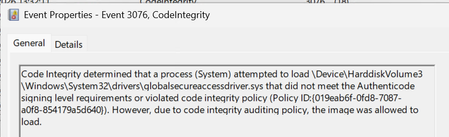
While testing WDAC on a fully patched Win11 pro machine - I noticed that kernel audit/block events do not get collected by MDE in the advanced hunting portal, only user mode audit/blocks are collected. Can anyone confirm they see this too and is this by design? My test case is to use a Strict Kernel Mode WDAC policy (as per: https://github.com/HotCakeX/Harden-Windows-Security/wiki/WDAC-policy-for-BYOVD-Kernel-mode-only-protection) which is active, using the global secure access client as my test, when the machine boots, the below event is generated locally on the machine: This event is never shown on the MDE advanced hunting portal, though user events do show. Examples of events that are coming through: Not receiving these events centrally for auditing would make deploying a kernel mode wdac control impossible. Would be amazing if Microsoft product team could look into this and resolve as these alerts should be captured as well please to facilitate deployment of more secure controls.175Views0likes2CommentsWays to fetch quarantine files
We are working with quarantine files and have a few questions: 1. Is there a public API available to retrieve quarantined files from Microsoft Defender for Endpoint? 2. Is there a documented method to map an alert or a file SHA-1/SHA-256 hash to the corresponding object in the Defender quarantine store? 3. Is there a way to retrieve quarantined files other than using a PowerShell script through the Live Response API?273Views0likes4Comments
Understanding AI workloads on Linux
Hi everyone, I’m a PM working on security for Linux environments and trying to better understand how AI workloads are actually showing up in production today. Would appreciate hearing from folks here: Are you running any AI workloads on Linux today? Or actively exploring? What does your deployment/setup look like — e.g., model training/inference, agents, MCP servers, data pipelines, etc.? How are you thinking about securing this stack, if at all? If you’re open to a quick 30-min chat, I’d love to learn more from your experience as well. Thanks in advance — this will directly help shape where we invest next.119Views0likes1CommentLarac2shell: Turning MDE Live Response into a near real-time shell We are the EDR!
https://github.com/akefallonitis/larac2shell Turning MDE live response into a near real time interactive shell beta version out Features: - Internal (Thanks to https://www.linkedin.com/in/fabianbader/ - https://www.linkedin.com/in/nathanmcnulty/ and xdrinternals research ) vs External api authentication - Arbitrary command execution via pre-uploaded base64 wrapper script - Cross-OS support PS Two MSRC bugs reported for direct command execution bypass waiting for Microsoft Response in order to publish them Coming SOON TM Full LaraC2 Post Exploitation OST framework over MDE as C2/C3 Channel - We are the EDR / No external Infra / Onboarding to your controlled tenant silencing MDE Happy testing 🥳 🎉128Views0likes2CommentsrunHuntingQuery API and 'evaluate pivot'
Seem to have a problem where any request to the runHuntingQuery API with 'evaluate pivot' fails with error": { "code": "UnknownError", "message": "", Is this just a 'feature' ? The query happily runs trough the website/XDR portal. :-( Is there a way to simulate a pivot (easily) in powerapps ?101Views0likes1CommentDefender for Business - No alert after process lock out ?
Hello all, A few days ago, I have setup Defender for business server on a Windows Server 2019. I can see that server in the Microsoft security portail devices list. I have also tested the "suspicious" powershell command provided by Microsoft and it went all good. Powershell blocked, alert escaladed as incident in the security portal, email received, ... But the next day, I tried to install a service on that server that got blocked by Virus & Thread Protection because it was attempting to modify a lot of files. That was a good point for Defender (it was not a real thread and was later added as exception). My worry is that it was never escaladed to the security portal, I didn't received a alert email, .. The system blocked that "thread" multiple times during my attempt to deploy it and no incident were throw. What could be wrong ? Thank you.173Views0likes3CommentsSave the date - January 26, 2026 - AMA: Secure your endpoints with policy and Microsoft Defender
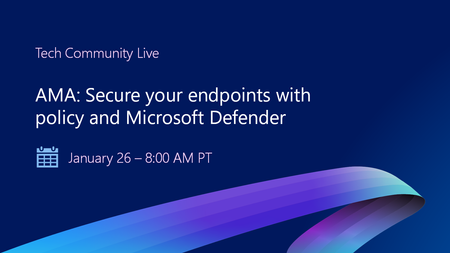
Save the date for January 26 at 8:00 AM PT! Have questions about using Microsoft Intune to enforce device compliance? Curious how to configure devices to help prevent security breaches and limit the impact of threats? Ask Microsoft Anything (AMA) about integrating Microsoft Defender for Endpoint with Microsoft Intune at Tech Community Live! Product teams will be answering your questions live and in chat. Get tips using policy to onboard devices, define risk level, block non-compliant devices from accessing corporate resources, and more. Go to aka.ms/AMA/SecureEndpoints to save the date and add this event to your calendar!383Views0likes0CommentsUsing MDE (Passive Mode) with Palo Alto Cortex XDR to enable Defender for IoT (Enterprise IoT)
Hi everyone! I’m working with a customer that uses Palo Alto Cortex XDR as their primary EDR. We want to leverage Microsoft Defender for IoT specifically for Enterprise IoT (not OT/ICS). I have a few questions: MDE in Passive Mode as a sensor: Can Microsoft Defender for Endpoint (MDE) running in Passive mode act as a sensor to enable Enterprise IoT discovery/monitoring for Defender for IoT? Are there any feature limitations when MDE is not the primary EDR? Appliance sensor in Enterprise IT: If we cannot use the MDE agent, is it supported to deploy the Defender for IoT appliance sensor in an enterprise IT network (e.g., offices/campuses) to cover Enterprise IoT use cases? Coexistence / Complementary sensors: Is it possible (and recommended) to run the appliance sensor alongside MDE (sensor) to complement coverage/features? Any guidance on architecture, data overlap/deduplication, or licensing implications?421Views0likes1Comment- 190Views0likes2Comments



Events
Recent Blogs
- In brief: Defenders can now easily identify logons involving high-privilege identities or special logon flags to better hunt threats and fine-tune detections. When a user logs on, Windows’ Loca...Jul 15, 20262.2KViews0likes0Comments
- In today’s threat landscape, internet exposure, i.e. devices that allow inbound connectivity from the public internet, continues to be a major vector for initial access and compromise. Devices that a...Jun 11, 2026786Views1like0Comments


Tags
No tags to show