What Microsoft’s Autopilots Change About the Enterprise Microsoft’s Autopilots can have their own identity, email, Teams presence, manager and place in the org chart. As AI moves from answering prompts to holding standing responsibilities, the challenge shifts from deploying agents to redesigning how work itself is organized.
Something has changed in the enterprise AI conversations I have been part of over the past few months. A year ago, much of the discussion was about what agents can do. Can they reason across multiple steps? Use tools? Access enterprise data? Complete a workflow?
Increasingly, I hear different questions. How much work should we give an agent? How much authority should it have? Who owns it once it is in production? What happens when nobody is watching?
These aren’t model questions. They are operating-model questions. And Microsoft’s newest category of agents makes them particularly relevant.
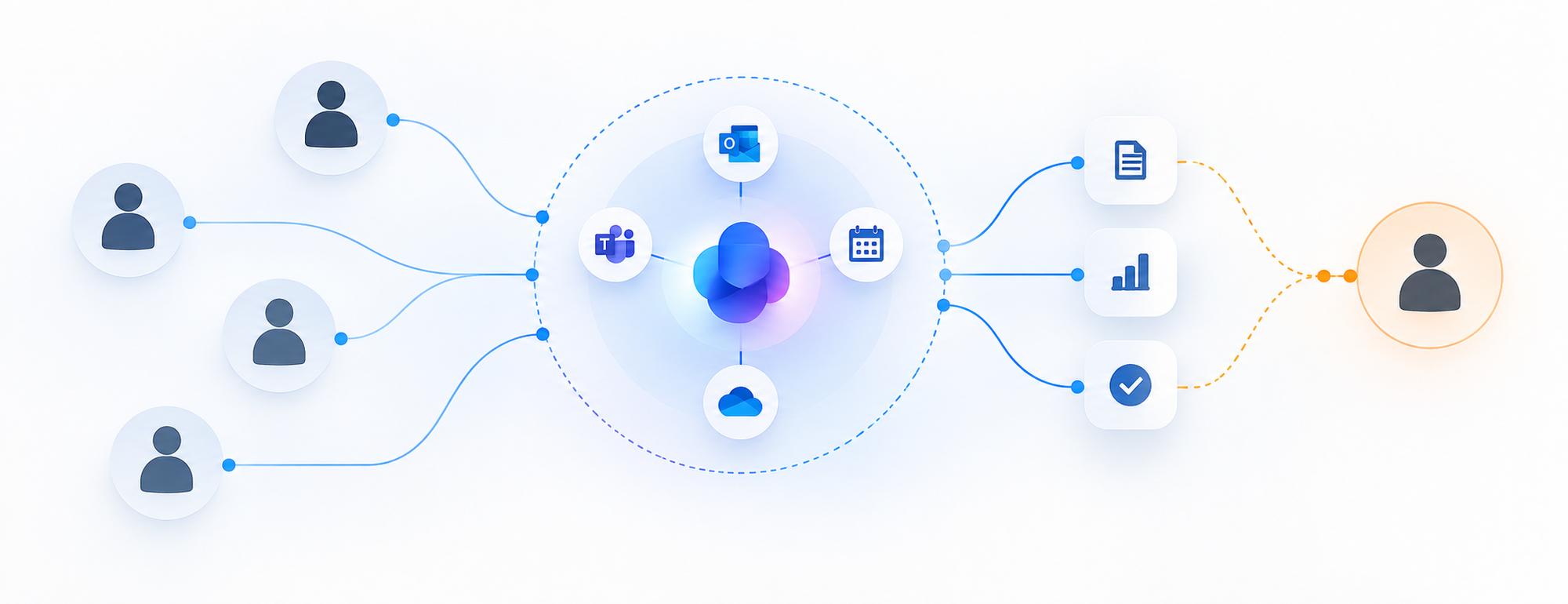
At Build 2026, Microsoft introduced Autopilots. Recent Microsoft Foundry updates make the concept much more tangible: a persistent agent can have its own identity, email, calendar, OneDrive, Teams presence, manager and even a place in the organization chart.
Microsoft Scout, the first Autopilot, makes this less theoretical. It works across Teams, Outlook, OneDrive and SharePoint, proactively coordinating meetings, preparation and the follow-ups that accumulate through the working day.
For most of the history of enterprise technology, software has waited for us. Now it is beginning to hold a job.
From prompts to responsibility
The progression has happened remarkably quickly. We started with AI that answered questions. Copilots helped people perform work. Agents began completing multi-step tasks using tools and enterprise context.
Autopilots take us another step forward.
PROMPT → TASK → ROLE → RESPONSIBILITY
At the prompt level, AI responds. At the task level, it executes. At the role level, it persists. At the responsibility level, it owns an outcome within defined boundaries.
Consider release management. Today, an engineer might ask an agent to check whether a release is ready. An always-on agent could instead monitor dependencies continuously, track unresolved issues, prepare documentation, follow up with teams and escalate risks as they emerge.
Nobody needs to remember to ask. The work itself activates the agent. That shift, from being invoked to having standing responsibility, has much bigger consequences than another improvement in model capability.
A Copilot has a user. An Autopilot has a job.
Microsoft Foundry currently distinguishes between assistive agents, background service agents and Autopilots.
There is an important nuance: autonomy alone does not make an agent an Autopilot. A background agent may operate autonomously all day. The defining difference is identity.
Every Foundry agent receives an Entra agent identity. An Autopilot additionally receives an agent user account, allowing it to operate as itself within Microsoft 365 rather than borrowing the identity of whichever employee invokes it.
In enterprise conversations about agentic AI, identity and accountability often surface surprisingly late. We get excited about reasoning, tools and orchestration, and only then somebody asks: Whose permissions is this agent using? Who gave it access? Who can see what it did? Who switches that access off? Those questions become unavoidable when agents persist.
Autonomy determines what an agent can do. Identity tells us who is doing it. Accountability tells us who answers for it. The smarter agents become, the more important those last two questions become.
And this doesn’t stop with individual agents. Microsoft Agent 365 provides the broader governance layer: published Foundry agents can automatically appear in its registry, giving administrators a common view across the growing agent estate.
Build it. Publish it. Hire it.
Perhaps the most fascinating part of Microsoft’s Autopilot architecture is its lifecycle.
Developers build a blueprint defining what an Autopilot knows how to do and the infrastructure it requires. Once approved and published, teams can hire instances from that blueprint. Each instance can have its own identity, permissions, manager and access.
Microsoft’s lifecycle increasingly resembles: Build → Publish → Approve → Hire → Onboard → Operate → Offboard
The terminology is revealing. Not because agents are employees. They aren’t.
But once software has persistent identity, access, responsibility and initiative, some familiar management disciplines become necessary: onboarding, ownership, permissions, policy and eventually offboarding. That is how agentic AI starts moving from experimentation toward an operating model.
Always-on Changes the Economics
There is another issue that comes up frequently in customer conversations: economics.
An agent that works only when prompted has relatively visible consumption. An always-on agent may monitor events, retrieve context, reason, invoke tools and coordinate work while nobody is actively interacting with it.
Consumption begins moving from transactional to continuous. In my previous article, Beyond Tokens, I argued that enterprises need to move beyond token consumption toward Cost per Successful Outcome, and that every outcome deserves an Intelligence Budget - the economically rational amount of intelligence worth spending to create it.
Autopilots make that discipline more important. A release-management Autopilot shouldn’t be judged by how few tokens it consumes. It should be judged by whether releases happen faster, risks are identified earlier and engineering capacity is freed for more valuable work.
Before giving an agent initiative, give it an economic boundary.
The question isn’t simply, How much will this agent cost? It is: What standing responsibility are we paying it to fulfil and what is that responsibility worth?
Maximum Autonomy is the Wrong Goal
Another pattern I notice is the tendency to treat autonomy like a maturity score. More autonomous must mean more advanced. I’m not convinced.
For most enterprises, the objective should be appropriate autonomy, not maximum autonomy. Every persistent agent needs what I call an Autonomy Envelope: a clear boundary around what it may observe, decide and execute independently. Inside that envelope, let it work. At the boundary, require additional authority. Outside it, escalate.
A scheduling agent and a clinical workflow agent shouldn’t have the same envelope. Neither should an agent recommending a purchase and one approving a multimillion-dollar payment.
This is why Microsoft’s recent Foundry developments around long-running execution, durable state, human-in-the-loop approvals, resilience and steerability matter. An always-on agent needs to be interruptible. It needs to recover. And sometimes it needs to know when to stop and ask.
Good autonomy isn’t the absence of human intervention. It is knowing when human intervention matters.
The Technology may not be the Hardest Part
Microsoft’s own AI journey offers an interesting reality check. In September, Microsoft published lessons from its own AI transformation. One admission stood out: it initially approached AI much like a traditional technology rollout and discovered that access and usage do not equal transformation. The bigger gains came when teams redesigned workflows around AI.
Microsoft reports more than 111 agents operating across cloud supply-chain workflows, with cycle times in selected planning processes falling from around 10 business days to under 2.5. It also describes a nine-person cross-functional team working with agents to deliver an initial product release in 35 days.
McKinsey’s recent research reaches a complementary conclusion: organizations are scaling agents faster than they are redesigning the work underneath them.
That resonates with what many of us see on the ground. Organizations can build impressive agents surprisingly quickly. The harder discussion starts afterward. What should the agent own? What should the person still own? Where does accountability sit? And does the old workflow make sense anymore?
From Deploying Agents to Redesigning Work
Microsoft’s 2026 Work Trend Index describes Frontier Professionals as people actively redesigning their work around agents rather than simply using AI tools. Microsoft reports that 32% of surveyed AI users in India fall into this category, compared with 16% globally. I suspect this is where the larger opportunity lies.
The future isn’t simply about inserting agents into today’s organization. It is about reconsidering the work the organization was designed to perform.
Copilots augmented people. Agents allowed us to delegate bounded work. Autopilots introduce persistent responsibility. The next step is orchestration and redesign - people and agents working across processes where the division of labor may look very different from today’s.
Before deploying an Autopilot, I would therefore ask five practical questions: What outcome does it own? What authority does it have? What context may it access? When must it escalate? And which human remains accountable?
If those questions sound suspiciously like a job description, perhaps that is the point.
When Software Gets a Job
Copilots asked us to change how individuals work. Autopilots ask something harder: to rethink how work itself is divided.
Microsoft is making the underlying technology increasingly tangible: persistent identity, blueprints, hiring and onboarding, team presence, long-running execution, lifecycle controls and human intervention. But technology cannot decide how much responsibility an organization should delegate. That remains a human judgment.
For decades, software waited for instructions. Then it learned to answer. Then it learned to act. Now it is beginning to hold standing responsibilities.
The organizations that benefit most won’t necessarily be those that deploy the most Autopilots. They will be those that get very good at deciding what agents should own, how far their authority should extend, and where people must remain firmly in control.
Because when software stops waiting for instructions, deployment is no longer the hardest question. Responsibility is.
And perhaps that leaves us with one useful rule for the agentic enterprise: Hire slowly. Even when the candidate is software.
References
Microsoft Learn — What is an autopilot in Microsoft Foundry?
Microsoft Learn — Autopilot lifecycle in Microsoft Foundry
Microsoft Learn — Microsoft Agent 365 integration with Microsoft Foundry
Microsoft — Introducing Microsoft Scout: Your always-on personal agent
Microsoft Learn — What’s new in Microsoft Foundry
Microsoft — What we’ve learned from Microsoft’s own AI transformation
Microsoft — Work Trend Index 2026: India’s AI advantage is human
McKinsey & Company — Stacking the odds: A blueprint for successfully scaling agentic AI
