By Omar Aftab, Vice President, Conversational AI
The way customers interact with brands is fundamentally changing. More and more interactions are driven by conversational AI, and customers increasingly expect every interaction to be deeply personalized and contextual. With millions of people interacting with sophisticated AI systems every day, consumers are no longer willing to put up with legacy IVRs, restrictive menus, and loss of context.
Engaging with customers has been central to Microsoft Copilot Studio from the very start. Copilot Studio customers have created thousands of agents that engage with their customers, whether those customers are chatting on a website, speaking with a voice agent on the phone, or using an AI agent embedded in an app or kiosk.
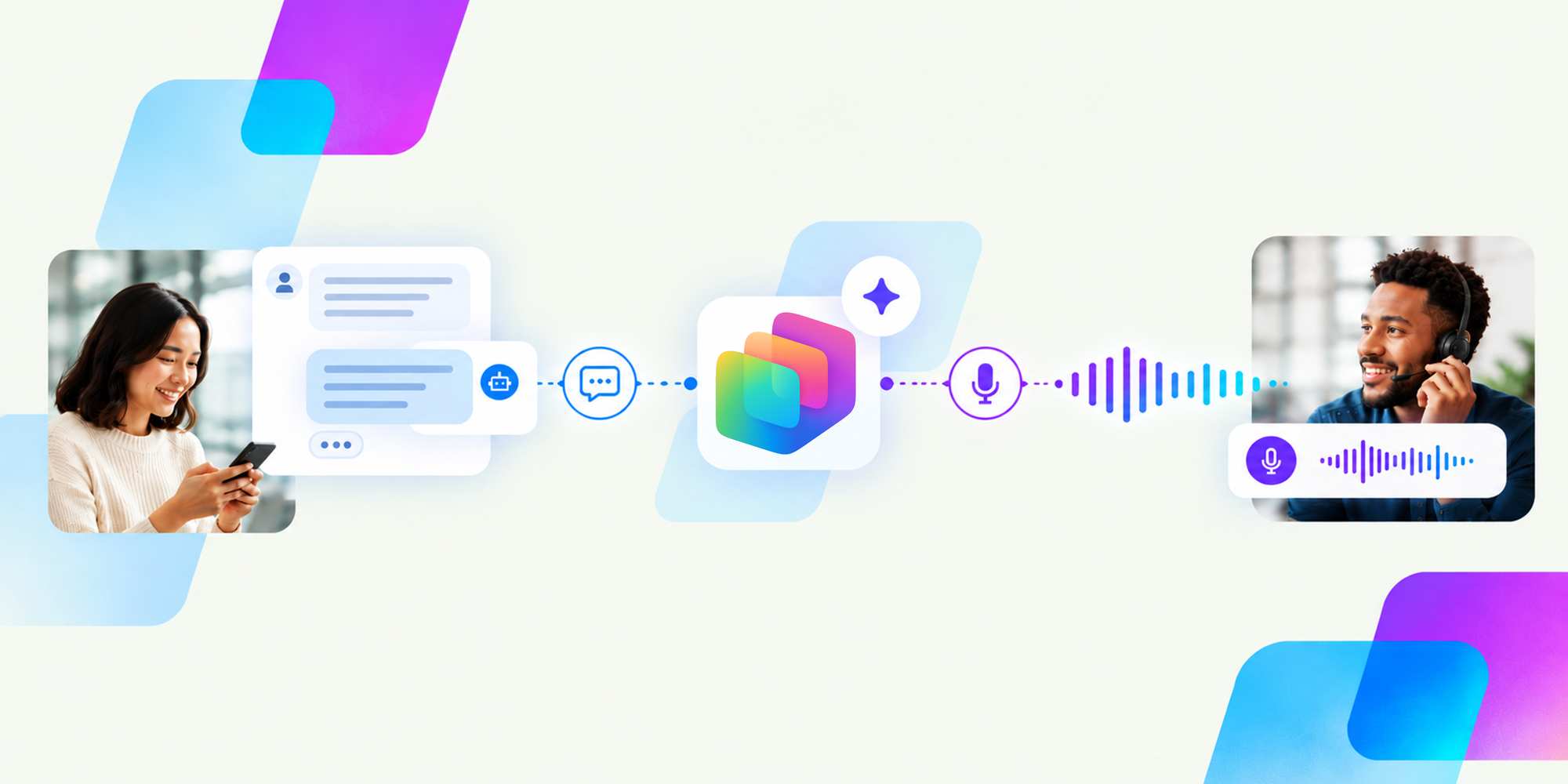
Today we’re announcing the public preview of our new customer conversation harness in Copilot Studio. This is a purpose-built harness and builder specifically designed to create powerful conversational agents for customer engagement. It supports the full arc of a customer interaction in a modern world: connecting to customers across channels, understanding what they need, drawing on the right knowledge and tools, interacting with human representatives as needed, and providing a swift resolution – whether the customer is speaking or typing.
To enable this, the harness introduces a set of core new conversational capabilities. These range from teams of agents that work together, more seamless interactions between generative skills and deterministic topics, powerful omnichannel conversations across chat and voice, to better human-agent interactions. The harness also enables integration with third-party contact centers through our new Microsoft Contact Center Intelligence product that we also announced today.
Build intelligent conversational agents that work together
At the center of the new harness is the new conversational agent builder. Makers can now build state-of-the-art experiences for voice and chat within a single agent. Every agent is omnichannel out of the box and has the skills you’d expect any versatile customer-facing representative to have. They speak conversationally. They understand multiple languages. They are channel-aware. You can move between digital and voice channels without losing context, and the agents maintain memory across them.
Connect a team of specialized agents to business knowledge and tools
The customer conversation harness makes it easy to orchestrate multiple agents to work together as a team of specialists. Each sub-agent can have its own knowledge and its own tools to hand its own specialized tasks. At GA, each agent will also be able use its own model. This means makers can choose which model is best suited to the kinds of jobs and intents each specialist agent handles. Some tasks call for deep reasoning, while others benefit from models optimized for cost and latency. The harness is designed to orchestrate and combine these agents seamlessly into one customer engagement system.
What's more: Microsoft Foundry extensibility is built in. You can create a custom agent with code in Foundry and add it to the team of agents with just a few clicks. The harness handles the complexity and does the heavy lifting, allowing you to build on your existing assets or more easily leverage pro-code capabilities.
Finally, Microsoft IQ, which helps ground AI experiences in your organization's work context and business data, is also backed into the harness and available to each agent. With Work IQ, agents can draw on information from the Microsoft 365 apps your team uses every day. For example, an agent helping resolve a billing dispute could reference a refund policy stored in SharePoint and also reference an exception that was agreed to in a Teams thread. The agent accesses this information with its own identity, respecting existing enterprise data access and security policies.
Agents can also connect to Foundry IQ for large-scale knowledge sources, such as product manuals, warranty terms, and documents indexed in Azure AI Search; Fabric IQ for reasoning over business data; and more.
Combine generative skills with topics
Each agent in the team handles multiple jobs - whether it's recommending a credit card, looking up a balance, or taking a payment. And just like when giving a task to an employee, you can provide general instructions for some tasks, and provide specific turn-by-turn directions for others.
In the new harness, each agent skill can either be fully generative - you simply provide a prompt and let the model use its own judgment (e.g. “Go and gather the credit card information from the user”) - or fully deterministic, using a topic (commonly used, for example, in IVRs or voice trees where exact, step-by-step instructions are desired). This flexibility is key for large customer engagement systems and has been a recurring customer ask. In the past, an agent could do one or the other. Now, each agent in your team can seamlessly handle a mix of both, depending on the job to be done.
Deliver natural experiences across voice and chat
Because the harness is natively omnichannel, voice is a first-class experience for both makers and customers. You can choose among speech models and configure rich voice capabilities. These include voice fonts for more natural and customized interactions, speech instructions to guide the agent’s tone and speaking style, DTMF behavior, speech sensitivity settings, and more.
When you're ready to publish, you can even acquire phone numbers and deploy your agent to them, making the agent accessible to customers over the phone. And you can test and evaluate all of this right within the experience.
Make customer verification easier with voice biometrics
Authentication can be one of the most frustrating parts of a customer service call. Traditional verification methods, from security questions to one-time passcodes, can add time and friction before customers can even explain why they're calling. Verifying a customer's identity is essential, but it shouldn't get in the way of a great service experience.
The new harness, together with Contact Center Intelligence, supports enterprise grade state-of-the-art voice biometrics that help authenticate customers in real time. Rather than ask a rigid set of questions to validate identity, customers can continue to speak about why they’re calling in while the system validates the caller's identity with a unique voiceprint designed to meet the precision level required by the organization. This also means that if a call drops and the customer calls back, the conversation can seamlessly resume.
Connect customer conversations to the enterprise
Conversational agents and human representatives work best when they can collaborate to resolve customer needs, and the customer conversation harness in Copilot Studio provides built-in handoff capabilities for different kinds of escalation paths to live representatives.
Partner with your human agents in Teams
Out of the box, the new harness has better support for partnering with your internal employees in Teams. You can escalate incoming calls to a Teams queue, and very soon directly to Teams chats. Think of a scenario: Oh, that’s an invoice coding issue, it should go to…Sally in accounting. And you can send that call to Sally with just a few clicks, right from within the UX.
Or connect to your existing contact center
When a full-fledged contact center is needed, connecting to one is simple. The new harness is designed to integrate seamlessly with our new Microsoft Contact Center Intelligence product and is also accessible within it. You can connect to your existing contact center, modernize your existing IVR systems and chat bots, partner with your existing human agents, configure advanced biometrics, score your calls, get insights on how your human-AI partnerships are working, and more - while retaining your existing telephony, routing, and queues. All with a few simple clicks.
Govern agents with Microsoft Agent 365
Finally, like all Copilot Studio agents, these conversational agents are fully part of Microsoft’s Agent 365 governance story. Every agent built on the customer conversation harness will show up in Agent 365 upon creation. Admins should immediately see the details of the agent, including owner, channels, Entra agent ID, knowledge, tools, permissions, usage, etc. Centralized governance helps admins apply and update existing policies comprehensively across the enterprise. And, like the rest of Copilot Studio, the customer conversation harness uses Copilot Credits with usage-based billing, so it's easy to get started.
Get started with the customer conversation harness
With the new customer conversation harness in Copilot Studio, we're helping organizations build more natural, intelligent, and effective customer experiences - wherever they engage with customers. Many of these capabilities are available now in public preview, with more rolling out over the coming weeks.
Together with the launch of our new Contact Center Intelligence offering, this is the first step in a journey to transform how everyone on the planet interacts with a brand. Head over to Copilot Studio, click "more ways to build" to try out our new customer conversation harness, and start changing how you engage with your customers today.
For more information as you get started, explore the resources below:

 Microsoft
