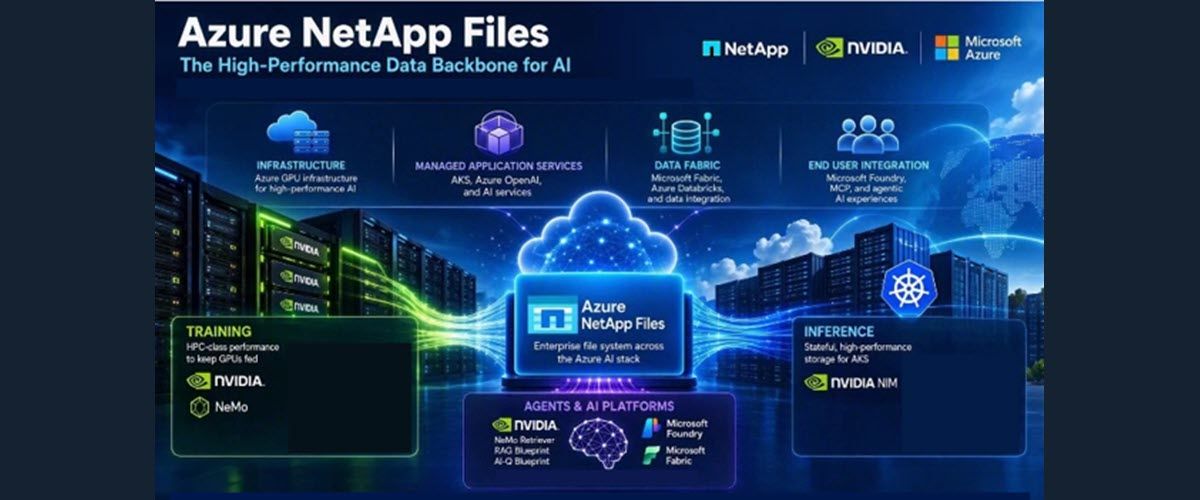
Azure NetApp Files provides a unified data foundation for enterprise AI, connecting data mobility, model training, inference, and agentic workflows. This article explores how caching, replication, high-throughput storage, low-latency checkpointing, and rapid dataset cloning help bring data closer to GPU compute and support efficient experimentation. It also examines persistent storage for containerized inference on Azure Kubernetes Service and integration with NVIDIA’s AI stack, Microsoft Foundry, and Microsoft Fabric. Two reference use cases illustrate its role in supporting domain-specific model training and modernizing AI inference while reducing infrastructure complexity.
Table of Contents
Data Mobility Before Compute and AI
Azure NetApp Files: Your Data Gateway to Advanced AI Services in Azure
Where Azure NetApp Files meets the stack
AI Domain-Specific Model Training with HPC Infrastructure
Short-Term Clones for Rapid Experimentation
Reference Use Case #1: Lightweight LLM Training on Azure NetApp Files
Azure NetApp Files for Containers and AKS: High-Performance Storage for AI Inference and Agentic AI
Azure NetApp Files with NVIDIA’s agentic AI stack
Azure NetApp Files with Microsoft’s AI platform
Reference Use Case #2: AI Inference Modernization and Consolidation
What Azure NetApp Files delivers, together with NVIDIA and Microsoft
Introduction
Enterprises accelerating their AI initiatives increasingly face two bottlenecks: getting data close to compute and keeping high-value GPU investments continuously fed during training and inference. Azure NetApp Files addresses both challenges by serving as an enterprise file system integrated across all four layers of the Azure AI stack: Infrastructure, Managed Application Services, Data Fabric, and End User Integration.
For domain-specific model training, Azure NetApp Files provides HPC-class, ultra-high throughput and ultra-low-latency checkpointing, ensuring that NVIDIA GPU clusters running on Azure never stall. For AI inference, Azure NetApp Files delivers stateful, high-performance persistent storage for Azure Kubernetes Service (AKS), giving containerized workloads, including NVIDIA NIM microservices, consistent performance and automated provisioning.
With the rise of Microsoft Foundry, Model Context Protocol (MCP), and agentic AI architectures, Azure NetApp Files plays an even more strategic role. Through RESTful API integration, Azure NetApp Files serves as the unified data layer that feeds Microsoft Fabric, Microsoft Foundry, and NVIDIA’s agentic AI stack (NVIDIA NeMo, Nemotron open models, and the AI-Q Blueprint), creating a seamless, scalable foundation for next-generation AI workloads.
Co-authors:
- Andy Chan, Azure NetApp Files, Principal Product Manager
- Ranga Sankar, Azure NetApp Files, Product Manager
- Vinay Maddi, GTM - Agentic AI | PAI, NVIDIA
- Charlie Huang, Sr. Product Marketing Manager, Accelerated Computing, NVIDIA
- Jitesh Mani, Sr. Product Manager Azure Storage, Microsoft
Data Mobility Before Compute and AI
AI initiatives often stall before training begins because the data and compute resources are not in the same location. GPU capacity is constrained and frequently available in regions different from where enterprise data resides. Azure NetApp Files provides multiple mechanisms to close that gap:
- Azure NetApp Files cache volumes for low-latency access to large datasets
- Migration assistant for seamless data transfer with preserved permissions
- Cross-region replication for global AI deployments
- High-performance access in Azure to on-premises and multi-cloud data powered by Azure NetApp Files cache volumes.
These capabilities help organizations to:
- Improve data hygiene and consistency
- Move data efficiently without compromising security
- Position data as close as possible to NVIDIA GPU clusters and AI services
- Accelerate distributed AI workflows with fast access to datasets across regions and environments
- Simplify dataset management by updating data once at the source while remote locations access cached content
By reducing data movement overhead, Azure NetApp Files ensures that AI pipelines start fast and stay fast. Organizations can centrally manage training and inference datasets while giving geographically distributed AI teams, GPU clusters, and AI services high-performance local access, without sacrificing consistency or operational efficiency.
Azure NetApp Files: Your Data Gateway to Advanced AI Services in Azure
AI success begins and ends with data. Azure NetApp Files provides a unified, enterprise-grade file system that supports the full lifecycle of AI workloads:
- Data mobility before compute/AI
- Data performance during compute/AI
- Data integration with NVIDIA’s AI software stack, Microsoft Fabric, Microsoft Foundry, and containerized AI services
Azure NetApp Files’ “one-stop-shop” model, combined with a comprehensive portfolio of services and dedicated cloud solution architects, ensures customers can onboard quickly, scale confidently, and operate efficiently across Azure’s AI platform.
Where Azure NetApp Files meets the stack
|
Stage |
Azure NetApp Files |
NVIDIA |
Azure |
|
Data mobility |
Caching, migration assistant, cross-region/zone replication |
GPU capacity, wherever it is available |
Azure regions with GPU capacity |
|
Training |
Ultra-low latency checkpointing, high throughput NFS, QoS, short-term clones |
Blackwell-generation GPUs; NeMo for data curation, fine-tuning, evaluation |
ND GB200 v6 and ND GB300 v6 VMs |
|
Inference |
Trident CSI persistent volumes, NFS and SMB, QoS-controlled throughput |
NIM microservices, Nemotron models |
AKS |
|
Agents |
Object REST API – Integration with AI services with no copy and in-place data access. |
NeMo Retriever, RAG Blueprint, AI-Q Blueprint, NeMo Agent Toolkit |
Microsoft Foundry, Microsoft Fabric |
AI Domain-Specific Model Training with HPC Infrastructure
“Azure NetApp Files scales dynamically to keep those high-value GPUs busy.”
AI training is fundamentally a throughput problem. High value GPU clusters must be continuously fed with data. Any storage-related stall directly impacts cost and time to result.
Azure NetApp Files solves this with:
- Ultra-low-latency checkpointing
- High-throughput NFS performance at scale
- Dynamic QoS controls to match GPU demand
For training domain-specific LLMs and proprietary models, Azure NetApp Files provides HPC-class performance. Azure NetApp Files provides scalable storage performance designed to support fine-tuning and experimentation with large AI models.
Built to keep NVIDIA GPUs fed
Azure delivers NVIDIA Blackwell-generation systems, such as GB200 and GB300 NVL72, through ND GB200 v6 and ND GB300 v6 VMs, with NVLink and NVIDIA Quantum InfiniBand networking for large-scale training. NVIDIA NeMo adds the software to curate data, fine-tune Nemotron and other open models, and evaluate results. All of it consumes data at very high rates. Azure NetApp Files is the data layer that sustains those rates, so checkpoint writes and dataset reads never leave this GPU capacity idle.
Short-Term Clones for Rapid Experimentation
Azure NetApp Files short-term clones allow teams to instantly create writable dataset copies that are space-efficient, with no full copies. This is ideal for:
- Training multiple model variants
- Running parallel experiments
- Creating isolated test environments
Clones ensure GPU clusters always have the data they need, without waiting for slow, full dataset copies.
Impact for Training Workloads
- SaaS-like deployment with high throughput and predictable performance
- HPC storage management abstracted away, so teams focus on models rather than file system tuning
- Optimized cost efficiency by keeping NVIDIA GPU clusters fully utilized
Reference Use Case #1: Lightweight LLM Training on Azure NetApp Files
A global technology provider recently trained a lightweight local-language LLM with fewer than 20 billion parameters on Azure using Azure NetApp Files. The organization needed:
- Low-latency storage for aggressive checkpointing
- Regional availability aligned with GPU capacity
- Scalable performance to keep pace with ever-increasing model parameters
- Predictable throughput for both training and inference pipelines
Highlights
- Low-latency, predictable throughput designed to keep GPUs productive
- Scalable storage to support growing model sizes
- Foundation for future domain-specific AI models
Business Challenge
The team faced GPU availability constraints and required a storage solution capable of sustaining high-performance checkpoint writes. Their objective was to optimize cost, performance, and scalability while ensuring seamless integration with existing AI workflows.
Solution
The organization deployed its lightweight LLM in an Azure region with available GPU capacity and selected Azure NetApp Files Ultra service level to support the training pipeline. The ultra service level provided low-latency checkpointing, high throughput for large single-file writes, and scalable capacity as model parameters increase.
During training, frameworks like TensorFlow and PyTorch often generate large, monolithic checkpoint writes, which can overwhelm software-defined storage. In this deployment, Azure NetApp Files demonstrated superior write latency, ensuring GPUs remained fully utilized.
Business Outcomes
- Faster training cycles
- Improved GPU utilization
- Eliminated storage bottlenecks
- A scalable foundation for future domain-specific LLM projects
Azure NetApp Files for Containers and AKS: High-Performance Storage for AI Inference and Agentic AI
As enterprises shift toward containerized, cloud-native architectures with Azure Kubernetes Service (AKS), Azure NetApp Files ensures consistent throughput, low latency, and dynamic provisioning for real-time AI applications. AI inference workloads increasingly run on containerized platforms such as AKS and OpenShift, and these environments demand storage that is stateful, high performance, dynamically provisioned, and easy to automate.
Azure NetApp Files meets these requirements with:
- Trident CSI driver for automated persistent volume creation
- NFS and SMB support for both Linux and Windows containers
- QoS-controlled throughput to ensure inference pipelines remain responsive
Azure NetApp Files with NVIDIA’s agentic AI stack
NVIDIA NIM microservices package optimized inference engines as containers that run on NVIDIA GPUs in Azure and on AKS. NVIDIA NeMo, the Nemotron open models, and Blueprints such as the RAG Blueprint and AI-Q give teams a production path from model to agent. Every one of these components needs fast, shared, governed access to enterprise data, and this is where Azure NetApp Files fits:
- Persistent storage for NIM and agent services. Trident-provisioned Azure NetApp Files volumes give containerized inference and agent workloads durable, shared storage that scales with them.
- Fast retrieval for RAG. Low-latency shared storage can back the document corpora and indexes that NeMo Retriever and the NVIDIA RAG Blueprint depend on, so agents answer from your authoritative data.
- A data flywheel. Usage data captured for NVIDIA’s Data Flywheel Blueprint, used to keep improving agent accuracy, latency, and cost, needs a durable, high-performance home. Azure NetApp Files provides it.
- Hybrid reach. For data that lives on premises, NetApp’s AI Data Engine and AFX systems integrate with the NVIDIA AI Data Platform reference design, so the same data-to-agent pattern works wherever data resides.
Azure NetApp Files with Microsoft’s AI platform
The Azure NetApp Files object REST API lets Azure services such as Microsoft Fabric, Foundry, Azure OpenAI, Azure Databricks, and Azure AI Search reach NFS and SMB datasets directly, without copying them into a separate object store. This unified approach simplifies deployment, accelerates inference performance, and provides the reliability needed to scale intelligent services across Azure and edge environments.
Reference Use Case #2: AI Inference Modernization and Consolidation
A global consumer solutions provider recently modernized its AI inference platform by migrating to Azure. The organization selected Azure NetApp Files and AKS to build a unified, high-performance architecture capable of supporting next-generation personalization services.
Highlights
- AI inference modernization using Azure NetApp Files as the high-performance NFS backbone
- Performance uplift and complexity reduction compared to other solutions, especially for random and small-write data patterns
- Unified data fabric via object/file duality, ingesting data from Azure and edge sources
- AKS-based AI inference services delivering faster, more reliable recommendations at global scale
Business Challenge
The organization’s existing recommendation platform spanned multiple clouds and on-premises data centers with fragmented data sources, creating performance constraints, operational inefficiencies, and rising infrastructure costs. To scale personalization globally, they needed a unified data foundation, high-performance shared storage for inference, and a cloud-native architecture based on Microsoft Fabric capable of supporting advanced AI workloads.
Solution
Azure NetApp Files provides the ultra-low-latency shared file storage, scalability, and Kubernetes integration required for production AI inference. Other services were integrated as a single fabric to improve operational effectiveness and reduce complexity:
- Azure Data Lake and ADLS Gen2
- Azure Databricks integration
- Microsoft Fabric for unified governance
- Microsoft Foundry, enabling MCP pipelines and agentic AI workflows
Business Outcomes
- Reduced infrastructure complexity
- Improved inference performance
- A unified, API-driven data fabric with seamless ingestion of multicloud and edge data
- Enabled MCP and agentic AI workflows
- A foundation for next-generation AI capabilities, including NVIDIA-accelerated agentic services
What Azure NetApp Files delivers, together with NVIDIA and Microsoft
- For infrastructure leaders: fewer moving parts. One managed, enterprise-grade data layer that plugs into NVIDIA’s GPU and software stack and Azure’s AI platform, so less integration work and fewer places for performance to leak.
- For executives: faster time to value and better return on GPU investment. Higher utilization during training, scalable serving in production, and agents grounded in trusted enterprise data.
- For AI teams: a continuous path from data to trained model to deployed agent, with the flexibility to iterate quickly.
Conclusion
Azure NetApp Files is uniquely positioned to support the full lifecycle of enterprise AI: from data mobility, to HPC-class training on NVIDIA GPU infrastructure, to containerized inference with NVIDIA NIM on AKS, to modern agentic AI architectures built on NVIDIA’s agentic AI stack, Microsoft Foundry, and Microsoft Fabric. Its combination of high performance, low latency, dynamic scaling, and deep integration with the NVIDIA and Azure AI ecosystems makes it a versatile file system for organizations building domain-specific AI solutions.
Whether training proprietary models or deploying inference pipelines and agents across AKS, Azure NetApp Files ensures that data is always close, always fast, and always ready for the next stage of your AI journey.
Ready to get started
Explore how Azure NetApp Files can simplify data access across training, inference, and agentic AI workflows while delivering the performance and scalability required for enterprise-grade AI. Work with your Microsoft and NetApp teams to evaluate your data architecture, identify high-value AI use cases, and develop a deployment strategy that leverages Azure NetApp Files with NVIDIA AI, Microsoft Foundry, Microsoft Fabric, and AKS. Contact us at askanf@microsoft.com to get started.
Learn more
- What is Azure NetApp Files
- Retrieval‑Augmented Generation (RAG) with Azure AI Search
- Integrated vectorization with Azure OpenAI embeddings
- Understand Azure NetApp Files object REST API
- Configure object REST API in Azure NetApp Files
- Microsoft Discovery: The path to an agentic EDA environment
- From Enterprise File Storage to an AI-Ready Data Foundation using Azure NetApp Files and OneLake
- Bringing Enterprise File Data to Users with Azure NetApp Files, Microsoft Foundry, and M365 Copilot
- From File Data to AI‑Powered Knowledge Pipelines using Azure NetApp Files object REST API
- Unlocking Advanced Data Analytics & AI with Azure NetApp Files object REST API

 Microsoft