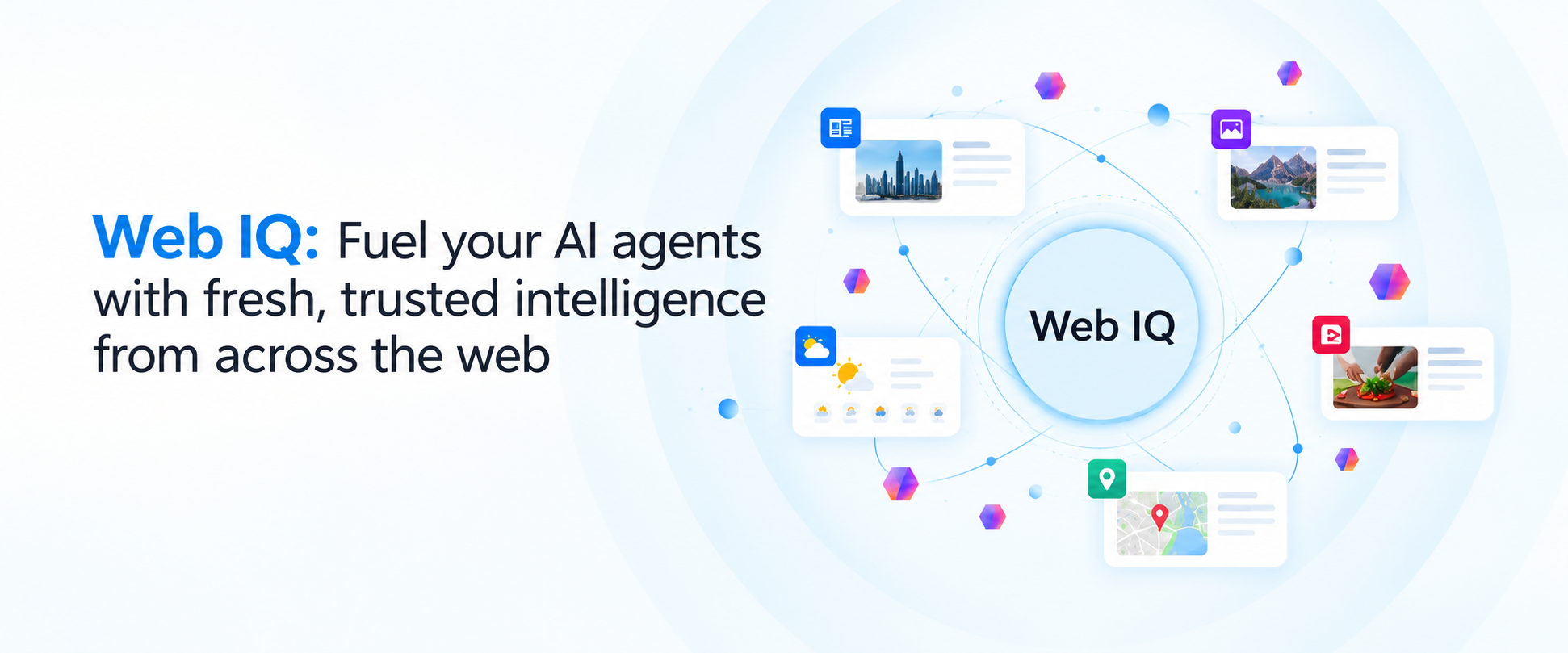
Take a closer look at how Web IQ connects AI agents to current web information through grounding, delivering faster, higher-quality agent answers with fewer tokens.
AI applications are only as good as the information they reason from. A model can plan, summarize, and write code at a high level, but its built-in knowledge is bound by its training data. When an AI application needs to know what happened today, understand a recently updated regulation, or find a highly specific piece of information, the model needs access to knowledge beyond its own weights. The bottleneck isn't reasoning. It's evidence.
For a support agent, that might mean finding a newly published vendor advisory. For a research assistant, it could mean locating a specific disclosure in a public filing. In both cases, the model needs information that didn't exist when it was trained.
That is where grounding comes in. Microsoft Web IQ helps close the gap between what models know and what is happening now by giving AI applications and agents access to fresh, relevant information from across the web.
We introduced Web IQ at Microsoft Build in June 2026. Here, we'll look at what Web IQ is, how it retrieves and structures web intelligence, and why its architecture is designed for the demands of modern AI agents.
What is Microsoft Web IQ?
Web IQ is a suite of AI-native web-search and grounding APIs that gives LLMs, AI agents and applications access to current, relevant web information. It provides access to fresh, real-world intelligence from across the public web, including webpages, news, images, and video, helping AI systems reason beyond the limits of their training data. It’s also the same technology that powers grounding experiences across leading frontier AI assistants, including Microsoft Copilot and ChatGPT.
If you're building retrieval-augmented generation (RAG) applications or AI agents, think of Web IQ as a web retrieval layer that complements enterprise search, vector databases, Azure AI Search, and other organizational knowledge sources with fresh evidence from the public web.
A few practical characteristics define it:
It is AI-native. Its output is built for a model to read, not for a person to scan on a results page, so agents get compact, citable context and spend fewer tokens.
It exposes two calling surfaces: A REST API and a Model Context Protocol (MCP) endpoint, so MCP-aware agent frameworks can treat grounding as a first-class tool inside the reasoning loop without custom integration work.
It is fully hosted and Azure-billed. Web IQ is an Azure resource that’s consumption-based, MACC-deductible, and eligible for Azure consumption discounts.
How Web IQ delivers grounded web intelligence
Under the hood, Web IQ is one system tuned end to end for for things that matter at web scale: quality, speed, token efficiency, freshness and more. If you've built a grounded agent before, you've probably stitched together multiple APIs, MCP servers, and data sources to answer different questions, and paid for it in complexity, latency, and operational cost. Web IQ replaces that patchwork with one foundation for grounding.
At a high level, Web IQ combines four core layers: the Bing web substrate, Harrier embeddings, the DiskANN semantic index, and structured evidence. Together, these layers take a user or agent question through query understanding, planning, retrieval, and evidence assembly and hand the model compact, token-efficient context it can use to answer with citations and provenance. The sections below walk through each layer in turn, starting with the Bing web substrate.
Access fresh, comprehensive web intelligence with Bing's web-scale foundation
Every good answer starts with good coverage. Web IQ sits on Bing’s web substrate, built on more than two decades of Microsoft investment in web search, crawling, indexing, ranking, and understanding the open web. It continuously discovers, crawls, indexes, and refreshes content spanning webpages, news, images, and video. So instead of relying on a standalone corpus assembled specifically for AI retrieval, your agent draws on a mature, web-scale foundation.
That matters, because no retrieval system can be better than what it has to retrieve from. If a vendor publishes a security advisory this morning, your support agent can only find it if it has already been discovered and indexed. Bing provides the underlying coverage, freshness, infrastructure, and publisher ecosystem; Web IQ builds on that foundation with retrieval capabilities designed specifically for AI agents and applications.
Build with confidence using responsibly sourced web intelligence
As enterprises move AI systems into production, responsible sourcing of information becomes increasingly important. Web IQ is designed to honor supported publisher controls, including applicable robots.txt directives and other publisher signals recognized by Microsoft, and does not reach into private back-end systems or internal customer data. The result: your agents can cite current, attributable sources, and you can be confident publisher controls and content preferences were respected along the way. Web IQ also indexes content covered by publisher agreements, such as pay-walled or copyrighted information from publishers that have licensing relationships with Microsoft.
Web IQ’s index depth is deliberate rather than exhaustive. Web IQ does not treat all web content equally. It prioritizes important and frequently accessed documents, while indexing more deeply in content classes where completeness has greater value, such as regulatory filings or company financial disclosures, where agents may need to retrieve specific details rather than general summaries.
Improve answer quality with Harrier semantic retrieval
Above the substrate, Web IQ uses Microsoft’s Harrier family of multilingual embedding models to retrieve information based on meaning, not just matching words. Harrier helps preserve signals such as paraphrases, multilingual equivalence, entity specificity, and fine-grained topical relevance, helping agents surface the right evidence even when sources use different terminology from the query. Web IQ applies it at web scale as part of a semantic-first retrieval system tuned to deliver relevant, efficient context to your agents.
In practice, you get better retrieval quality across different phrasings and languages, spend less time engineering exhaustive keyword and synonym logic, and send more relevant context to the model. Better first-stage retrieval can also reduce unnecessary searches, retries, and oversized context windows—helping improve grounded answer quality while making agent workflows more efficient.
Retrieve relevant web intelligence faster with DiskANN
Semantic search only helps if it's fast enough to keep up with your agent. Web IQ uses DiskANN, Microsoft’s distributed approximate-nearest-neighbor indexing technology, to search the Harrier embedding space quickly and at web scale. It keeps recall high across a very large index without giving up the latency interactive AI applications need.
That's what turns semantic retrieval from an embedding capability into production-scale infrastructure. At sub-200 ms latency, agents can search across the web semantically without sacrificing the response times required for multi-step workflows.
Deliver better answers with fewer tokens using structured evidence
The last layer is where Web IQ really parts ways with a standard search API. Rather than returning pages and snippets, Web IQ’s retrieval targets evidence: passages, table sections, and document structures, packaged as units carrying provenance, metadata, and local context.
This is also where the token savings come from. Passage-level ranking maximizes information density per token, so the model receives the specific paragraph that answers the question instead of the full document surrounding it. For the support agent, that means the paragraph listing affected versions and the fix, not the whole advisory page. You spend fewer prompt tokens and less of the context window, while keeping the evidence needed for a grounded response.
When search isn't enough
Sometimes your agent already knows exactly where to look, like a link in a support ticket or a URL a user pasted into chat. For that, Web IQ offers a browse endpoint: pass it a URL and get back just the page content, with navigation, headers, footers, and other page clutter stripped out. If the page is already indexed, the response comes back in tens of milliseconds. If it isn't, Web IQ can retrieve it live, process it, and return cleaned content. One caveat: you're still responsible for applying your own content cleaning and prompt-injection protections on top.
Control what your agents can access
Not every agent should read the entire internet. Web Scopes let you define inclusion and exclusion lists for the sources an application can retrieve from, with exclusions taking precedence when a domain appears in both.
Where current web evidence pays off
Web IQ is well suited to applications where a stale or unsourced answer is costly. Common patterns include:
- Research. Ground analysis in current, sourced evidence and spend less time validating it.
- Competitive intelligence. Spot market shifts, launches, and announcements as they happen.
- Regulatory and compliance. Act on changes to laws and guidance before outdated rules become risk.
- Sales preparation. Walk into customer conversations with the latest account and market context.
- Enterprise copilots and agents. Answer with both your organization's knowledge and what's happening outside it.
- Customer-facing AI experiences. Give customers accurate, current answers that build trust and reduce escalations.
Combining web and organizational context with Microsoft IQ
Web IQ gets even more useful as part of Microsoft IQ. It grounds agents in current, attributable intelligence from the web, while Microsoft IQ provides the enterprise context needed to understand your organization: how people work, how the business is modeled, and the knowledge distributed across your data and apps. Together, they give AI agents and applications a shared understanding of both your business and the world around it, so they can reason with the right internal and external context from the start. For a quick look at each Microsoft IQ component, see the FAQ below.
Getting started with Web IQ
To get started, deploy Web IQ through Azure or create API keys on the Web IQ Customer Site. For production applications, use Microsoft Entra ID and link your application’s client ID to your Web IQ Application Profile.
Resources
---
Frequently asked questions
What is grounding, and why do AI agents need it?
Grounding connects an AI system to relevant external information at request time, so the model can answer with current evidence instead of relying only on its training data. Web IQ provides that evidence from across the public web. For a deeper look, see our companion article, Why AI Agents Need External Grounding.
How is Web IQ different from Grounding with Bing?
Grounding with Bing returns short snippets to augment answers and is designed for integrated web augmentation experiences within Azure Foundry. Web IQ is a direct, agent-first API over REST and MCP that returns ranked passages, full documents, and metadata at under 200 ms P95 latency, so agents decide what to retrieve, what to read in full, and how to use it at each step of a workflow.
Grounding with Bing currently remains available for existing customers, so teams can keep using it while they evaluate Web IQ for workloads that need deeper, faster, more controllable grounding.
How does Web IQ fit into Microsoft IQ?
Microsoft IQ brings together the forms of intelligence agents need to operate effectively across the enterprise:
- Fabric IQ connects enterprise data to the entities, relationships, rules, and governed actions that define how an organization operates.
- Work IQ provides context about how work gets done across Microsoft 365, including people, conversations, documents, and organizational activity.
- Foundry IQ provides the infrastructure and orchestration layer for building and scaling agentic systems.
- Web IQ grounds agents in fresh, relevant, and attributable information from the public web.
How is Web IQ billed?
Web IQ is a fully hosted Azure resource. It's consumption-based, deductible against your Microsoft Azure Consumption Commitment (MACC), and eligible for Azure consumption discounts.

 Microsoft