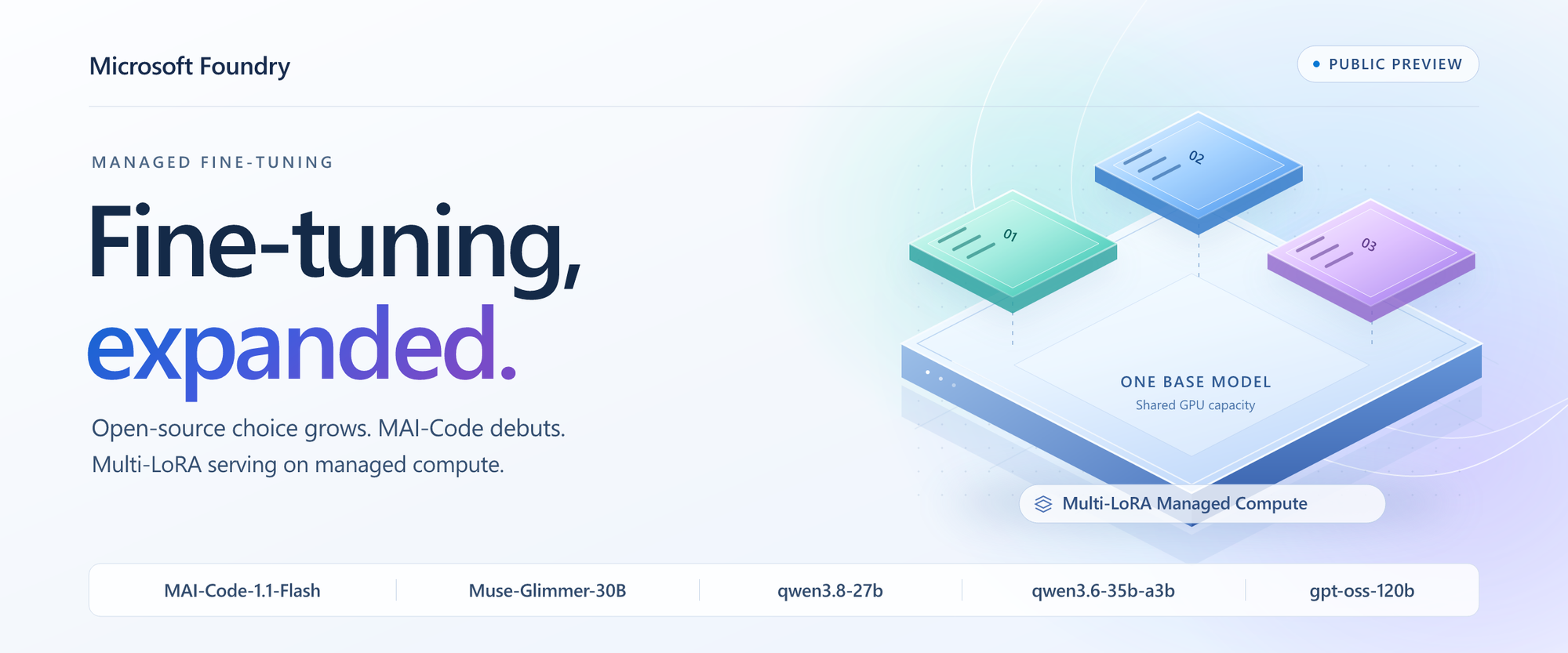
Today, Microsoft Foundry Managed Fine-Tuning expands its collection with four new open-source models and brings MAI-Code-1.1-Flash to Foundry resources, all in public preview. Alongside them, Multi-LoRA Managed Compute deployments enter public preview, letting compatible adapters share base-model weights and GPU capacity instead of each needing a separate serving allocation.
More open-source choice for your next custom model
Muse-Glimmer-30B, qwen3.8-27b, qwen3.6-35b-a3b and gpt-oss-120b join Foundry's managed open-source model collection, with supervised fine-tuning (SFT) support across all four. You can now bring your example-driven customization workflow to more backbones, choosing for tool-use reliability, coding efficiency, extended planning or reasoning capacity. Here's what each option brings:
|
Model |
Why put it on your shortlist? |
|
Muse-Glimmer-30B |
Resilient tool orchestration: precise tool calls, interpreting unexpected results and recovering when a workflow goes off-script. |
|
qwen3.8-27b |
Extended research and planning: a dense backbone for sustained autonomous work that adapts to feedback from its environment. |
|
qwen3.6-35b-a3b |
Repository and frontend coding: a sparse mixture-of-experts backbone for navigating codebases and making coordinated changes. |
|
gpt-oss-120b |
Reasoning headroom: a higher-capacity alternative to the existing gpt-oss-20b option for difficult analytical and problem-solving tasks. |
Use SFT to tailor these models to your application's needs:
- Coding conventions: organization-specific library usage and preferred implementation patterns.
- Structured outputs: JSON schemas and extraction responses used by downstream applications.
- Domain workflows: product terminology, support tone, and classification or triage decisions.
- Distillation: use teacher-generated example responses to specialize a smaller model for your task.
All four also support reinforcement fine-tuning (RFT) if your workflow calls for more advanced, reward-based optimization.
MAI makes its fine-tuning debut in Foundry
In addition to the open-source models above, we're introducing MAI-Code-1.1-Flash, the first Microsoft model available for Managed Fine-Tuning on Foundry resources. With the base model already available in GitHub Copilot, this compact, coding-focused model brings particular strengths in software development tasks. Its emphasis on responsiveness and token efficiency makes it a compelling backbone for repeated edit-build-test loops, where inspecting code, proposing edits and responding to compiler or test feedback all contribute to the task's latency and token budget.
MAI-Code-1.1-Flash supports RFT only in this preview. Use it to target outcomes you can verify: a change that passes task-specific tests, correctly uses an internal software library, or satisfies your repository's acceptance checks. Build rewards around correctness and the required scope of the change, rather than whether an answer reproduces a reference patch. That leaves room for different valid solutions while keeping the customization anchored to your engineering requirements.
Share hardware across adapters to reduce serving costs
Previously, Foundry's managed fine-tuning outputs went to serverless pay-as-you-go deployments: input/output token charges plus hosting fees for each fine-tuned deployment. More traffic increased usage charges; more deployed variants added hosting costs. With Multi-LoRA adapter deployment on Managed Compute, compatible adapters share LoRA-enabled base-model deployment and GPU capacity. You pay an hourly rate for that hardware, rather than per-token inference charges, so multiple customizations can use one serving allocation instead of funding separate GPU footprints.
Three task-specific qwen3.8-27b adapters, for example, can share a LoRA-enabled base deployment while remaining separately addressable. When their combined traffic fits, adding an adapter doesn't mean another hardware bill. You avoid duplicating base-model serving capacity and can improve utilization by pooling requests across variants, instead of paying separate serverless hosting fees for each one.
The tradeoff is utilization: running hardware is billed even when idle, so size for aggregate concurrency and context lengths. More traffic can require additional capacity, while serverless remains an option for intermittent workloads on eligible models. The managed compute deployment path supports Muse-Glimmer-30B, both new Qwen models and gpt-oss-120b. Adapters must match the same base model and version; the base deployment needs a compatible LoRA-enabled template. Accelerator quota is required.
Put the new models to work in your agents
The expanded model collection helps you pick a backbone suited to your tasks; Multi-LoRA lets compatible customizations share serving capacity. These choices come together in agent applications, where different roles can need different model behavior. A coding assistant and a code-review agent, for example, can use separate adapters on the same supported OSS base model while sharing the hardware that serves them.
Fine-tuning customizes model behavior, but the goal is to improve the agent application that uses it. Connect your tuned models to your agent applications in Foundry and evaluate them alongside the instructions, tools and workflows they'll use in production. That keeps customization focused on better application outcomes, not just better training results.
Put these new capabilities behind your agent's next iteration. Get started with Foundry Fine-Tuning today.

 Microsoft