The Shift Happening Inside the Microsoft Partner Ecosystem
There’s a quiet shift happening in the Microsoft partner ecosystem—and it’s not just about AI. It’s about how partners work together.
For years, many partners have tried to build “full-service” capabilities spanning sales, delivery, data, AI, and industry expertise, but as technology becomes more complex and customer expectations rise, that model is starting to break down. The partners who are winning today are doing something different. They focus on building the right partnerships and executing together, not trying to do everything.
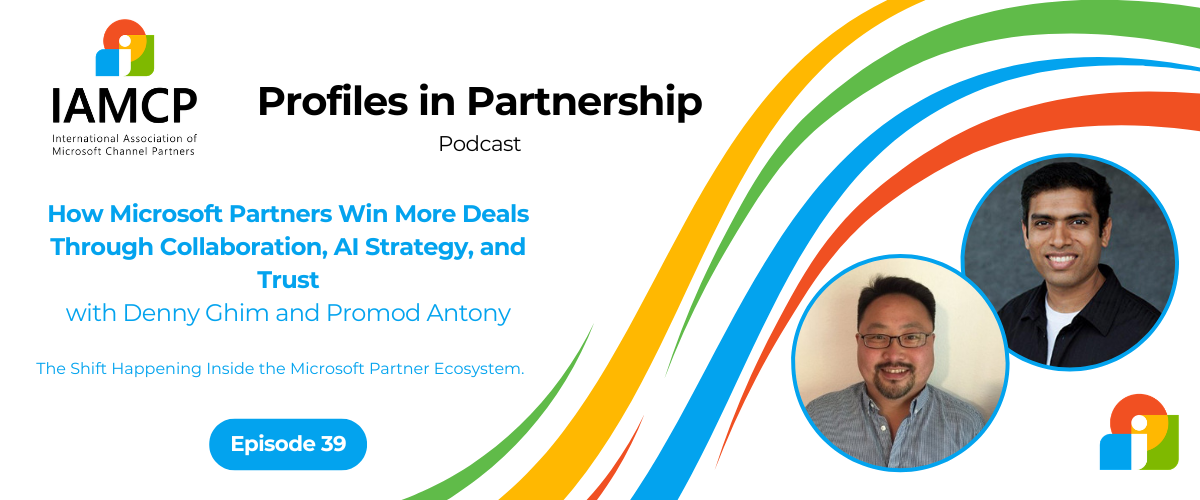
That shift came to life in a recent episode of IAMCP Profiles in Partnership , where Anthony Carrano and Rudy Rodriguez sat down with Denny Ghim of Sandler Partners and Promod Antony of Logic Intelligence. Their story isn’t theoretical; it’s a real example of how partner-to-partner collaboration turns conversations into revenue and relationships into long-term growth.
Listen to the full episode: How Microsoft Partners Win with P2P Collaboration, AI, and Data Strategy .
A Simple Dynamic That Changes Everything
At first glance, their partnership looks straightforward.
Denny operates at the front of the market. He builds relationships, uncovers opportunities, and deeply understands customer needs. Promod leads with technical depth, data, AI, and business applications, turning those opportunities into real, working solutions, but what makes this dynamic powerful isn’t just the division of labor. It’s the alignment. There’s no competition between them. No overlap to navigate. No confusion about ownership. Instead, there’s clarity:
One partner finds the problem. The other partner solves it.
In a market where many partners struggle to balance sales and delivery, this kind of alignment becomes a force multiplier. It allows each side to operate at a higher level while presenting a unified front to the customer. And that unity is often what closes the deal.
Where Most Partnerships Fail and Why This One Didn’t
What’s striking about their story is how it started. Not with a formal agreement. Not through a strategic initiative, but in a breakout room during an IAMCP session. Like most networking interactions, it could have ended there. A quick introduction, a few exchanged ideas, and then nothing.
But it didn’t.
They followed up immediately. Continued the conversation outside the meeting. Took a rough idea and treated it like a real opportunity. Within a short period of time, they had moved from discussion to execution.
That’s the difference.
Partnerships don’t fail because of a lack of opportunity.
They fail because of a lack of follow-through. In this case, momentum turned a casual interaction into a real project—and eventually into multiple opportunities in the pipeline.
From Data Chaos to Real Business Impact
The partnership quickly found its first proving ground: a nonprofit organization struggling with data. Like many organizations, they weren’t lacking tools; they were lacking clarity. Data was being collected manually. Systems were disconnected. Reporting took time. Decisions were delayed. The organization wasn’t just inefficient—it was operating without visibility.
This is where the partnership model became tangible.
Instead of leading with technology, they led with the problem. From there, the solution took shape:
A move to Azure.
A unified data environment.
Automated processes.
Real-time reporting.
The outcome wasn’t just better infrastructure. It was better decision-making. Leaders could see what was happening in real time. They could respond faster and allocate resources more effectively. And for a nonprofit navigating funding pressures and operational complexity, that shift had real consequences.
Microsoft partners: Customers rarely care about the platform. They care about what it enables.
The AI Conversation Everyone Is Getting Wrong
It’s impossible to have a conversation in today’s Microsoft ecosystem without talking about AI. But what stood out in this discussion was not the excitement around AI—it was the caution.
There’s a growing tendency among organizations to treat AI like a switch. Something you can turn on by purchasing the right tool.
But that’s not how it works.
Underneath every successful AI initiative is something far less glamorous: data discipline.
Clean data. Unified data. Governed data. Without it, AI doesn’t accelerate outcomes—it amplifies confusion. What Denny and Promod are seeing in the market reflects this disconnect. Companies are stacking tools, increasing spend, and expecting transformation, only to realize they’ve built complexity instead of capability.
The opportunity for Microsoft partners is significant.
Not by selling more AI but by guiding customers through the steps that make AI meaningful. Helping them slow down just enough to build the right foundation before scaling forward. Because in the end, AI is not the starting point. It’s the multiplier.
Why Human Relationships Are Becoming More Valuable, Not Less
As automation increases, there’s a natural assumption that human interaction becomes less important.
The opposite is happening.
One of the most compelling ideas from the conversation is the balance between what Denny calls AI and “real intelligence” (RI), the human side of business. The ability to read a situation, understand nuance, build trust, and navigate complexity. AI can generate insights. It can automate tasks. It can even simulate conversation. But it cannot replace trust. And trust is what drives enterprise decisions, long-term partnerships, and repeat business. This is especially true in the Microsoft partner ecosystem, where deals often involve multiple stakeholders, layered solutions, and ongoing engagement. The partners who will stand out are not the ones who adopt AI the fastest. They're the ones combining AI efficiency with human connection.
The Invisible Advantage: Trust Between Partners
One of the reasons this partnership works so well is something customers don’t always see, but they feel immediately.
Trust.
There’s transparency in how they work. Clarity in roles. Alignment in expectations. Even though how revenue is shared is defined upfront. That eliminates friction. And when there’s no friction internally, the external experience improves dramatically. Conversations are smoother. Proposals are clearer. Delivery is more consistent.
Customers pick up on that.
They may not articulate it directly, but they recognize when two partners are truly operating as one team, and that confidence often becomes the deciding factor.
Growth Comes from Partnership—Not Expansion
There’s a tendency among growing firms to expand capabilities internally: hire more people, add more services, cover more ground; but this story suggests a different path.
Instead of expanding outward, they built depth through partnership. Rather than trying to become everything to everyone, they focused on becoming exceptional at what they do and then connected with others who complement that strength.
The result isn’t just efficiency….
- It’s leverage.
- More opportunities.
- Better solutions.
- Stronger positioning.
- And ultimately, more growth.
A Different Way to Think About the Future
Looking ahead, the trajectory is clear. AI will continue to evolve. Automation will increase. New tools will emerge. The Microsoft ecosystem will become even more dynamic, but the underlying principle won’t change. The partners who succeed will not be the ones with the most capabilities. They will be the ones with the strongest relationships, with customers, with partners, and within the ecosystem itself, because in a world where technology is increasingly accessible…the real differentiator is how well you work with others.
Final Thought
If there’s one core takeaway from this conversation, it’s this: Growth in the Microsoft ecosystem is driven by focus and partnerships. Doing the right things, with the right partners, at the right time turns conversations into action and action into results.
To learn more about IAMCP and the benefits of membership, visit the website at www.IAMCP.org.
