windows 11
12 Topics
Winre.WIM file went missing - WHY?
I regularly do "create a restore point" and noted that the WinRETools row is "Missing". It says "WinRETools (Missing)". As I do NOT play around with any system files on my PC, how has this item become corrupted. And no, I do not have the Winre.wim file in the System Recovery directory.43Views0likes3CommentsISO file download time - crdownload status
I have selected the buttons to download a new ISO file for my Windows 11 computer. I can see that a .crdownload file has been started BUT it's just a few MB. The web says the ISO file is usually a few GB. How do I know that the download is still in progress v/s being stalled/failing/whatever?25Views0likes0CommentsWin11 Heavy sound stutter, don't know what else to do
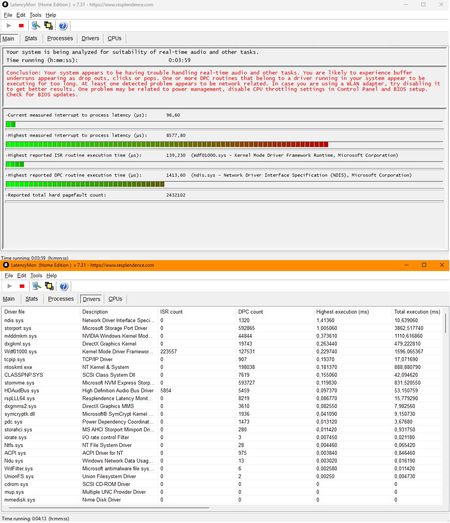
I've been having this issue for about a week now without any success in solving it. I updated BIOS, CPU firmware, GPU driver (nvidia 595.79) and realtek audio driver with a file from their website, I also updated my WiFi adapter. Windows is up-to-date with no optional updates. I usually have several monitoring/device programms running like MSIAB/RTSS, razer synapse etc while listening to music through spotify and sometimes with discord open which has never been a problem in the last few years. https://teufel.de/concept-e-450-digital-51-set-104762000?srsltid=AfmBOorsYlrK9AyTv9PYuchRwzbmmRaxhVEHvE4QhKD_F6XhrzTIbSHU is my 5.1 surround sound system, discontinued but still working perfectly fine (you might have to translate the website). My power plan is set to ultimate performance, nvidia global setting is set to prefer maximum performance, cpu min/max set to 100%, no throttling in BIOS and I even created a power throttling key in RegEdit to disable it. I will add screenshots from LatencyMon and other stuff that might be useful. LatMon while under full LOAD with Prime95 LatMon while IDLE My network connections, I disabled my WiFi adapter days ago, NordLynx, OpenVPN is from NordVPN My device manager with my audio/sound and network devices, SteelSeries is from my rarely used headset My sound settings from my digital output, someone on reddit mentioned setting it to 96000 Hz stopped it for him, unfortunately not for me.505Views0likes1Comment
0.011W Power Floor on i7-1255U: A Step Toward Microsoft’s Sustainability Vision
It is inspiring to see Microsoft leading the tech industry toward a greener future. Initiatives such as the Carbon Negative 2030 goal and the Energy Saver features in Windows 11 are important steps in environmental stewardship. These efforts show that software and hardware can work in harmony to preserve our planet. As a researcher, I have spent 18 months exploring how to further support this vision by identifying the absolute efficiency “floors” of the Intel Core i7-1255U (Alder Lake). My study focuses on a configuration that enhances Microsoft’s energy-saving protocols to achieve maximum hardware longevity. Key Technical Findings (18-Month Case Study): Dynamic Power Floors: Through precise optimization, I observed CPU power draw dropping to a floor of 0.011W at 1.8MHz during deep idle/sleep states, with the GPU reaching a 0W floor. Efficiency in Motion: During active productivity tasks, the system can reach 0.4W – 0.5W at a voltage range of 0.6V – 0.8V, demonstrating impressive scaling flexibility. Thermal Performance: The system consistently operates between 25°C – 35°C. In cooler ambient environments (15°C – 25°C), hardware can maintain 16°C – 20°C, virtually eliminating thermal stress. Battery Endurance: Using a standard 3-cell battery with 5% wear (originally marketed for 6 hours), these optimizations enabled up to 10 hours of continuous video playback. Uncompromised Stability: Over 18 months of daily usage, the system has encountered zero Blue Screen of Death (BSOD) events. This confirms that pushing efficiency boundaries can be done while maintaining the rock-solid reliability expected of the Windows platform. This study is a tribute to the versatility of Windows 11 and the engineering behind modern silicon. By maximizing the life of the devices we already own, we contribute directly to reducing global e-waste. Detailed technical logs (HWiNFO) and configuration data are available for verification here: 👉 [[Intel 12th] 0.011W Package Power Floor via Custom Optimization | Microsoft Community Hub] I look forward to discussing these efficiency milestones with the community and Microsoft engineers.205Views0likes0Comments[Intel 12th] 0.011W Package Power Floor via Custom Optimization
The Challenge Current Windows 11 power management protocols often fail to reach the theoretical hardware residency limits of modern silicon. My research focuses on bridging this gap through a custom-developed optimization framework that interacts directly with kernel-level registers. The Breakthrough Using a proprietary optimization solution I have developed over the past 18 months, I have successfully triggered unprecedented power residency floors on Intel 12th Gen hardware: Package Power Floor: 0.011W (11mW). GPU Power: Fully gated at 0W during idle transitions. Clock Frequency: Observed dips to 1.8MHz during state transitions. Thermal/Active Range: Sustained 0.4W - 0.5W at 25°C - 35°C under light workloads. Technical Context These metrics (0.011W and 1.8MHz) represent peak optimization floors during system fluctuations and state transitions. They demonstrate a significant threshold of hardware residency that is normally bypassed by standard OS power profiles. Verification and Engineering Review The methodology involves complex synchronization of MSR and PCIe offsets that I have integrated into a unified optimization environment. To protect the intellectual property of this software-level integration: Preliminary HWiNFO logs are available for review on Microsoft Q&A: https://learn.microsoft.com/en-us/answers/questions/5708928/breaking-the-efficiency-barrier-intel-12th-gen-ach. The entire optimized environment has been preserved via a verified disk image for formal validation. I am seeking a technical review with a Senior Power Management Engineer or Kernel Architect to discuss these findings. I am prepared to provide a full demonstration of the software framework and the resulting residency logs under a Non-Disclosure Agreement (NDA). Sincerely, Viet Anh (email address removed for privacy reasons)248Views0likes1Comment
Windows 10 11 Enterprise Restrict access to MS Store via group policy
Issue presented: Multiple users are downloading and installing Remote Access tools that are deemed not supported as well as other applications in the environment. We want to restrict access to the MS Store to Administrators or a specific AD group without using AppLocker or InTune. I have seen various threads in multiple sources that are conflicting about disabling the store or setting to the Company Portal for Windows 10/11. If you set the MS Store to Company Portal, in Windows 11 it disables the store. Turn off the Store application GPO: Denies or allows access to the Store application. If you enable this setting, access to the Store application is denied. Access to the Store is required for installing app updates. Other threads as well as the gpo verbiage itself indicate that if you disable the store, all installed applications will no longer update. There are some threads that state the opposite. https://learn.microsoft.com/en-us/windows/configuration/store/?tabs=gpo Has anyone configured a way to restrict users or a specific group of users from using the MS Store while allowing existing applications the ability to update?545Views0likes0Comments
Password reset and recovery fail
Hi there, good morning. First i appreciate any ones assistance here, its been a little frustrating. My regular windows account, for purchases, family content etc is "email address removed for privacy reasons". I cant sign in to that one any more. it is under 2fa with a code generator (I have that and the code is fine etc), it has a phone number (i have that!), and email account of course. I tried to enter the password to login to microsoft account - account.microsoft.com - and it gives the error "there have been too many failed login attempts". So i go through the password reset and works fine and i have a new password. I try again straight away and it fails with the same error. I try again for password reset... see above.. So i try for account recovery and go through the form - but i get an email saying because i have 2fa this is ignored and done automatically. However the automatic process does not seem to work - as indicated above. I tried to find a microsoft chat to have a live session, but it says i need to login... so i have logged in with a secondary account. I cant find the live chat sessions though. So i am posting here for any help - if i have the wrong forum i apologize - it was confusing to me about where i should actually make a post... this is making me feel old...lol... thanks Dan166Views0likes0Comments
Moved 2.5"ssd from old Intel NUC to new Intel Nuc, can't find docs/pics
So not sure if this is the right place after wading through all the options so here goes: I moved a ssd from my old NUC that was on it's last legs (pwr supply). It was windows 10 and I needed a new system as the hardware was too old to upgrade to WN11 and the pwr supply was on the blink anyways. I installed two brand new SSD's in the new NUC and installed a new version of WN11 on one (Linux mint on the other). I got the new system up running both OS's w/o much trouble (other than my old HP laser printer which is so old that HP doesn't support it anymore). I took the old 2.5" ssd out of the failing nuc and connected it to the new system via usb-c. wn11 recognizes it as drive F but show two identical F drives...? why two F's? I can open it via File explorer but I can't find any of my word docs. Doing a search in the search box with drive F selected, all wn11 does is state : "working on it" and never finds anything (the little spinning circle spins itself senseless) and I finally give up and end the task :) If I boot my Linux ssd, I can find the docs and also pics too. What am I doing wrong? I can find docs using the linux OS but I can't in the OS that they originally were created in (windows/word)121Views0likes0CommentsWindows 10 21H2 and Windows 11 21H2 both show up as "2009" release
I'm not real sure where to post this, so will try here. I have noticed that for both Windows 10 - 21H2 and Windows 11 - 21H2, the "ReleaseID" value in the Registry is incorrectly shown as "2009". (We are using Windows 10/11 Enterprise.) This is located at this key in the registry: HKEY_LOCAL_MACHINE\SOFTWARE\Microsoft\Windows NT\CurrentVersion We rely on inventorying this value to determine which computers have which "Feature Update" installed, and therefore, which computers we still need to update. Has Microsoft migrated away from using this value to indicate which Feature Update is installed? Do we need to change our approach to look at the "DisplayVersion" instead of the "ReleaseID"? Or some other value in the registry? Also, Windows 11 has another issue. In the same registry key location, the "ProductName" value is listed as "Windows 10 Enterprise", which of course is incorrect. Are others seeing these same results with these items? Anyone heard if Microsoft has plans to fix these issues?32KViews2likes6CommentsGPO stettings for Privacy Windows 10 and Windows 11
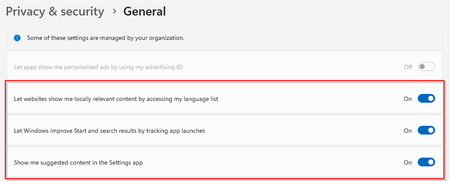
Hello, I have set a security policy in GPO for some privacy & security settings. But I cannot find these settings in GPO. I don't want to edit this using the Windows registry, does anyone perhaps know where these settings are available? Let apps show me personalized ads by using my advertising ID Let websites show me locally relevant content by accessing my language list Let windows improve start and search results by tracking app launches Show me suggested content in the Settings app2.6KViews0likes2Comments