teaching
45 TopicsGPT Making higher education affordable, personalised, inclusive, and reflective
In this post, we discuss how prompts and GPT could play a role in education coupled with metacognition and the inverse bloom’s taxonomy. The views are based on my teaching at the University of Oxford but are my individual / personal perspective. Based on this approach, we could potentially achieve goals of personalization and scale in learning and assessment. More interestingly, they take us back to a much older, reflective style of teaching and learning characterised by the Oxford tutorial. Comments welcome - especially from other educators. I am also developing this idea at our start-up Salooki. Other major universities such as Harvard University are also adopting GPT/LLMs in the classroom - such Harvard for their flagship coding course - Computer Science 50: Introduction to Computer Science. I am keen to discuss how other educators are adopting Generative AI in higher education.4.6KViews0likes3Comments
Exploring Responsible Data Analytics - Empowering Students for a Data-Driven Future
In today's data-driven world, organizations rely heavily on big data for crucial insights and business solutions. With the advancements in machine learning and artificial intelligence, data analytics has become an essential competency for organizations' viability. However, the use of big data and data analytics also raises ethical questions regarding privacy, surveillance, and responsible decision-making. Recognizing the significance of these issues, Radboud University has revamped its Business Administration Master’s elective course, "Data-driven analytics for responsible business solutions (DARBS)," to equip students with the necessary knowledge and skills to navigate the complexities of the data-driven landscape.3.1KViews0likes0CommentsCross the Hurdles: Innovate in the Classroom with Power Platform
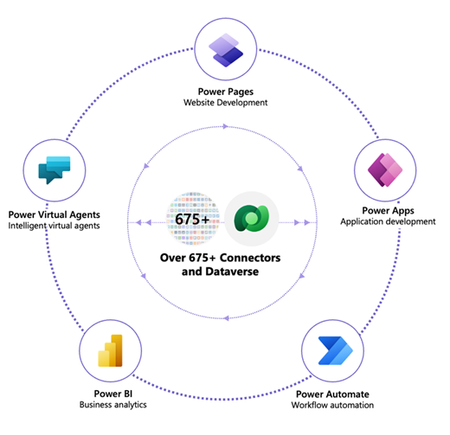
More and more we see teachers implementing the Power Platform tools to teach students future-ready skills, innovate the classroom, and decrease the gap between the university and the workforce. But in our endeavor to teach low-code skills, there are some hurdles on the track on the way to the finish. How can we identify and cross those?3.1KViews2likes0CommentsLearn how to develop Java applications and services with Microsoft technologies
Learn how to develop Java applications and services with Microsoft technologies. Join the developer Java Webinar on 23rd Nov 2022 and learn all about Microsoft resources at Microsoft for Java Developers | Microsoft Learn1.5KViews0likes0CommentsIntroduction to Auto Assessment and Grading with PyBryt for Python
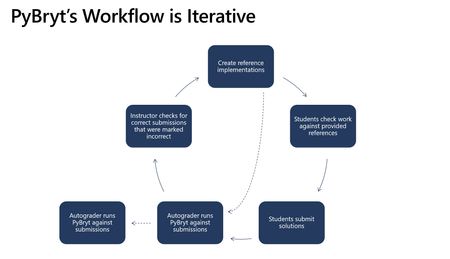
We continuously interact with computerized systems to achieve goals and perform tasks in our personal and professional lives. Therefore, the ability to program such systems is a skill needed by everyone. Consequently, computational thinking skills are essential for everyone, which creates a challenge for the educational system to teach these skills at scale and allow students to practice these skills. To address this challenge, we present a novel approach to providing formative feedback to students on programming assignments. Our approach uses dynamic evaluation to trace intermediate results generated by student’s code and compares them to the reference implementation provided by their teachers. We have implemented this method as a Python library and demonstrate its use to give students relevant feedback on their work while allowing teachers to challenge their students’ computational thinking skills4.8KViews1like0Comments
Students viewing feedback before teacher hits "return"
Hi I have just tested the functionality and as some other people have identified, students can view feedback as and when teachers add comments or highlight the attached documents in an assignment. As a teacher, there are times when this is okay, but other times when it would make Teams unsuitable. When students submit exams or coursework teachers need the ability to edit and provide feedback within the document (by adding comments, or highlighting) in draft mode, before it is visible to the students. Since this has been an identified issue since 2018, as far as I can see from previous comments, I was hoping that there is a workaround or a setting that can be applied to achieve this. Please confirm. Best wishes, Gareth3.1KViews1like5CommentsHow can I create a space for student to student feedback on a task
Hi everyone. I'm just beginning teaching at university and there are many things that I want to do with Teams that I simply don't know how best to do because I'm still new to Teams. What I really need suggestions on is the best way to get students to leave brief feedback on each other's work for a particular task I'm setting. I have recorded a short lecture on a practical subject and given students a short writing task at the end. What I would like is for students to write their short report in Word, upload it to teams and then look at someone else's report and give them brief formative feedback on it. No grading is required. Class size is about 70 students. There is a pre-existing team with a pre-existing channel this will need to go in. This is just for a simple task so a simple solution would be great. I don't want to cause major disruption to this channel for the other staff! For example I rather not have staff in this team to be bombarded with notifications of students uploading work or making comments, if possible. The first thing I thought is that this could be done in the posts section, but the problem is that replies to a comment do not get grouped with that comment as you would see in social media. This might make it quite confusing to follow. Really I would like each student's piece of work to be it's own mini-thread. I hope that makes sense. Photo of a doodle I did included in case my explanation is not clear. Also, it's possible lots of posts would result in lots of notifications, which is okay for me but not for other staff. Any suggestions how to do this would be really welcome! Thank you!Solved1.6KViews0likes2Comments